

A bathroom may appear simple, yet every inch inside it serves a precise purpose.
Behind a layout that feels open and effortless lies careful planning shaped by measurements, spacing rules, and fixture placement.
This is where standard bathroom layout dimensions play a defining role.
Correct dimensions influence comfort, movement, and long-term usability across powder rooms, shared baths, and primary bathrooms.
Poor spacing can turn even a large bathroom into an awkward space, while correct proportions create balance and flow.
The sections ahead break down how standard sizes, clearances, and layouts come together, revealing the structure that quietly shapes bathrooms that function smoothly day after day.
What Are Standard Bathroom Layout Dimensions?
Standard bathroom layout dimensions refer to the commonly accepted measurements used to plan bathroom size, fixture placement, and clearance space.
These dimensions help ensure the bathroom is functional, comfortable to use, and compliant with building codes.
They cover overall room size, the spacing between fixtures like the toilet, sink, shower, or bathtub, and the minimum clearances needed for movement, door swing, and safe use.
Using standard dimensions helps avoid cramped layouts and costly design mistakes during construction or remodeling.
Standard Bathroom Sizes by Type
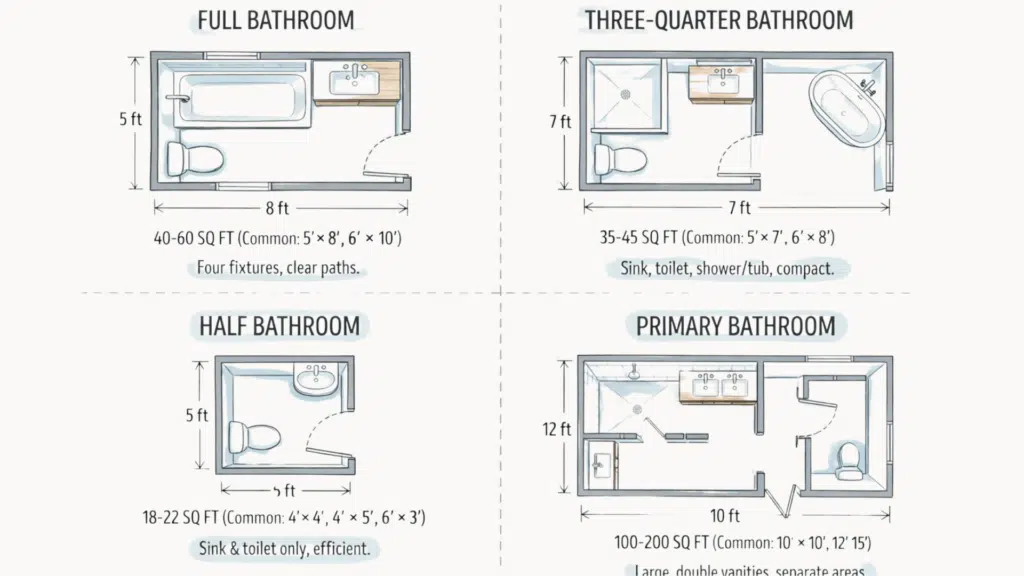
Bathroom layout dimensions vary depending on the type of bathroom and the fixtures included.
Below is a breakdown of standard bathroom sizes by type, including typical dimensions and how each layout functions in real-world use:
Full Bathroom Layout Dimensions
A full bathroom includes a sink, toilet, bathtub, and shower (or a tub–shower combination).
- Minimum size: 40–45 sq ft
- Average size: 40–60 sq ft
- Common dimensions: 5 ft × 8 ft, 6 ft × 10 ft
This layout usually places fixtures along one wall or in an L-shape to maintain clear movement paths while fitting all four fixtures comfortably.
Three-Quarter Bathroom Layout Dimensions
A three-quarter bathroom includes a sink, toilet, and either a shower or a bathtub.
- Minimum size: 32–35 sq ft
- Average size: 35–45 sq ft
- Common dimensions: 5 ft × 7 ft, 6 ft × 8 ft
These bathrooms rely on compact layouts, often using a linear arrangement to reduce wasted space while keeping fixtures easily accessible.
Half Bathroom Layout Dimensions
A half bathroom contains only a sink and a toilet and is often used as a powder room.
- Minimum size: 16–18 sq ft
- Average size: 18–22 sq ft
- Common dimensions: 4 ft × 4 ft, 4 ft × 5 ft, 6 ft × 3 ft
The layout is simple and efficient, with fixtures placed opposite each other or along a single wall to maximize limited space.
Primary Bathroom Layout Dimensions
Primary bathrooms are larger and designed for daily use by more than one person.
- Average size: 100–200 sq ft
- Common dimensions: 10 ft × 10 ft, 12 ft × 15 ft
These layouts allow space for double vanities, separate shower and bathtub areas, and wider clearances for easier movement and storage.
Standard Fixture Dimensions and Clearances
Bathroom fixtures require precise spacing to ensure safe use, easy movement, and compliance with standard building practices. Correct dimensions help prevent cramped layouts and improve overall usability.
Below are the standard dimensions and clearance requirements for common bathroom fixtures, along with how each measurement supports practical layout planning:
1. Toilet Dimensions and Clearance
Toilets require adequate side and front space for comfortable and safe use.
- Standard toilet depth: 28–30 inches
- Standard width: 20–26 inches
- Minimum side clearance: 15 inches from centerline to wall or fixture
- Minimum front clearance: 21 inches (24 inches recommended)
Proper spacing ensures ease of use and allows doors and adjacent fixtures to function without obstruction.
2. Shower Layout Dimensions
Shower size affects comfort, accessibility, and water containment.
- Minimum shower size: 36 inches × 36 inches
- Comfortable size: 42 inches × 60 inches
- Minimum entry clearance: 24 inches
Larger shower dimensions improve movement inside the enclosure and allow for easier entry and exit.
3. Bathtub Layout Dimensions
Bathtub dimensions influence both layout flexibility and bathing comfort.
- Standard alcove tub: 60 inches long × 30–32 inches wide
- Larger tubs: up to 72 inches long × 36 inches wide
- Front clearance: 18 inches recommended
Adequate clearance around the tub helps with cleaning, access, and fixture installation.
4. Vanity and Sink Dimensions
Vanity size determines counter space, storage capacity, and user comfort.
- Single vanity width: 30–60 inches
- Double vanity width: 60–72 inches
- Standard depth: 21–24 inches
- Minimum front clearance: 30 inches
Correct spacing ensures drawers open fully and allows multiple users to move comfortably within the bathroom.
Minimum Clearance Rules for Bathroom Layouts
Minimum clearance rules set the required open space around bathroom fixtures to ensure safe movement, proper usability, and code alignment.
These standards help prevent cramped layouts, allow doors and drawers to operate correctly, and support everyday comfort in both small and large bathrooms.
| Area / Fixture | Minimum Clearance | Recommended Clearance | Purpose |
|---|---|---|---|
| Toilet – front | 21 inches | 24 inches | Allows comfortable sitting and standing |
| Toilet – side | 15 inches (from centerline) | 18 inches | Prevents contact with walls or fixtures |
| Vanity / sink – front | 30 inches | 36 inches | Ensures ease of movement and drawer access |
| Shower entry | 24 inches | 30 inches | Safe entry and exit |
| Space between fixtures | 12 inches | 18 inches | Avoids overcrowding |
| Door width | 28 inches | 32 inches | Maintains clear entry access |
| Ceiling height | 80 inches | — | Provides adequate headroom |
Using these clearance standards during layout planning helps maintain a bathroom that feels open, functional, and easy to use, regardless of overall room size.
Common Bathroom Layout Configurations
Common bathroom layout configurations are based on room shape, available square footage, and fixture placement efficiency.
The layouts follow standard dimension principles to maintain clear movement paths while fitting essential fixtures without crowding:
- Linear Layout: Fixtures are arranged along a single wall, typically within a 5 ft × 8 ft or 6 ft × 10 ft space. This layout works well for full and three-quarter bathrooms with limited width.
- Galley Layout: Fixtures are placed on opposite walls, usually in bathrooms measuring 5–6 ft wide and 8–12 ft long. This configuration improves workflow in narrow spaces.
- L-Shaped Layout: Fixtures are divided across two adjoining walls, commonly used in bathrooms over 60 sq ft. This layout helps separate wet and dry zones while maintaining open circulation.
Each configuration is selected to balance fixture access, clearance requirements, and efficient use of available space.
Planning Tips for Getting Bathroom Dimensions Right
Accurate bathroom dimensions depend on balancing available space with fixture requirements and clearance rules.
Planning around existing plumbing, door placement, and room shape helps reduce layout conflicts and unnecessary construction changes.
- Measure the full room, including wall thickness and door swing
- Keep plumbing fixtures aligned where possible to limit rework
- Allow minimum clearances before adding extra features
- Match fixture sizes to room proportions rather than floor area
- Prioritize walking space over oversized fixtures
Key Takeaway
A well-planned bathroom is the result of thoughtful measurements, not extra square footage.
By understanding room sizes, fixture dimensions, clearance rules, and layout types, it becomes easier to create a space that feels balanced and functional.
Standard bathroom layout dimensions provide a reliable framework for planning bathrooms that support daily routines without wasted space or awkward movement.
Whether working with a compact layout or a larger primary bath, the correct dimensions make a visible difference.
If a bathroom layout has worked exceptionally well or created challenges, share your experience or favorite setup below.

Ava Taylor, holding a Bachelor’s degree in Interior Design from the Pratt Institute, has made her mark in creating engaging and functional living spaces for over 14 years. She began her career with a New York-based design studio, where she gained a reputation for her innovative and user-centric designs. Ava joined our team in 2019, bringing a blend of artistic flair and practicality to our home improvement section. Since the she has been the lead contributor to our room transformation series, inspiring readers with her unique approach to maximizing space utility and aesthetic appeal. Beyond her professional work, Ava is a passionate collector of vintage furniture, a hobby that enriches her design perspective.