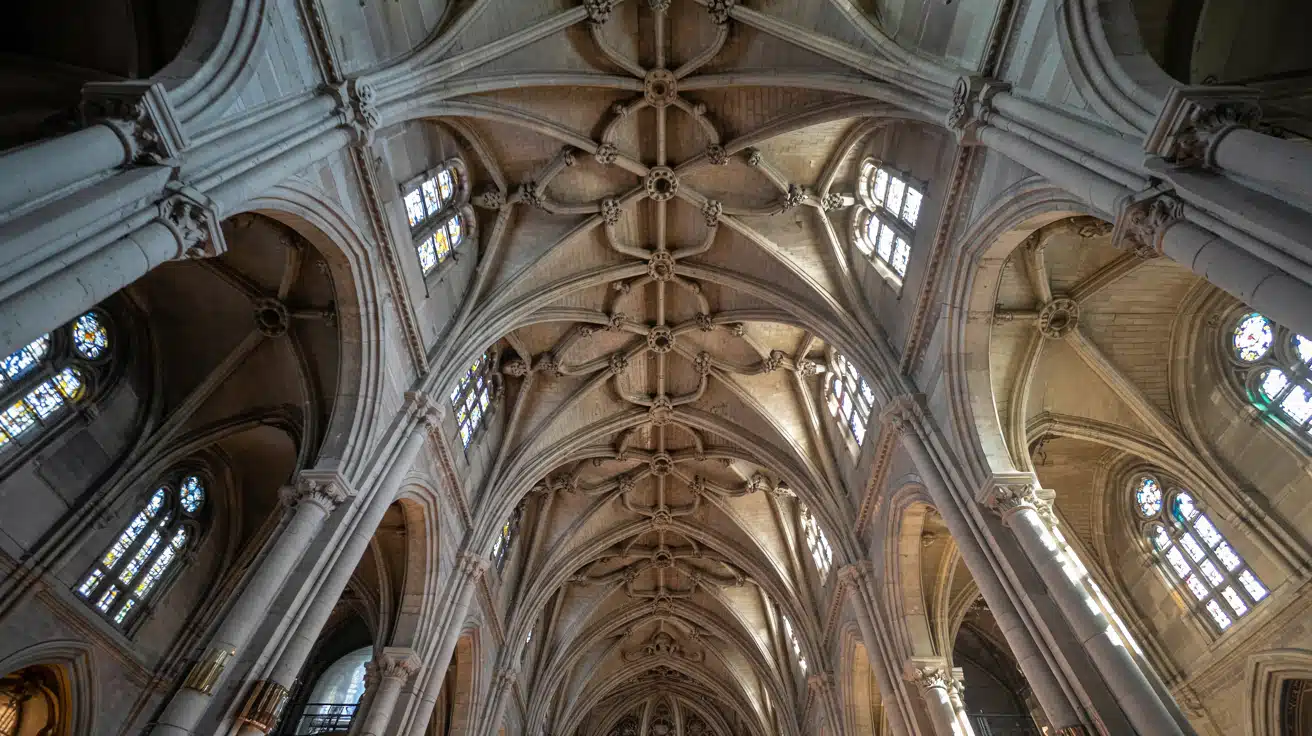

Look up. That feeling of space, light, and height is not accidental.
A cathedral ceiling is designed to change how a room is experienced from the moment someone enters.
It replaces flat, closed surfaces with upward movement that makes rooms feel larger and more open.
Homes, churches, and great rooms often use this ceiling style to create impact without adding floor space.
But a cathedral ceiling is more than a visual feature. It affects structure, lighting, comfort, and energy use.
This article explains what a cathedral ceiling is, the types available, how it compares to vaulted ceilings, and the key benefits to consider before choosing one.
What is a Cathedral Ceiling?
A cathedral ceiling is a ceiling with two sloping sides that meet at a high center point. It follows the roofline instead of hiding it with a flat ceiling. Because of this shape, the ceiling feels tall and open.
This type of ceiling is often used in living rooms, great rooms, and churches. It helps create a spacious feeling even in smaller homes.
Cathedral ceilings are different from standard flat ceilings because they remove the horizontal barrier above the room.
Things to Know Before Choosing a Cathedral Ceiling
Before adding a cathedral ceiling, there are a few important points to understand.
1. Cathedral ceilings need proper structural support. Since the ceiling follows the roof, the framing must be strong enough to hold the weight. This often requires careful planning during construction.
2. Heating and cooling can be affected. Warm air rises, so rooms with cathedral ceilings may feel cooler in winter. Good insulation and ceiling fans can help manage this.
3. Lighting should be planned early. High ceilings need well-placed lights so the room does not feel dark. Skylights and tall windows are often used.
4. Maintenance can be harder. Changing light bulbs or cleaning high areas may require special tools or professional help.
Types of Cathedral Ceilings
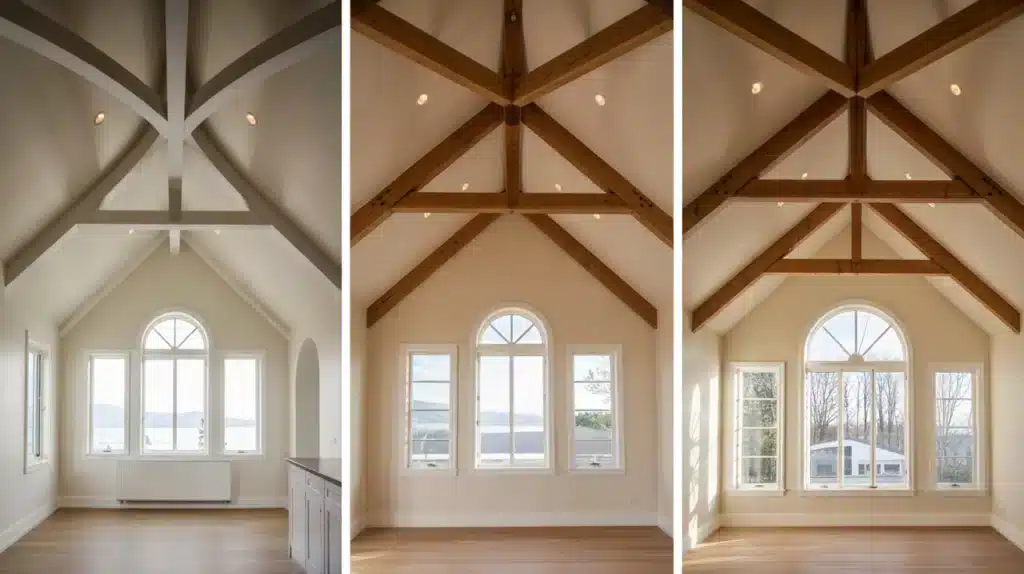
Cathedral ceilings can be designed in different ways, depending on roof structure, layout, and visual preference, with each type offering a slightly different look and feel.
| Type of Cathedral Ceiling | Description |
|---|---|
| Symmetrical cathedral ceiling | Both sides of the ceiling slope evenly and meet at the center. This creates a balanced and classic look that is common in many homes. |
| Asymmetrical cathedral ceiling | One side of the ceiling slopes higher than the other. This creates a modern appearance and is often used in custom or contemporary designs. |
| Cathedral ceiling with exposed beams | Wooden beams or rafters are left visible. These beams add character and show how the ceiling is supported. |
Benefits of Cathedral and Vaulted Ceilings
Cathedral and vaulted ceilings offer practical and visual benefits that can improve how a space looks, feels, and functions.
Rooms feel larger and more open. The extra height creates a sense of space, making rooms feel less crowded and more comfortable.
More natural light enters the room. Tall windows and skylights work well with high ceilings, helping sunlight spread more evenly.
Stronger visual appeal. A cathedral ceiling often becomes a focal feature that adds character to the room.
Better air movement. Warm air rises toward the ceiling, which can improve airflow when ceiling fans are used.
Vaults in Architecture & Types of Vaults in Architecture
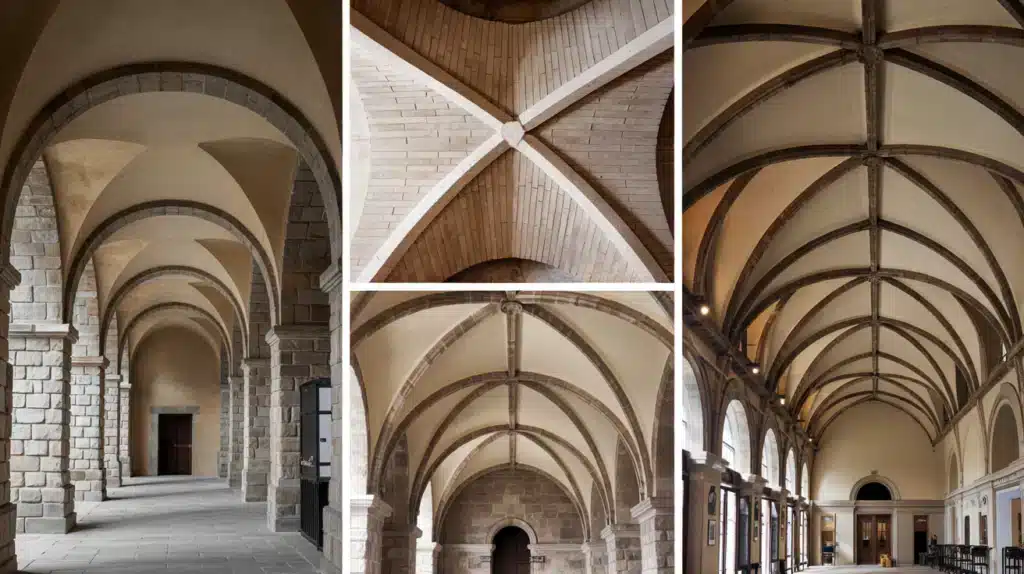
In architecture, a vault is a ceiling or roof structure that spans space using arches or angled surfaces.
Cathedral ceilings are a type of vaulted ceiling, but not all vaulted ceilings are cathedral ceilings.
Vaulted ceilings can take many shapes. Some are curved, while others are angular. Cathedral ceilings are defined by their straight slopes that follow the roofline.
Understanding vaults helps explain how cathedral ceilings fit into architectural design.
There are several common vault types used in buildings, each designed to support weight while shaping the space below in different ways.
1. Barrel Vault
A barrel vault looks like a long tunnel formed by a single curved arch. It runs in one direction across a space and creates a smooth, continuous ceiling.
This type is strong but can feel heavy if not balanced with windows or openings. Barrel vaults are often seen in churches, hallways, and older stone buildings.
2. Groin Vault
A groin vault is created when two barrel vaults cross at right angles.
The crossing forms edges called groins, which help direct weight down into the corners.
This design allows for larger open spaces and makes it easier to add windows. Groin vaults were commonly used in Roman and medieval buildings.
3. Rib Vault
A rib vault uses thin, curved supports called ribs to hold up the ceiling.
The ribs carry most of the weight, while the spaces between them are filled with lighter materials.
This design makes ceilings taller and allows for more detailed shapes. Rib vaults are often found in Gothic churches and cathedrals.
4. Fan Vault
A fan vault spreads outward from a single point, creating a pattern that looks like an open fan.
The ribs are evenly spaced and curve upward in a decorative way. This type of vault focuses more on visual design while still providing support.
Fan vaults are mostly seen in historic buildings, especially in England.
Difference Between a Cathedral Ceiling and a Vaulted Ceiling
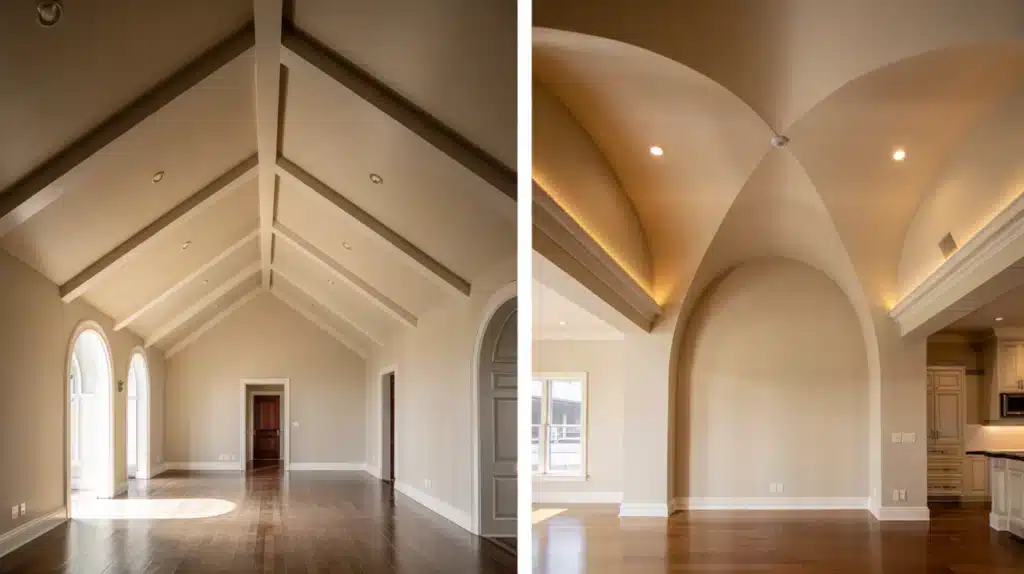
Cathedral ceilings and vaulted ceilings are often confused because both create height and open space. While they look similar, the main difference lies in how they are built and how closely they follow the roof structure.
Cathedral Ceiling vs Vaulted Ceiling
| Feature | Cathedral Ceiling | Vaulted Ceiling |
|---|---|---|
| Shape | Two straight sides slope and meet at a center peak | Can be curved, angled, or uneven |
| Roofline | Follows the roof shape exactly | Does not always match the roof shape |
| Design style | Sharp and pointed at the top | Can be soft, rounded, or varied |
| Common use | Homes, churches, great rooms | Homes, halls, public buildings |
| Flexibility | More limited in shape | More flexible in design options |
Simple Explanation
A cathedral ceiling always follows the roof’s slope and meets at a clear center point. A vaulted ceiling is a broader term that includes many ceiling shapes, some of which do not match the roof at all.
In short, all cathedral ceilings are vaulted ceilings, but not all vaulted ceilings are cathedral ceilings.
Conclusion
A cathedral ceiling brings more than extra height to a space. It changes how a room feels, moves air, and uses light throughout the day.
When planned well, this ceiling style adds openness without needing additional square footage.
At the same time, it requires thoughtful design choices, from structure and insulation to lighting and upkeep.
Understanding the different ceiling types, vault styles, and construction details helps avoid common mistakes.
With the right planning, a cathedral ceiling can support both comfort and visual balance, making it a strong design option for spaces that benefit from light, airflow, and a sense of openness.

Holding a Master’s in Library and Information Science from the University of Illinois, Josh Clarke has dedicated more than 15 years to managing and disseminating information across various platforms. His professional journey includes significant experience as a research librarian, where he developed an expertise in sourcing and providing accurate and comprehensive answers to diverse questions. In 2018, Josh brought his rich experience to our platform, quickly establishing himself as a reliable source for general FAQs. He has been overseeing our information curation since then, combining his research skills with a flair for engaging content delivery. When not involved in information management, Josh enjoys exploring digital photography and participating in local quiz competitions, hobbies that complement his inquisitive nature and love for learning.