
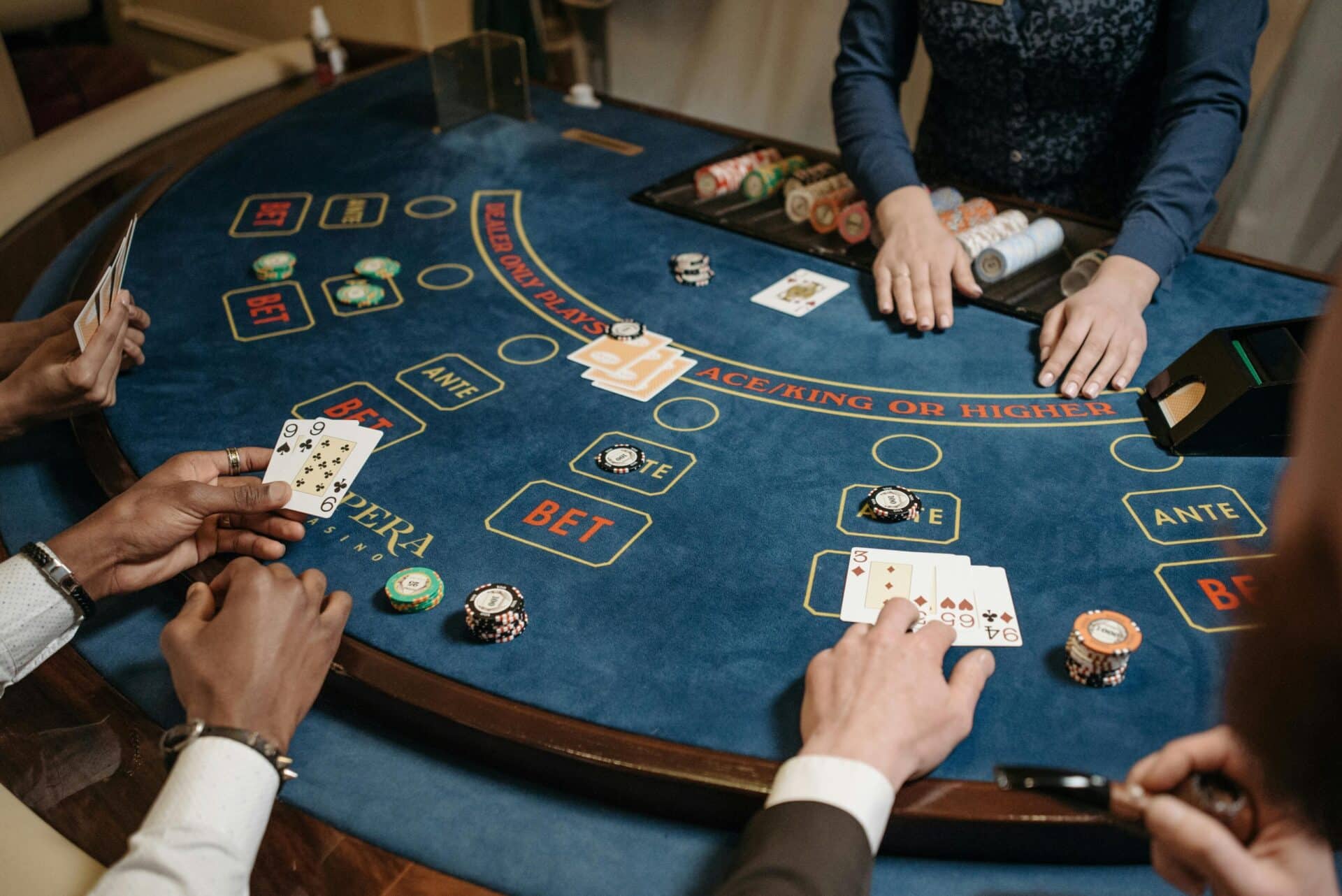
The dealer flips an ace. The table pauses. A prompt appears — or the dealer asks aloud — “Insurance?” And most beginners, operating on instinct rather than math, say yes. The reasoning feels sound: the dealer might have blackjack, and insurance protects you from losing your entire bet. It’s right there in the name — insurance. Who wouldn’t want insurance?
The problem is that insurance in blackjack isn’t insurance in any meaningful sense. It’s a separate side bet on whether the dealer’s hidden card is a ten-value card. It pays 2:1, costs half your original wager, and carries a house edge of approximately 7% — roughly fourteen times worse than the main game played with basic strategy. It is, by a significant margin, the worst routine decision a beginner can make at the blackjack table.
What the Bet Actually Is
Stripping away the branding clarifies the mechanics. When the dealer shows an ace, you place a side bet — half your original wager — that the dealer’s face-down card is a 10, jack, queen, or king. If it is, insurance pays 2:1. If not, you lose the side bet, and the hand continues normally.
This bet has nothing to do with your hand. You’re not insuring your cards — you’re wagering on the dealer’s hidden card. The word “insurance” is marketing, not mechanics.
Why the Math Doesn’t Work
The insurance bet pays 2:1, but the true odds of the dealer having a ten-value card underneath are worse than that.
In a standard 52-card deck, 16 out of 52 cards are worth ten points (10, J, Q, K). When the dealer shows an ace, 51 cards remain, and 16 of them would complete a blackjack. That’s a 16/51 probability — approximately 31.4%. The bet pays as if the probability were 33.3% (which is what 2:1 implies). The gap between 31.4% and 33.3% is where the house edge lives. This math holds whether you’re playing at a physical casino or running through hands at nv casino online — the probability doesn’t change with the medium.
What you’re told | What actually happens |
|---|---|
“Insurance protects your hand.” | It’s a separate side bet unrelated to your cards |
Pays 2:1 | True odds are approximately 2.25:1 against |
“You break even if the dealer has blackjack.” | You lose the insurance bet 69% of the time it’s offered |
Sounds like risk management | Carries a ~7% house edge vs ~0.5% on the main game |
Offered every time the dealer shows an ace | Designed to extract additional revenue from cautious players |
Over 13 insurance decisions at $10 each, the expected outcome is: four wins ($80 profit) and nine losses ($90 loss) — a net loss of $10. The house keeps that $10 regardless of what happens to your main hand. Multiply across thousands of hands, and insurance becomes one of the most reliable revenue streams in the casino’s toolkit.
In multi-deck shoes, the house edge shifts slightly but stays in the 5.8% to 7.7% range. No standard configuration makes insurance profitable.
The “Even Money” Trap
The insurance bet has a particularly seductive variant: even money. When you have a natural blackjack, and the dealer shows an ace, you’re offered the option to take a guaranteed 1:1 payout instead of risking the possibility that the dealer also has blackjack (which would result in a push).
This feels like the one situation where insurance makes sense — guaranteed money versus the risk of winning nothing. But the math disagrees, and it disagrees identically across every blackjack NV casino table, whether live dealer or RNG:
- Taking even money: You receive 1x your bet, guaranteed. On a $10 bet, you get $10 every time.
- Declining even money: Approximately 69% of the time, the dealer doesn’t have blackjack, and you receive the full 3:2 payout ($15). Approximately 31% of the time, the dealer does have blackjack, and you push ($0). Expected value: 0.69 × $15 + 0.31 × $0 = $10.35.
The expected value of declining even money ($10.35) exceeds the guaranteed payout ($10.00). The guaranteed option feels safer, but it costs you 35 cents per occurrence — a small leak that compounds over time.
When Insurance Could Theoretically Work
There is exactly one scenario where insurance becomes positive-expectation: when the remaining deck contains more than one-third ten-value cards. This is the domain of card counting — taking insurance only when the count indicates a disproportionate number of tens remain.
For the average player on any platform — particularly online, where decks are reshuffled every hand or continuous shufflers eliminate count advantages — this scenario never arises. The insurance bet remains negative-expectation under all normal playing conditions.
The Simplest Rule in Blackjack
Skip insurance. Always. The math is unambiguous, the house edge is enormous relative to the main game, and the bet’s name is designed to exploit a psychological bias toward loss aversion. The best protection available in blackjack isn’t a side bet — it’s basic strategy, which reduces the house edge to approximately 0.5% and costs nothing to learn.

Film-buff journalist Felix Moreno earned his Film Studies degree at NYU and has reviewed cinema and streaming culture since 2012. Joining us in 2025, he spotlights must-watch releases, crafts spoiler-free synopses, and interviews behind-the-scenes talent. Felix’s playful trivia keeps readers ahead of the pop-culture curve. Offscreen, he runs a community film club and experiments with short-film screenwriting in his Brooklyn studio.