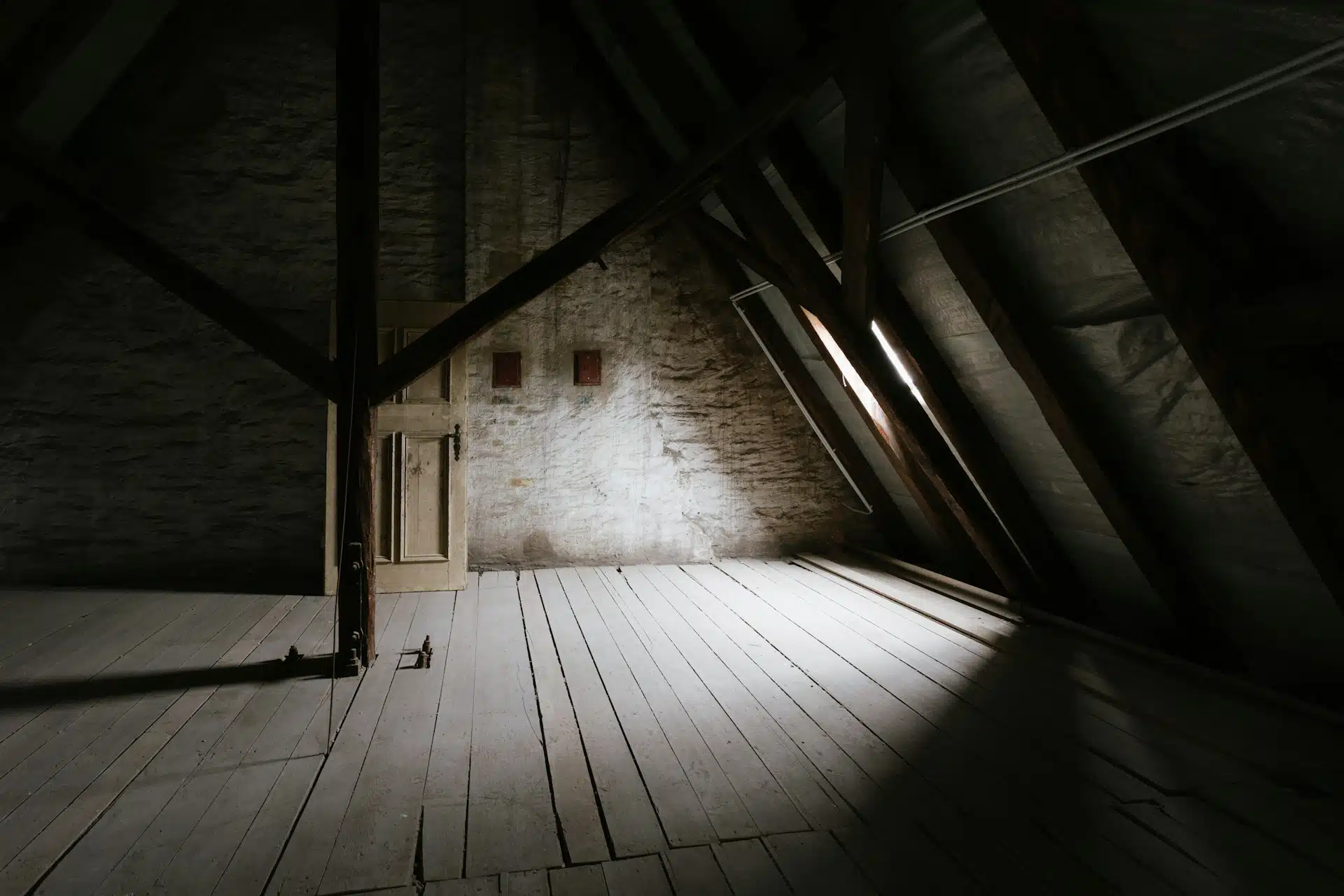

If your house feels like it can’t hold a temperature, the attic is usually where the story starts.
Seattle homes take a slow, steady beating from the weather – not dramatic blizzards, or desert heat. But months of cool, damp air that quietly pulls warmth out of a home day after day. And in a lot of older houses here, the attic is basically the escape hatch.
We’ll break down attic insulation energy savings in plain terms: what causes the loss, what you can realistically save, what R-value makes sense, how long it takes to see results, and when insulation is not the first upgrade you should do.
Key Notes
- Upgrading attic insulation typically cuts heating and cooling bills by 15–30%, more in underinsulated homes.
- R-49 is the practical insulation target for Seattle’s climate, with diminishing returns beyond that point.
- Actual savings depend on starting insulation levels, air sealing quality, and heating system type.
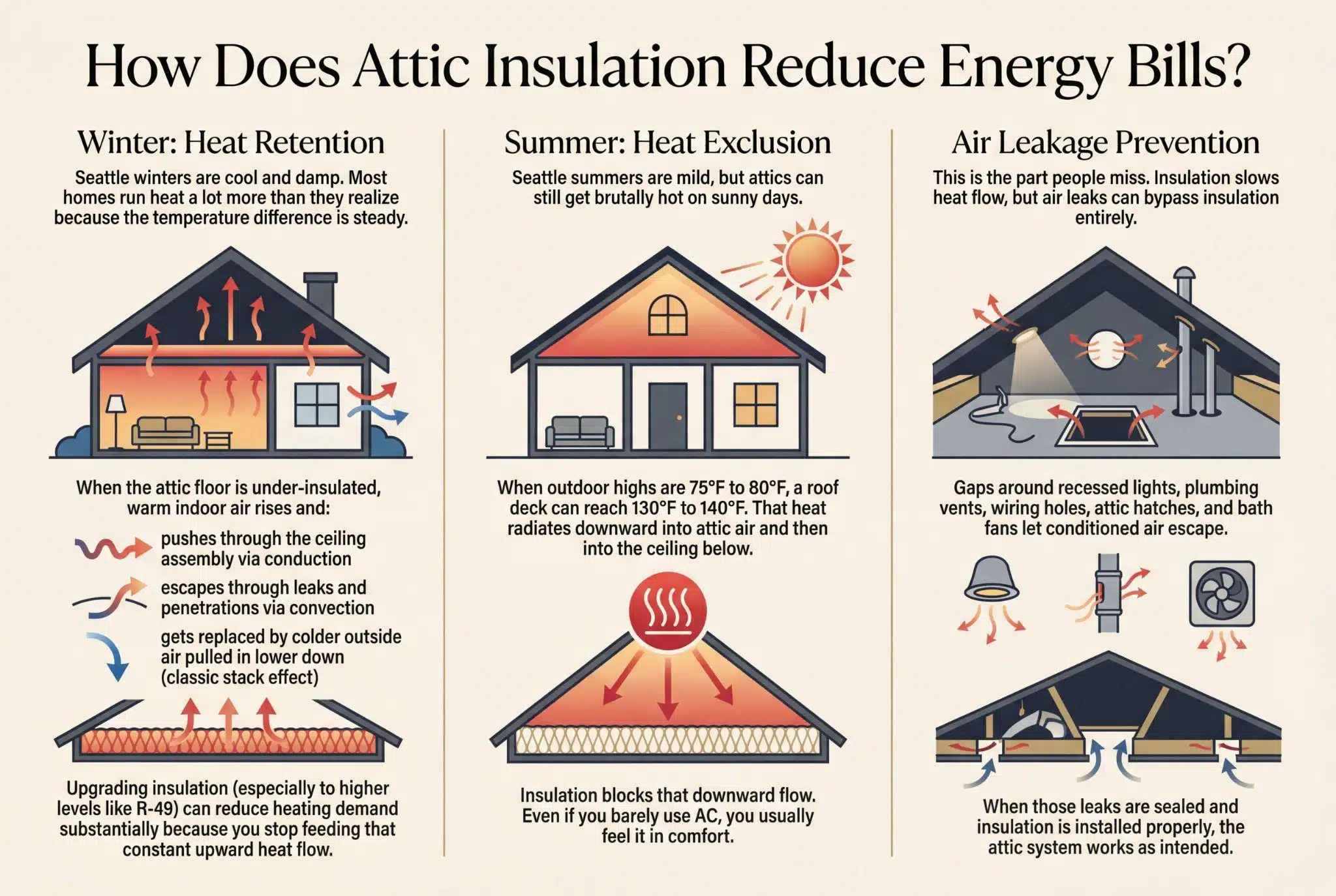
How Does Attic Insulation Reduce Energy Bills?
Attic insulation is a thermal barrier. It slows heat transfer in three main ways:
- Conduction: heat moving through materials (drywall, framing, roof deck)
- Convection: heat moving via air currents (stack effect, drafts, air loops)
- Radiation: heat transfer from warm surfaces (like a sun-baked roof deck)
In practical terms, insulation works because it traps still air. Still air has high resistance to heat flow. Insulation materials like fiberglass and cellulose are basically engineered to hold air in place.
Attic Insulation Energy Savings: What Homeowners Can Expect
Let’s get specific.
Based on our consultation with Fast Patch Drywall Company, typical attic-insulation savings in Seattle are:
- 15% to 30% savings on heating and cooling bills in the average case
- 30% to 50% savings in best-case scenarios (usually when the attic was basically bare)
- Under 10% savings in worst-case scenarios (already well insulated, or major leaks elsewhere)
And in dollar terms, a common range is:
- $200 to $400 per year for many average homes
- $300 to $600 per year for homes with meaningful upgrades (R-11/R-19 to R-49)
- $450 to $900 per year for high-usage homes or severely under-insulated attics
Here’s A Simple Way To Visualize It:
| Starting Condition | Typical Upgrade | Likely Savings Range | Why |
|---|---|---|---|
| Bare / very low insulation | R-0 to R-49 | 30%–50% | You’re reclaiming major heat loss immediately |
| Partial old insulation | R-11/R-19 to R-49 | 15%–25% | Big jump in thermal resistance |
| Decent insulation already | R-30+ to R-49 | 5%–10% | Diminishing returns |
If someone asks how much does insulation save on energy bills, this is the honest answer: it depends on your starting point. Homes with weak insulation and air leaks see the biggest changes.
Heating vs Cooling Savings In Seattle’s Marine Climate
This is where Seattle is a little different from hotter or colder climates.
Heating Savings
Heating is the main driver. Even though Seattle doesn’t have Minnesota-style winters, it has months of steady cool temperatures.
If your home is losing 25% to 35% of its heat through the attic, the heating system is basically paying that tax daily. That’s why heating savings from insulation upgrades are often noticeable.
Cooling Savings
Cooling is usually secondary, but still real.
Even if you don’t run AC much, insulation helps:
- reduce that “hot ceiling” feeling on sunny afternoons
- protect ducts in attic spaces from heat gain
- keep bedrooms and upper floors more stable
👉 In short: heating savings matter most, but comfort gains often show up year-round.
What R-Value For Attic Insulation Makes Sense In Seattle
For Seattle’s climate zone (marine 4C), R-49 is commonly recommended for vented attics.
You’ll also see R-38 as a minimum in some code contexts, but if you’re upgrading for performance, R-49 is the practical baseline.
What R-Value Means
R-value measures resistance to heat flow. Higher number means slower heat transfer.
But real homes are messy. R-value can get “derated” because of:
- air movement through the insulation
- compression
- gaps
- settling (especially with loose-fill)
- moisture issues
So an attic labeled R-19 does not always perform like R-19.
R-49 vs R-60
Some contractors recommend R-60 in Seattle. It can help, but the extra savings are often modest. Going from R-38 to R-60 might add 5% to 10% more heating savings in some cases, but the payback can stretch out.
If you’re deciding where to spend upgrade dollars, air sealing is usually the better “first” move than going ultra-high on R-value.
How Existing Insulation Levels Affect Energy Savings
This is the part that makes the savings story make sense.
If Your Attic Is Close To Bare
This is the high-win scenario.
- You may reclaim a large chunk of that 25% to 35% heat loss.
- Savings can land in the 30% to 50% range, especially when paired with air sealing.
If You Have Thin Insulation (R-11 To R-19)
This is extremely common in older Seattle homes.
- Upgrading to R-49 often yields 15% to 25% savings.
- Comfort improvements can be obvious within days.
If You Already Have R-30+
You’ll still get benefits, but don’t expect fireworks.
- Savings might be 5% to 10%
- Worth it for comfort, moisture control, and future-proofing
- Not always the top ROI upgrade
Insulation Materials & Their Impact On Energy Savings
Different materials can hit the same R-value, but they don’t behave the same in real attics.
Fiberglass Batts
Common, inexpensive, but performance depends heavily on installation.
- Pros: affordable, widely available
- Cons: gaps and misfits reduce effectiveness, can underperform in drafty attics
Blown-In Fiberglass
A popular upgrade path.
- Pros: even coverage, cost-effective
- Cons: can still lose performance if attic is leaky
Blown-In Cellulose
Often performs well in older Seattle homes because it can reduce air movement better than fiberglass.
- Pros: dense fill, good with air sealing, strong real-world performance
- Cons: can settle over time (depth matters)
Spray Foam
Best air barrier and moisture control, but most expensive.
- Pros: excellent air sealing, high R per inch, moisture resistance
- Cons: premium cost, not always needed for typical energy savings goals
A Quick Comparison:
| Type | Typical Savings Range | Best Fit |
|---|---|---|
| Fiberglass batts | 10%–20% | Simple attics, careful installs |
| Blown-in fiberglass | 15%–25% | Common upgrade baseline |
| Blown-in cellulose | 20%–30% | Older homes, leaky attics |
| Spray foam | 25%–40% | High-performance builds, moisture-sensitive assemblies |
Peak Demand vs Monthly Energy Use Reduction
Insulation helps in two ways at the same time.
Peak Load Reduction
During a cold snap or a sunny summer afternoon, insulation helps keep temperatures stable.
That means:
- fewer system “surges”
- less aggressive cycling
- fewer drastic room-to-room swings
Monthly Usage Reduction
Over time, insulation reduces total energy consumption by cutting steady heat loss and unwanted heat gain.
So you typically feel the comfort change first, and then the utility bill follows.
Cost Of Attic Insulation In Seattle & Payback Timeline
A typical attic insulation upgrade in Seattle often runs $3,000 to $6,000 for a 1,500 sq ft attic.
Cost depends on the material and the prep.
Typical Cost Ranges
- Blown-in cellulose or fiberglass: $1.50 to $3.50 per sq ft
- Spray foam: $3 to $7 per sq ft
Common Add-Ons
- Old insulation removal: $1 to $2 per sq ft
- Air sealing: $300 to $800
Payback
With savings often landing in the 15% to 30% range, payback is commonly 3 to 7 years. Best-case homes with high losses can see payback faster.
When Attic Insulation Produces Minimal Energy Savings
Sometimes insulation is still worth doing, but energy savings are not the main reason.
Expect Lower Savings When:
- You already have R-30+ insulation
- Air leaks dominate (attic hatch, recessed lights, chases)
- Ducts in the attic are leaky or unwrapped
- Your heating costs are already low
If You’re In That Camp, Prioritize:
- Air sealing first
- Duct sealing and insulation
- Crawlspace insulation
- The biggest envelope leaks identified by an audit
Comfort, Moisture Control & Secondary Benefits
Energy savings are the headline, but comfort is what homeowners talk about.
Comfort Gains
After a solid attic upgrade, people usually notice:
- warmer upper floors in winter
- fewer drafts
- less “cold ceiling” effect
- more stable room temperatures
Moisture Control
Seattle’s humidity matters.
High relative humidity (often 70% to 90%) can drive condensation risk in attics. Moisture plus poor insulation can mean:
- mold growth
- wood rot
- reduced insulation performance
A properly insulated and sealed attic helps control that moisture movement and reduces condensation risk.
How Quickly Energy Savings Show Up After Installation?
You don’t have to wait months to feel a change.
Immediate (1 to 14 days)
- comfort improves quickly
- HVAC runtime often drops 10% to 20% right away
First bill (4 to 8 weeks)
Most people see a noticeable change on the next billing cycle.
Full seasonal payoff
The “true” annual savings picture shows up after a few months of consistent weather.
How To Know If Your Attic Insulation Is Failing
Insulation doesn’t last forever, and Seattle attics can be rough on it.
Common Signs:
- visible gaps or exposed joists
- settled or compressed insulation
- dark, wet, or clumped areas
- musty odors or mold spotting
- droppings, nests, or pest damage
Performance Clues:
- ice dams
- frost on rafters
- attic temperatures that spike above 120°F in summer
If you see moisture or contamination, it’s worth addressing that before simply adding more insulation.
Frequently Asked Questions
Does attic insulation help even if I don’t use air conditioning?
Yes. Even without AC, insulation blocks radiant heat from sun-heated roofs and stabilizes indoor temperatures. Most homeowners notice fewer hot ceilings and less temperature swing on warm days.
Can attic insulation lower energy bills if my windows are old?
It can, but results vary. Insulation reduces heat loss through the roof, while old windows leak energy elsewhere. You’ll still see savings, but sealing the attic first usually delivers faster ROI than window replacement.
Is attic insulation worth it in a small Seattle home?
Often, yes. Smaller homes lose a similar percentage of heat through the attic as larger ones. Lower total bills mean smaller dollar savings, but comfort improvements are usually immediate.
Do I need to remove old insulation before adding new insulation?
Not always. Clean, dry insulation can often be topped up. Removal is usually only needed if the insulation is wet, moldy, pest-damaged, or severely compressed.
Conclusion
Attic insulation energy savings in Seattle are real, measurable, and heavily tied to what’s already in your attic.
In many older homes, 25–35% of heat loss happens straight through the ceiling. Bringing an under-insulated attic up to R-49 can cut heating and cooling costs by 15–30%, and in some cases much more.
The biggest gains come from stopping steady winter heat loss, tightening air leaks, and reducing summer heat pushing down from the roof.
Add faster comfort, lower system runtime, and a payback that often lands within a few years, and attic insulation stands out as one of the most practical energy upgrades Seattle homeowners can make.

With a Master’s in Architecture from the University of California, Berkeley, Mitchell Green has spent over two decades dedicated to the study and practical application of home fixture design. His career started in an architectural firm, providing him a strong foundation in the structural and aesthetic aspects of home interiors. Mitchell brought his comprehensive knowledge to our platform, where he has been an influential voice in our home fixtures and fittings section. Since 2018, he has been guiding our readers through the intricacies of selecting and installing fixtures, combining technical know-how with design flair. In his spare time, Mitchell is a keen photographer, capturing architectural details and design elements, an interest that complements his professional focus.