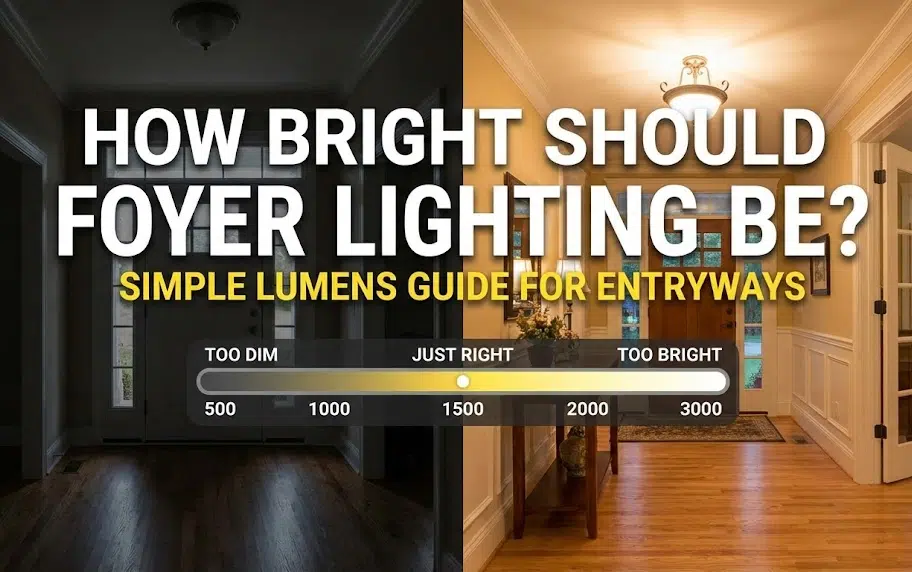

A foyer does more than connect the front door to the rest of the house. It is where guests decide in a few seconds if a home feels welcoming, clean, and organized. The fixture style plays a role, but the brightness of the foyer lighting often has an even bigger impact.
Too dim, and the space feels cramped and a bit neglected. Too bright, and the entry feels harsh and uncomfortable at night. This guide gives a straightforward lumen breakdown so you can get foyer brightness in a comfortable middle zone.
What Lumens Mean for Foyer Lighting
Lumens tell you how much light a bulb or fixture gives off, not how much electricity it uses. For foyer lighting, lumens are your best reference point for how bright the entry will actually feel.
In simple terms:
- Lower lumens = softer, dimmer light.
- Higher lumens = stronger, brighter light.
The goal is to match total lumens to the size and layout of your entryway, then fine tune with dimmers and additional fixtures.
Step 1 – Measure Your Foyer
Start with a quick set of measurements:
- Length of the foyer in feet
- Width of the foyer in feet
- Ceiling height (8 ft, 9 ft, two-story, etc.)
Multiply length by width to get the floor area in square feet. That number makes the lumen math easy.
Example: an 8 ft by 10 ft foyer
8 × 10 = 80 square feet
Step 2 – Use Simple Lumen Ranges for Foyers
For most entryways, a good starting point is:
Roughly 10–20 lumens per square foot
Applying that to the 80 square foot example:
80 × 10–20 = 800–1,600 total lumens
This range usually feels bright enough to see clearly, but not so strong that guests feel blasted with light at night.
A smaller foyer or mudroom-style entry can sit closer to the lower end of the range. Larger, more open foyers often benefit from the upper end, along with support from wall lights or nearby fixtures.
Step 3 – Adjust for Wall Color, Ceiling Height, and Windows
The basic lumen range is only the starting point. A few factors push you up or down within that band.
Wall and floor color
- Light walls and light floors: surfaces bounce light back, so you can stay closer to the lower side of the range.
- Dark paint or dark flooring: these materials absorb light, so move toward the higher end for the same foyer size.
Ceiling height
- Low ceilings (around 8 ft): a flush or semi flush fixture with modest lumens can feel sufficient because the light is close to eye level.
- Taller foyers: more height means more space for light to spread, so total lumens usually need a bump upward.
Natural light
- Entries with glass doors and side windows feel brighter in the day, but still need a solid lumen plan for evening.
- Closed foyers with few windows often benefit from more lumens overall and a dimmer to keep things flexible.
Step 4 – Share Lumens Across Several Fixtures
Your total foyer lumens rarely need to come from one chandelier alone. In many homes, the entry connects to a hallway, stair, or open living space where other fixtures contribute to the brightness.
Common foyer lighting combinations
- One main chandelier or flush mount plus a wall sconce or two.
- Ceiling light in the foyer plus light spilling in from a nearby hallway fixture.
- Foyer chandelier plus stair lighting that stays on in the evening.
When you look at the entry at night, consider the combined effect of all visible lights, not just the main one. That whole picture should fall roughly into your target lumen range.
Step 5 – Pick the Right Color Temperature
Brightness is one part of how the foyer feels. Color temperature is the other piece many homeowners overlook.
- Around 2700 K: warm and cozy, similar to traditional incandescent light.
- Around 3000 K: still warm, but a bit cleaner and crisper, a popular choice for modern entries.
Extremely cool, bluish light can make the foyer feel more like a hallway in a commercial space. Warm or soft white usually fits better with residential front doors, decor, and skin tones.
Step 6 – Use Dimmers to Fine Tune Foyer Brightness
Even if you pick the perfect lumen range on paper, daily life changes. A dimmer switch can handle those shifts with one simple control.
- Turn the foyer light up when you bring in groceries, luggage, or packages.
- Set a lower, gentler level for evenings, late arrivals, or movie nights when doors open.
- Use the foyer light at a very low setting as a guide at night instead of relying only on night lights.
For foyers connected to open living spaces, dimmers also help coordinate levels so the entry does not feel either much darker or much brighter than nearby rooms.
Quick Foyer Brightness Checklist
Before you choose bulbs or a new fixture, run through this small list:
- Measure foyer length and width, then calculate total square feet.
- Aim for about 10–20 lumens per square foot as a starting range.
- Adjust upward for dark finishes or tall ceilings, downward for light finishes.
- Remember that nearby hallway, stair, or living room lights add to the total effect.
- Pick a warm or soft white color temperature to keep the entry comfortable.
- Install a dimmer if possible so you can shift brightness through the day.
Choosing Fixtures Once Your Lumen Plan Is Clear
After you know how bright the foyer should be, sizing and styling a fixture becomes much easier. You can look at chandeliers, flush mounts, and semi flush pieces with a specific lumen target in mind instead of guessing.
For foyer and entry fixtures in different sizes, heights, and styles that work with plans like this, you can browse foyer and entry lighting by Seus Lighting and more. A clear lumen strategy paired with the right fixture helps the first step into your home feel balanced and easy on the eyes.

Tommy Hardy, an alumnus of the Georgia Institute of Technology with a degree in Mechanical Engineering, has been a go-to figure in residential upkeep and innovation for over 18 years. His career commenced in a leading home appliance manufacturing company, where he mastered the intricacies of household systems. Joining our platform in 2020, Tommy quickly became a reader favorite for his practical and easy-to-follow guides. He took the helm of our DIY section in 2019, consistently delivering content that empowers homeowners. Beyond his professional pursuits, Tommy is a passionate gardener and enjoys woodworking, skills enhancing his hands-on approach to home care.