
Throw pillows can make or break a living room. Too few, and your couch looks bare and uninviting. Too many, and you’re tossing cushions onto the floor every time someone sits down.
The right number of pillows creates visual interest while keeping your seating functional.
Most people struggle to find this balance because they focus on either aesthetics or comfort instead of both.
The truth is that pillow count isn’t arbitrary. It depends on your couch size, pillow dimensions, and how you actually use your space.
These practical rules determine how many pillows belong on your couch, provide specific recommendations for different furniture types, and indicate when you’ve crossed into excessive territory.
How Many Pillows Should You Have on Your Couch?
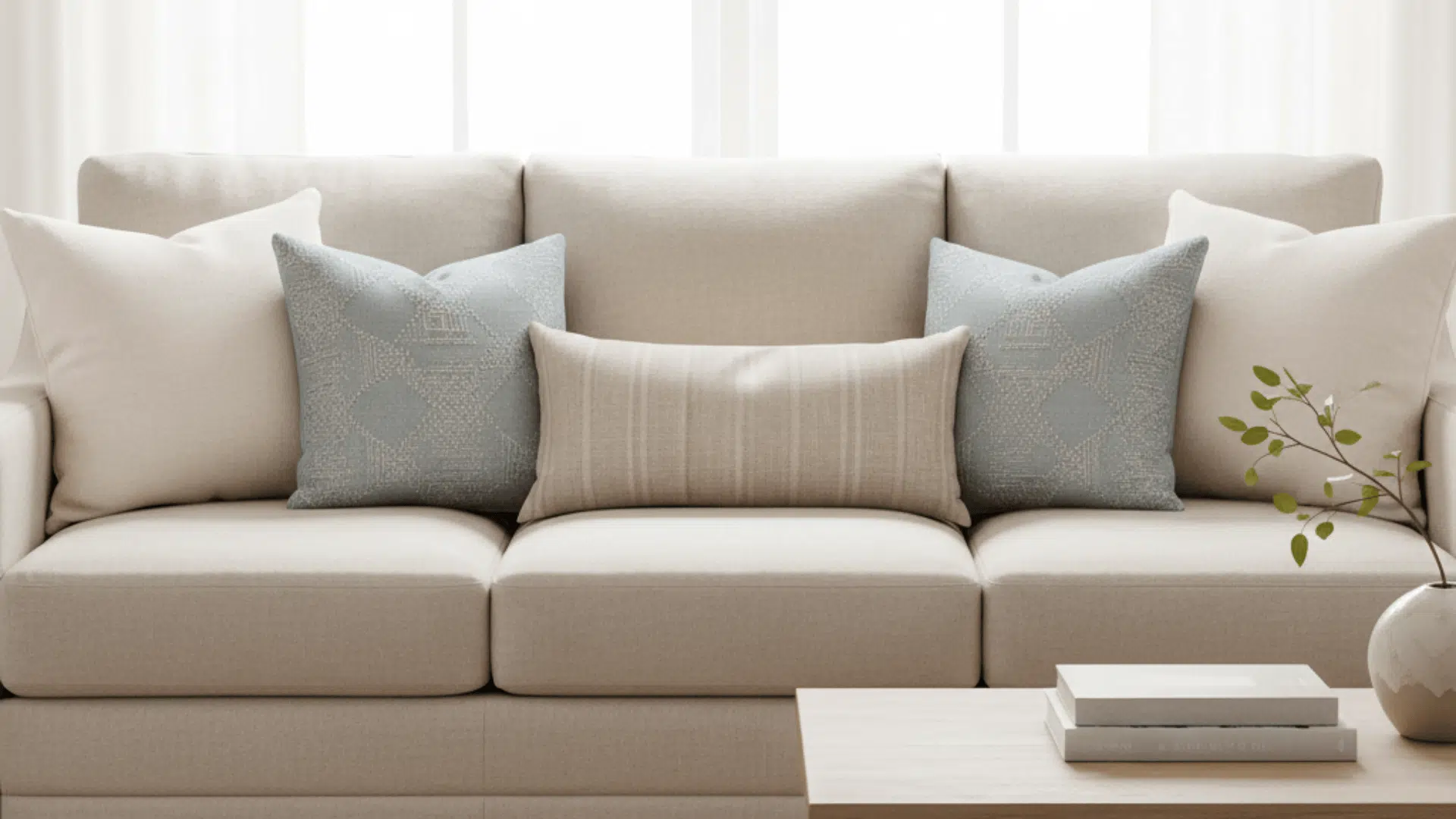
The 1-2-3 rule for couch pillows involves layering: start with one large base pillow on each end, add two medium-sized pillows in front of those, then layer a smaller third accent pillow (like a lumbar) in the middle for a full, balanced look on standard sofas.
This approach uses odd numbers like three or five for a relaxed feel, while even numbers work better in formal spaces or when your couch faces a focal point.
Couch type and pillow size directly affect these numbers. Deep-seated sofas with thick back cushions handle more pillows than shallow couches.
Two 22-inch pillows create the same visual weight as three or four 18-inch pillows. Cushion firmness matters too.
Firm cushions support pillows without shifting, while soft cushions compress and look sloppy. Seat depth determines usable surface area.
Deeper seats accommodate more pillows before intruding on seating space, while standard-depth couches require restraint to stay functional.
How Many Throw Pillows Are Too Many?
You have too many pillows when they actively interfere with using your couch. If guests need to relocate more than two pillows before sitting down, you’ve exceeded the practical limit.
If half or more of your throw pillows end up on the floor during normal use, the arrangement isn’t serving its purpose.
Visual overcrowding is another clear indicator. When pillows stack unevenly against each other or compete for space, the arrangement looks chaotic rather than curated.
Constant reshuffling throughout the day signals that your pillow count exceeds what the space can naturally accommodate.
A practical benchmark: if you need to remove more than half your pillows for comfortable seating, you have too many.
Throw pillows should enhance your couch, not force you to constantly manage them.
The negative space around and between pillows contributes to the overall composition just as much as the pillows themselves.
Pillow Numbers Based on Couch Styles
Different couch styles have different capacity limits for throw pillows. Use these ranges as starting points, then adjust based on your specific furniture dimensions and personal preferences.
1. Standard 3-Seater Sofa

Most three-seater sofas work well with three to five pillows. Three creates a minimal, clean look. Five allows for more variety in size and pattern without crowding the seating.
Place larger pillows at each end to frame the couch, then add smaller or lumbar pillows in the center or layered in front.
2. Sectional Sofa

Sectionals typically accommodate five to nine pillows, depending on their configuration. L-shaped sectionals benefit from pillows clustered at each end and in the corner. U-shaped sectionals can support more pillows distributed across the longer spans.
The goal is to create multiple conversation areas rather than treating the entire sectional as one continuous surface.
3. Loveseat

Loveseats look best with two to three pillows. Two matching pillows on either end provide symmetry without overwhelming the smaller frame.
Three pillows (two at the ends and one in the center) work if you’re using smaller dimensions or want a fuller look.
4. Sleeper Sofa

Sleeper sofas function better with two to four pillows since you’ll need to remove them regularly when converting the couch to a bed.
Fewer pillows mean less daily setup and storage hassle. Choose pillows that are easy to move and store rather than heavily embellished or oversized options.
Throw Pillow Sizes and Layouts
Pillow size combinations determine how your arrangement looks and functions. These layout options give you proven formulas for different couch types.
| Couch Type | Layout 1 | Layout 2 |
|---|---|---|
| Standard Sofa | Two 22″ pillows on the ends + one lumbar pillow in the center | Four 20″ pillows arranged symmetrically (two on each end, layered front to back) |
| Sectional Sofa | Two 22″ pillows in each corner section + one accent pillow | Layered mix: 22″ pillows at the back, 20″ pillows in front, and lumbar pillows at key points along longer sections |
| Loveseat | One 20″ pillow on each end | Two 18″ pillows + one lumbar pillow centered between them |
How to Style Your Sofa With Pillows

Styling pillows effectively requires more than just choosing colors you like. These methods help you create arrangements that look cohesive and feel comfortable.
1. Color and Pattern
Start with a neutral base color that complements your couch, then add one accent pillow in a bolder color and one patterned pillow.
This formula prevents the arrangement from looking too busy while still adding personality.
Coordinate pillow colors with other elements in the room, such as curtains, rugs, or artwork, to create visual continuity throughout your space.
2. Texture and Fabric
Mixing textures adds depth without requiring more pillows. Combine velvet with linen, or pair smooth cotton with textured weaves.
The contrast between soft and structured fabrics creates interest that pure color variation can’t achieve alone. Different materials catch light differently, adding dimension to your arrangement.
3. Layering and Placement
Always place larger pillows at the back and smaller pillows in front when layering. This creates a graduated effect that looks intentional rather than haphazard.
Avoid stacking pillows directly on top of each other. They should rest against each other at slight angles instead for a more natural appearance.
Common Pillow Styling Mistakes to Avoid
Even well-intentioned pillow arrangements can fall flat when you make these common errors. Here are the mistakes that undermine both comfort and visual appeal:
Using too many small pillows: Three 18-inch pillows often look more chaotic than two 22-inch pillows, even though they take up similar space. Larger pillows create cleaner lines with less visual clutter.
Blocking armrests or seating areas: Pillows that obstruct where people naturally sit or rest their arms defeat their purpose. Keep functional zones clear and position pillows where they support rather than interfere.
Matching everything too closely: When pillows match in both color and texture, they blend together and lose impact. Vary at least one element, either color, pattern, or fabric, to create distinction.
Ignoring scale and proportion: A single oversized pillow on a loveseat looks awkward, just as tiny pillows get lost on a large sectional. Match pillow size to your furniture dimensions.
Forgetting about maintenance: Pillows with excessive embellishments, delicate fabrics, or difficult closures become a chore to manage. Choose options that look good and remain practical for daily use.
Conclusion
The right number of pillows for your couch depends on furniture size, pillow dimensions, and how you use your space.
Start with the 1-2-3 rule as a baseline, then adjust based on your couch type and personal preferences.
Comfort should always come first. If pillows interfere with sitting or require constant rearranging, reduce the count.
Focus on balance and proportion rather than filling every available inch. The best arrangements look intentional, feel comfortable, and require minimal maintenance throughout the day.
When in doubt, choose fewer, larger pillows over many small ones, and remember that restraint often creates more visual impact than excess.

Alex Guerrero, a graduate with a Fine Arts degree from the Rhode Island School of Design, has been a visionary in the world of color and design for over 15 years. His professional journey began in the heart of the fashion industry in Milan, where he developed an acute sense for color harmonies and trends. Alex joined our team in 2018, offering fresh and innovative perspectives on color utilization in various spaces. Renowned for his ability to blend contemporary trends with timeless elegance. Outside of work, Alex is an accomplished painter and a volunteer art therapist, his artistic talents further enriching his professional insights.