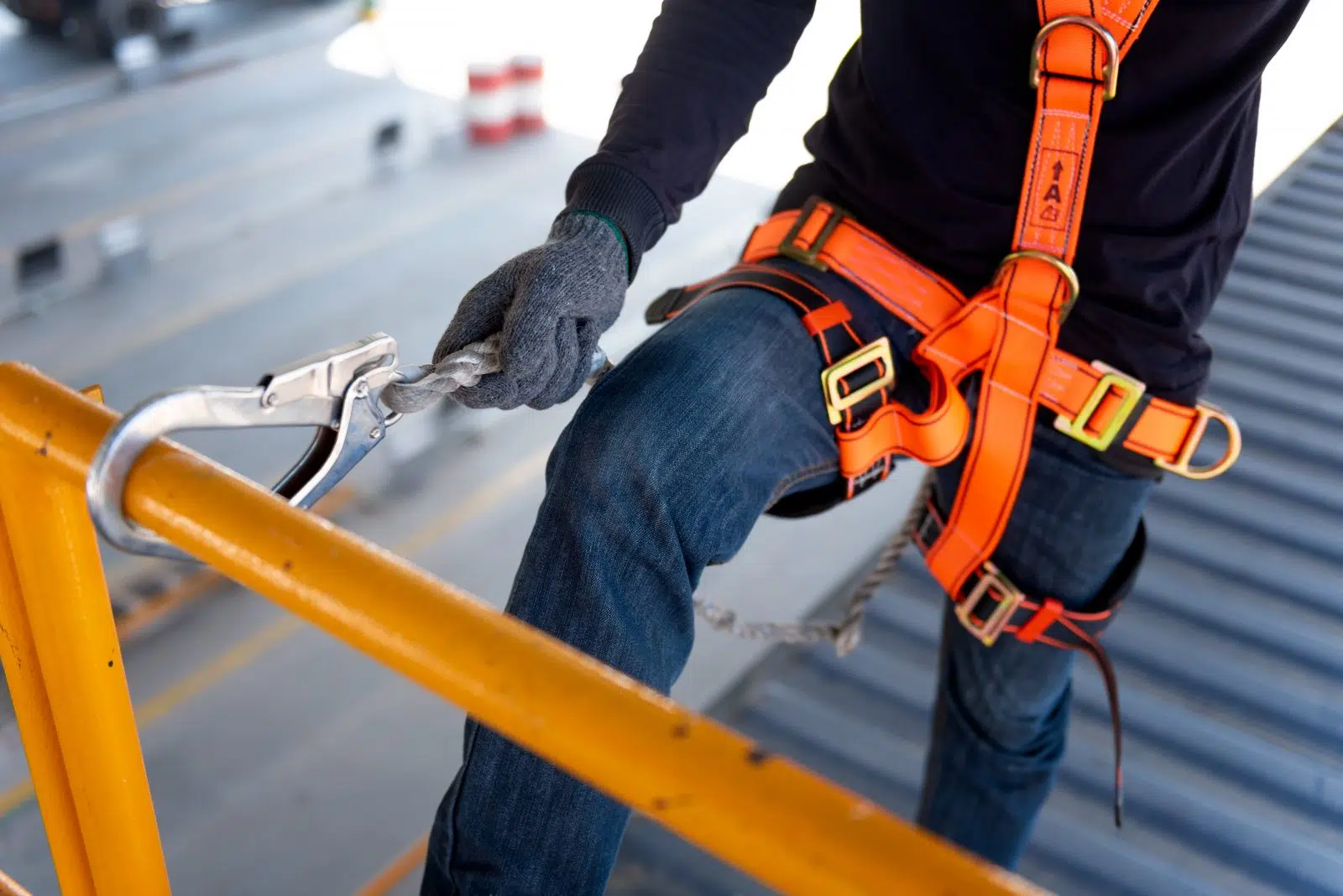

For decades, fall protection selection followed a simple playbook: Grab a harness, clip into a lanyard, and get to work. That era is gone. Modern jobsites demand a far more deliberate approach, one shaped by data, application-specific testing, and tighter American National Standards Institute (ANSI) performance thresholds.
Today’s crews don’t just “gear up”; they engineer a fall protection system around the work environment, exposure type, and performance characteristics of each component.
The payoff is substantial. When you match the right safety harness and connection device to the surface conditions, anchor availability, and fall clearance envelope, crews move faster, risks drop dramatically, and compliance becomes a baked-in operational habit rather than a regulatory chore.
This shift didn’t happen by accident. Advances in connection devices, updated testing requirements, and new digital selection tools have formalized a more analytical way of choosing equipment. The result is a jobsite that operates with the same intentionality and precision as any other engineered system.
From “One Setup Fits All” to Job-Specific Fall Protection
Historically, crews relied on a universal combination: a generic full-body harness and a six-foot shock-absorbing lanyard. It worked well enough on open decking, scaffolds, and ironwork. However, as work environments diversified and ANSI began defining more explicit categories for device performance, that simplicity no longer held up.
The modern landscape includes:
- Leading-edge steel that can sever improperly selected lanyards
- Confined areas where workers have minimal free fall distance
- Tilted or brittle surfaces where restraint, not arrest, is the correct control
- Dynamic work zones (roofs, rebar, formwork, telecom, solar arrays) where anchor points and fall clearance vary daily
Because of this, crews now evaluate equipment more like engineers assess load paths: They identify hazards, map movement zones, calculate vertical clearance, and pick components that perform predictably under those exact conditions.
This precision is why fall protection harness and lanyard selection has become a decision tree rather than a default option.
Understanding the Four Core Lanyard Categories
Modern jobsite evaluation starts by identifying the correct type of connection device. Each category manages a different exposure, and misapplication is one of the fastest ways to negate an otherwise compliant setup.
1. Restraint Lanyards: Eliminating the Fall Altogether
Restraint systems prevent workers from reaching an unprotected edge. These are common on roofs, elevated platforms, and areas with stable walking surfaces.
Key considerations:
- Must be sized to physically prevent exposure to a fall hazard
- No deceleration device required, but anchor capacity still matters
- Ideal when fall arrest introduces unnecessary clearance requirements
Crews treat restraint as a preferred control whenever feasible because it eliminates the fall event entirely, no free fall, arrest forces, or rescue complexity.
2. Positioning Lanyards: Hands-Free Productivity at Height
Positioning devices hold workers in place while allowing them to use both hands, which is essential for tasks such as rebar tying, tower work, ladder systems, and pole structures.
Key considerations:
- Permitted maximum free fall is limited (often ≤2 ft).
- Devices must be used with a separate fall arrest system.
- Abrasion resistance and adjustability dictate real-world safety.
Positioning is about precision: The worker must be stable, tensioned correctly, and able to perform tasks without sway or drift.
3. Energy-Absorbing Lanyards: The Backbone of Traditional Fall Arrest
These devices remain the most widespread solution for general construction because they limit the impact forces that occur during free fall. However, modern versions are radically different from the early, textile-based units crews grew up with.
Key considerations:
- Available in 6 ft free fall and 12-ft free fall configurations.
- Deploy under specified load profiles dictated by ANSI Z359.13.
- Require careful clearance calculations based on deceleration distance.
- Often include internal webbing, tear-away packs, or hybrid systems.
The biggest evolution is predictability. Tested performance curves, dynamic drop profiles, and updated arrest force thresholds have made these devices far more reliable when chosen correctly for the task.
4. Tie-Back Lanyards: Solving the Anchor Access Problem
Tie-back units allow the lanyard to serve as its own anchorage connector. This is invaluable where traditional anchors don’t exist or when structural members provide the only viable tie-in point.
Key considerations:
- Requires a specialized jacketed or reinforced leg designed for abrasion and cutting resistance
- Must sustain higher cyclic and static forces during tie-back scenarios
- Not interchangeable with standard lanyards, improper use is a major failure risk
Tie-back devices directly address the jobsite reality: sometimes the anchor comes to the worker, not the other way around.
How ANSI Z359.13 Redefined Lanyard Performance Expectations
The shift was formalized with the publication of ANSI Z359.13, which established performance criteria for energy-absorbing lanyards, alongside ANSI Z359.3, which governs restraint and positioning systems, bringing clarity and accountability to equipment selection.
A New Emphasis on Dynamic Testing
Older standards leaned heavily on static load measurements. The updated Z359.13 introduced:
- Dynamic performance tests simulating real fall arrest conditions
- Multiple weight class trials (including 310 lb and 420 lb test masses)
- Defined maximum arrest forces and strictly enforced deceleration distances
- Environmental and conditioning tests for UV, moisture, and heat
The intent is simple: If a device can’t perform under controlled stress, it has no business being deployed at height.
Clear Distinctions Between Free Fall Classes
Z359.13 recognized that crews routinely encounter more than 6 feet of free fall, especially in steel erection or scenarios with low anchors. As a result, the standard defined:
- Class 1 devices for free falls up to 6 feet.
- Class 2 devices for free falls up to 12 feet.
This reclassification compelled safety directors to reassess their assumptions. A lanyard tested only for 6 feet free fall is not safe (or compliant) when used in a low-anchor scenario that produces double the free fall distance.
Implications for Jobsite Selection
The updated testing protocol means crews expect:
- Precise product labeling showing class, performance limits, and clearance requirements
- Predictable deployment behavior across changing temperature and material conditions
- Compatibility guidance that aligns harness attachment points, anchorage capacities, and system configurations
In other words: no guesswork.
The SRL vs. Lanyard Decision: A More Nuanced Question
There’s a growing tendency for crews to default to SRLs for everything, but this is as flawed as the old habit of relying solely on lanyards. SRLs vs. lanyards solve different problems.
When an SRL Is the Better Choice
Self-retracting lifelines offer:
- Reduced free fall distances (often inches, not feet)
- Automatic retraction that minimizes slack
- Superior performance in lower clearance environments
- Leading-edge-rated variants for sharp-edge work
They excel where movement is dynamic and edges are hostile.
When a Lanyard Still Makes More Sense
Even with SRLs widely available, lanyards remain essential for:
- Controlled, predictable movement zones
- Situations where anchorage geometry does not favor overhead SRLs
- Lower-cost, fully compliant fall arrest setups
- Environments where SRL leading-edge use introduces added risk or complexity
The correct decision depends on the type of exposure, anchor location, and energy path. Modern crews analyze these factors instead of relying on habit.
Digital Selection Tools Are Changing Procurement and Planning
One of the most significant advancements in fall protection isn’t physical; it’s digital. Online selection tools, work zone calculators, and digital resource libraries now guide users through the decision-making process.
How These Tools Improve Gear Matching
Digital platforms help teams:
- Calculate required clearance for energy-absorbing lanyards and SRLs.
- Determine the correct free fall class for specific anchor heights.
- Cross-reference harness models with compatible connection devices.
- Filter products by ANSI compliance, material properties, or exposure conditions.
- Validate training requirements for authorized vs. competent users.
This removes the ambiguity that historically caused mismatched components and noncompliant assemblies.
Impact on Procurement
Procurement teams now:
- Compare lanyard performance curves side-by-side.
- Review test data and compliance documentation before making a purchase.
- Build standardized kits for recurring job types, roofing, tower work, ironwork, utility, telecom.
- Reduce downtime by eliminating trial-and-error equipment selection.
Digital tools have effectively modernized the fall protection purchasing lifecycle, aligning selection with engineering rigor rather than tradition.
Why Smarter Selection Translates to Safer, Faster Jobsites
Selecting a fall protection harness and lanyard is no longer a routine task; it’s a risk mitigation strategy. Crews that choose equipment based on job type, anchor geometry, and compliance data see measurable improvements in both efficiency and safety:
- Reduced arrest distances mean more usable work area.
- Appropriately chosen materials minimize edge failures and abrasion.
- Better-matched harnesses improve worker mobility and reduce fatigue.
- Correct system classification ensures compliance without over-engineering.
- Standardized selection processes streamline crew training and inspections.
Safety leadership now evaluates connection devices the way mechanical engineers evaluate load paths: systematically, with an eye toward predictable failure modes and real-world constraints.
The result is a safer workforce, and a more capable one.

Holding a Master’s in Library and Information Science from the University of Illinois, Josh Clarke has dedicated more than 15 years to managing and disseminating information across various platforms. His professional journey includes significant experience as a research librarian, where he developed an expertise in sourcing and providing accurate and comprehensive answers to diverse questions. In 2018, Josh brought his rich experience to our platform, quickly establishing himself as a reliable source for general FAQs. He has been overseeing our information curation since then, combining his research skills with a flair for engaging content delivery. When not involved in information management, Josh enjoys exploring digital photography and participating in local quiz competitions, hobbies that complement his inquisitive nature and love for learning.