
Mattress stains happen in real life, especially on memory foam that holds heat and moisture.
The goal is to lift residue and sanitize the surface without soaking the foam, which can trap odor and slow drying.
A low-moisture routine using enzymes, careful rinsing, and strong airflow removes most sweat and light urine marks safely at home.
Work in thin layers, give cleaners time to break down soils, and rinse out anything you apply so it doesn’t attract dirt later.
Finish with strong airflow so the mattress dries fast and stays fresh. Keep pets and kids away until it’s fully dry.
How to Clean Your Mattress Step-By-Step
This low-moisture method helps lift sweat and light urine stains without soaking a memory-foam mattress. Follow the steps carefully, and you can clean, sanitize, and refresh your mattress safely at home.
Materials Required
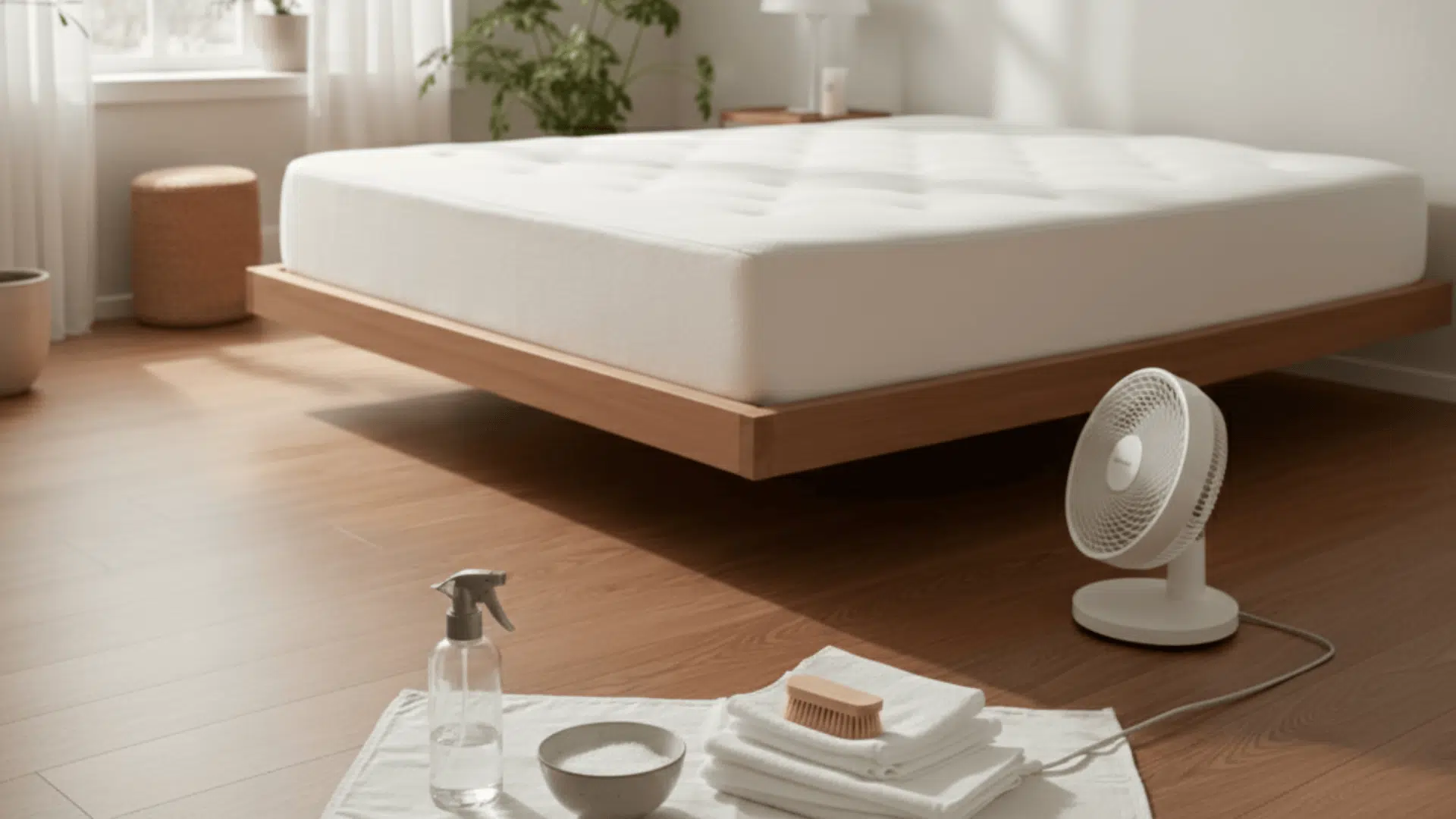
Gather everything first so you can clean, rinse, and dry the mattress without pauses.
| Item | Quantity |
|---|---|
| Biological washing powder (enzyme-based) | 1 tbsp (≈15 g) per 1 liter water |
| Warm water (for enzyme mix) | 1 liter (scale as needed) |
| Pump sprayer or spray bottle | 1 (1–2 L ideal) |
| 3% hydrogen peroxide (ready-to-use) | 250–500 mL (as needed) |
| Clean white microfiber towels | 4–8 towels |
| Soft upholstery brush | 1 |
| Wet/dry extractor + upholstery/mattress tool (optional, best) | 1 |
| Clean rinse water | 2–5 liters |
| Distilled white vinegar (optional rinse neutralizer) | ½–1 cup per 10 liters of rinse water |
| Nitrile gloves (optional) | 1 pair |
| Fan/air mover (for drying) | 1–2 |
| Baking soda (optional, after drying) | ½–1 cup |
Pro tip: Use white towels only, so you can see what you’re lifting out and avoid dye transfer. Mix the enzyme solution fresh each session for the strongest cleaning power.
Step 1: Prep the Mattress and Identify the Stains

Strip all bedding and protect the floor if needed. Vacuum the entire mattress slowly to remove dust, skin flakes, and debris that can smear once moisture is added.
Find every stain in bright light and lightly mark them. If a strong urine odor is obvious, plan on deeper extraction rather than surface wiping alone.
Step 2: Mix the Enzyme Prespray

Add 1 tablespoon (about 15 g) of biological washing powder to 1 liter of warm water. Stir or swirl until mostly dissolved, then pour it into a pump sprayer or spray bottle.
Mix fresh so enzymes stay effective. Don’t over-concentrate; stronger isn’t always better, and it can leave more residue to rinse out.
Step 3: Mist the Stained Areas without Soaking

Hold the sprayer back and apply a fine mist over each stained area. Aim for an even dampness, not a wet, spongy mattress; memory foam can hold water like a sponge.
Avoid flooding seams and edges. You want the enzymes to contact the stain on the surface layers, not to drown the mattress core.
Step 4: Let It Dwell, Then Gently Agitate

Leave the enzyme prespray to work for 15–30 minutes. Watch for lightning or a color shift as residue breaks down.
After the dwell time, gently agitate the damp fabric with a soft brush using light strokes. Keep pressure gentle so you don’t fuzz or damage fibers while they’re weakened from moisture.
Step 5: Extract for Best Results, Then Optionally Neutralize

If you have a wet/dry extractor or upholstery tool, do a controlled rinse extraction: inject a small amount of warm water and vacuum it back out, pass by pass.
This pulls out deeper residues and speeds drying. For extra neutralizing, add vinegar to rinse water (½–1 cup per 10 liters) to reduce alkalinity.
Step 6: Dry Fast and Finish Safely

Dry the mattress as quickly as possible to prevent odors and mildew. Stand it on edge if you can, and run a fan or air mover across the surface for several hours.
Don’t remake the bed until it’s fully dry. If desired, sprinkle baking soda after drying, wait 30–60 minutes, then vacuum for freshness.
Video Tutorial
Special thanks to Cleaning How To for providing valuable insights in their video, which I referenced while creating this guide.
Different Methods for Specific Mattress Stains
Not every stain responds to the same cleaner or technique. Match the method to the stain type so you remove the source properly without over-wetting memory foam or leaving residue behind.
1. Sweat and Body Oil Stains
Mist an enzyme-based cleaner lightly over the stain and let it dwell for 15–30 minutes so enzymes can break down proteins and oils. Gently agitate with a soft brush, then towel-rinse and blot dry. Use strong airflow to finish drying.
2. Fresh Urine Stains
Blot immediately with dry towels to pull out as much moisture as possible. Mist the enzyme solution evenly and allow full dwell time before rinsing. Repeat rinse-and-blot cycles until towels come up clean. Dry quickly with a fan to prevent lingering odor.
3. Old or Set-In Urine Stains
Apply enzymes first and give extra dwell time, then mist 3% hydrogen peroxide to brighten remaining discoloration. Rinse thoroughly to remove residues that can re-brown. Dry fast and fully. If a strong odor remains, deep extraction may be required.
4. Food and Drink Spills
Blot first, then use a mild enzyme or diluted detergent mist to loosen sugars and oils without soaking. Lightly agitate, towel-rinse, and blot until the surface feels clean, not tacky. Dry completely to prevent sticky re-soiling or faint odor.
5. Blood or Protein-Based Stains
Use cold water only, since heat can set protein stains. Apply enzyme cleaner, allow dwell time, and blot gently instead of scrubbing. Repeat as needed. If using peroxide for light fabrics, spot-test first to avoid uneven lightening around the stain.
Pro Tips for Best Results
A few small details make the difference between a fresh, clean mattress and one that stays damp or streaky. Use these practical tips to improve stain removal, prevent residue, and speed up drying.
Always use low moisture: Memory foam acts like a sponge. Light misting and frequent blotting prevent trapped moisture and odor issues.
Warm water activates enzymes: Mix enzymes with warm, not hot, water to help them break down sweat and body oils more effectively.
Give chemistry time to work: Don’t rush dwell time. Enzymes and peroxide need 10–30 minutes to do their job properly.
Rinsing matters more than spraying: Leftover detergent or enzymes can attract dirt and cause skin irritation, so thorough rinsing is essential.
Spot test first: Especially with peroxide, test in an inconspicuous area to avoid unexpected color changes.
Stop if odors persist: Strong urine smells deep in the foam usually require professional extraction with specialized tools.
Follow these pro tips, and you’ll get cleaner results with less risk of odors, residue, or reappearing stains.
Conclusion
Enzyme cleaner does the heavy lifting on sweat, oils, and light urine, but results depend on the follow-through: controlled misting, enough dwell time, and thorough rinsing.
Peroxide can brighten remaining discoloration, yet it should be used lightly and only after spot-testing.
Most importantly, dry the mattress fast with strong airflow so moisture does not linger in the foam. With this method, stains fade, odors drop, and the surface feels clean without flooding the mattress.
Share the stain type and mattress material in the comments for tailored ratios and drying tips. Label your sprays, ventilate the room, and avoid mixing chemicals.

Stephanie Grace, a graduate with a degree in Fine Arts from the Savannah College of Art and Design, has been inspiring DIY enthusiasts with her creative and practical guidance for over 14 years. Her career in design and crafting began in a small artisan workshop, where she developed a passion for transforming everyday materials into beautiful and functional items. Stephanie joined our website in 2018, rapidly gaining popularity for her easy-to-follow DIY tutorials and innovative project ideas. Since then, she has been the creative mind behind our DIY section, helping readers bring their artistic visions to life. Outside her professional pursuits, Stephanie enjoys pottery and urban gardening, hobbies that showcase her love for hands-on creativity and nature.