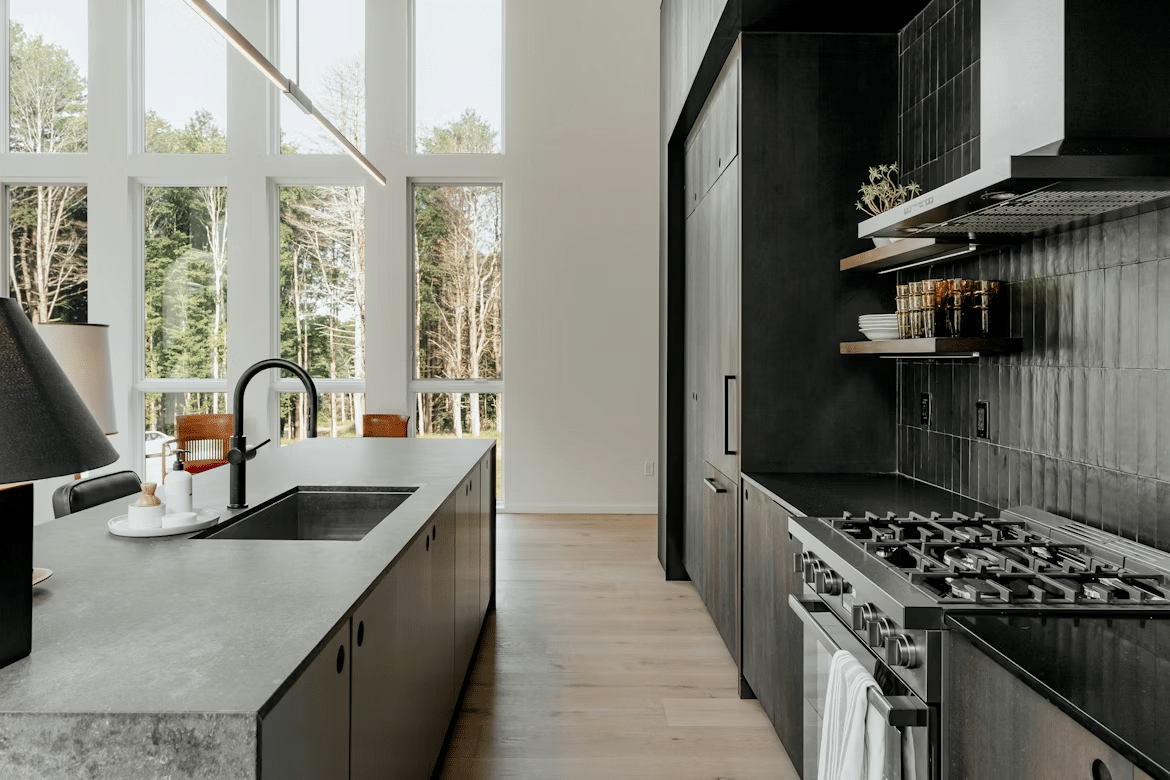

A black sink is a bold and stylish choice that can make your kitchen look uniquely aesthetic. A sink of that color instantly draws the gaze of anyone walking into the kitchen and creates a very awesome contrast with the other elements surrounding it.
However, with a black sink, you have to be careful about how you design the rest of the space. If you’re not careful, you can end up creating too much density in the sink area with dark colors, making the sink itself look over the top. Or, you could accidentally go the other way and create such a contrast that makes the sink look stark out of place.
In this post, we’re going to give you some tips on how design a modern kitchen featuring a black sink in the most moderate and aesthetic manner. We’ll first describe how you can design the sink area itself, before moving outwards to the cabinet area, the countertops, and so on.
Let’s go.
Step 1: Designing the Sink Area
In this heading, we’re going to guide you on how to position the sink, how to choose between single and double-bowl, and how to pair the sink with the right faucet.
Positioning the Black Sink for Maximum Impact
Where you place the sink shapes how much impact it has.
- Under a window is the classic position. Natural light hits the sink directly and prevents the space from feeling heavy.
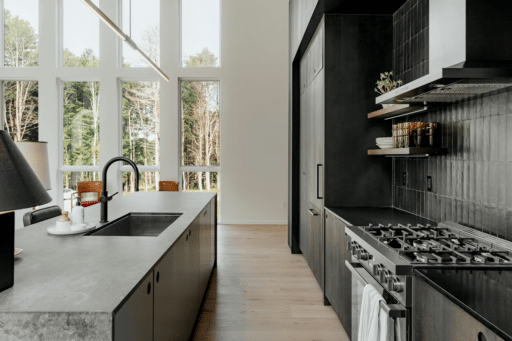
- On a kitchen island turns the sink into a centrepiece. This works best when the island has clean lines and minimal clutter.
- In a minimal wall run keeps the layout tight and functional. The sink integrates rather than dominates, which suits more restrained designs.
Single Bowl vs Double Bowl in Modern Kitchens
Single bowl sinks fit modern kitchens better in most cases. The uninterrupted basin reads as cleaner and more considered. It also accommodates large pans and baking sheets without difficulty.
Double bowl makes more sense for busy households where washing and rinsing happen simultaneously, or where one side is used for food prep. The trade-off is a more segmented look that can work against a streamlined layout.
Depth matters too. A deeper basin hides dishes from view and contributes to a tidier appearance at bench height.
Always remember. You should buy your black kitchen sink from a high-end brand so that it keeps its aesthetic looks for a long time and the effort that you make for the area around it doesn’t go to waste.
Pairing the Right Faucet
The faucet sits directly next to the sink, so the finish relationship is important.
Faucet Finish | Effect |
|---|---|
Matte black | Seamless, unified look |
Brushed brass | Warmth and contrast against the black |
Stainless steel | Balanced, works in transitional kitchens |
Matte black is the most cohesive option. Brushed brass adds personality without clashing. Stainless steel is the most neutral choice if you want the sink to stand out without the faucet competing.
After the sink area, the next area that you need to focus on is the cabinetry. In the next heading, we’re going to cover that.
Step 2: Choosing Cabinet Colors That Complement a Black Sink
Crisp White and Off-White Cabinets
White cabinets and a black sink is a high-contrast combination that defines a lot of modern kitchen design. It is direct and clean. Off-white tones soften the contrast slightly and suit Scandinavian-inspired spaces where the goal is warmth rather than sharpness.
To avoid a clinical result, introduce texture through cabinet fronts, natural materials on the countertop, or warm lighting.
Warm Wood Finishes
Wood and black work well together because the warmth of the timber offsets the weight of the sink.
- Light oak keeps things soft and approachable.
- Walnut creates a richer, more dramatic space. Use it carefully so the combination does not become oppressive.
The key is proportion. If the cabinetry is predominantly wood, the black sink reads as an accent. If black appears elsewhere in hardware or appliances, the wood becomes the relief element.
Deep and Moody Cabinetry
Navy, charcoal, and forest green all pair well with a black sink. The result is a cohesive, tonal kitchen rather than a high-contrast one.
In these schemes, texture does the work that contrast would otherwise do. Shaker fronts, ribbed glass inserts, or a mix of matte and semi-gloss finishes prevent the design from looking flat.
Step 3: Picking Countertops That Go Well with a Black Sink
Moving on, let’s talk about countertops that go well with a black sink. You can make your pick from the various materials and colors that we’re mentioned below. Or, you can take them as inspiration and go with something similar that suits your particular kitchen better.
White Quartz and Marble
White countertops against a black sink produce strong contrast and immediately brighten the space. Marble and marble-look quartz add veining that can be used to tie in other elements, whether that is grey, charcoal, or warm gold tones.
Choose veining that connects to something else in the room. A vein with a warm undertone works with brass fixtures. A cooler grey vein suits a more industrial palette.
Grey and Concrete-Inspired Surfaces
Grey countertops sit between the contrast of white and the boldness of all-black. They suit industrial modern kitchens and work particularly well with matte finishes throughout.
Concrete-effect quartz is a practical alternative to poured concrete and coordinates naturally with black hardware and sinks.
All-Black Countertops
An all-black countertop paired with a black sink creates a seamless surface that reads as bold. It works best in kitchens with strong lighting and at least one element that provides visual relief, whether that is white cabinetry, light flooring, or natural wood.
Without adequate lighting, this combination can make a kitchen feel smaller and heavier than it is.
Step 4: Picking a Backsplash That Supports the Design
Moving on from the cabinetry, another important element that you have to be careful about designing is the backsplash. There are a number of different options that you can choose from, including these.
Classic White Subway Tile
White subway tile is a clean, reliable backdrop for a black sink. It does not compete and lets the sink do its job. Grout color is important here. White grout keeps things light. Dark grout adds definition and can tie the backsplash to the sink more deliberately.
Full Slab Marble or Quartz
Running the countertop material up the wall eliminates grout lines and creates a sleek, continuous surface. This approach works well in minimal kitchens where visual interruption is something to be avoided.
Textured or Patterned Tile
Patterned tile adds depth to the design, but it needs to be balanced against a dark sink carefully. As a general rule, if the sink is already a strong design element, the backsplash should support rather than compete with it. Scale the pattern down or limit it to one defined zone.
Dark or Matching Backsplash
A dark backsplash behind a black sink creates a feature wall effect. To prevent the area from becoming a visual void, use lighting deliberately. Under-cabinet strips or focused downlighting on the backsplash maintain separation between surfaces.
Moving on, we’re also going to cover what you should do regarding the hardware and appliances around the sink area to get the most out of your black sink.
Step 5: Nailing the Hardware, Appliances, and Finishing Touches
Coordinating Cabinet Hardware
Three approaches work in modern kitchens with a black sink.
- Matching black pulls create consistency throughout the space.
- A mixed metal strategy uses the sink as the black anchor while hardware introduces a second finish, typically brushed brass or satin nickel.
- Minimal hardware with integrated or handleless cabinets keeps the focus on the sink and countertop rather than the fittings.
Appliance Finishes
Appliance Finish | Works Best With |
|---|---|
Stainless steel | Almost any palette. Think transitional kitchens |
Black appliances | Cohesive dark schemes. Think monochrome kitchens |
Panel-ready | Seamless cabinetry-forward designs |
Panel-ready appliances are worth considering if the goal is a kitchen where nothing interrupts the cabinet line.
Open Shelving vs Closed Storage
Open shelving near a black sink draws attention to what is on the shelves, so curation matters. A few considered items work. A crowded shelf competes with the sink and makes the whole area feel busy. Closed storage keeps the sink as the primary focus and is easier to maintain over time.
Step 6: Getting the Lighting in the Kitchen Right
The lighting in the kitchen also plays a role in how the black sink is perceived. Here are some ideas to consider:
Task Lighting at the Sink
Under-cabinet LED strips placed directly above the sink provide functional light for washing and food prep. They also graze the backsplash and add visual interest without requiring additional fixtures. Focused downlighting from above serves the same purpose and suits kitchens with recessed ceiling lighting throughout.
Pendant Lighting Over Islands
If the sink is on an island, pendants positioned above it reinforce its role as the focal point. Proportion matters. Pendants that are too small get lost. Pendants that are too large overpower the sink they are meant to complement. Space them evenly and keep the finish consistent with the faucet or hardware.
Choosing the Right Color Temperature
Color Temperature | Effect |
|---|---|
Warm white (2700K to 3000K) | Softens contrast, suits wood and warm palettes |
Neutral white (3500K to 4000K) | Crisp and clean, suits white and grey kitchens |
Avoid cool daylight bulbs in kitchens with black elements. They heighten the contrast in a way that can feel harsh.
Wrapping Up
With these tips and pointers in mind, you will be able to design a stylish and modern kitchen for yourself with a black sink in the center of it.
We hope you enjoyed reading this post and that you’ll check out the other content that we’ve published here on our website.
Thanks a lot!

With a Master in Architectural Studies from University of Pennysylvania, Marwa Haydar has pioneered living spaces since 2005. Her expertise, initially honed in a prestigious architectural firm, is evident in her approach to creating environments. Marwa became part of our team in 2019 and has since been a driving force in our home improvement section, known for her practical yet stylish solutions. She’s been spearheading our design workshops since then, infusing her passion for teaching into her work. In her leisure time, Marwa enjoys exploring historic architecture and is an enthusiastic pottery hobbyist, further enriching her understanding of form and texture.