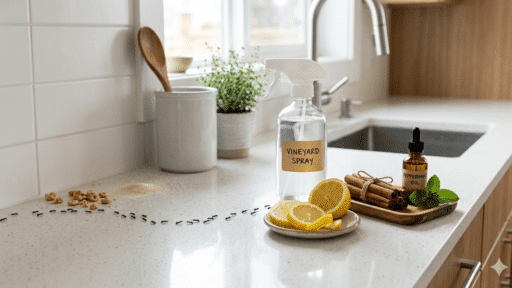
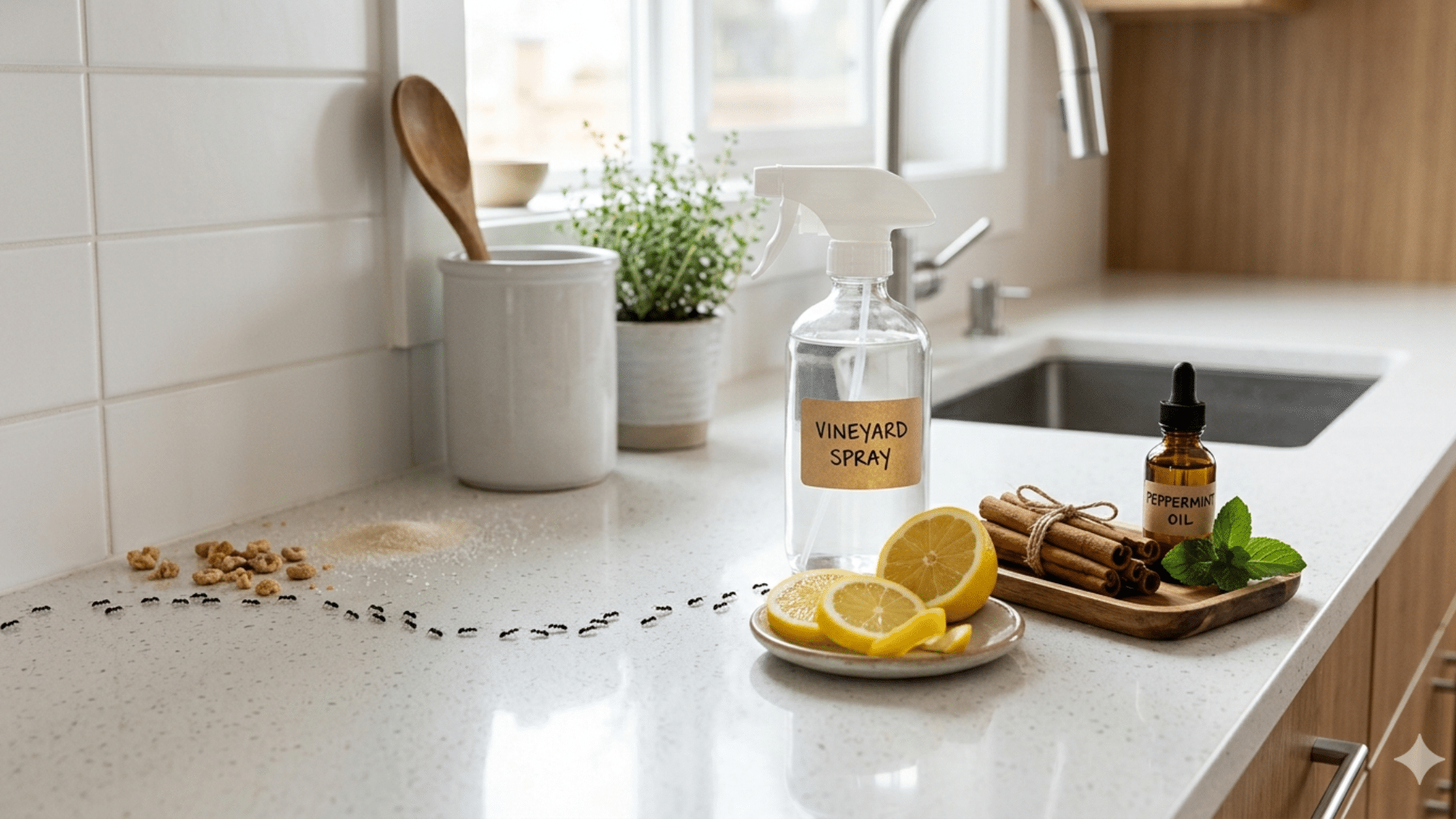
You walk into your kitchen for a midnight snack and freeze. A tiny, determined army is marching across your counter like they own the place. Sound familiar?
Here’s the unsettling truth: for every ant you see, hundreds more are hiding behind your walls, following invisible scent trails straight to your food.
But before you reach for that chemical-laden spray, pause. Those harsh pesticides don’t just kill ants; they contaminate your cooking surfaces, harm your pets, and linger in the air your family breathes.
The silver lining? Nature already has the answer. These simple, chemical-free methods will reclaim your kitchen and keep it ant-free for good.
Why are Ants Invading Your Kitchen?
Before you wage war on ants, it helps to understand why they’re there in the first place. Ants aren’t random; they’re strategic, and your kitchen is basically their five-star restaurant.
They follow invisible scent trails. When a single scout ant finds food in your kitchen, it doesn’t keep the secret.
It heads back to the colony, leaving behind a chemical signal called a pheromone trail, an invisible GPS route that tells thousands of its siblings exactly where to go.
This is why you always see ants marching in a neat, single-file line; they’re following directions.
Ants are attracted to a few key things that you need to know:
- Sugar and sweet residue: Even a tiny drop of juice or jam on the counter is enough.
- Crumbs and leftover food: Under the toaster, behind the stove, near the trash.
- Grease and protein: Especially carpenter ants and fire ants.
- Moisture: A dripping tap or a damp sponge is like a water park for ants.
Common Entry Points You’re Probably Ignoring
Tiny gaps in your walls, loose window screens, and cracks around pipes, ants don’t need a wide-open door to get inside. Here are the most overlooked entry points in and around your home that could be quietly letting colonies in.
- Hairline cracks in walls, baseboards, and foundation edges
- Gaps around pipes, utility lines, and electrical conduits where they enter walls
- Poorly sealed windows and door frames, especially in older homes, where caulking has worn down
- Holes, tears, or loose-fitting window and door screens
- Gaps beneath exterior doors where weatherstripping has worn out or was never installed
- Cracks in concrete slabs, patios, or porch steps that connect directly to the home’s foundation
- Open or poorly sealed vents, including attic, crawl space, and dryer exhaust openings
- Spaces around cable lines, satellite dish wiring, or internet cables are drilled through exterior walls
Identify the Type of Ant (Know Your Enemy)
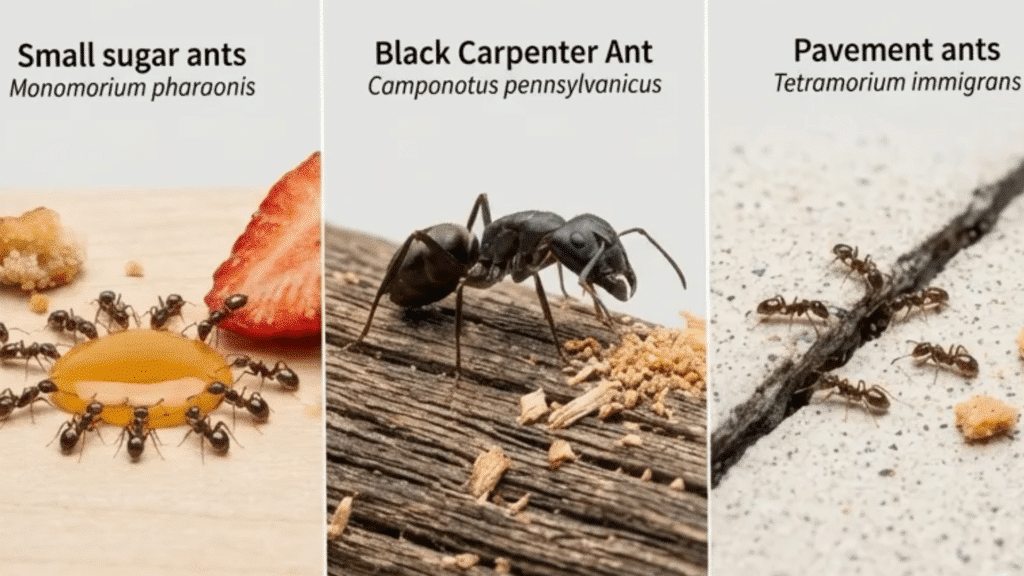
Not all ants are the same, and the type invading your kitchen can change your approach. Here are the most common kitchen invaders:
1. Sugar Ants / Odorous House Ants
- Appearance: Tiny, dark brown or black, 1–3 mm.
- Attracted to: Sweets, fruits, syrup, and honey.
- Signature sign: Emit a faint coconut-like smell when crushed.
- Best natural fix: Vinegar spray + cinnamon barriers.
2. Carpenter Ants
- Appearance: Large, black, 6–12 mm.
- Attracted to: Moist or decaying wood and protein-rich foods.
- Signature sign: Small piles of wood shavings near walls or cabinets.
- Best natural fix: Fix moisture issues, use diatomaceous earth, and seal entry points.
Warning: Carpenter ants can cause structural damage so you need to act fast
3. Pavement Ants
- Appearance: Small, brown-black, 2–4 mm.
- Attracted to: Almost everything greasy, sweets, bread crumbs.
- Signature sign: Enter through floor cracks and gaps near doors.
- Best natural fix: Dish soap spray + sealing floor gaps.
Natural and Humane Methods to Get Rid of Ants in the Kitchen
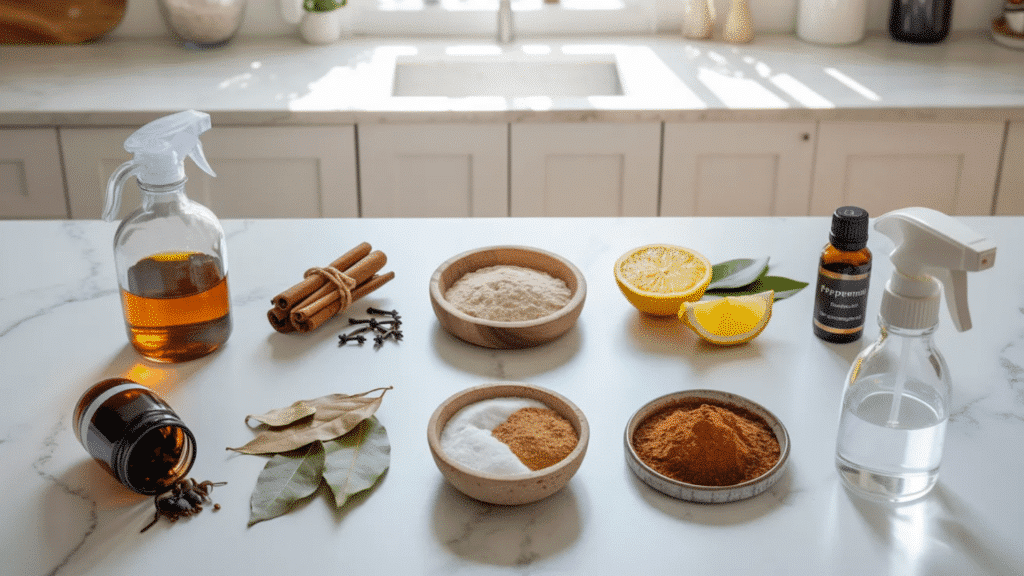
This is the heart of the battle. Here are the most effective, chemical-free methods, each one safe for your family, your pets, and your food prep surfaces.
1. Vinegar Spray {Destroy the Scent Trail Instantly}
How it works
White vinegar disrupts and destroys pheromone trails. Ants can no longer follow their GPS; they scatter and eventually abandon the route.
How to use
- Mix equal parts white vinegar and water in a spray bottle.
- Spray directly on ant trails, entry points, and countertops.
- Wipe clean with a damp cloth.
- Repeat twice daily until ants disappear.
Safe for food surfaces | Pet-friendly | Doubles as a natural cleaner
2. Cinnamon & Cloves {The Spice Barrier}
How it works
Ants breathe through tiny pores in their bodies. Strong-smelling spices like cinnamon and cloves overwhelm these receptors, making the area impossible to navigate.
How to use
- Sprinkle ground cinnamon near entry points, windowsills, and cabinet corners.
- Place whole cloves near fruit bowls or sugar containers.
- Refresh every 2–3 days for consistent effectiveness
Completely food-safe | Pleasant aroma for humans | Zero toxicity
3. Diatomaceous Earth {The Silent Barrier}
How it works
Food-grade diatomaceous earth (DE) is made from fossilized algae. Its microscopic, sharp edges damage the waxy exoskeleton of ants, causing them to dehydrate and die without the use of toxic chemicals.
How to use
- Use only food-grade DE (not pool-grade).
- Lightly dust along baseboards, under appliances, and at entry points.
- Keep it dry; it loses effectiveness when wet.
- Reapply after cleaning or mopping.
Safe for humans and pets | Long-lasting | Works on multiple pests. Avoid inhaling the powder. Use a mask when applying.
4. Lemon Juice & Citrus Peels {Nature’s Disinfectant + Repellent}
How it works
The d-limonene compound in citrus destroys the waxy coating on ants’ scent trails and acts as a natural repellent. Its strong citrus scent also disrupts their navigation, preventing ants from finding their way back.
How to use
- Squeeze fresh lemon juice along windowsills, door frames, and trail paths.
- Place dried orange or lemon peels near food storage areas.
- Wipe countertops with diluted lemon juice after cooking.
Smells amazing | Repels other insects too | Affordable
5. Peppermint Essential Oil {Ants’ Worst Nightmare}
How it works
Peppermint oil contains menthol, which is intensely irritating to an ant’s sensory system. It masks pheromone trails and acts as a strong territorial repellent.
How to use
- Add 10–15 drops of pure peppermint essential oil to 1 cup of water.
- Spray around entry points, under the sink, and along baseboards.
- Soak cotton balls in peppermint oil and place them in corners and cabinet edges.
- Refresh every 3–4 days.
Highly effective | Fresh scent | Safe when diluted.Keep away from cats. Peppermint oil can be toxic to felines
6. Bay Leaves {The Silent Guardian of Your Pantry}
How it works
Bay leaves contain compounds that ants find deeply repulsive. They won’t cross a bay leaf barrier and will actively avoid areas where the scent is present.
How to use
- Place whole dried bay leaves on pantry shelves, in spice cabinets, and in food containers.
- Tuck them under the fridge, in drawers, and near the trash can.
- Replace monthly or when the scent fades.
Zero effort | Food-safe | Works passively 24/7
7. Baking Soda + Powdered Sugar Bait {The Humane Trap}
How it works
Ants are attracted to sugar and carry the baking soda back to the colony. When ingested, baking soda reacts with the acidic compounds in the digestive system, effectively eliminating the colony at the source.
How to use
- Mix equal parts baking soda and powdered sugar.
- Place small amounts in bottle caps or shallow lids near ant trails.
- Do NOT place where pets or children can easily access.
- Be patient, it takes 24–72 hours to work.
Targets the whole colony | Inexpensive | Non-toxic ingredients
8. Coffee Grounds {Repel and Confuse}
How it works
The strong acidic scent of coffee grounds overwhelms an ant’s ability to detect pheromone trails, effectively scrambling their navigation system.
How to use
- Spread used coffee grounds along windowsills, door thresholds, and outdoor entry points.
- Place small bowls of grounds near suspected entry areas.
- Refresh every few days as the scent fades.
Zero cost (reuse your morning coffee) | Eco-friendly | Also enriches garden soil
9. Dish Soap + Water Spray {Instant Contact Solution}
How it works
Dish soap breaks down the protective waxy layer on an ant’s exoskeleton, causing dehydration. It also destroys pheromone trails on contact.
How to use
- Mix 1 tablespoon of liquid dish soap with 1 cup of water in a spray bottle.
- Spray directly on ants for immediate results.
- Spray along trails and entry points as a preventative barrier.
- Wipe and reapply as needed.
Instantly effective on contact | Available in every home | Leaves surfaces clean
How to Seal Entry Points Permanently?
Repelling and eliminating ants means nothing if there’s still a highway of entry points into your kitchen. This step is the long-term solution.
To inspect for entry points, walk slowly around your kitchen checking for cracks at wall-floor or ceiling joints, gaps around pipes and electrical conduits, spaces under doors and around window frames, and holes in insect screens.
These small openings are common entry paths for ants. To seal them naturally and effectively, use silicone or acrylic caulk to close cracks and gaps around pipes.
Install weather stripping along the bottom of exterior doors to block access. For larger openings, first fill them with copper mesh, as ants cannot chew through it, then seal with caulk.
For added protection, apply peppermint or tea tree oil along sealed edges to create a natural repellent barrier.
Common Mistakes That Make It Worse
Even with the best intentions, many people unknowingly make their ant problem worse. Avoid these mistakes:
- Killing ants without removing the trail: Squishing ants alone doesn’t work; clean the trail too.
- Leaving pet food out overnight: Pet bowls attract ants; clean and remove them daily.
- Ignoring moisture problems: Damp areas can continue to attract ants.
- Using bleach near food areas: Bleach is unsafe and ineffective; use vinegar instead.
- Inconsistency: Natural remedies need regular use; stay consistent for results.
Signs You Need Professional Help
If ant trails continue for more than two to three weeks despite consistent treatment, it’s a strong sign that the infestation is more established than it appears on the surface.
Regular sightings of large black carpenter ants further suggest that they may not just be foraging but actually nesting inside your walls, which is a more serious structural concern.
This is often supported by physical clues such as small piles of wood shavings or walls that sound hollow when tapped, especially around areas like the kitchen, where moisture attracts them.
The situation becomes even more complex if you notice ants entering from multiple locations, indicating the presence of multiple colonies rather than a single source.
At this point, basic DIY treatments are unlikely to fully resolve the issue, and a more targeted, professional approach is typically needed to locate and eliminate all nesting sites effectively.
Conclusion
Ants in your kitchen are frustrating, but they don’t require harsh chemicals to get rid of them.
Nature has quietly handed you everything you need: vinegar to erase their trails, cinnamon to block their paths, and diatomaceous earth to guard your perimeter.
The real secret isn’t one magic remedy; it’s consistency. Clean daily, seal every crack, store food properly, and reapply your natural barriers regularly. Within two weeks, you’ll notice the difference.
These methods are safe for your children, gentle on your pets, and kind to the environment without sacrificing results.

Certified Veterinary Technician Ethan Brooks has cared for companion animals in clinics and shelters for 13 years. Joining us in 2025, he shares health advice, training hacks, and product reviews that keep pets happy and owners informed. Off duty, Ethan rehabilitates injured wildlife and competes in agility trials with his border collie, Scout.