

Buying a couch sounds simple until you’re standing in a furniture store second-guessing every dimension. If you’ve ever wondered: how long is a couch? You’ll quickly realize it’s not as straightforward as it seems.
Does a three-seater actually fit your wall? Will a sectional take up more space than expected? The truth is, couch length isn’t one-size-fits-all.
If you’re furnishing a small apartment or a large living room, understanding standard sofa sizes is the first step to making the right choice.
This blog breaks down exactly how long a couch is, what size works best for your room, and how to measure properly so you avoid any furniture regrets.
How Long Is a Couch?
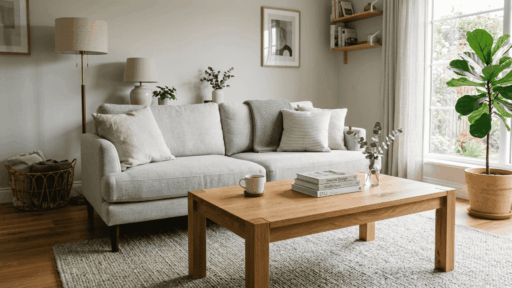
Most standard couches range from 60 to 96 inches in length, but that length varies significantly depending on style, seating capacity, and configuration.
Smaller couches are ideal for compact spaces like apartments or studios, while larger sofas and sectionals work better in spacious living rooms.
Keep in mind that armrest size, cushion depth, and design can also affect the overall length.
Before buying, always measure your available space and compare it with the couch dimensions. This ensures the sofa fits well without making the room feel cramped or empty.
How to Measure a Couch?
Measuring a couch properly helps ensure it fits your space and layout without any surprises. It also helps you plan movement around the room and avoid overcrowding.
- Measure the Length: Start at one armrest and move to the other across the front of the couch. This gives you the full length and helps you check if it fits your wall.
- Measure the Depth: Measure from the back of the couch to the front edge of the seat. This is important for comfort and for making sure it doesn’t stick out too much.
- Measure the Height: Measure from the floor to the top of the backrest. This helps you see how it fits with windows, shelves, or wall decor.
- Check Doorways and Entry Paths: Measure door frames, hallways, and staircases before buying. This ensures the couch can be easily moved into your home.
- Leave Extra Space Around the Couch: Keep at least 18–24 inches of walking space around the couch. This makes your room feel open and comfortable.
Types of Couches and How Size Varies by Style
Not all couches are the same, even if they have the same number of seats.
The design, arm style, and structure can change the overall size by several inches. Understanding these differences helps you choose the right couch without surprises.
1. Three-Seater Sofa

This is the most common type of couch and works well in most living rooms. It offers a good balance of comfort and size.
- Dimensions: Length: 72 to 90 inches, Depth: 32 to 40 inches.
- Why it works: It pairs easily with other furniture and is ideal for medium-sized spaces.
2. Four-Seater Sofa
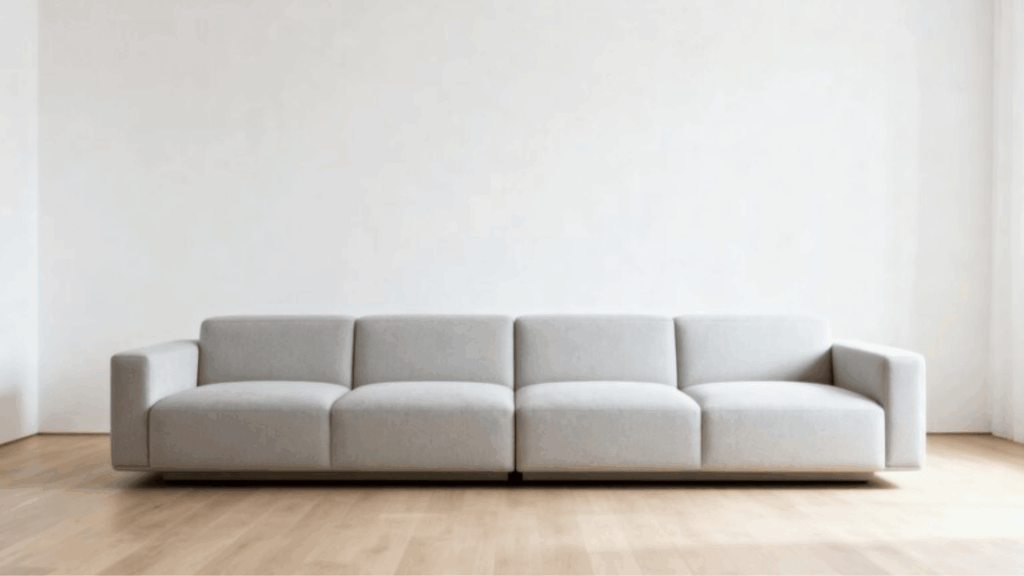
A four-seater sofa provides more seating and is ideal for larger families or living rooms. It takes up more wall space but offers extra comfort.
- Dimensions: Length: 90 to 12 inches, Depth: 34 to 42 inches.
- Why it works: Best for spacious rooms and creates a fuller, more filled-out layout.
3. Loveseat

A loveseat is a smaller version of a sofa, designed for two people. It’s perfect when space is limited, but you still want comfortable seating.
- Dimensions: Length: 92 to 65 inches, Depth: 30 to 40 inches.
- Why it works: Ideal for apartments and small rooms, and often used as extra seating alongside a larger sofa.
4. Sectional Sofa

Sectionals are larger and come in multiple pieces, usually in L-shape or U-shape designs. They focus more on total space coverage than on length alone.
- Dimensions: Length: 95 to 140+ inches, Depth: 35 to 45 inches.
- Why it works: Great for large or open spaces. Also offers flexible seating arrangements.
5. Sleeper Sofa

A sleeper sofa works as both a couch and a bed. Because of the built-in mattress, it tends to be bulkier than regular sofas.
- Dimensions: Length: 72 to 90 inches, Depth: 38 to 48 inches.
- Why it works: Needs extra space in front to open. Ideal for guest rooms or small homes.
What Size Couch Works Best for Your Room Size?
Getting the right couch isn’t just about what fits; it’s about what fits well. A sofa that’s too large kills traffic flow; one that’s too small looks lost in the space.
Matching couch size to room size is the single most important decision you’ll make when sofa shopping.
Small Living Rooms (Under 150 sq ft)
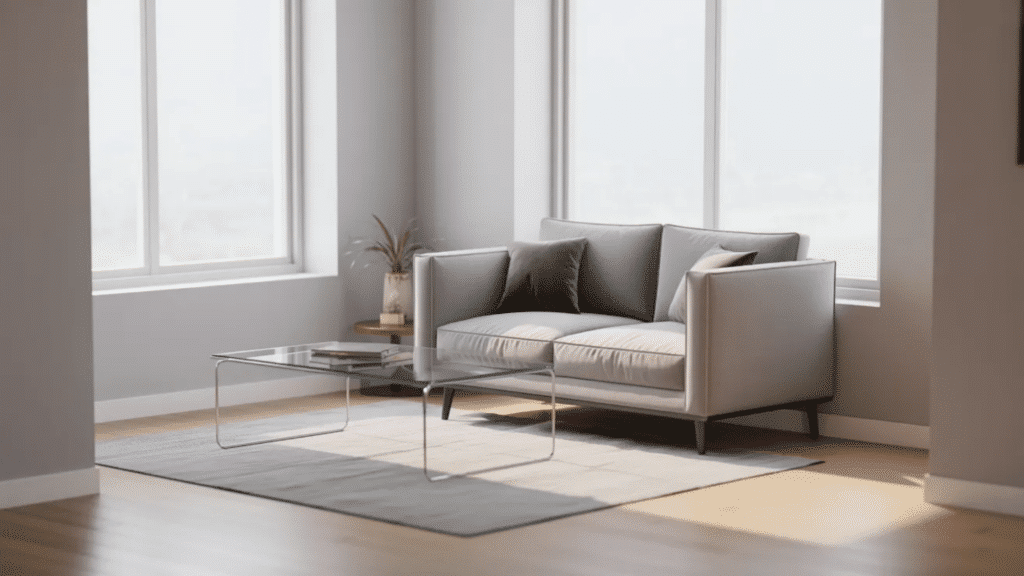
Small rooms demand smart choices. The wrong sofa can make a tight space feel completely suffocating.
- Stick to a loveseat between 52 and 65 inches, a 2-seater between 60 and 72 inches, or an apartment sofa capping at 75 inches.
- As a hard rule, never exceed 72 inches in a room under 150 sq ft.
Spacing matters as much as size. Keep 18 inches between the sofa and coffee table and maintain a 24 to 30 inch walkway on all open sides. Avoid sofas deeper than 35 inches; depth eats into a small room faster than length does.
For the best visual result, choose a sofa with exposed legs, slim arms, and light upholstery to keep the space feeling open and airy.
Medium to Large Living Rooms
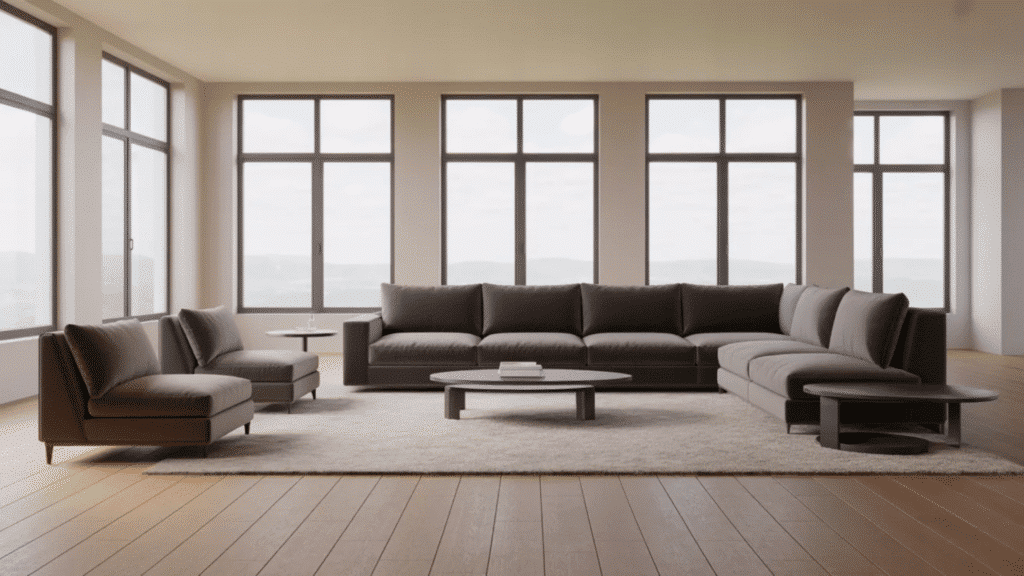
More square footage means more freedom, but getting the scale wrong is just as easy. An undersized sofa in a large room looks just as awkward as an oversized one in a small room.
- For rooms between 150 and 250 sq ft, a standard 3-seater between 72 and 90 inches is the sweet spot.
- Step up to 250 to 400 sq ft, and a 4-seater between 90 to 110 inches fills the space properly.
- For rooms over 400 sq ft, a sectional or L-shape configuration is almost always the right answer.
Beyond size, always leave 18 to 24 inches of clearance around the sofa and resist pushing it against the wall in open-plan spaces. Floating it to define the seating zone looks far more intentional.
Anchor the layout with a well-sized rug and pair the main sofa with accent chairs or a loveseat to complete the arrangement without the space feeling empty.
Sofa Sizing Slip-Ups Most Buyers Don’t See Coming
Even experienced shoppers get this wrong. Here are five sizing mistakes that are far more common than you’d think and easy to avoid once you know them.
- Not measuring the room leads to poor walkway and doorway clearance.
- Ignoring depth eats into floor space faster than length does.
- Going too small in a large room looks just as off as going too big.
- Forgetting delivery dimensions can turn delivery day into a nightmare.
- Skipping the tape test is the easiest and most common mistake of all.
Conclusion
The perfect couch isn’t the one that looks best in the showroom; it’s the one that works best in your home.
If you’ve been wondering how long is a couch, the answer matters more than you think, because size, style, and layout all need to work together for a space to feel complete.
Before you commit, always tape out the dimensions on your floor, double-check the spec sheet, and factor in delivery clearance.
These small steps take just a few minutes but can save you from costly mistakes. Get the sizing right, and your living room will not only look better but also work better.

With a Master’s in Architecture from the University of California, Berkeley, Mitchell Green has spent over two decades dedicated to the study and practical application of home fixture design. His career started in an architectural firm, providing him a strong foundation in the structural and aesthetic aspects of home interiors. Mitchell brought his comprehensive knowledge to our platform, where he has been an influential voice in our home fixtures and fittings section. Since 2018, he has been guiding our readers through the intricacies of selecting and installing fixtures, combining technical know-how with design flair. In his spare time, Mitchell is a keen photographer, capturing architectural details and design elements, an interest that complements his professional focus.