
Art Deco and Art Nouveau are often mentioned together, yet telling them apart can feel confusing at first glance.
Both styles shaped art, architecture, and interiors in powerful ways, and traces of each still appear in modern homes today.
The confusion usually starts when curved lines meet bold geometry or when nature-inspired details overlap with sleek finishes.
To clear this up early, Art Nouveau came first, emerging in the late 1800s, while Art Deco followed in the 1920s.
This guide breaks down their origins, visual language, materials, and interior use so the differences become easy to recognize.
It helps when spotting design details, decorating a space, or building a clearer understanding of both movements.
What is Art Nouveau, and Where Did It Begin?
(c. 1890–1910)
Art Nouveau emerged in the late 1800s, during a period when industrial production was rapidly expanding.
Many artists and designers felt disconnected from rigid historical styles and factory-made objects, so they turned toward craftsmanship and organic design.
This movement aimed to restore artistic value to everyday items by treating furniture, posters, jewelry, and architecture as unified works of art.
Curving lines, plant forms, flowers, insects, and flowing hair became defining motifs.
Designs often feel continuous and fluid, as if each element naturally grows into the next.
Art Nouveau sought harmony, softness, and visual rhythm rather than strict structure.
This kind of approach is clearly seen in the decorative posters of Alphonse Mucha, the architectural work of Hector Guimard, and the richly patterned paintings of Gustav Klimt, whose The Kiss reflects the ornamental and symbolic qualities of the style.
What is Art Deco and How It Emerged?
(c. 1920–1939)
Art Deco appeared later, gaining momentum in the 1920s and 1930s, at a time when cities were expanding and modern technology shaped daily life.
Unlike Art Nouveau, this style embraced industrial progress, machinery, and new materials.
It reflected optimism, confidence, and an adoration for speed, luxury, and urban living.
Art Deco favors symmetry, sharp lines, and strong geometric forms.
Designs feel bold and intentional, often built around repeated patterns and vertical emphasis.
Across architecture, interiors, furniture, and graphic design, Art Deco celebrates structure, clarity, and modernity.
The art deco can be seen in the sleek portraits of Tamara de Lempicka, the sculptural figures of Demétre Chiparus, and iconic architectural landmarks such as the Chrysler Building.
Main Differences Between Art Deco and Art Nouveau
Although these two styles are often confused, their core differences become clear once you focus on how they use shape, inspiration, and visual intent.
Each movement reflects a very different way of responding to modern life.
1. Line and Shape
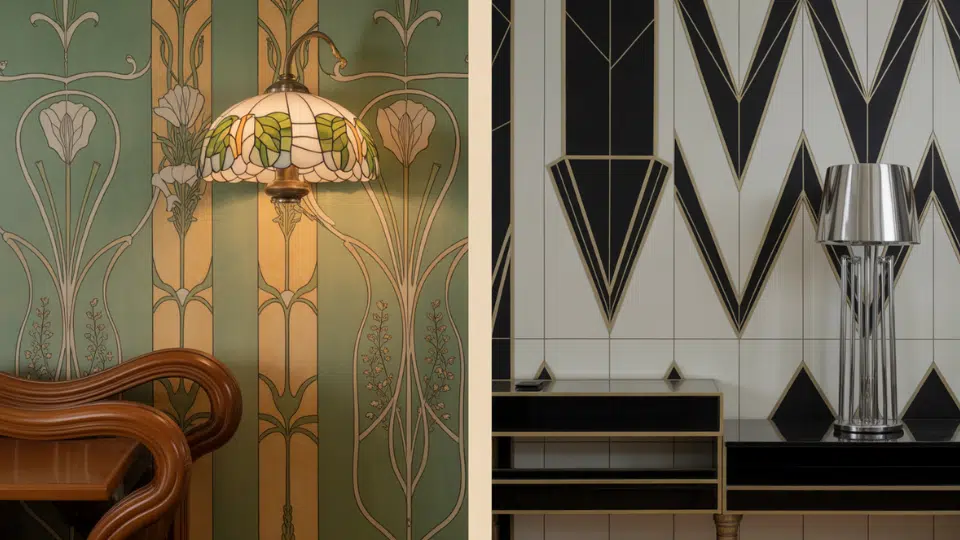
Art Nouveau is defined by soft, flowing lines that curve and loop in a natural rhythm.
These lines often resemble vines, waves, or strands of hair, creating a sense of movement across the surface.
Art Deco, on the other hand, favors straight lines, sharp angles, and stepped forms. Its shapes feel measured and deliberate, creating a strong sense of order and balance.
2. Themes and Inspiration
Art Nouveau looks to nature and mythology for influence.
Plants, flowers, insects, and idealized figures appear frequently, emphasizing harmony with the natural world.
Art Deco draws inspiration from progress and innovation.
Its imagery reflects speed, industry, travel, and luxury, capturing the optimism of a rapidly modernizing era.
3. Overall Visual Character
Art Nouveau feels ornamental and expressive, with designs that appear handcrafted and emotionally driven.
Art Deco presents a confident, polished appearance, where symmetry and structure create a bold and modern visual identity.
Colors and Materials Used in Art Deco vs Art Nouveau
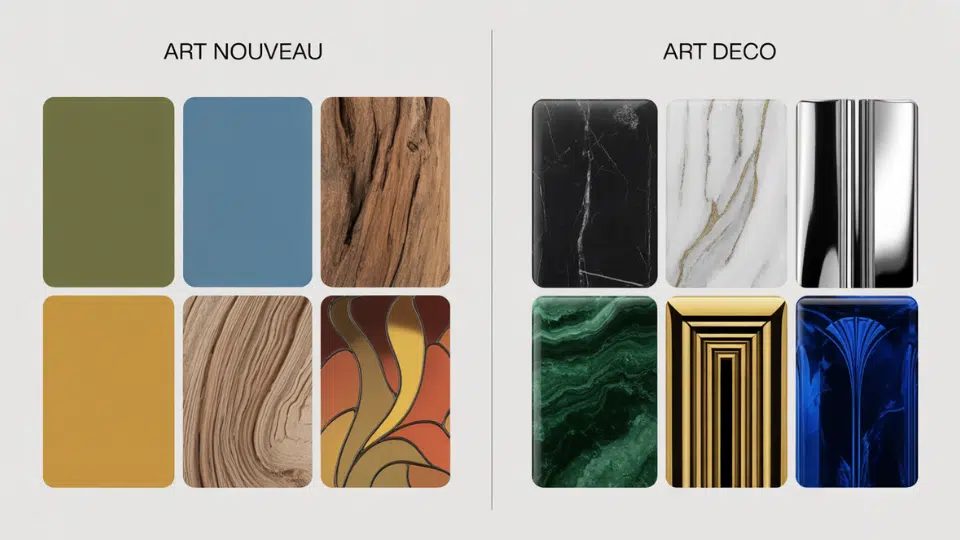
Art Nouveau typically uses muted, earthy tones such as olive green, soft blue, mustard yellow, and warm browns.
Materials often include wood, stained glass, ceramics, and delicate metals shaped into detailed forms.
Art Deco favors a stronger contrast. Deep blacks, whites, golds, silvers, and jewel tones are common.
Materials like chrome, lacquer, glass, marble, and polished metals help create a sleek surface.
| Style | Common Colors | Typical Materials |
|---|---|---|
| Art Nouveau | Olive green, soft blue, mustard, warm browns | Wood, stained glass, ceramics, soft metals |
| Art Deco | Black, white, gold, silver, jewel tones | Chrome, lacquer, glass, marble, metals |
Art Deco vs Art Nouveau in Homes and Interiors
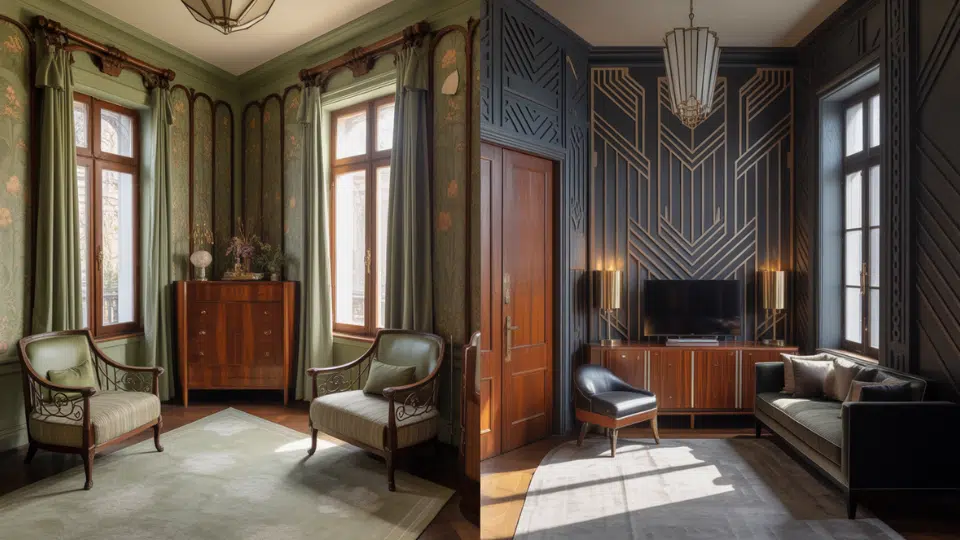
In interiors, Art Nouveau spaces often feel decorative and layered.
Furniture may feature curved legs, carved details, and flowing outlines. Lighting, mirrors, and railings often carry natural shapes that soften the room.
Art Deco interiors feel more structured. Furniture tends to have bold silhouettes and clean edges.
This style works especially well in spaces designed around symmetry and strong focal points.
Many modern homes draw inspiration from this look, as seen in art deco bathroom ideas that use geometric tiles and metallic accents, or art deco bedroom ideas that rely on balance and contrast.
Larger properties designed around this aesthetic are often described as an Art Deco house, where architecture and interior design follow the same visual logic.
How to Identify Art Deco and Art Nouveau Quickly?
The confusion between Art Deco vs Art Nouveau is widespread, but both styles have distinct visual clues that make identification easier once you know what to look for.
Focusing on line quality, themes, and materials helps separate these movements at a glance.
Art Nouveau
It is easiest to recognize through its flowing, organic lines.
Designs often feel fluid, with curves that move freely rather than stopping abruptly.
Natural themes dominate this style, including flowers, vines, insects, and softly stylized human figures.
Materials and finishes tend to look handcrafted, with an emphasis on texture and detailed surface work that feels connected to nature.
Art Deco
It stands out through structure and repetition.
Straight lines, sharp angles, and clear geometric patterns are key indicators.
Common motifs include sunbursts, zigzags, stepped forms, and bold symmetry.
Materials usually appear polished and refined, often featuring strong contrasts, smooth surfaces, and a sense of modern precision that reflects technological progress.
Common Mistakes When Comparing Art Deco and Art Nouveau
Assuming all floral or plant designs belong to Art Nouveau, even though Art Deco also uses nature-inspired forms in a more geometric way.
Judging a piece only by its age instead of its visual structure leads to mislabeling later reproductions or revivals.
Overlooking shape language, such as curves versus sharp angles, and focusing only on decorative details.
Misidentifying mixed-style pieces without considering which design elements dominate overall.
Ignoring materials and finishes, which often reveal whether a design leans more toward craftsmanship or modern polish.
Conclusion
Art Deco and Art Nouveau may sit close in history, but they represent very different ways of thinking about design.
One reflects a deep connection to nature and craftsmanship, while the other expresses confidence in progress, structure, and modern life.
Understanding their differences makes it easier to recognize authentic details, appreciate design choices, and apply the right style in interiors or collections.
Whether noticing curved ornamentation or bold geometry, each movement leaves a distinct visual signature.
Knowing what sets them apart allows better design decisions and a stronger appreciation for how these styles continue to influence art and architecture today.

Holding a Master’s in Library and Information Science from the University of Illinois, Josh Clarke has dedicated more than 15 years to managing and disseminating information across various platforms. His professional journey includes significant experience as a research librarian, where he developed an expertise in sourcing and providing accurate and comprehensive answers to diverse questions. In 2018, Josh brought his rich experience to our platform, quickly establishing himself as a reliable source for general FAQs. He has been overseeing our information curation since then, combining his research skills with a flair for engaging content delivery. When not involved in information management, Josh enjoys exploring digital photography and participating in local quiz competitions, hobbies that complement his inquisitive nature and love for learning.