
You’ve just moved into a new home, the garage floor is stained, the basement looks tired, and someone mentions epoxy flooring.
Suddenly, you’re three hours into reviews, Reddit threads, and contractor quotes, wondering if it’s actually worth it and how long it’ll last before you have to do it all over again. Sound familiar?
The short answer is that epoxy flooring lasts a lot longer than most people expect, but how long exactly depends on a few things worth knowing before you spend a dollar on it.
What is Epoxy Flooring?
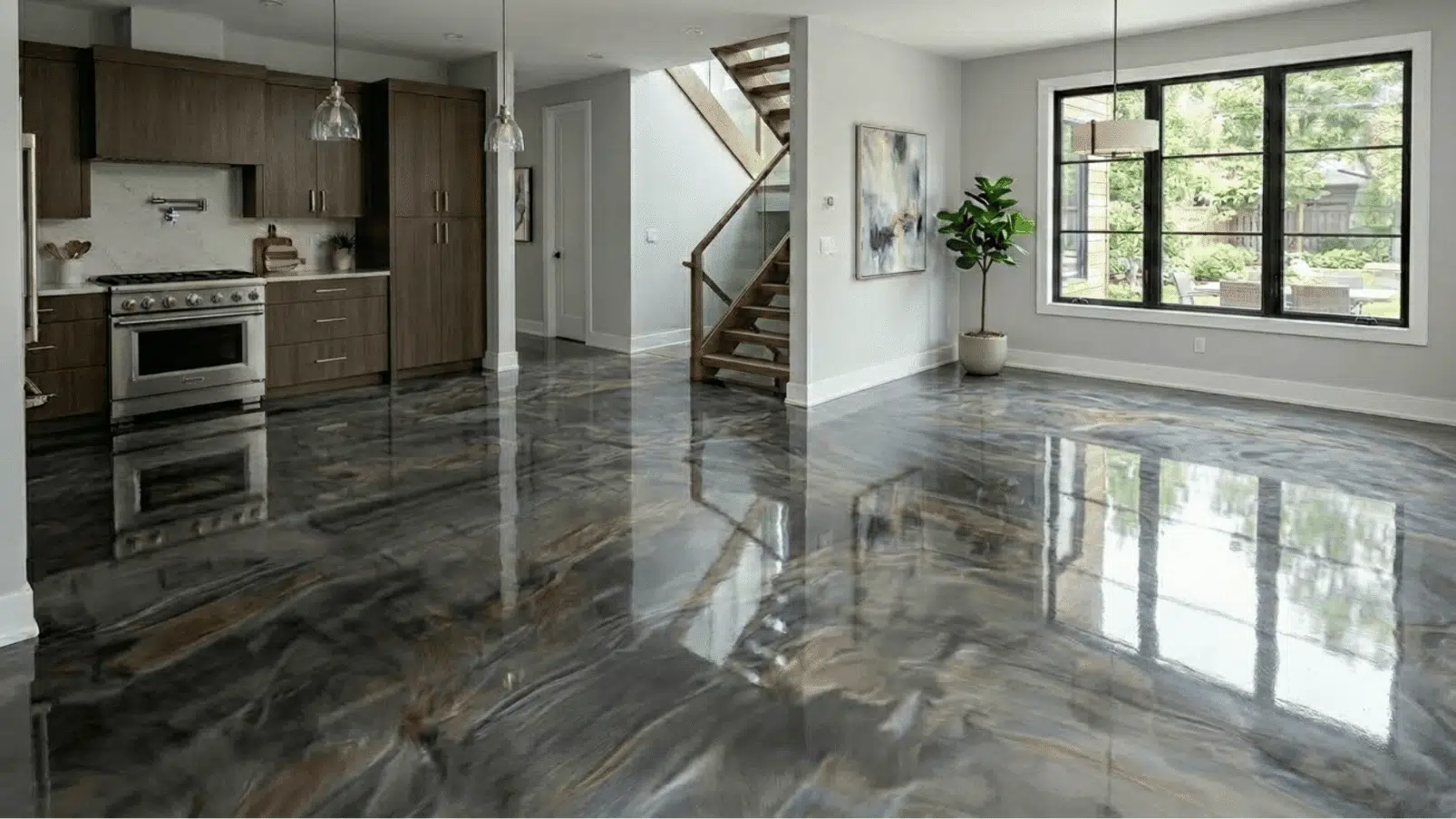
Epoxy flooring is essentially a hard, resin-based coating that gets applied directly over concrete, creating a surface that is smooth, seamless, and significantly tougher than the bare floor underneath.
It has become a go-to choice for garages, basements, commercial kitchens, and warehouses because it handles heavy use well, cleans up easily, and looks far more polished than plain concrete ever could.
From what makes one epoxy floor outlast another, to what a realistic lifespan looks like for your specific space, to how to keep it looking great for as long as possible, here is everything you need to know.
Factors That Affect Epoxy Floor Lifespan

Not all epoxy floors are built equal, and how long yours lasts comes down to a handful of factors that are worth understanding before you commit to anything.
- Quality of Epoxy: High-quality, commercial-grade epoxy is formulated with stronger resins and better bonding agents, making it far more resistant to wear, chemicals, and moisture than budget alternatives. Spending a little more upfront almost always pays off in years of extra lifespan.
- Surface Preparation: Epoxy is only as good as what it sticks to. If the concrete hasn’t been properly cleaned, etched, and primed before application, the epoxy won’t bond correctly, and peeling becomes inevitable. This is where most flooring failures begin.
- Installation Process: Common DIY mistakes like skipping the primer coat, applying in high humidity, or not allowing enough curing time can quietly cut years off your floor’s life. Professional installation reduces that risk significantly.
- Maintenance and Care: Sweeping regularly, cleaning spills promptly, and resealing every few years help keep the coating intact. Using the wrong cleaning products, anything highly acidic or abrasive, breaks down the surface over time, even when the floor looks fine.
- Environmental Factors: UV exposure causes yellowing, heavy chemical contact erodes the surface, and extreme temperature fluctuations in uninsulated spaces can lead to cracking. The harder the environment, the shorter the lifespan without proper protection.
When the above factors are ignored, they show up in predictable ways.
Peeling and cracking are almost always the result of poor surface preparation rather than the epoxy itself failing; catch it early, and a targeted repair can fix it without replacing the entire floor.
Standard epoxy formulations without UV stabilizers yellow or fade in sun-exposed spaces over time.
Surface scratches from heavy traffic, dropped tools, or dragged furniture are mostly cosmetic rather than structural, but they accumulate faster when protective measures are skipped from the start.
How Long Does Epoxy Floor Last?
The honest answer is that it depends, but not in a frustrating, non-committal way.
Epoxy floors have a well-documented track record, and with the right information about your specific space and usage, you can get a pretty clear idea of what to realistically expect.
Space Type | Traffic Level | Epoxy Quality | Expected Lifespan |
Home garage | Low to moderate | Budget | 3 to 5 years |
Home garage | Low to moderate | High quality | 7 to 10 years |
Basement or living area | Low | Budget | 5 to 7 years |
Basement or living area | Low | High quality | 10 years or more |
Retail or small commercial | Moderate | High quality | 8 to 12 years |
Warehouse or industrial | Heavy | Commercial grade | 10 to 15 years |
Food and chemical facilities | Heavy with exposure | Commercial grade | 5 to 10 years |
Real Experiences: What Homeowners and Business Owners Say
Sometimes, the most useful information comes from people who have actually lived with an epoxy floor and can tell you what worked and what they wish they had done differently.
“I had my garage floor done over eight years ago and it still looks almost new. The installer spent an entire day on prep alone, and I think that made all the difference.” — Mark, homeowner, Ohio
Not every experience is that straightforward. For some, the problems showed up early and traced back to the same root cause.
“We started seeing peeling at the edges within two years. Turns out the installer skipped the concrete etching step entirely. We had no idea until a different contractor pointed it out.” — Sarah, small business owner
Flooring professionals see this pattern consistently, and the advice they give is always the same.
“The number one mistake is rushing the prep work. Proper surface preparation on a standard garage can take six to eight hours alone. Cut that short and the clock starts ticking on your floor from day one.” — James, flooring contractor with 15 years of experience
The floors that last are almost always the ones where no corners were cut at the start.
How to Maximize the Lifespan of Your Epoxy Floor

A little consistent effort goes a long way with epoxy flooring, and the good news is that keeping it in great shape doesn’t require much.
- Sweep or dust mop weekly to clear out grit and debris, as small particles act like sandpaper underfoot and wear down the surface faster than most people expect.
- Use a pH-neutral cleaner diluted in warm water when mopping and avoid anything acidic, abrasive, or bleach-based, as these break down the epoxy coating over time.
- Reseal your floor every two to three years, depending on traffic levels, as a fresh topcoat restores the protective layer and adds years to the overall lifespan.
- Place rubber-backed floor mats at entry points and high-traffic zones to catch the dirt, moisture, and grit that cause the most surface wear.
- Use furniture pads under chair legs, shelving units, and workbenches to prevent scratches from daily movement.
- Apply a UV-resistant topcoat in sun-exposed spaces like garages or sunrooms, as standard epoxy yellows faster under prolonged UV exposure without it.
- Clean up chemical spills immediately rather than letting them sit, as even mild chemicals can dull and erode the surface with repeated contact.
When to Resurface or Replace Your Epoxy Floor
If an epoxy floor looks dull, scratched, or harder to clean than before, a full replacement may not be necessary.
A quick inspection of the surface condition can help determine if resurfacing will fix the issue or if replacement is the better option.
| Floor Condition | Recommended Solution |
|---|---|
| Surface dullness, light scratches, or uneven sheen | Resurfacing candidate |
| Small isolated peeling or lifting at edges | Resurfacing candidate |
| Widespread peeling across large sections | Replacement likely needed |
| Deep cracks running through the epoxy into the concrete | Replacement needed |
| Persistent moisture rising through the concrete | Replacement needed with moisture barrier |
Resurfacing usually works when damage is cosmetic or limited to certain areas, requiring light grinding, small repairs, and a new epoxy coat.
If the concrete base is damaged or moisture issues exist, full replacement is typically the safer and longer-lasting solution.
Conclusion
Epoxy flooring holds up remarkably well when the right product is chosen, the prep work is done properly, and a little routine maintenance is kept up over time.
If you are coating a home garage or a commercial warehouse, the lifespan you get out of it is largely in your hands.
On the investment side, professional installation runs between $3 and $12 per square foot. For a standard two-car garage, that works out to roughly $120 to $480 per year across a 7 to 10 year lifespan, and commercial floors scale similarly.
Where the value breaks down is when quality is compromised, a budget installation that fails in three years is never the bargain it seemed.
Weigh your space, your budget, and your usage honestly, and epoxy will almost certainly deliver the durability you are looking for.

Tommy Hardy, an alumnus of the Georgia Institute of Technology with a degree in Mechanical Engineering, has been a go-to figure in residential upkeep and innovation for over 18 years. His career commenced in a leading home appliance manufacturing company, where he mastered the intricacies of household systems. Joining our platform in 2020, Tommy quickly became a reader favorite for his practical and easy-to-follow guides. He took the helm of our DIY section in 2019, consistently delivering content that empowers homeowners. Beyond his professional pursuits, Tommy is a passionate gardener and enjoys woodworking, skills enhancing his hands-on approach to home care.