
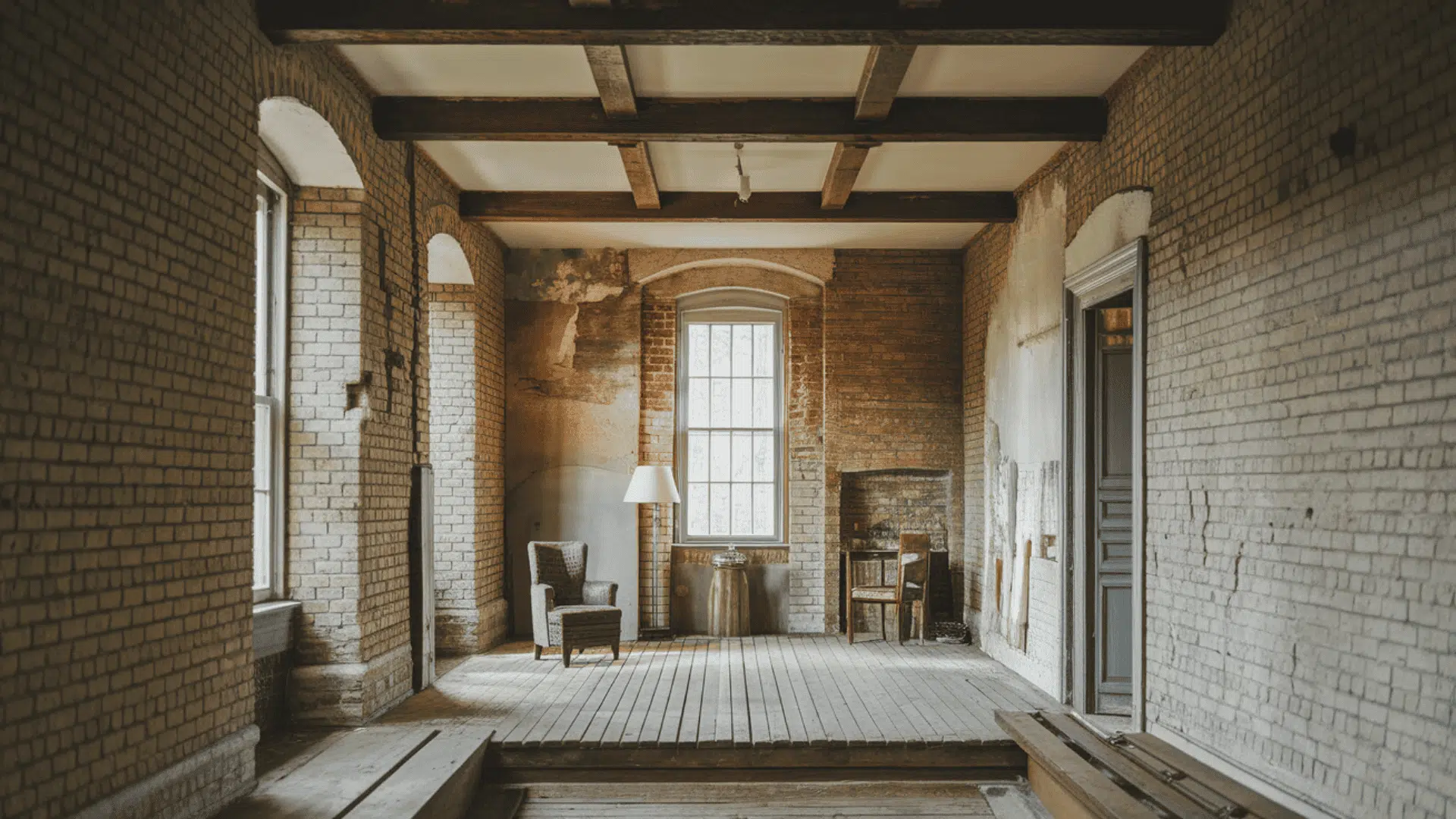

Pull back the wallpaper in almost any American home built before 1950, and there’s a good chance you’ll find lath and plaster walls staring right back at you.
Yet most homeowners have no idea what they’re actually looking at or what to do with it. Are they worth keeping? Are they a problem? And how were they even built in the first place?
This post covers everything you need to know about lath and plaster walls, from their history and construction to whether you should keep them or not.
What are Lath and Plaster Walls?
Lath and plaster walls are a two-part wall system consisting of a wooden framework covered with layers of wet plaster.
The lath refers to narrow strips of wood nailed across the wall studs to form a base. The plaster is the thick coating applied over those strips to create a smooth, solid wall surface.
Think of it this way, the lath is the skeleton, and the plaster is the skin.
Together, they form a wall that is dense, hard, and remarkably durable. It is an older system, but one that held up American homes for over two centuries.
How to Identify Lath and Plaster Walls
Not sure what type of walls you have? There are a few quick ways to tell. Most of these checks take less than a minute and require no special tools.
- Age of the home: If your house was built before 1940, there is a strong chance it has lath and plaster walls. The older the home, the more likely it is that the original walls are still intact behind paint or wallpaper.
- The knock test: Knock on the wall. Lath and plaster produce a dense, solid sound. Drywall sounds noticeably hollow. It is one of the quickest and most reliable ways to tell the difference.
- Outlet and switch plates: Remove the cover plate and check the wall thickness. Lath and plaster walls run significantly thicker than drywall, often close to an inch deep at the opening.
- Door and window edges: Thicker framing around door frames and window edges is a reliable sign of lath and plaster construction. If the returns look unusually deep, that is a strong indicator.
A Brief History of Lath and Plaster Walls
Lath and plaster construction dates back to colonial America in the 1700s.
Back then, builders had no alternatives; drywall did not exist, and sheet materials were not available. So craftsmen nailed thin strips of wood to wall frames by hand and applied wet plaster coat by coat.
It was labor-intensive work, but it produced walls that were hard, dense, and long-lasting. For over 200 years, it was simply how American homes were built.
Lath and plaster remained the standard wall system in American homes right through the 1940s.
But after World War II, everything changed. The post-war housing boom created massive demand for new homes fast. Builders needed a quicker, cheaper way to finish walls, and drywall delivered exactly that.
By the mid-20th century, drywall had largely replaced lath and plaster in new construction across the country.
How Lath and Plaster Walls are Built

Building a lath and plaster wall was a multi-step process that required skill, patience, and the right materials. Unlike modern drywall, which goes up in large sheets, lath and plaster were built up layer by layer entirely by hand.
1. Installing the Lath Framework
Narrow wood strips, typically 1.5 inches wide, were nailed horizontally across the wall studs from floor to ceiling. They were stacked one above the other with small gaps of roughly 1/4 inch left between them.
When wet plaster was pressed in, it squeezed through those gaps and formed small anchors called keys, and once dry, those keys locked everything firmly in place.
Without these keys, the plaster would have nothing to hold onto and would simply fall away from the wall.
2. Mixing the Plaster
Traditional plaster was made from lime, sand, and water. Horsehair was added as a binding agent to prevent cracking as it dried, a simple but effective technique that held up for centuries.
Later versions used gypsum plaster as a faster-setting alternative, while cement-based plasters were used mainly for exterior applications. Each material had its own drying time, strength, and finish quality.
3. Applying the Three-Coat System
The plaster was applied in three coats, not one. Each coat had a specific purpose and needed time to dry before the next one went on.
The scratch coat was the first layer pushed into the lath gaps to form the keys, then scratched to help the next coat grip.
The brown coat was a thicker second layer that built up the wall and leveled out any uneven spots. Finally, the finish coat a thin, smooth layer created the paintable wall surface that gave lath and plaster walls their characteristic hard, solid feel.
Types of Lath Used in Plaster Walls

Not all lath and plaster walls were built the same way. The type of lath used often depended on when the home was built and where the wall was located.
Over the years, three main types of lath were used, each with its own material, purpose, and time period.
| Type | Material | Description | Best Used For |
|---|---|---|---|
| Wood Lath | Pine or other softwoods | Thin, flat strips, typically 1.5 inches wide and 1/4 inch thick, nailed horizontally to studs. | Common in homes built before 1940; used for plasterwork |
| Metal Lath | Steel | Sheets slit and stretched into a mesh-like pattern; more durable and moisture-resistant. | Curved surfaces, high-moisture areas like bathrooms and kitchens |
| Gypsum Board Lath | Gypsum (rock or button board) | Small 16 x 48-inch sheets with holes for plaster keys, bridging the gap between traditional lath and modern drywall. | Transitional material used from the 1900s-1960s in plastering |
Should You Keep or Replace Lath and Plaster Walls?
This is the question most homeowners land on after learning what they have. And the honest answer is it depends on the condition of the walls, the age of the home, and what you are planning to do with it.
When to Keep Them
- The plaster is still structurally sound with no major key failure or water damage. If the walls are solid, there is no urgent reason to replace them
- You own a historic or period home where the original materials add character and value. Replacing lath and plaster in older homes can actually reduce their appeal and resale value
- Your budget does not support a full wall replacement right now. Well-maintained lath and plaster can last for decades more with minor repairs
When to Replace Them
- There is widespread key failure, water damage, or large structural cracks throughout the walls at that point. Patching becomes impractical, and replacement makes more sense
- You are planning a major renovation that requires updated electrical wiring, plumbing, or insulation. Opening up lath and plaster walls for these upgrades is the right time to replace them entirely
- The cost of repairs has grown to the point where full replacement makes more financial sense. Get quotes for both options before making a final call
Conclusion
Lath and plaster walls have been around for centuries, and if your home has them, they are worth understanding before you make any decisions.
They are denser than drywall, better at blocking sound, and more fire-resistant. But they also crack over time, cost more to repair, and can make renovations tricky.
The good news? They do not have to be a problem. With the right knowledge, you can maintain them, repair them, or replace them with confidence.

Holding a Master’s in Construction Management from Purdue University, William Ray has dedicated more than two decades to studying and applying construction principles. His professional journey includes a tenure with a prominent construction firm, where he specialized in project management and building technologies. William brought his knowledge to our team, providing in-depth insights into practical construction techniques. As the leader of our beginner’s guide to building since 2019, he has a knack for breaking down intricate processes into easily digestible content. When not involved in writing or onsite consultations, William enjoys woodworking and volunteering in community building projects, which aligns with his passion for hands-on construction and community service.