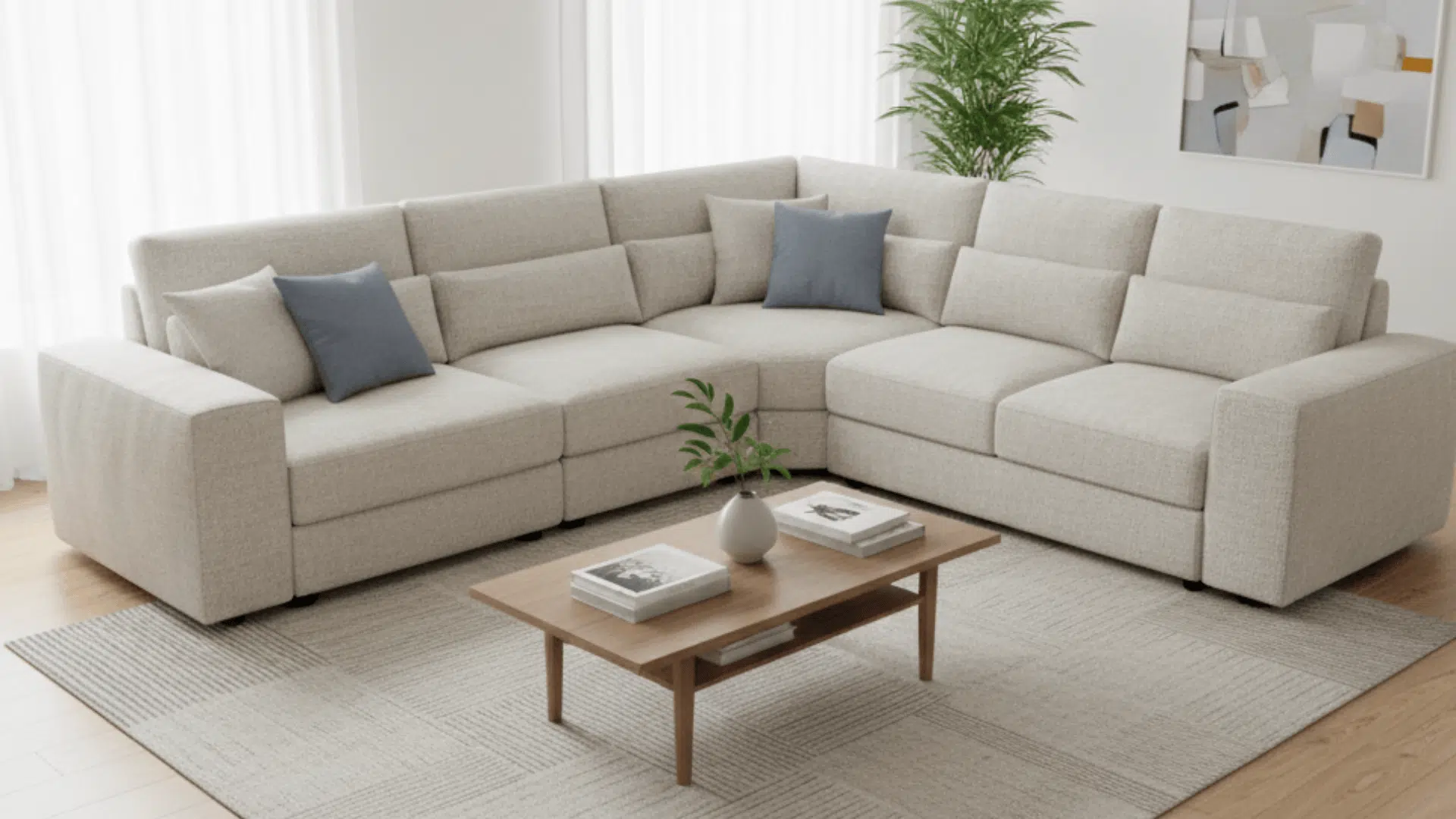

Sectional sofas have become a go-to choice for modern homes because they offer flexible seating that adapts to different room layouts and needs.
What makes a sectional different from other sofas isn’t just its size. It’s the way the pieces connect and arrange to fit your space.
This guide covers what defines a sectional sofa, how the pieces work together, how sectionals compare to traditional sofas, and when choosing one makes the most sense for your home.
What Is a Sectional Sofa?
A sectional sofa is a multi-piece seating system designed to be arranged in different configurations.
The individual pieces connect to form various shapes like L-shaped, U-shaped, or custom layouts that fit your room.
These sofas appear commonly in living rooms where flexible seating matters.
Unlike a traditional sofa that comes as one fixed piece, a sectional lets you adjust the arrangement based on your space and how you use it.
The key feature is modularity. Each section serves a purpose, and together they create a larger seating area that can adapt when your needs change.
Core Components of a Sectional Sofa
Understanding the pieces helps you see how sectionals work and why they offer so much flexibility.
1. Corner Units

Corner pieces create the angle in L-shaped or U-shaped configurations. They typically have no arms and connect two straight sections at a 90-degree angle.
The corner unit forms the pivot point where the sectional changes direction, making it essential for creating the characteristic L or U shape that defines most sectional layouts.
2. Armless Chairs

These are middle sections without arms on either side. They connect with other pieces to extend the length of the sectional and add more seats.
Armless chairs create continuity in the seating line and let you customize the overall length. You can add or remove these pieces to adjust how many people the sectional accommodates.
3. Chaises

A chaise is an extended seat where you can stretch your legs out fully. Chaises usually appear on one end of the sectional and provide a dedicated lounging spot.
The extended length makes them comfortable for napping, reading, or watching TV. Most chaises face either left or right, depending on your room layout and personal preference.
4. Ottomans

Ottomans work as footrests or extra seating when needed. Some sectionals include ottomans that match the sofa, and they can move around freely as your needs change.
Unlike fixed pieces, ottomans add flexibility because you can reposition them, use them as a coffee table surface, or tuck them away when not in use.
5. End Units with Arms

These pieces have one arm and form the ends of the sectional. The arm provides a finished edge and a place to lean while sitting.
End units give the sectional visual closure and structural support. They define where the seating area stops and create a polished appearance that makes the furniture look intentional and complete.
Sectional Sofa vs Traditional Sofa

Sectionals and traditional sofas serve the same basic purpose but differ in how they fit into a room and how much flexibility they offer.
| Feature | Sectional Sofa | Traditional Sofa |
|---|---|---|
| Configuration | Multiple pieces, adjustable layouts | Single fixed piece |
| Seating Capacity | Typically seats 5-8+ people | Usually seats 3-4 people |
| Flexibility | Can rearrange pieces | Cannot change shape |
| Best Room Type | Large rooms, open-plan spaces | Smaller or formal spaces |
| Paired Furniture | Often stands alone | Usually paired with chairs |
| Footprint | Larger, fills more floor space | Compact, easier to place |
The main difference is flexibility. Sectionals let you adjust the layout, while traditional sofas stay in one shape.
If you need more seating with a conventional sofa, you can add chairs or loveseats, which means more separate pieces to arrange.
Advantages of a Sectional Sofa
Sectionals offer several benefits that make them practical for many homes.
These advantages explain why they’ve become a popular choice for families and anyone who values flexible, comfortable seating.
1. Maximizes Seating Capacity
A sectional seats more people in the same floor space compared to separate sofas and chairs. This makes it useful for families or anyone who hosts guests regularly.
Instead of arranging multiple pieces to accommodate everyone, one sectional provides all the seating you need in a coordinated layout that looks intentional and cohesive.
2. Provides Flexible Layouts
You can rearrange the pieces to fit different room shapes or change the setup when you move. This flexibility means the sofa adapts to your needs instead of the other way around.
Modular and reversible designs let you reconfigure the sectional as your living situation changes, making it a long-term investment that grows with you.
3. Defines Zones in Open Spaces
In open-concept homes, a sectional helps separate the living area from the dining or kitchen space. The sofa creates a visual boundary without needing walls or dividers.
This zoning effect makes large open areas feel more organized and purposeful while maintaining the airy, connected feel that open floor plans provide.
4. Offers Lounging Options
With chaises and extra-deep seats, sectionals give you more ways to relax. You can stretch out, curl up in a corner, or sit traditionally depending on your mood.
The variety of seating positions makes sectionals more comfortable for extended use, whether you’re watching movies, reading, or taking a nap on a lazy afternoon.
5. Replaces Multiple Furniture Pieces
Instead of buying a sofa, loveseat, and chair separately, a sectional provides all that seating in one coordinated piece. This simplifies furniture shopping and creates a cohesive look.
You avoid the challenge of matching different furniture pieces, and your living room feels more unified with a single statement piece anchoring the space.
Other Types of Sofas and When They Are a Good Choice
Different sofa types suit various situations. Knowing the options helps you choose what works best.
- Modular Sofa: Individual units that rearrange freely without a fixed configuration. Great for people who move frequently or like changing their room layout often.
- Loveseat: A smaller two-seat sofa that fits tight spaces. Best for apartments, bedrooms, or pairing with other furniture in a living room.
- Traditional Sofa: A fixed three-seat design with a standard shape. Works well in classic layouts, formal rooms, or when you want a straightforward seating option.
- Sleeper Sofa: A sofa with a built-in bed that pulls out. Useful for guest spaces, studios, or any room that needs to serve multiple purposes.
Common Sectional Sofa Configurations
Sectionals come in standard arrangements that fit most room types. Each configuration offers a different seating capacity and works better in specific spaces.
| Configuration | Shape | Best For | Seating Capacity |
|---|---|---|---|
| L-Shaped | One long side, one short side meeting at the corner | Most living rooms fit against walls or float in the center | 4-6 people |
| U-Shaped | Three sides forming a U | Large rooms, great rooms, maximum seating needs | 6-10 people |
| Chaise | Standard sofa with extended lounging section on one end | Medium rooms, a balance of seating and lounging | 4-5 people |
| Reversible | Chaise can move from the left to the right side | Flexible room arrangements, future moves | 4-5 people |
| Modular | Individual pieces arranged in custom layouts | Unique room shapes, changing needs | Variable |
When to Choose a Sectional Sofa
Sectionals work well in specific situations but aren’t the right choice for every home.
Choose a sectional when your room can accommodate a larger footprint. Sectionals take up more floor space than traditional sofas, so you need enough room for the couch plus walkways.
Choose a sectional when you need flexible seating for guests or family. If you regularly have people over or have a large household, the extra seats make gatherings more comfortable.
Choose a sectional when defining a space in an open floor plan. The sofa helps separate the living area visually and creates a clear zone for sitting and relaxing.
Choose a sectional when comfort and lounging are priorities. If you spend a lot of time on your sofa watching TV, reading, or napping, the extra room and chaise options provide more comfort.
Choose a sectional when you prefer a single seating solution over multiple pieces. One cohesive sectional often looks cleaner and more intentional than several separate sofas and chairs.
Key Considerations Before Buying
Before purchasing a sectional, measure your room dimensions and walkways carefully to ensure the sofa fits with at least 30 inches of space for walking around it.
Check that it fits through doorways during delivery. Decide whether you need a left-facing or right-facing chaise by standing in your room facing where the sofa will go.
Consider traffic flow to make sure the sectional doesn’t block pathways to other rooms. Evaluate fabric and maintenance needs based on your lifestyle.
Homes with kids or pets benefit from durable, easy-to-clean materials like microfiber or performance fabrics, while lighter fabrics show stains more easily and require more care.
Final Thoughts
A sectional sofa is a multi-piece seating system that offers flexibility, high seating capacity, and the ability to adapt to different room layouts.
Unlike traditional sofas that come in one fixed shape, sectionals let you arrange the pieces to fit your space and needs.
The main advantages are maximizing seating without adding multiple furniture pieces, defining zones in open spaces, and providing comfortable lounging options.
Different configurations like L-shaped, U-shaped, and chaise sectionals work for other room types and preferences.
Sectionals work best in larger rooms where you need flexible seating for family or guests.
For the right home and lifestyle, a sectional offers practical, comfortable seating that grows with your needs.

Holding a Master’s in Library and Information Science from the University of Illinois, Josh Clarke has dedicated more than 15 years to managing and disseminating information across various platforms. His professional journey includes significant experience as a research librarian, where he developed an expertise in sourcing and providing accurate and comprehensive answers to diverse questions. In 2018, Josh brought his rich experience to our platform, quickly establishing himself as a reliable source for general FAQs. He has been overseeing our information curation since then, combining his research skills with a flair for engaging content delivery. When not involved in information management, Josh enjoys exploring digital photography and participating in local quiz competitions, hobbies that complement his inquisitive nature and love for learning.