
Start with What Gets Delivered
A well-designed hotel isn’t judged at the concept stage. It’s judged when doors open, guests check in, and operations begin at full speed. That’s why the most effective approach to luxury hotel interior design starts with outcomes.
Owners want clarity around three things: Will the design meet brand standards without endless revisions? Will procurement stay aligned with the budget and schedule? Will the finished space hold up under daily use?
Guest comfort, operational efficiency, and consistency across the brand experience are among the factors to consider when designing luxury hotel interiors. Visual appeal matters—but only if it’s backed by performance.
At AK Design Group, design decisions are grounded in execution. Every material, layout, and specification is evaluated against lead times, installation feasibility, and long-term durability. That’s how design becomes a business tool.
Working Within Brand Frameworks Without Losing Identity
Global flags like Hilton and Marriott don’t leave much to chance. Their design guidelines are detailed, and for good reason—they protect brand consistency across markets. But strict standards don’t mean every property should feel interchangeable.
The opportunity is in interpretation. Strong luxury hotel interior concepts respect the framework while incorporating location-specific elements. This means including locally sourced finishes that align with brand palettes, integrating regional artwork that complements approved themes and adjusting spatial flow to reflect how guests actually use the space in that market.
These aren’t decorative choices. They’re strategic. A hotel that feels connected to its surroundings tends to perform better—guests remember it, review it, and return to it.
Why the Model Room Still Matters
It’s easy to underestimate the model room. On paper, everything works. In reality, small issues compound quickly.
The model room is where assumptions get tested. Door clearances, lighting levels, furniture placement, material transitions—these details do not fully reveal until the end. And once you scale across dozens or hundreds of rooms, even minor issues become expensive.
Handled correctly, the model room becomes a control point. It allows teams to:
- Validate FF&E selections in a real environment
- Catch installation challenges before full rollout
- Confirm compliance with brand expectations
- Align stakeholders before production accelerates.
Procurement Is Where Projects Are Won or Lost
Design gets attention. Procurement determines whether that design actually shows up on-site, on time and within budget.
In luxury hospitality, the margin for error is thin. A delayed shipment or pricing shift doesn’t just affect one item. It impacts sequencing, installation, and ultimately opening timelines. That’s why integrating FF&E procurement into the design process makes a difference.
Instead of specifying in isolation, a hotel interior design company must evaluate availability, vendor reliability, and lead times alongside aesthetics. This allows for:
- Early pricing validation to protect budgets
- Proactive ordering strategies to avoid bottlenecks
- Stronger vendor coordination throughout the project lifecycle
Consulting firms have repeatedly pointed to supply chain volatility as a key risk in hospitality development. The response isn’t reactive problem-solving—it’s building procurement awareness into the design phase from the start.
Durability Is Part of the Guest Experience
Guests may not think about durability, but they notice its absence immediately.
Worn upholstery, chipped finishes, inconsistent lighting—these details affect perception. In a competitive market, they influence reviews and brand scores just as much as service quality.
Effective luxury hotel interior design accounts for this from day one. That means specifying materials that perform under pressure without compromising the look and feel of the space.
Typical considerations include upholstery that resists staining and frequent cleaning, surfaces that maintain their finish despite heavy use and lighting systems designed for long operational cycles and flooring that balances acoustics, maintenance, and visual consistency.
Layouts That Reflect How Guests Actually Use Spaces
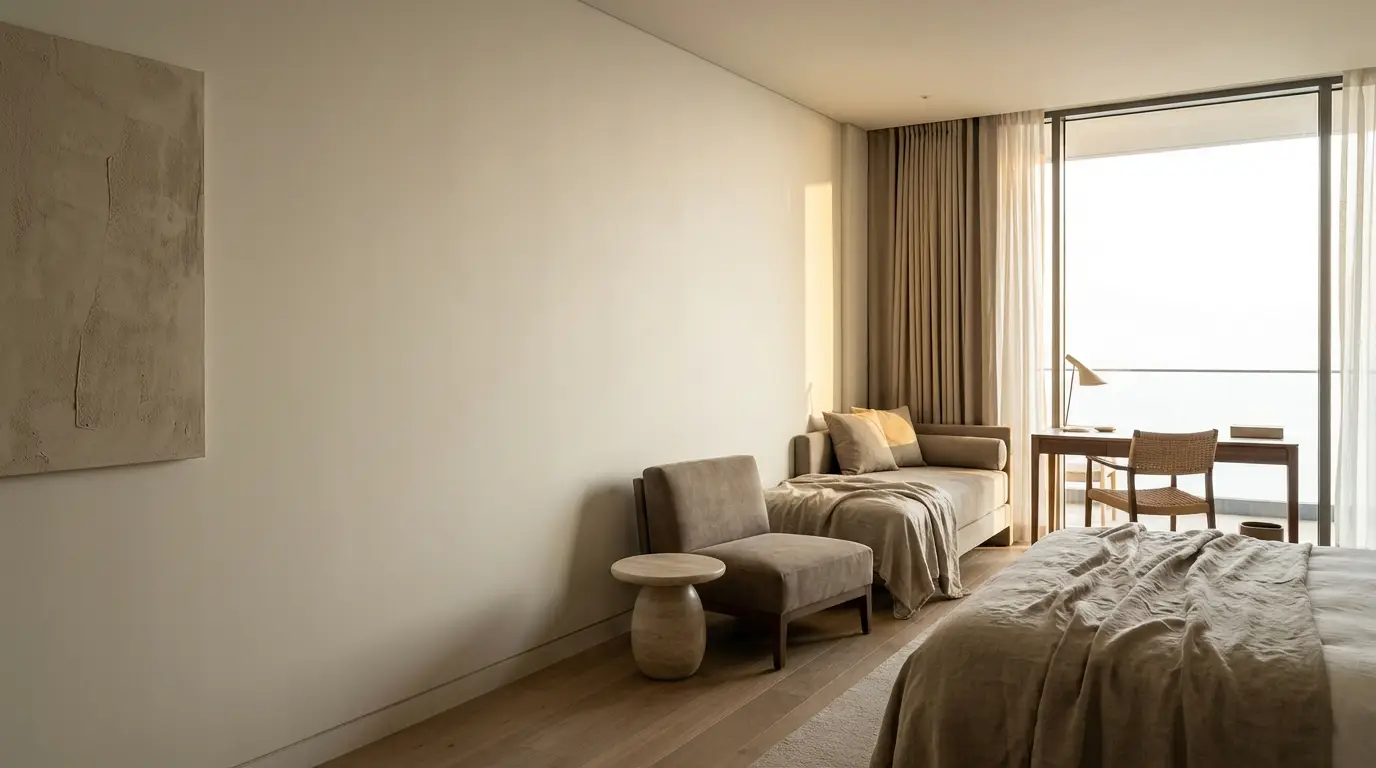
Guest expectations have shifted. Rooms are no longer single-purpose environments. They function as workspaces, relaxation zones, and sometimes even dining areas—all within the same footprint.
That shift has real implications for layout.
High-performing guest rooms tend to include flexible seating that adapts to different uses, integrated work surfaces without feeling corporate, layered lighting for task, ambient, and mood settings and storage that keeps the space uncluttered.
Public areas have evolved just as much. Lobbies now carry more weight—they’re meeting spaces, informal work zones, and social hubs. When designed well, they contribute directly to revenue through increased dwell time and ancillary spending.
Technology That Supports, Not Distracts
Modern guests expect technology to be present—but not intrusive.
Charging ports, smart controls, connectivity—these features are now baseline. The challenge is integrating them without disrupting the overall design.
Well-executed technology integration tends to have power access where guests naturally need it, controls that are intuitive and easy to locate and systems that don’t compete visually with the interior.
This requires coordination early in the process. Infrastructure decisions made during design reduce the need for adjustments later, which can be costly and disruptive.
Process Is What Protects the Project
Behind every successful hotel interior is a process that keeps everything aligned—design, procurement, construction, and ownership expectations.
That includes:
- Clear submittals and approval workflows
- Ongoing coordination with vendors and contractors
- Transparent communication around timelines and budgets
- Quick resolution of issues as they arise
Without that structure, even strong designs can lose momentum.
Designing for Long-Term Performance
It’s easy to focus on opening day. The real measure of success comes later.
Does the space still meet brand standards after a year?
Are maintenance costs manageable?
Are guest satisfaction scores holding steady?
These questions define the long-term value of a project.
The most effective luxury hotel interiors are designed with that horizon in mind. Materials, layouts, and systems are selected not just for immediate impact, but for sustained performance.
For many clients, that leads to ongoing partnerships. When a process works—when design and procurement align—there’s a clear path to replicating that success across multiple properties.
Closing the Loop: From Concept to Completion
Luxury hospitality projects are complex by nature. There are too many variables for design and execution to operate in silos.
What owners need is alignment.
Working with a hotel interior design company like AK Design Group brings that alignment into focus. Design leads the process, setting the direction. Procurement supports it, ensuring that direction is delivered accurately and efficiently.
The result is a project that stays on track, meets expectations, and performs long after opening.
In a market where guest experience and operational performance are closely tied, that kind of consistency isn’t optional. It’s what defines success.

With a Master in Architectural Studies from University of Pennysylvania, Marwa Haydar has pioneered living spaces since 2005. Her expertise, initially honed in a prestigious architectural firm, is evident in her approach to creating environments. Marwa became part of our team in 2019 and has since been a driving force in our home improvement section, known for her practical yet stylish solutions. She’s been spearheading our design workshops since then, infusing her passion for teaching into her work. In her leisure time, Marwa enjoys exploring historic architecture and is an enthusiastic pottery hobbyist, further enriching her understanding of form and texture.