

Ferns solve problems that most ornamental plants can’t. Dry shade under a mature oak. The north-facing strip along a foundation. The slope where every other plant has washed out or dried up. In spots like those, ferns don’t just survive — they spread and fill.
The challenge is that “fern” covers a wide range of plants with genuinely different habits, sizes, and soil preferences. Planting the wrong species in the wrong spot is the main reason fern plantings fail.
Match Species to Site Conditions First
The site dictates the species. Work backwards from your conditions, not forward from the plant catalog.
Wet or consistently moist soil, part to full shade: Ostrich fern is the strongest option. It tolerates standing water, spreads aggressively by underground runners, and reaches 4 to 6 feet in full leaf. A single plant becomes a clump of 10 to 15 within 3 seasons in moist conditions. Royal fern (Osmunda regalis) also handles wet soil and grows to a similar height, but it spreads more slowly and has a more open, vase-shaped habit that reads differently in a design.
Average moisture, part shade: Cinnamon fern and interrupted fern are both reliable in average woodland conditions. Cinnamon fern gets its name from the rust-brown fertile fronds that rise from the plant’s center in spring. It grows to 3 to 4 feet and handles both moist and moderately dry conditions better than ostrich fern.
Dry shade, root-competitive zones: Autumn fern and wood fern (Dryopteris) are the two best choices for genuinely dry shade. Autumn fern is semi-evergreen in zones 6 and warmer, grows to about 18 to 24 inches, and produces copper-orange new fronds in spring before maturing to dark green. It tolerates root competition from trees better than most ferns.
Sun with consistent moisture: Ostrich fern handles morning sun with afternoon shade. Lady fern tolerates more sun than most, up to 4 to 5 hours of direct light, if moisture is consistent. Most ferns in full afternoon sun without reliable moisture will scorch by July.
Design Uses
Mass planting for ground cover: Ostrich fern in a moist, shaded area fills space faster than almost any other ground cover. Plant at 3-foot spacing and the bed closes within 2 seasons. The uniform height and texture reads as a deliberate design choice rather than a collection of plants.
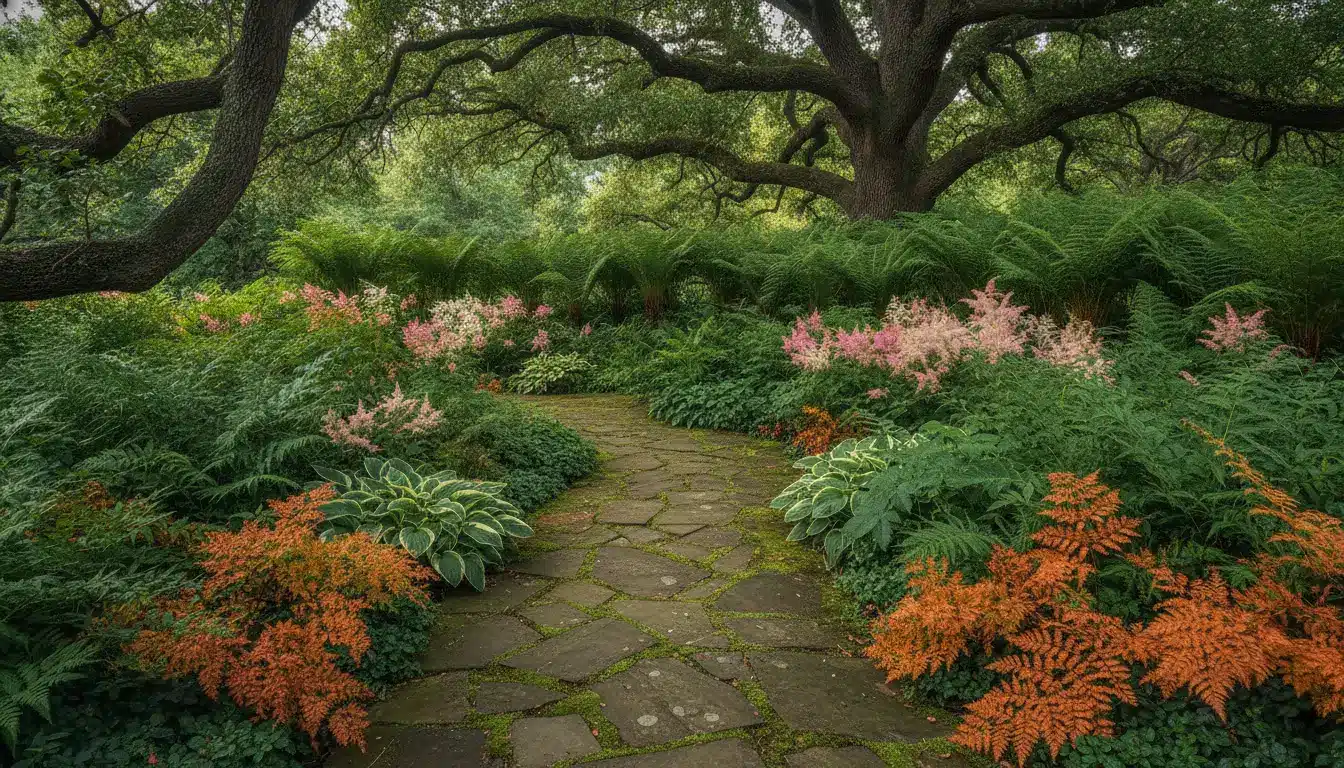
Mixed shade border: Pair ferns with hostas, astilbe, and bleeding heart for a layered shade border with both textural contrast and bloom sequence. Ferns don’t bloom visually in the traditional sense, so they work as the structural backbone while other plants cycle through their flowering periods.
Slope stabilization: Ferns that spread by rhizomes (ostrich, hay-scented) knit soil together effectively on slopes. The dense root system holds soil through rain events, and the spreading habit means less maintenance than planted annuals that need replacing each year.
Foundation plantings on north or east exposures: North and east-facing foundations are consistently shaded and often have dry soil from roof overhang runoff avoidance. Autumn fern and wood fern both handle these conditions and stay attractive year-round in warmer zones.
Transition zones between lawn and woodland: A band of tall ferns at the edge of a wooded area creates a visual and physical transition that looks intentional. Ostrich fern at the back, medium-height cinnamon fern in the middle, and a low ground cover at the lawn edge gives the transition depth without complex planting.
Combining Ferns With Perennials
Ferns work best as part of a mixed planting rather than in isolation. The key is pairing them with plants that cover the seasonal gaps ferns leave.
Most deciduous ferns go dormant after first frost, leaving the bed bare through winter and early spring. Plants that emerge early (hellebores, snowdrops, early bulbs) fill that window. Plants that peak in summer (hostas, astilbe, ligularia) fill the summer period alongside ferns at their full size.
For a shade border that looks good from March through November, the plant list draws heavily on shade perennials with staggered bloom times:
- Hellebores emerge in March, bloom through April
- Ferns unfurl in April and May, reaching full size by June
- Astilbe blooms June through August
- Hostas carry the foliage display through summer and into fall
- Toad lily blooms September and October
- Ferns yellow and collapse after frost; hellebore foliage remains
That sequence requires about 4 to 5 genera but covers 8 months of garden interest with minimal maintenance.
For the flowering component of the design, ferns for sale pair naturally with companion perennials selected for the same light and moisture conditions. Mixing plants from the same ecological guild — woodland edge, moist shade, dry shade — produces a planting that stays in balance without one species crowding out others.
Planting

Dig holes at the same depth as the root ball and twice as wide. Ferns are sensitive to crown depth: too deep and the crown rots, too shallow and roots dry out at the surface. The crown (the point where stem meets root) should sit at or just slightly above soil level.
Space according to mature spread, not current size. Ostrich fern planted at 18 inches apart will overcrowd within 2 seasons; 3 feet is the correct spacing. Autumn fern at 18 inches works well.
Backfill with native soil and firm gently. Water immediately and thoroughly. Mulch with 2 to 3 inches of shredded bark or leaves, keeping mulch away from the crown.
For large-scale plantings, bare-root ferns ordered in bulk from a wholesale nursery cost significantly less than individual container plants and establish just as well when planted correctly in spring or fall.
First-Season Care
Water twice a week through the first growing season in the absence of rain. Ferns root slowly in year one, and dry spells that established ferns shrug off will stress new plants.
Don’t fertilize in year one. A balanced slow-release granular fertilizer applied in early spring of year two is enough for most ferns in average conditions.
Leave dead fronds in place through winter. They protect the crown from temperature swings and break down to feed the soil. Cut them to the ground in early March before new growth emerges.
Dividing and Expanding
Clump-forming ferns can be divided every 4 to 5 years when the center of the clump shows reduced vigor or the outer rings start to crowd adjacent plants. Dig the entire clump in early spring before fronds unfurl, split with a sharp spade, and replant outer sections.
Runner-spreading ferns (ostrich, hay-scented) can be divided by digging individual crowns from the outer edge of the colony and transplanting them. Each division takes the same amount of space as an original plant and fills in at the same rate.
Division is the most cost-effective way to expand a fern planting across a large area once the initial plants are established.
Can ferns grow in full sun? A few can tolerate morning sun if moisture is consistent. Ostrich fern handles 3 to 4 hours of direct sun; lady fern handles up to 5 hours. Most ferns in full afternoon sun without consistent moisture will scorch. If the site gets more than 5 hours of direct sun, the plant list needs to change.
How do I stop ostrich fern from spreading too far? Ostrich fern spreads by underground runners that are easy to sever with a spade. Check the edges of the planting once a year in spring and cut any runners extending beyond the intended area. Physical root barriers (12 inches deep) installed at planting also limit spread.
Do ferns attract wildlife? Ferns provide cover for ground-nesting birds and small mammals. Some native moth caterpillars feed on fern fronds. They’re not a primary nectar or pollen source, but as part of a mixed planting they contribute to overall habitat quality.
What’s the easiest fern for a beginner? Autumn fern is the most forgiving: tolerates dry shade, semi-evergreen in most zones, grows slowly enough to stay manageable, and doesn’t require any special soil conditions. It’s a reliable first choice in spots where other plants have struggled.

Jordan Mathews, who has a degree in horticulture from Texas A&M University, has been a guiding force in plant health and sustainable gardening for over 16 years. His career began with a role at a renowned botanical garden, where he deepened his understanding of plant physiology and eco-friendly cultivation methods. Jordan joined our website as a freelancer in 2020, becoming a go-to expert for readers seeking advice on nurturing diverse plant species apart from offering insights grounded in scientific knowledge and practical experience. Beyond his professional achievements, Jordan is a keen nature photographer, capturing the beauty of flora in its immensely diversified forms.