
A motorbike almost brushes against your elbow in Hanoi.
A vendor in Marrakech quotes a price that’s clearly a joke, and you both know it.
These moments pile up during travel, and most of them vanish, unwritten, forgotten by the time you’re home.
Travel writing aims to capture moments before they disappear.
It’s a craft built on specific angles, sharp scenes, and voices that sound human, not polished into blandness.
This blog defines what makes some trip recaps forgettable while others stick with readers, and outlines practical steps to turn a passport full of stamps into paid opportunities.
What is Travel Writing and What Makes It Different?
Travel writing changes a location into a narrative.
It’s not a list of attractions or a packing checklist. It’s the smell of street food in Hanoi, the sound of a train pulling into a station you can’t pronounce, the awkward small talk with a stranger who becomes a friend by sunset.
Regular writing informs, while travel writing transports.
The writer becomes a lens, filtering a destination through personal experience, detail, and honest reflection.
Facts matter, sure, but emotion drives the piece.
Readers should finish an article feeling as if they’ve experienced being there, even from their couch.
Core Skills Every Travel Writer Needs
Excellent travel writing is built on a few core skills that you can actively practice and improve.
- Observation: Pay attention to the subtle, unusual details that others often overlook.
- Research: Research the history, culture, and context thoroughly before you start writing.
- Structure: Arrange the content to ensure it flows smoothly rather than rambling.
- Voice: Speak in your natural voice, not like a brochure.
- Editing: Remove anything that doesn’t justify its existence.
- Adaptability: Write for blogs, magazines, or guidebooks, each with different rules.
- Ethics: Depict individuals and locations accurately, avoiding any exaggeration.
What Community People Say About Travel Writing
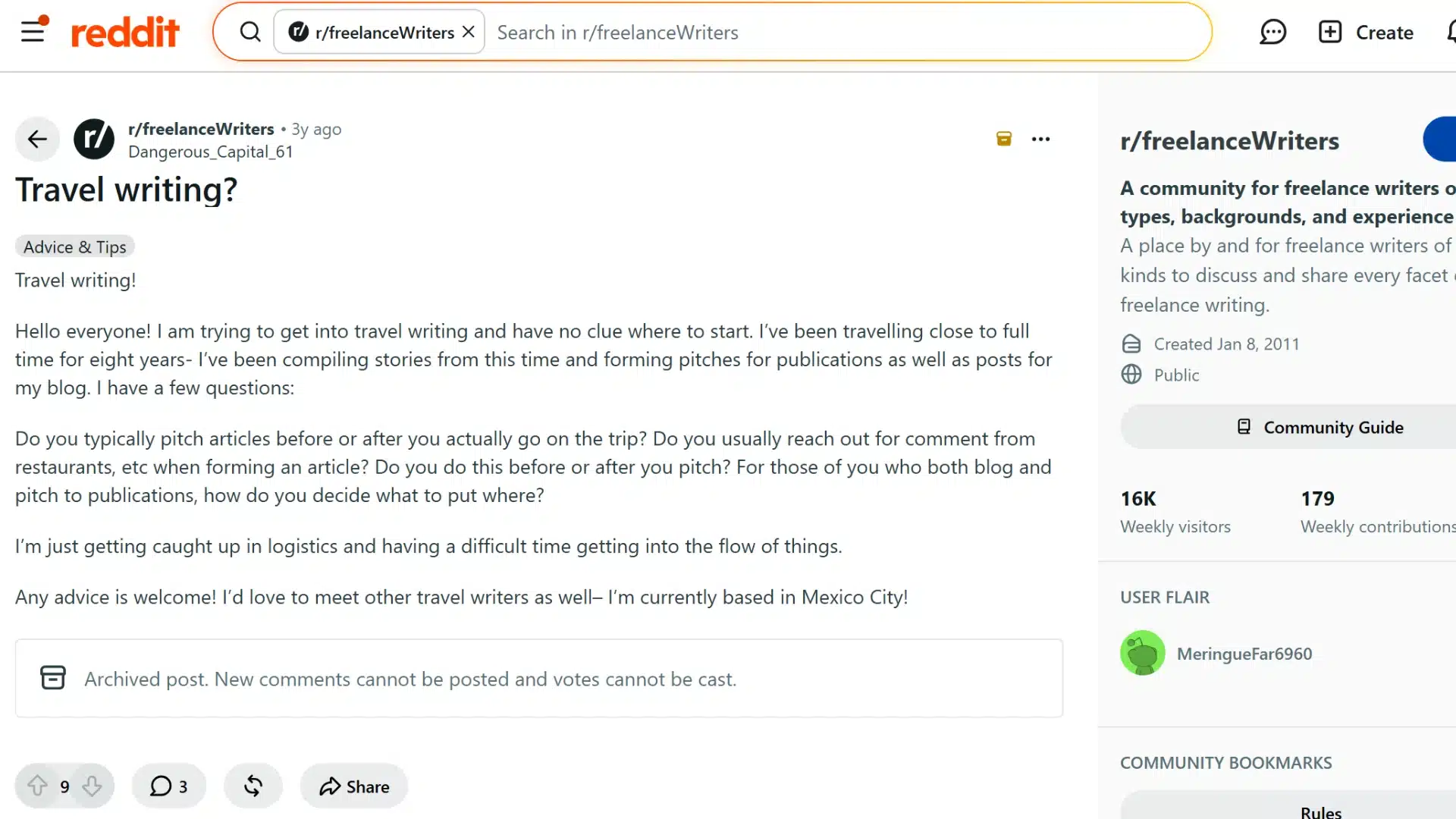
On Reddit, a traveler-turned-writer with eight years on the road asked how to break into travel writing.
Their questions covered timing, restaurant outreach, and splitting content between a personal blog and paid publications. They also mentioned struggling with logistics and workflow.
One commenter pitches sites before and during trips, compiling ideas as they travel, then submitting once home.
Restaurant outreach works better for blog posts than for pitches, they noted.
They pitch based on calls for submissions and write blogs for other people’s sites.
Another chose a documentary approach. Self-funded trips contributed to their portfolio. Their model involves paying small vendors in cash and having big brands cover expenses, combining local locations with special events.
They called the work rewarding, if not especially profitable, since other projects keep them financially afloat.
The Principles of Travel Writing

These principles distinguish memorable stories from those easily forgotten. Master these skills, and every destination will be worth exploring.
1. Choose a Strong Travel Story Angle
Choose a single, specific angle rather than trying to cover everything.
An article on “Japan” fails; an article on “learning to bow correctly in Kyoto” works. Narrow focus gives readers a reason to care. Ask what surprised you most on the trip, then build around that single thread.
Editors reject broad, unfocused pitches fast.
A writer covering Marrakech might focus on haggling etiquette in the souks instead of the entire city.
As an editor noted, give me one door, not the entire hallway.
2. Write an Engaging Travel Story Opening
Skip the flight details and weather report.
Open mid-action: a taxi driver refusing payment, a market vendor shouting your name.
Drop readers straight into a moment. Avoid starting with “I have always wanted to visit.”
Instead, try dialogue, a bold statement, or a strange detail that demands explanation.
For Example: A Hanoi scene could begin with a motorbike nearly hitting your elbow before you check into a hotel, quickly capturing attention.
3. How to Turn Travel Experiences Into Scenes
Avoid summarizing; focus on staging.
Instead of “the market was chaotic,” show a chicken running loose while vendors laugh.
Incorporate dialogue, body language, and reactions. Scenes need a beginning, conflict, and resolution.
Treat memories like mini film clips, not diary entries.
A missed train in Milan becomes a scene with the conductor’s shrug, ticket scramble, and a translator stranger.
Even minor conflicts have more impact than an entire paragraph of explanation.
4. Use Sensory Details without Overwriting
Pick one or two senses per paragraph, not all five at once.
The smell of grilled corn and the sound of a distant motorbike work better than a crowded list.
Cut adjectives that don’t add information. “Fragrant, aromatic, delicious” repeats the same idea three times.
Choose the sharpest word, then move on. When describing a Bangkok night market, highlight the sizzle of a wok, not the noise, smoke, heat, and crowd together. One vivid detail surpasses five vague ones.
5. How to Describe a Destination With Specific Details
Name the actual street, the actual dish, the actual hour.
“A café in Lisbon” is forgettable; “Café A Brasileira at 7 a.m.” is not.
Specificity builds trust and helps readers picture the place. Vague descriptions read like every other travel post.
Details readers can look up make writing credible. Naming the exact tram number or the price of a pastel de nata gives readers something concrete to hold onto, and something they could verify themselves.
6. How to Balance Personal Experience With Useful Information
Weave logistics into narrative instead of listing them separately. Mention the ferry schedule while describing the ride, not in a bullet point after. Readers want a story, but they also need practical takeaways.
Blend the two: one paragraph of feeling, one detail readers can actually use for planning.
A piece on Santorini might describe the sunset crowd at Oia while noting the ferry back runs until 9 p.m., so the practical detail rides along with the moment instead of interrupting it.
7. How to Develop a Natural and Authentic Writing Voice
Write as you talk to a friend, not like a brochure. Drop stiff phrases and formal transitions.
Read your draft aloud; if it sounds robotic, rewrite it.
Authentic voice comes from specific opinions, not neutral observations. Say what annoyed you, what delighted you, and don’t soften every reaction. If a hostel breakfast was disappointing, say so plainly.
As one travel editor advises, “Write the sentence you’d text a friend, not the one you’d put on a postcard.”
8. How to Structure a Travel Story from Beginning to End
Follow a clear arc: setup, tension, turning point, resolution. A trip has no natural plot, so build one.
Maybe you got lost, then found the best meal of the trip because of it.
Structure keeps readers moving forward instead of wandering through unconnected paragraphs like a travel log.
A piece on hiking in Patagonia might open with a wrong turn, build tension through worsening weather, then resolve with an unplanned but unforgettable campsite.
9. How to Write Effective Travel Dialogue and Interviews
Quote people exactly, then trim for clarity. Skip small talk; keep lines that reveal character or local insight.
Ask specific questions on-site: “Why does your family still make this dish by hand?” works better than “Tell me about your culture.” Dialogue should move the story, not pad it.
A Sicilian fisherman’s quote about his grandfather’s boat is more influential than three paragraphs of knowledge.
10. Research and Fact-Check Travel Information
Verify opening hours, prices, and historical claims before publishing. Sources change locations or shut down; confirm details close to your deadline.
Cross-check facts with at least two sources, especially for cultural or historical claims.
Wrong information damages credibility fast and can mislead readers planning their own trips.
Confirming a temple’s open status after renovation takes one call and prevents a wasted trip.
11. Travel Writing Rules for Accuracy and Originality
Never invent details for effect, even small ones. If you didn’t try the dish, say so.
Avoid copying angles from other articles on the same destination; search what’s already published first.
Editors reject pitches that mirror existing coverage.
Original observation, not recycled information, gets a piece accepted. Before pitching a piece on Iceland’s Blue Lagoon, check how many outlets already ran the exact same angle this year.
12. How to Write About Local Cultures Respectfully
Avoid exoticizing everyday life or framing locals as backdrop.
Ask permission before photographing people or ceremonies. Skip words like “primitive” or “untouched.”
Present traditions with context, not judgment.
When unsure about a custom, ask someone from that culture instead of guessing or relying on stereotypes.
When writing about Kyoto’s tea ceremony, describe its history from a practitioner’s perspective, not your impression.
13. Avoid Clichés and Generic Travel Descriptions
Cut phrases like “hidden gem,” “off the beaten path,” or “melting pot.” These say nothing specific.
Replace them with an actual detail: what makes the place different from the last five you visited? If a description could apply to any city, rewrite it until it applies to only one.
Instead of calling a village “untouched by tourism,” mention that the only sign in English is on the bus schedule.
14. How to End a Travel Story With Impact
Avoid vague outlines like “overall, it was amazing.” End with a specific image, leftover question, or unresolved detail.
Maybe the last line is the vendor’s laugh, still stuck in your head weeks later.
A strong ending lingers instead of wrapping everything into a neat little bow. A piece on Varanasi might close on the sound of temple bells fading as your train pulls away, not a statement about spirituality.
15. How to Use Humor in Travel Writing
Poke fun at your own mistakes, not at the place or its people.
Self-deprecating humor about getting lost or ordering the wrong dish builds connection.
Keep jokes short; over-explaining kills them. Timing matters more than cleverness.
If a line doesn’t make you smile while editing, cut it. Admitting you accidentally ordered a plate of cow tongue in Oaxaca, and ate it anyway, lands better than any punchline you’d plan in advance.
16. How to Write Travel Pieces for Different Platforms
A blog post can wander; a magazine feature needs tight structure and a strong hook by paragraph two.
Guidebooks demand a concise, factual tone with minimal personal voice. Match length and style to the platform’s audience. Reusing one draft everywhere weakens the piece and signals lazy repurposing to editors.
Trim a 2,000-word Bali blog essay to 800 words for a magazine pitch, reducing humor and emphasizing facts.
17. How to Edit and Revise Travel Writing
Cut the first paragraph you wrote; it’s usually throat-clearing.
Eliminate adverbs and unnecessary adjectives. Read the text backward sentence by sentence to identify awkward phrasing. Consider whether each paragraph is necessary.
If a sentence doesn’t add a fact, feeling, or image, delete it without hesitation.
Types of Travel Writing
Travel writing isn’t one format. It branches into distinct styles, each with its own purpose and audience.
| Type | Purpose | Example Format |
|---|---|---|
| Guidebook Writing | Practical info for trip planning | Itineraries, transport tips |
| Narrative Travel Essay | Personal story around a journey | Magazine feature |
| Food and Culinary Writing | Covers regional cuisine, dining | Restaurant review |
| Adventure Travel Writing | High-risk or physical trips | Trekking account |
| Budget Travel Writing | Low-cost travel strategies | Backpacking guide |
| Luxury Travel Writing | High-end stays, exclusive access | Resort review |
| Solo Travel Writing | Independent, self-reliant travel | Personal essay |
| Family Travel Writing | Trips planned around kids | Family destination guide |
| Cultural Immersion Writing | Local customs, language, traditions | First-person feature |
| Historical Travel Writing | Place tied to past events | Heritage site feature |
| Digital Nomad Writing | Remote work plus travel | Co-working city guide |
| Travel Listicle | Ranked recommendations | Top 10 roundup |
| Trip Report | Chronological trip documentation | Day-by-day log |
Publications and Societies Worth Studying for Travel Writing
Reading widely is how most working travel writers built their sense of pace and structure.
Publications like AFAR, Condé Nast Traveler, National Geographic Traveler, and Roads & Kingdoms show what a fully realized travel story looks like at a professional level, from angle selection to pacing.
Books help too. Tim Leffel’s Travel Writing 2.0 covers pitching and monetization in detail, while Lonely Planet’s guide to travel writing breaks down craft fundamentals for beginners.
Neither replaces practice, but both save time by explaining what editors actually want.
Online communities matter as well. Groups built around resources like The Travel Writer’s Life connect writers who trade leads, critique drafts, and share which editors respond fastest.
A Quick Note: Editor contacts, submission guidelines, and publishing rates shift often. Verify current details directly with each outlet before pitching, rather than relying on older roundups.
How Freelance Travel Writers Actually Find Paid Work

Paid work seldom arrives unexpectedly in an inbox.
Writers scan editor calls on X and Substack, follow outlet submission pages, and join freelance writer Slack groups where leads get shared first. Press trips open doors too, but only after a few published clips exist.
Some writers pitch tourism boards directly for sponsored features.
Others build recurring gigs with one or two outlets instead of constantly chasing new clients.
Referrals from writers usually outperform cold outreach because editors trust vetted proposals more than queries.
How to Pitch a Travel Story to an Editor
A pitch needs a subject line that states the angle immediately, not a vague trip summary.
Open with the hook, not your bio. Mention why this outlet, specifically, fits the story. Include one strong clip link, not five. State word count and timeline upfront. Skip attachments unless requested.
End with a direct question, like asking if they’d like a full outline.
Editors reject rambling passages that extend beyond three short paragraphs.
How to Build a Travel Writing Portfolio that Gets Attention
Lead with your strongest three clips, not every piece you’ve written. Use a simple site, not a cluttered template.
Organize clips by publication type: journalism, essays, guides.
Add a brief context line for each clip describing the angle. Avoid decorative design elements; editors focus on content, not animations. Refresh the portfolio after each new publication.
A stale portfolio with old clips signals inactivity, which makes editors hesitate before assigning new work.
Common Problems and How Experienced Writers Solve Them
Every travel writer hits the same roadblocks eventually. Here’s how seasoned writers push through them.
| Problem | Solution |
|---|---|
| Writer’s block mid-trip | Jot rough notes instead of polished sentences; refine later |
| Too many ideas, no focus | Pick the one moment that surprised you most, drop the rest |
| Rejection from editors | Ask for feedback, then resubmit a sharper angle elsewhere |
| Difficulty describing overused places | Find an unexpected detail locals mention, not tourists |
| Slow research process | Build a repeatable checklist for facts, sources, and permits |
| Weak first drafts | Write fast, then revise in a separate, later sitting |
| Trouble getting local access | Build contacts through fixers or local writer networks |
| Losing motivation between trips | Revisit old notes to spark new angles without traveling |
How to Improve a Travel Writing Draft Before Publishing
Set the draft aside for a day before touching it again.
Distance reveals weak spots faster than immediate rereading.
Check that the opening still earns attention after multiple reads. Read each paragraph aloud to catch clunky rhythm. Trim any sentence repeating an idea already made.
Verify names, dates, and prices one final time. Ask a fellow writer for blunt feedback, not polite praise.
Confirm the ending lands on a specific image, not a vague wrap-up statement.
A Practical Travel Writing Workflow from Trip to Published Story
Converting a trip into a published piece involves a consistent, step-by-step process from start to finish.
- Capture raw notes and sensory details on-site, before memory fades.
- Photograph key moments for reference, even if not for publication.
- Identify the single strongest angle once the trip ends.
- Draft the piece fast, without editing mid-sentence.
- Set the draft aside briefly before the first revision pass.
- Fact-check names, prices, and details against a second source.
- Match tone and length to the target outlet’s style.
- Pitch the polished piece or publish directly to your blog.
- Track the submission and follow up if no response arrives.
- Archive the published clip for your portfolio immediately after.
Wrapping It Up!
Every trip holds a story worth telling, buried somewhere between the missed trains and the unexpected meals.
Travel writing rewards writers who notice the fisherman’s quote over the postcard view, the cracked sign over the polished monument. Skills sharpen through repetition, not talent alone.
Pitches get rejected, drafts get cut apart, and portfolios stay unfinished for months.
None of that stops the writers who keep showing up with sharper angles and better notes.
Choose a single trip and one detail, then begin writing today.
The next story worth reading could be right in your notes app at this very moment.
Frequently Asked Questions (FAQ’s)
1. How do I Start Travel Writing with No Experience?
Write about trips you’ve already taken, then publish them on a personal blog.
2. Do Travel Writers Need to Travel Full-Time?
No, part-time travelers write successful pieces using short trips and focused angles.
3. How Much Do Freelance Travel Writers Get Paid?
Rates vary widely, from $50 blog posts to $1-2 per word for magazines.
4. Do I Need a Journalism Degree to Become a Travel Writer?
No, strong writing samples and published clips matter more than formal degrees.
5. How Long Should a Travel Article Be?
Blog posts run 800-1,500 words; magazine features often reach 2,000-3,000 words.

Former airline pilot Marco Giannini has explored 80-plus countries and now designs immersive, budget-savvy itineraries. He joined us in 2024 to share packing lists, cultural etiquette, and eco-friendly lodging picks that turn dream trips into doable plans. Between flights, Marco mentors student aviators, maps coastal cycling routes, and brews Italian espresso for fellow travelers at community hostels during layovers worldwide.