
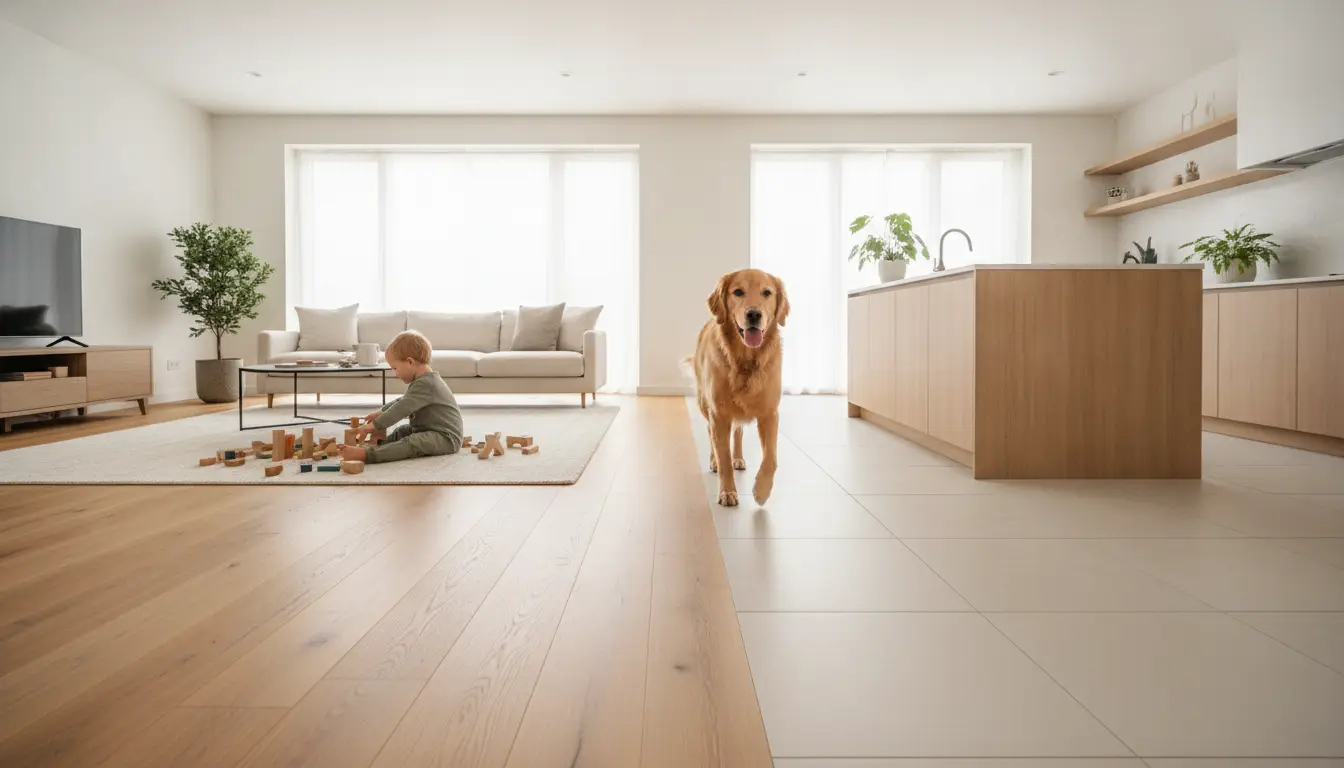

The lighting in a flooring showroom is meant to make every sample look flawless. But what a golden retriever will do to those beautifully finished planks, or a tile floor to a toddler’s cup, isn’t as easy to picture. Good home design is about more than just picking the most attractive option. It’s about choosing the appropriate material for each room, and living with it for years to come.
The showroom will never show you the version of the floor that’s had five years of muddy boots, dropped cast-iron pans, or a dog skidding around the corner into the kitchen. That gap between the sample and your actual life is exactly where most flooring regrets come from.
Start With a Room-By-Room Threat Assessment
The biggest regrets with flooring come when people don’t think of their home as seven or eight different zones with unique conditions and wear, but as one uniform surface. Then they pick something that can’t possibly outperform in every room.
So, the first decision is to be realistic about how you live. A living room might just have to look good and last 20 years. A mudroom has to be water resistant and super tough. The kids’ rooms just need to clean up easily now but hold up for play later. The bathroom floor shouldn’t be too slippery when you step out of the shower and needs to be waterproof.
Once you’ve sorted rooms by their threats, the next step is ranking them by how much abuse they’ll actually take on a daily basis. An entryway and a formal dining room might both be “high visibility,” but only one of them sees shoes, umbrellas, and delivery boxes every single day.
Walk your own home for a week and notice where you actually go – the path from garage to kitchen, the hallway to the kids’ bathroom, the spot in front of the sink where you stand for twenty minutes making dinner. Those paths deserve your most durable, most forgiving materials, even if that means spending less on a “showpiece” material elsewhere.
It’s a far better use of a flooring budget to put money into the surfaces that take the daily hits than to spread it evenly across every room and end up with a mudroom that can’t handle mud.
Learn to Read the Actual Durability Numbers
Flooring marketing often uses terms like “premium” and “designer-grade” that do not give you the real facts. The truth is in the details, so here are the three most important numbers you should look for, depending on the material you are considering.
For hardwood, the key number is derived from the Janka hardness test, which measures the amount of pounds-force needed to force a small steel ball halfway into the wood. Red oak, the most common hardwood species in North America, scores 1,290.
This is your baseline. Anything that scores significantly lower will be easier to dent from furniture legs and dropped items; anything that scores higher will provide better resistance in high-traffic areas.
For laminate, the number that matters is the AC rating, which ranges from AC1 to AC5. AC4 is the standard for residential high-traffic use, and it is recommended for kitchens, hallways, and living rooms. AC1 to AC3 are fine for bedrooms or low-traffic areas, but if you use them in areas with daily foot traffic, they will quickly show signs of wear and tear.
For luxury vinyl plank, the number that should interest you is the wear layer thickness, which is measured in mils. The wear layer is a clear protective layer that covers the printed design layer. A wear layer of 6 mils is thin and more appropriate for rooms with low use or rentals. A wear layer between 20 and 40 mils will protect your floor from scuffs, pet claws, and rolling furniture and will not wear out as quickly. If a salesperson cannot tell you the wear layer thickness of a luxury vinyl plank product, be wary.
Solid Versus Engineered Hardwood Isn’t a Style Choice
Many buyers find this comparison tricky because solid hardwood and engineered hardwood often look exactly the same once they’re installed. The difference is in their construction, and it’s key to how long your floor will last and how well it will handle things like moisture.
Solid hardwood is literally one piece of wood solid through and through. You can sand and refinish it five to seven times over its life, which is why it’s the winner for people expecting to spend a lifetime in their home.
But because it’s a real, living product, it will expand and contract with humidity levels, so you need to be careful about installing it in rooms that get very humid as it can warp, cup, or crown.
Engineered hardwood has a veneer of solid hardwood on top of a cross-layered core of wood byproducts. This makes it much more stable in humid or high-heat environments, or over radiant heat. The trade-off is that your real wood veneer is very thin. It’s the reason most engineered products only let you refinish it one to three times – after sanding through the veneer, you’ll hit the core layer and need to replace the floor rather than refinish it.
If you’re choosing engineered for a basement or very humid climate, that’s a good trade. If you’re choosing it simply because it’s cheaper than solid for an area that’s not going to be humid or wet, you’re giving up lifetime value you didn’t need to give up.
When Real Wood Isn’t the Right Answer
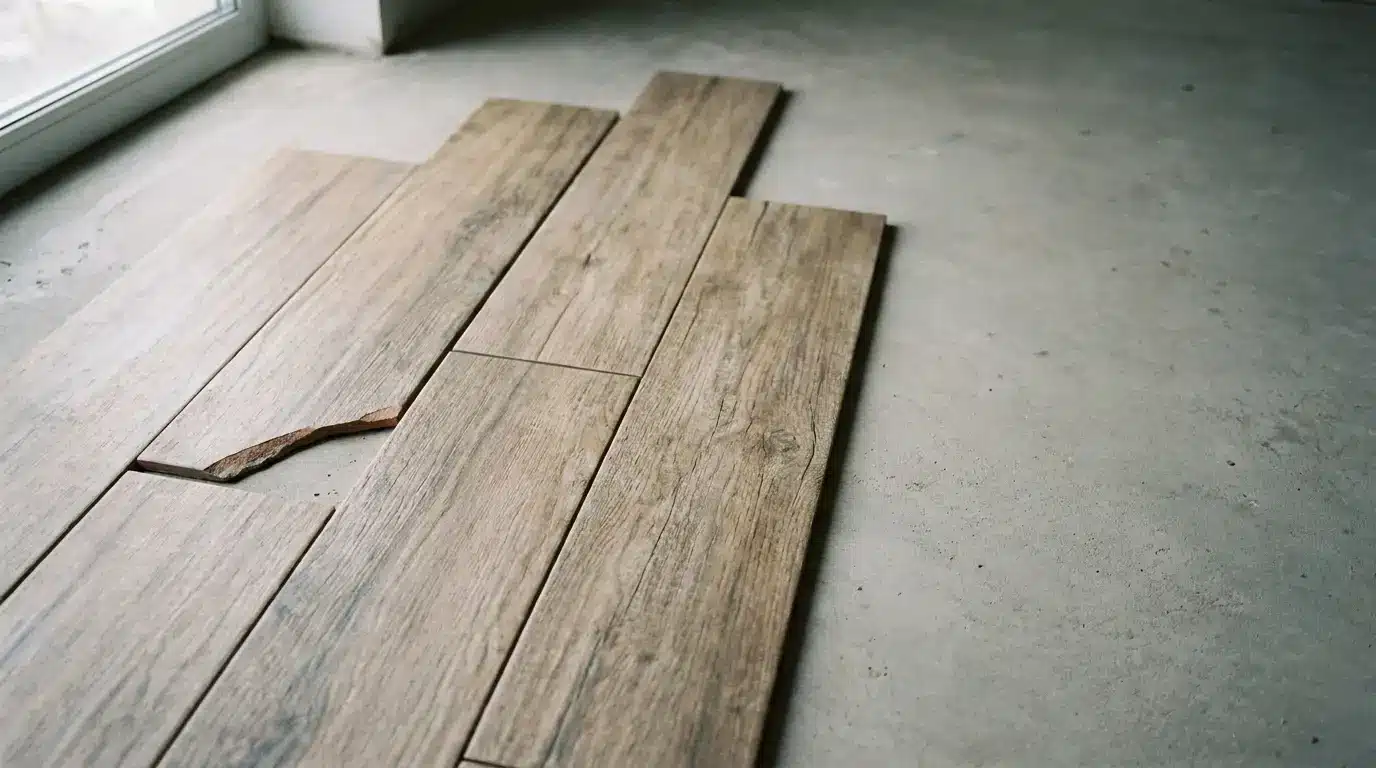
In bathrooms, laundry rooms, and basements, solid or engineered hardwood loses the moisture battle. Two competitors, however, give you the wood look without the problems attached.
Luxury vinyl plank (LVP) is fully waterproof and incredibly scratch-resistant. Modern printing technology also delivers remarkably convincing wood-grain visuals. In fact, you won’t notice the difference at a normal viewing distance.
The downside is that you can’t sand or refinish the LVP. When the wear layer is gone, you replace the plank. The product is designed to last a certain number of years, not be restored repeatedly like hardwood or wood-look tile.
Wood-look porcelain tile is virtually indestructible. It doesn’t scratch, stain, or warp from humidity or contact with liquids. That makes it an excellent choice for washrooms and laundry rooms that see a lot of humidity and kitchens where spills are constant.
It’s also a good option for homes with pets and kids. The downsides are that tile has grout lines, which require sealing, and the surface is hard and unforgiving underfoot. Large-format tiles or rectified edges – even the edges of the tile so that very narrow grout joints are possible – create a pleasingly seamless look reminiscent of hardwood.
The Finish Matters as Much as the Material
Many people will spend weeks poring over the distinctions between, say, Brazilian cherry and maple, but almost no time pondering the choice between site-finished wood and a product that has been cured in a factory with aluminum oxide. Yet the finish is what actually takes the daily abuse. When the balance between aesthetics and durability hinges on these kinds of details, consulting a proven flooring retailer such as Capitol Carpet & Tile can help homeowners translate spec sheets into real-world decisions.
Site finishing with polyurethane typically takes two coats, and then at least 48 hours to cure before furniture can be moved back in. Aluminum oxide is part of the finish and sprayed on as many as seven coats in the factory, where it cures in a matter of seconds under ultraviolet light. It will resist scratching and UV fading up to six times longer than floors finished on site with polyurethane, makers of the stuff boast. That means you aren’t likely to need the kind of screened re-coating that’s recommended every five to seven years with polyurethane finishes.
The aluminum oxide is baked on under controlled conditions, and it’s simply a harder, more consistent coating than what’s achievable with a brush or roller in your living room.
Use Area Rugs as a Durability Strategy, Not an Afterthought
One of the least-appreciated elements of interior home design is an area rug. It’s not simply decorative; it makes a softer, classier floor covering possible for much or all of your home, while providing a protective buffer right where you need it. You can have a durable, low-maintenance surface in the kitchen and entryway, and a beautiful, softer material in the living and dining rooms, protected by a rug in the highest-traffic path.
Rugs help solve a design problem many of us have right now: We want a wide-plank white oak, or a light, trendy finish, but it’s not a naturally hard-wearing material. A well-placed rug under the dining table, or in the main high-traffic walking path, will vastly extend the life of that material without making the room look different.
Installation Quality Determines Whether Any of This Holds Up
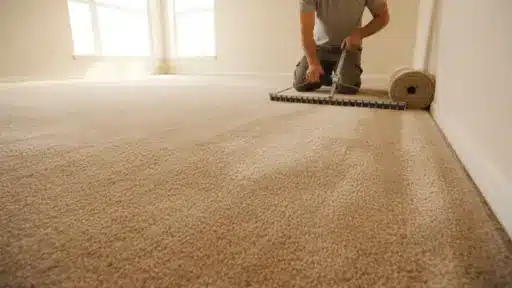
The most ignored factor that causes more flooring failures than anything else is a bad subfloor. Wavy, lumpy, soft subfloors, or those with moisture issues are quick warranty voids on any product. If you’re trying for the “lifetime of the home” part of that warranty, confidently spend time over the subfloor sorting out ventilation, humidity, and any unevenness first.
It’s much easier to get some OSB or concrete shaved down before installation than to have a brand-new floor ripped out later to do remedial leveling work. Also, an unlimited fade/stain warranty still won’t cover the scratches, dents, and gashes.
Think in Lifetime Cost, Not Sticker Price
For example, a cheap laminate might cost a third of what premium hardwood does per square foot, but if it needs full replacement in 12 to 15 years while a hardwood floor lasts 50-plus years with periodic refinishing, the laminate was the pricier choice over the life of the home.
Run the math per year of expected life, not per square foot at checkout. It changes the calculation on almost every flooring decision, especially for homeowners who plan to stay put for a decade or more.
Resale value factors into this too. Classic oak tones, wide neutral planks, and medium satin sheens hold the most buyer appeal. Hyper-trendy finishes, extreme wire-brushed textures, or high-contrast stains can date a home fast and shrink your buyer pool when it’s time to sell, even if the material itself is technically durable.
What Keeps Any Floor Looking Good Long After Installation
Choosing the right product makes up 50 percent of the work. The other half is upkeep, which most people don’t realize. For example, indoor humidity should ideally remain between 35% and 55% to protect your wood floor from expanding, contracting, or cupping.
Doormats at each and every door to the outside lessen the grit that grinds away the finish. Furniture pads under chair and table legs are an inexpensive way to ensure fewer small dents. None of this is rocket science, and none of it requires you to choose a fancier product.
The floor that gets better with age is not the most expensive one at the store. It’s the one that’s appropriate to its surroundings, correctly installed, and diligently maintained starting the day the installation crew packs up and leaves.

Holding a Master’s in Architecture from the University of Texas at Austin, Emily Rodriguez has dedicated more than two decades to the art and science of building renovation. Starting her journey in historic preservation, she developed a profound respect for blending old with new in building design. Emily became a vital part of our team in 2019, renowned for her insightful and innovative renovation tips. She has been leading our DIY home improvement series since ever since, where she shares her wealth of knowledge in turning outdated spaces into modern havens. When not engaged in writing or consulting, Emily is a passionate advocate for heritage conservation and enjoys exploring vintage architecture, a hobby that complements her professional expertise.