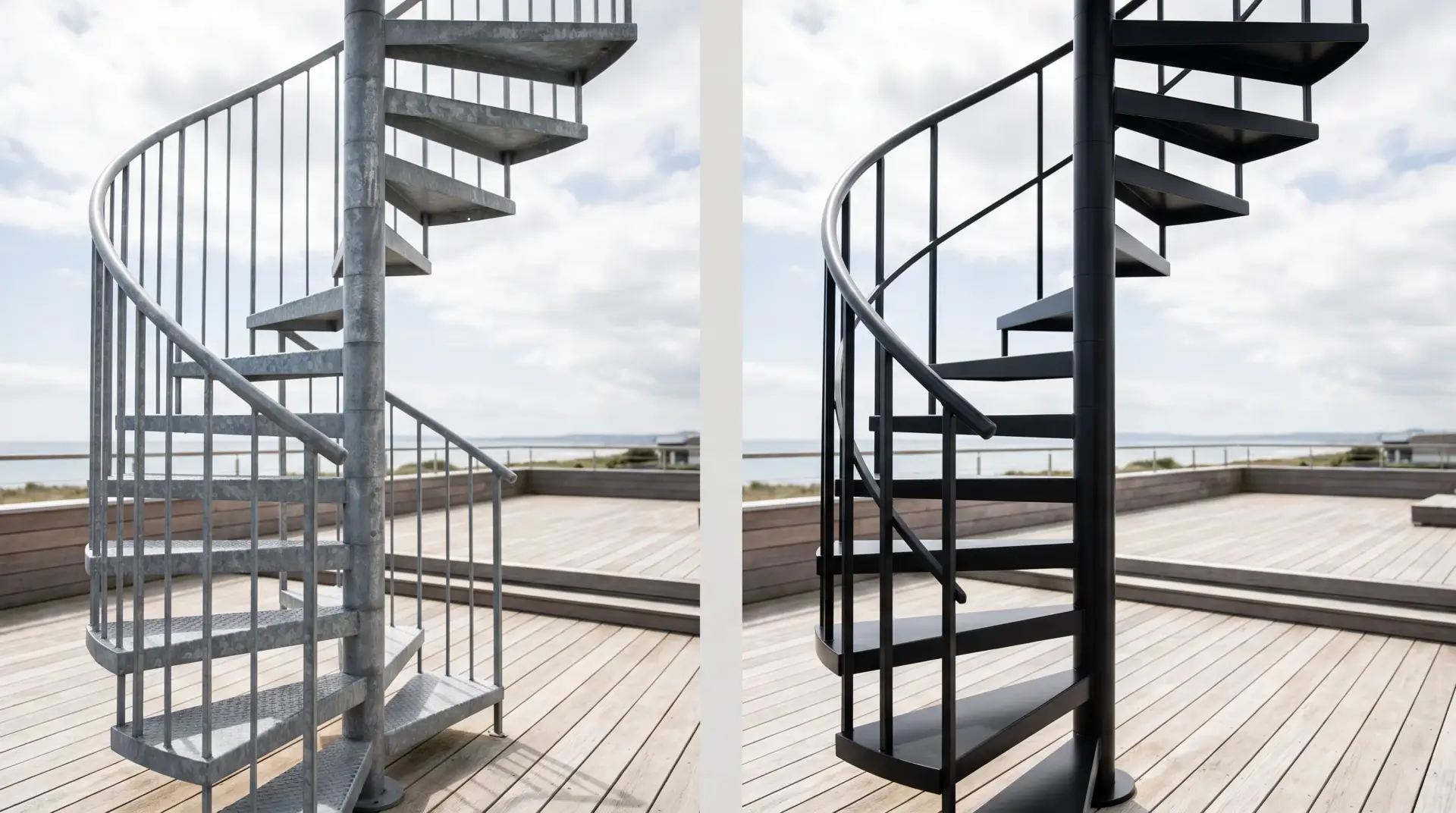

When designing an elevated deck, a rooftop patio, or a secondary egress for a multi-story home, layout efficiency is often the driving structural requirement. Spiral configurations are a standard choice for these projects because their vertical footprint preserves valuable ground space.
However, exterior spiral staircases are constantly exposed to environmental stressors. Sunlight, moisture, freezing cycles, and salt air all accelerate structural wear and surface corrosion. Selecting the proper material class is critical to ensuring long-term safety and reducing lifetime ownership costs.
For high-end residential and light commercial exterior builds, the specification choice usually comes down to two options: hot-dip galvanized steel or powder-coated aluminum. Both materials resist moisture degradation, but they utilize entirely different metallurgical properties to achieve longevity.
Galvanized Steel: Industrial Strength and Passive Barriers
Hot-dip galvanization is a heavy-duty coating method that differs fundamentally from traditional painting or spraying. Once the raw steel framework of the staircase is fully fabricated, it is submerged into a kettle of molten zinc at temperatures around 840 degrees Fahrenheit. This immersion creates a metallurgical bond, forming distinct layers of zinc-iron alloys topped by an outer layer of pure zinc.
Protective Mechanisms
Galvanized steel relies on a process known as galvanic protection to prevent iron oxide (rust) from forming. The zinc layer serves as an impermeable physical block against oxygen and moisture.
If the staircase surface is deeply scratched by heavy foot traffic or moving furniture, the surrounding zinc shields the exposed steel underneath. Because zinc is more chemically active than iron, it reacts with atmospheric oxygen and carbon dioxide first, creating a tough protective film of zinc carbonate that naturally seals the compromised area.
Operational Lifespan and Performance
- Durability: In suburban and rural climates, hot-dip galvanized steel structures routinely last 50 years or longer without requiring structural repairs. In high-exposure industrial settings, a service life of 20 to 30 years is typical.
- Structural Feel: Steel features high density and tensile strength. It handles heavy load limits with minimal deflection. This weight provides a rigid feel underfoot, eliminating the slight swaying sensation that can occur on lighter structures.
Aesthetic Properties
The main trade-off with galvanized steel is its appearance. New galvanized steel has a bright, mottled, or spangled texture. Over a few years, weathering transforms this finish into a uniform, matte gray color. It does not look like a smooth, painted surface. While this fits well with industrial, rustic, or modern farmhouse architecture, it can look out of place next to highly polished, traditional residential trim.
Powder-Coated Aluminum: Corrosion Resistance and Refined Finishes
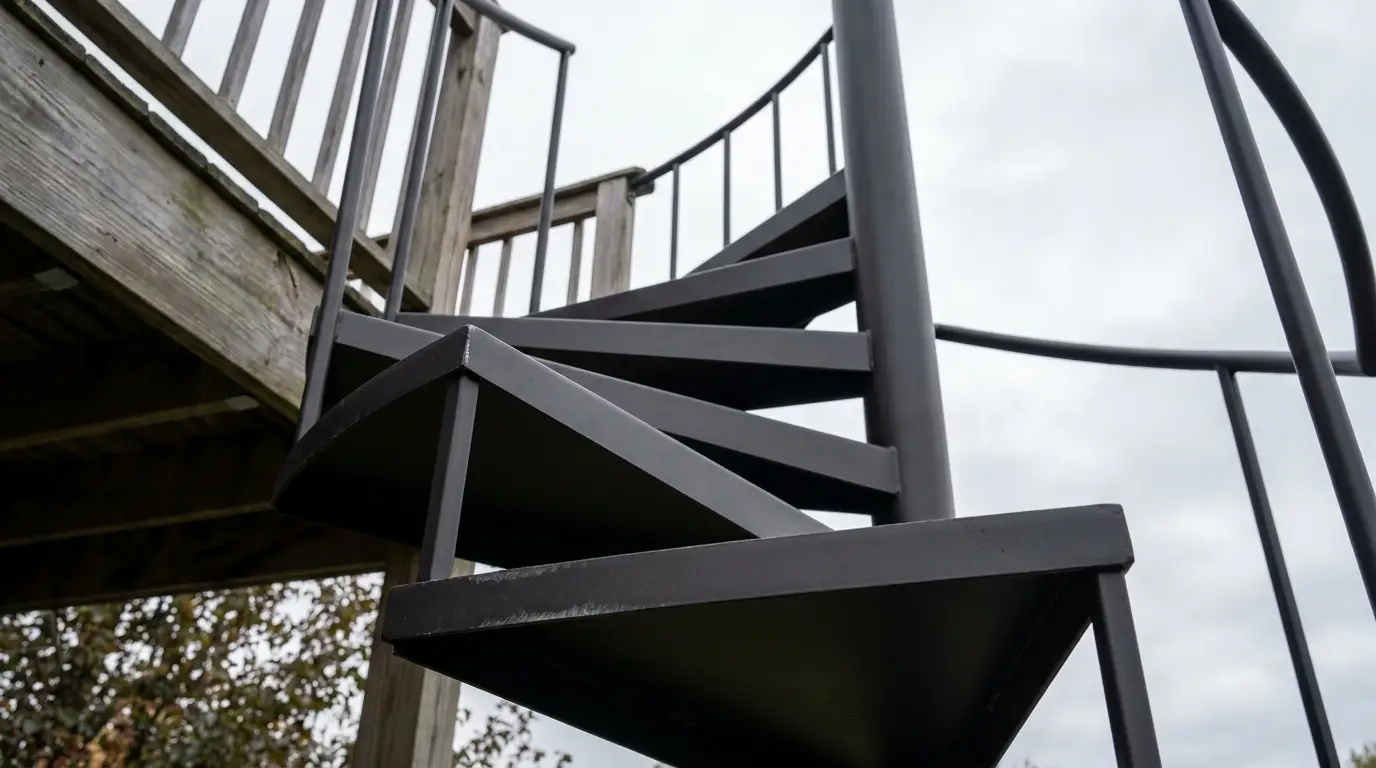
Aluminum approaches weather resistance through its native chemical properties. Unlike steel, aluminum contains no iron and cannot develop rust. When exposed to the atmosphere, it instantly forms an invisible, microscopically thin layer of aluminum oxide that seals the underlying metal against deep corrosion.
For architectural applications, this metal is paired with a baked-on powder coat. This finishing process applies electrostatically charged paint particles to the aluminum frame, which is then cured under high heat to form a uniform, durable finish.
Performance in High-Chloride Zones
Because aluminum does not rust, it is highly stable in regions with high humidity and constant coastal salt spray. Salt air quickly breaks down standard paints and accelerates zinc consumption on galvanized steel, but aluminum maintains its structural integrity under these conditions.
Architectural Versatility and Lifespan
- Longevity: A properly specified, architectural-grade aluminum staircase has an expected lifespan of 30 to 40 years. The underlying metal will not degrade or flake apart from water exposure.
- Aesthetic Integration: Powder coating provides a smooth finish available in a wide selection of architectural colors, such as textured bronze, semi-gloss black, and slate gray. This makes it easier to match the staircase with existing window mullions, deck railings, or roofing details.
Structural Mass Considerations
Aluminum is roughly one-third the weight of steel. While this lower weight makes transport and assembly easier, the material lacks the raw mass of steel. To ensure a rigid walk path, aluminum spiral systems must use thicker material walls, heavy-duty center columns, and robust bracing points to counteract physical flexing during use.
Comparative Assessment: Key Engineering Factors
Choosing the right material for a project depends on matching the specific environment with the mechanical attributes of the staircase.
Maintenance Protocols
- Galvanized Steel: This option requires virtually no long-term upkeep. It does not need to be painted, sealed, or pressure-washed. However, if a homeowner wants to paint over it later for cosmetic reasons, the zinc surface must be treated with specialized primers like acrylic passivators. Regular house paint will quickly bubble and peel off untreated zinc.
- Powder-Coated Aluminum: This material requires minimal maintenance, though it does benefit from occasional washing with water and mild soap to clear off dirt, pollen, or salt crust. If the powder coating is scratched down to the bare metal, the aluminum will not rust out from within, but using a matching touch-up paint is recommended to preserve the finish.
Site Conditions
- Marine Settings: Aluminum is generally the more stable choice for properties directly facing coastal salt air. Long-term exposure to salt can wear down zinc coatings prematurely, requiring a heavier galvanized coating thickness to achieve the same lifespan.
- High-Impact and Public Zones: Galvanized steel is better suited for rental properties, public commercial areas, or regions prone to severe storms and falling debris. Steel’s surface hardness resists dents, gouges, and physical wear much better than aluminum.
Technical Planning and Project Execution
Integrating an outdoor spiral staircase into a building plan requires careful prep work before procurement begins. The local building department should be consulted to confirm regional live load requirements, wind load metrics, and strict snow load calculations.
Additionally, engineers must review the foundation requirements. Because spiral stairs concentrate the entire weight of the structure and its users onto a small central footprint, they typically require a dedicated concrete footing rather than resting directly on standard decking or paver stones. Addressing these structural variables early ensures a safe, compliant, and durable installation.

With a Master’s in Architecture from the University of California, Berkeley, Alexander Martin has dedicated the last 18 years to enhancing outdoor living through thoughtful and robust structure design. His career kicked off in urban planning, giving him a unique perspective on integrating structures into diverse environments. In 2019, Alexander brought his expertise to our website, offering insights into creating versatile outdoor spaces. Since then, he has been the lead advisor for our outdoor design projects and is known for his ability to merge functionality with environmental consciousness. Alexander enjoys rock climbing outside of work and participates in community development projects, activities that reflect his passion for the outdoors and sustainable design.