
Every furniture store sells “modern minimalist” pieces, but most look cheap and feel uncomfortable.
You sit in those sleek chairs for five minutes, and your back hurts.
That’s because they copied the look without understanding the logic.
Real Bauhaus design from 1920s Germany solved this problem by making beauty and function inseparable.
Those iconic tubular steel chairs you see everywhere? They were engineered for comfort first, style second.
But here’s what most people miss: Bauhaus isn’t about owning expensive replicas. It’s a set of principles anyone can apply.
This guide shows you what Bauhaus actually means, why it revolutionized design, and practical ideas for applying these principles in every room of your home.
What is Bauhaus Style Interior Design?
Bauhaus style interior design is a modernist approach from 1920s Germany that strips away decoration and focuses on function, clean geometry, and honest materials.
The core principle is simple: form follows function. Every element serves a purpose. If something doesn’t improve how you live, it doesn’t belong.
This approach influenced mid-century modern, Scandinavian minimalism, and contemporary industrial design.
When you see tubular steel chairs or buildings with flat roofs and ribbon windows, that’s Bauhaus influence.
Rich History Behind Bauhaus
The Bauhaus school opened in 1919 in Weimar, Germany, founded by architect Walter Gropius.
His vision was radical: unite art, craft, and technology under one philosophy.
The school moved to Dessau in 1925, constructing its iconic glass-and-steel building.
Key figures included Ludwig Mies van der Rohe (architect), Marcel Breuer (furniture designer of the Wassily Chair), Josef Albers (color theorist), and Marianne Brandt (metal designer).
The Nazi regime closed the Bauhaus in 1933, calling it degenerate. Instructors fled to the United States, spreading Bauhaus principles to American design schools.
This migration made the movement global and established it as the foundation of modern design education.
Key Elements and Characteristics of Bauhaus Interior Design
Bauhaus design is defined by specific features that separate it from generic minimalism. These elements work together to create functional, visually striking spaces.
1. Primary Colors with Neutral Bases
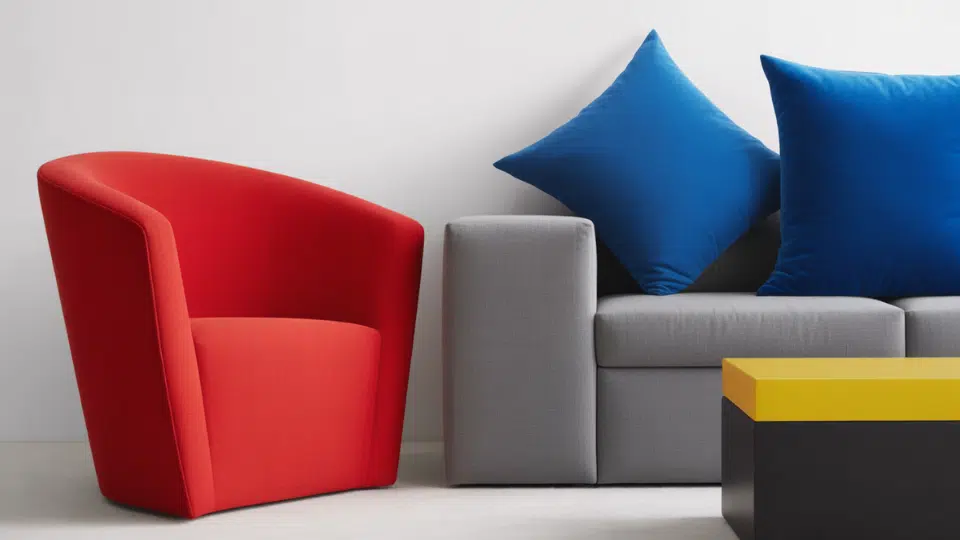
Red, blue, and yellow appear as bold accents against white, black, and gray backgrounds. A red chair against a white wall.
A blue rug defines a seating area. Yellow pillows on a gray sofa. Restraint makes each color powerful.
2. Minimal Ornamentation
Surfaces are smooth. Joints are clean. The structure itself becomes the visual interest through clarity that lets materials and form speak.
3. Tubular Steel Furniture with Exposed Structure
Bent tubular steel creates lightweight, strong, stackable pieces.
The Wassily Chair and Barcelona Chair remain iconic. Frames stay visible, joints become part of the design, and cushions attach without hiding construction.
4. Open, Flexible Spaces
Bauhaus interiors avoid rigid room divisions. Spaces flow into each other. Furniture placement defines areas instead of walls.
This creates adaptable rooms that can change purpose as needs shift. Built-in storage systems maintain clean surfaces without freestanding clutter.
5. Large Windows and Natural Light
Bauhaus architecture featured ribbon windows and glass walls.
Interior design maximizes natural light with minimal window treatments, simple blinds, or no coverings at all. Light itself becomes a design element that changes throughout the day.
6. Geometric Artwork and Industrial Lighting
Wall art features abstract compositions, typography, or photographs by Kandinsky, Klee, or Albers.
Lighting includes pendant lights, exposed bulbs, or articulated arms like the Bauhaus desk lamp sculptural but purposeful..
Bauhaus Interior Design Ideas for Different Rooms
You don’t need to redesign your entire home to embrace Bauhaus style. Start with one room using these specific ideas that balance industrial materials with livable comfort.
1. Living Room

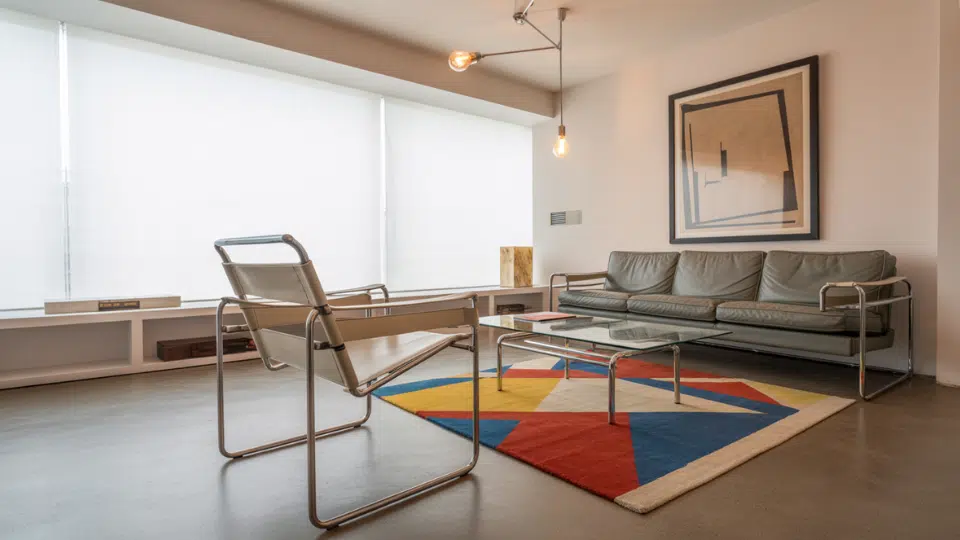
Use white or gray walls with polished concrete floors. Place a tubular steel Wassily Chair as a focal point with a low-profile leather sofa.
Add a geometric rug in primary colors and one large abstract artwork.
Install a pendant light with exposed bulbs. Use built-in shelving and a glass-steel coffee table to maintain openness.
2. Bedroom

Choose a platform bed with minimal framing. Use white or gray bedding with one bold accent pillow.
Install floating nightstands and an adjustable wall-mounted reading lamp.
Keep closets hidden behind handleless doors. Add large windows with simple roller blinds for natural light.
3. Kitchen
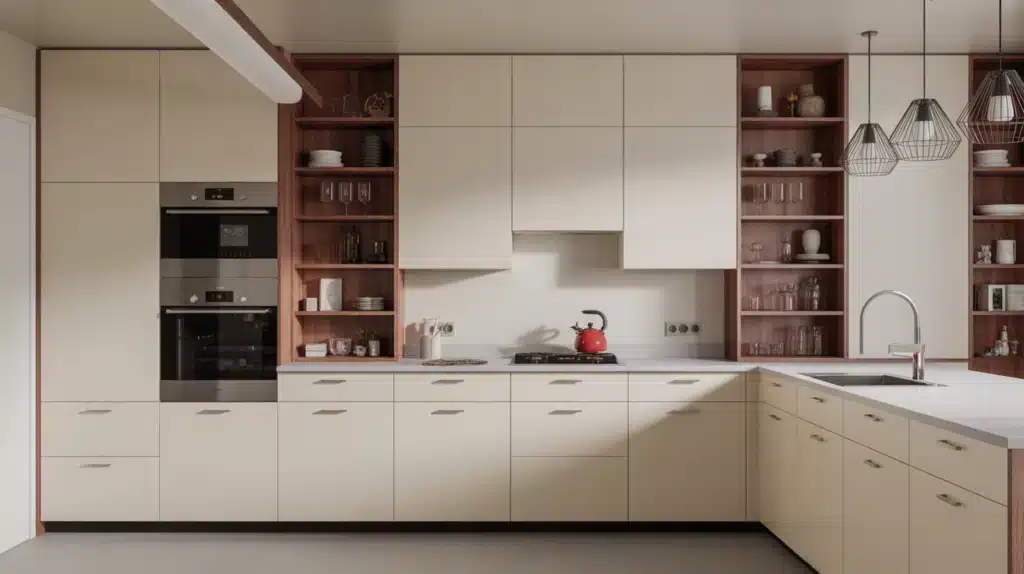
Install flat-front cabinets in white or black with push-to-open mechanisms. Use open shelving for dishes and stainless steel appliances.
Add geometric pendant lights and solid surface countertops.
Include one bold accent like a red kettle or yellow bar stools. Keep counters clear.
4. Bathroom

Install a wall-mounted sink with exposed chrome plumbing. Use large-format tiles in neutral tones.
Choose frameless glass shower panels and simple wall-mounted fixtures.
Add a thin metal-framed mirror and pendant lights with exposed bulbs. One bold towel adds color.
Conclusion
Bauhaus interior design isn’t complicated. It’s about keeping what works and removing what doesn’t.
Use clean lines, honest materials, and bold colors sparingly. Choose furniture that serves a purpose, not just fills space.
Let natural light in and keep surfaces clear. This style has lasted over 100 years because it makes sense.
Your home doesn’t need fancy decorations to look good; it needs smart design that improves how you live.
Whether you add one tubular steel chair or redesign an entire room, Bauhaus principles help create spaces that feel both modern and timeless.
Have you tried Bauhaus design in your home? Share your experience in the comments below.

With a Master in Architectural Studies from University of Pennysylvania, Marwa Haydar has pioneered living spaces since 2005. Her expertise, initially honed in a prestigious architectural firm, is evident in her approach to creating environments. Marwa became part of our team in 2019 and has since been a driving force in our home improvement section, known for her practical yet stylish solutions. She’s been spearheading our design workshops since then, infusing her passion for teaching into her work. In her leisure time, Marwa enjoys exploring historic architecture and is an enthusiastic pottery hobbyist, further enriching her understanding of form and texture.