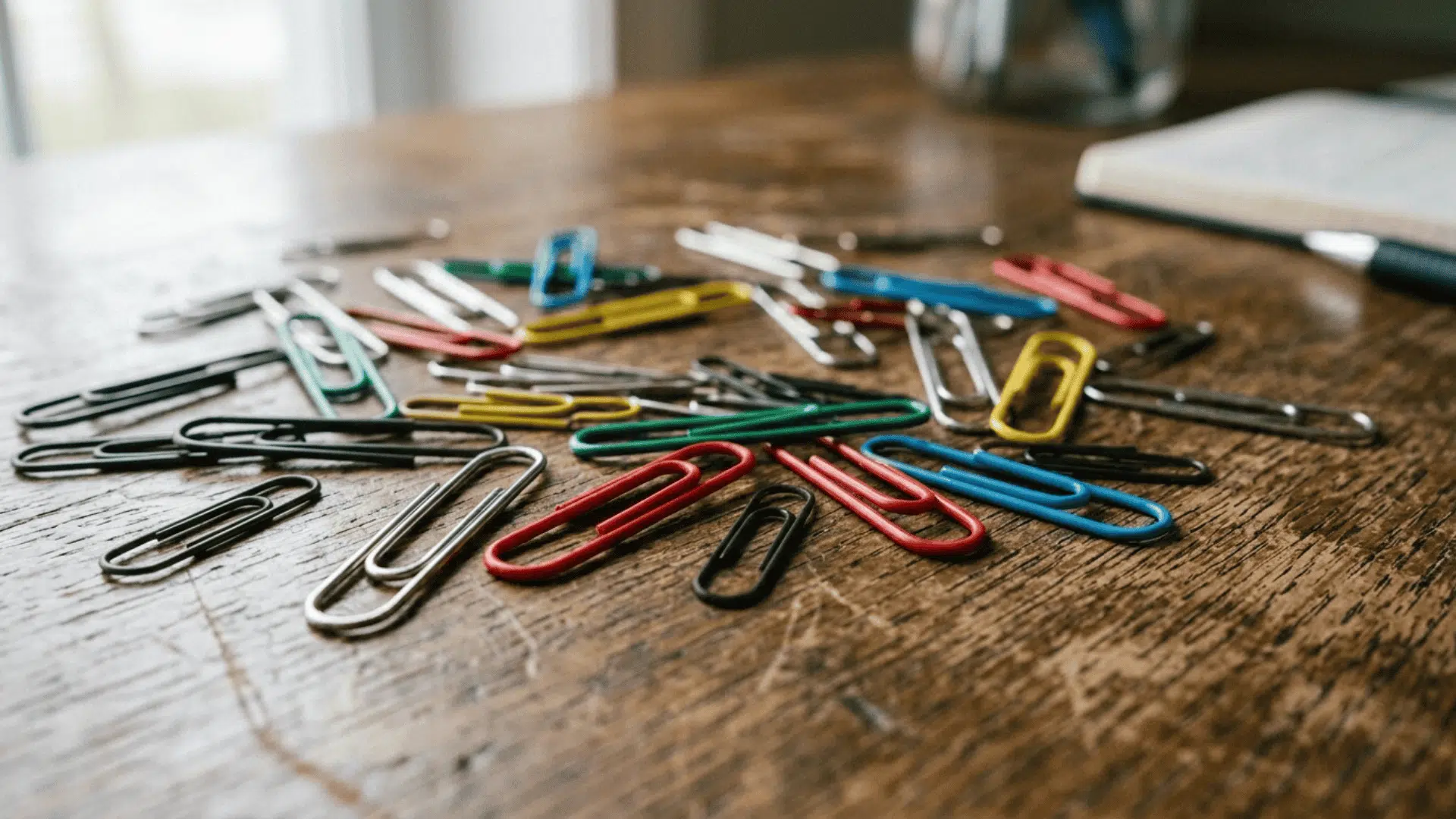

Most people use paper clips every single day without giving them a second thought. They sit quietly in desk drawers, hold documents together, and get bent out of shape without much complaint.
But here is the question: What are paper clips made of? It is more interesting than it sounds. These small tools are the result of careful material choices, from the type of metal used to the protective coatings applied.
This blog covers the materials, history, and practical uses of paper clips in a straightforward, easy-to-follow way.
The History of Paper Clips
Paper clips are small but practical tools that hold sheets of paper together without damaging them. Before their invention, people relied on pins, ribbons, or stitching to keep documents organized. It was not the most efficient system.
Steel wire is drawn, cut, and bent into shape through an automated process that produces thousands of clips per minute.
The modern design came together in the late 19th century, with the “Gem” shape quickly becoming the most recognized and widely used version.
So what are paper clips made of that makes them so reliable? It comes down to the materials chosen during manufacturing. Steel wire became the go-to choice because it was widely available, affordable, and easy to shape during manufacturing.
And despite countless design variations over the years, the basic structure has stayed largely the same. Simple, functional, and effective.
Key Factors that Define Paper Clip Performance
Understanding what paper clips are made of is only part of the story. The material selection directly shapes how well a paper clip performs in real use.
- Material strength and flexibility: Determines how well the clip bends and holds without breaking
- Type of coating applied: Protects the metal surface from rust and daily wear
- Wire gauge and size: Controls how many sheets the clip can hold securely
- Resistance to rust and wear: Affects how long the clip lasts in different conditions
- Grip strength on paper: Ensures the clip holds firmly without tearing or damaging sheets
- Shape and bending capacity: Defines how easily the clip can be applied and removed
Materials Used in Paper Clip Manufacturing
Different metals and coatings serve different purposes. Each material brings its own set of qualities to the table.
| Material Type | Properties | Common Use Case | Advantages | Limitations |
|---|---|---|---|---|
| Steel | Strong and flexible | Standard paper clips | Cost-effective and durable | Can rust without coating |
| Stainless Steel | Corrosion-resistant | Humid or long-term use | Rust-resistant and long-lasting | Higher cost |
| Aluminum | Lightweight | Light paper holding | Non-rusting and easy to handle | Less strength |
| Brass | Softer metal | Decorative or specialty clips | Non-corrosive | Lower strength |
| Plastic Coating | Outer layer over metal | Colored clips | Prevents rust and improves grip | Harder to recycle |
| Zinc/Nickel Coating | Protective metal layer | Standard coated clips | Adds corrosion resistance | Coating can wear over time |
Use of Paper Clips in Daily Life and Innovation
Paper clips do far more than hold documents together. Knowing what paper clips are made of helps explain why they work so well across so many different situations.
1. Office and Organization Use

In office settings, paper clips are among the most relied-upon tools for organizing documents. They hold sheets together without causing damage, making them easy to separate and reattach whenever needed.
Beyond holding papers, they are used for sorting and grouping related documents and bookmarking specific pages within larger files.
In legal and medical offices, especially, paper clips are a go-to tool for keeping multi-page forms and records grouped without permanent binding
2. Practical Everyday Use

Paper clips are not limited to office desks. Many people use them in small but practical ways throughout the day.
The reason they hold up so well comes down to what paper clips are made of: durable steel that withstands repeated use without losing shape.
They are commonly used to reset electronic devices, manage loose cables, and serve as temporary fasteners when a proper tool is unavailable—small fixes, but surprisingly effective ones.
3. Creative and Innovational Use

Paper clips have found a place in creative projects as well. Their flexible metal structure makes them easy to bend, reshape, and repurpose beyond standard use.
From DIY repairs and craft projects to prototyping simple mechanisms, they prove useful in unexpected situations.
Their metal composition makes it clear why they are so adaptable, as the steel core holds its form while still allowing controlled bending.
4. Scientific and Technical Use

In scientific and technical settings, paper clips are often used as basic conductors, connectors, and testing tools during experiments and prototype builds.
Their usability in these settings depends on their metal composition. Steel and other conductive metals can carry small electrical currents.
This makes them handy for basic circuit testing, classroom experiments, and low-scale technical applications. A simple tool that gets the job done.
Paper Clips vs. Alternatives: What Works Best?
Paper clips are useful for keeping papers together without causing damage. Compared with similar office items, they are simpler, lighter, and easier to remove.
| Item | Best For | Grip Strength | Reusable | Damages Paper | Main Advantage |
|---|---|---|---|---|---|
| Paper Clips | Small stacks of paper | Light | Yes | No | Easy to use and remove |
| Binder Clips | Thick stacks of paper | Strong | Yes | No | Holds large groups securely |
| Staples | Permanent document fastening | Strong | No | Yes | Keeps papers firmly attached |
| Rubber Bands | Bundling loose items | Medium | Yes | No | Flexible for mixed items |
| Bulldog Clips | Heavy paper stacks | Very strong | Yes | No | Strong hold for bulky documents |
Common Mistakes to Avoid
Choosing the wrong paper clip can cause more problems than expected. A basic understanding of their material composition helps avoid these common errors.
- Using low-quality clips: Poorly made clips bend too easily and fail to hold documents securely under regular use
- Ignoring rust-prone materials: Steel clips without proper coating can corrode quickly in humid or damp conditions
- Overloading clip capacity: Stacking too many sheets causes the clip to lose its grip and permanently deform
- Overlooking coating compatibility: Coated clips are not always suitable for recycling and require separate disposal methods
- Using incorrect sizes: Smaller clips used on thick document stacks will stretch out and stop functioning properly
Conclusion
Paper clips are a small but well-thought-out tool. The answer to the question: What are paper clips made of? goes beyond just steel wire.
It includes coatings, material choices, and design decisions that directly affect their performance. Steel provides the core strength. Coatings like zinc, nickel, and plastic add protection and improve usability.
Choosing the right paper clip for the right task makes a real difference. So next time one gets picked up off a desk, there is a bit more going on than it appears.

With a Master’s in Architecture from the University of California, Berkeley, Alexander Martin has dedicated the last 18 years to enhancing outdoor living through thoughtful and robust structure design. His career kicked off in urban planning, giving him a unique perspective on integrating structures into diverse environments. In 2019, Alexander brought his expertise to our website, offering insights into creating versatile outdoor spaces. Since then, he has been the lead advisor for our outdoor design projects and is known for his ability to merge functionality with environmental consciousness. Alexander enjoys rock climbing outside of work and participates in community development projects, activities that reflect his passion for the outdoors and sustainable design.