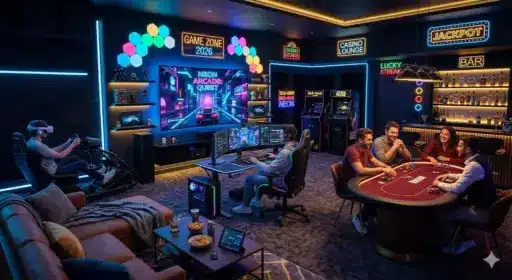
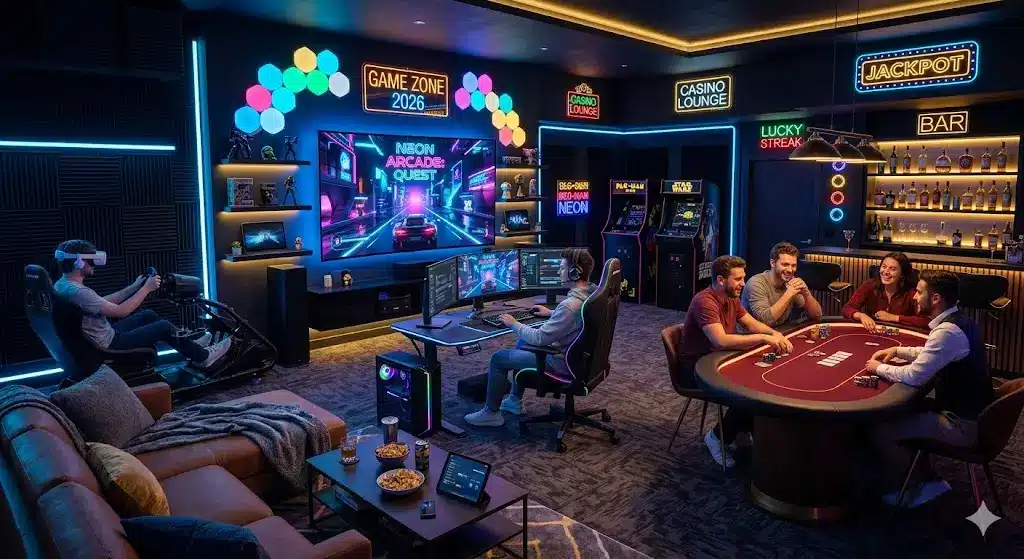
In 2026, the home game room is no longer a basement outcast – it’s a functional architectural feature. Inspired by smart interior design, IoT, and spatial efficiency, modern game rooms are highly engineered environments.
In today’s world, complete environments are required for total entertainment and leisure. From hosting a poker night to playing at a top-rated online casino, it’s a vital component. Here, we examine how the ultimate 2026 game room strikes a balance between technology, comfort, and luxury casino design.
Spatial Utility and Furniture-Grade Aesthetics
The aesthetic of home gaming has evolved from an arcade environment to furniture-grade installations. Design professionals are now specifying equipment, such as snooker tables, dartboards, and poker tables, as statement furniture items in residential design that complement the home’s overall look.
The Eradication of the Traditional “Man Cave”
The “man cave” – typified by its segregation and sports-themed or neon-laden interiors – has been ruthlessly eliminated from high-end residential design. Instead, there is now a focus on “furniture-grade” designs. Furniture-grade equipment is crafted from high-quality materials, including marble, brass, barnwood and concrete. It is meant to be integrated in modern, minimalist or mid-century modern spaces.
Dartboard cabinets and billiard tables are frequently being featured in luxury architecture magazines, which may indicate a shift from “toys” to “art”. The fluorescent has given way to white, beige and black colours, geometric forms, and symbols of affluence.
Intentional Eclecticism and Modular Architecture
The emerging, and very popular, interior design trend for 2016 deliberately avoids “matchy-matchy” rooms and creates “intentional eclecticism”. This trend is about mixing different design elements from different eras and styles (think modern digital gaming displays with original mahogany pool tables, or contemporary lounge room furniture with mid-century interior design).
Customisation is more common than ever, with consumers seeking specific colour felt colours, hardware finishes and custom joinery to match their spaces. Also, modular architecture is critical. Roll-out media shelves are just one example of how digital gaming consoles can be concealed until needed, thus retaining their stylish neutrality.
High-Fidelity Visual Technologies and Interactive Surfaces
The game room of 2026 is a visual environment, with ultra high-definition displays and touch-based interfaces that seamlessly join the physical and digital worlds.
Next-Generation LED and MicroLED Infrastructure
The luxury entertainment market has been saturated with LED and MicroLED displays. In 2026, 4K and 8K are the minimum resolution, accompanied by high dynamic range (HDR) and OLED hybrid technologies, offering unprecedented contrast ratios and true colour accuracy. Today’s screens offer “jaw-dropping” brightness, required for rooms that are increasingly open to daylight biophilic design.
For the serious digital gamer, speed is everything. The market has swung towards ultra-high refresh rates, zero response time and adaptive sync technologies that remove screen tearing and lag. This visual accuracy is essential for gaming, but also for the new class of high-definition live dealer casinos, which stream high-definition video to customers.
Digital Tabletop Gaming and Movement-Based VR
Gone are the days of wall-mounted, multi-screen displays; large digital display tables are now a must-have for high-end digital board gaming and simulations. 65-inch touchscreen tables are ideal for digital tabletop role-playing games and magnetic rails for connecting accessories for traditional board games.
Virtual Reality (VR) and Augmented Reality (AR) games are immersive experiences and require physical interaction, so these rooms are open with no low-hanging items to bump into and limited decorative items that can be broken.
Bio-Adaptive Illumination and IoT Synchronization
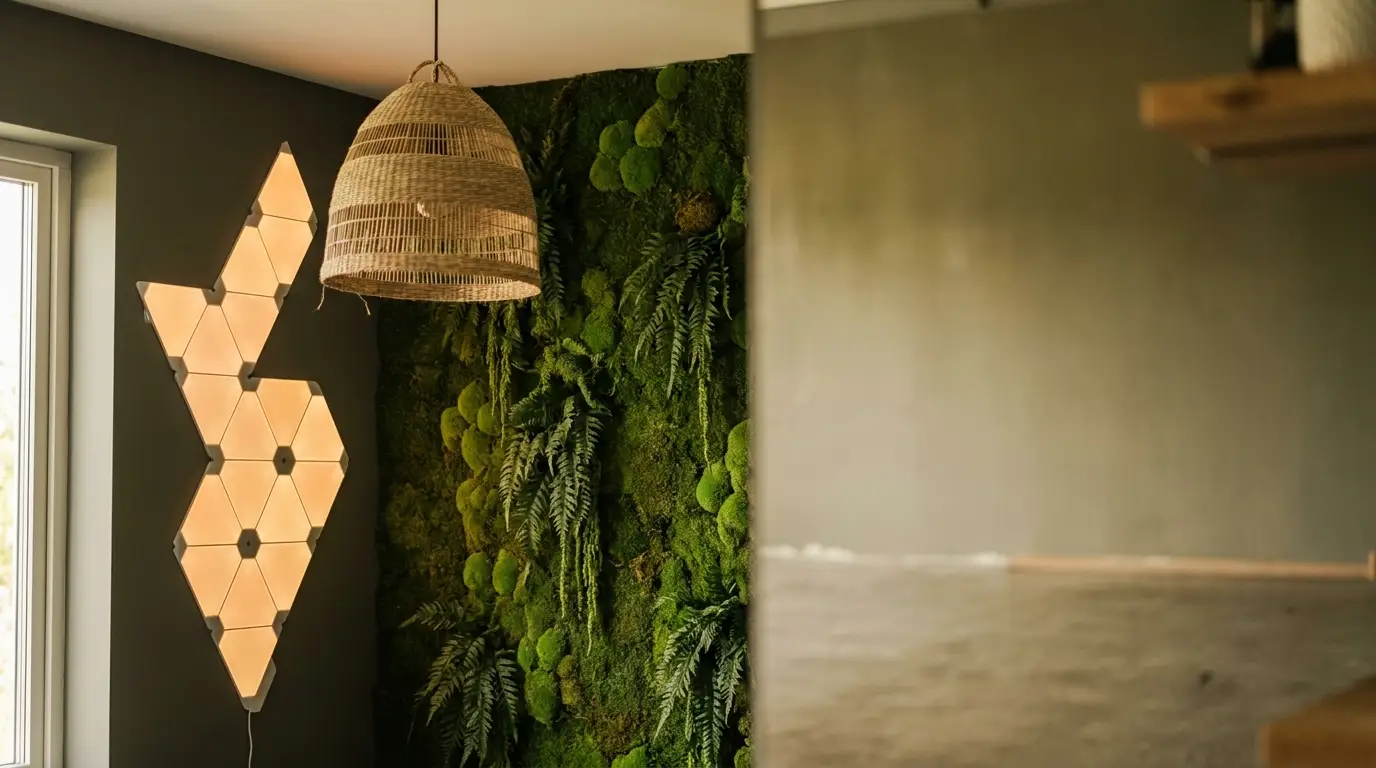
Lighting in today’s game room is no longer a mere utility, but an integral part of the entertainment experience, physiologically as well as visually.
Dynamic Synchronization and IoT Ecosystems
Over 40% of modern gamers consider smart lighting features essential to environment and ambience. Technologies such as Philips Hue, Razer Chroma and Govee combine IoT with lighting systems to connect the room to the game. They use light bars, ring lights and hexagonal wall panels to bring the virtual environment to the real world.
In the game room, as the digital game environment changes, or the digital slot machine pays, so does the lighting in colour and intensity. Biologically, ambient lighting decreases contrast on the screen and background, preventing eye fatigue for extended entertainment.
Biophilia 2.0 and Circadian Entrainment
The new way to reverse the effects of stimulating digital lighting is “Biophilia 2.0”. In 2026 the game room is not overstimulating with digital and real-life stimuli. Biophilia has moss walls, plants, wood and rattan lighting.
Crucially, smart lighting is set to circadian cycles. Cool blue light helps to focus in the morning. Later, warmer amber light is emitted for a calming effect.
Acoustic Engineering for Immersive Isolation
Acoustic design is a significant and previously under-valued element of game room design. In 2026, sound isolation is an important design consideration to improve sound immersion and preserve the acoustic environment of the home.
Mitigating Airborne and Impact Noise
For excessive airborne noise, architects use the “room-within-a-room” approach when decoupling internal walls from the main structure. Acoustic products like Maxiboard – a patented multi-layer acoustic wallboard – provide additional mass and flexibility to the interior walls, enhancing transmission loss. For impact noise (such as VR), dense acoustic carpet underlayments and floating floors are laid under the floor.
The Psychology of Acoustic Control
For the serious gamer, acoustics are the key to success. Acoustic designers specify acoustic panels with high mass (disguised as decorative fabric-wrapped art or natural wood slats) that absorb 90% of mid-to-high frequency sound. The outcome is an acoustic environment in which the user can identify audio cues with pinpoint accuracy, avoiding fatigue.
Advanced Ergonomics, Haptic Seating, and Smart Furniture
The furniture of 2026’s game room is not passive, but active, sensorized, and haptic, “smart” furniture.
The Biomechanical Evolution of the Gaming Chair
The traditional “race chair” has been replaced with biomechanically researched chairs. Herman Miller, Secretlab, and Dowinx dominate the industry. By 2026, the market standard requires responsive lumbar support, magnetic memory foam for the headrest, and elastomer mesh that allows quick thermal regulation.
Smart Sofas and Haptic Theater Seating
The “Smart Comfort” line of furniture sets a new benchmark for local, multi-person entertainment. The sofas are equipped with integrated sensors that sense the weight and position of the body, and automatically modulate cushion firmness in response.
In addition, haptic feedback actuators are discreetly embroidered into the fabric. These actuators, when paired with a video game console, home cinema system, or online casino game, translate low-frequency sound waves into precise tactile feedback, providing a reactive 4D experience that turns passive video gaming and multimedia entertainment into an interactive experience.
The Authentic Residential Casino Experience
The quest for opulence in commercial casinos has shaped the design of domestic game rooms. The 2026 paradigm simply scales down the luxury of commercial spaces.
Luxury Physical Infrastructure and Table Design
Custom manufacturers like Kings Poker and BBO Poker Tables create tables to order. Contemporary tables prefer high-end materials: solid wood table legs, custom-designed brass and stainless steel pedestals and high-quality, water-resistant speed cloth. They often include built-in LED lighting beneath faux-leather-padded armrests, USB-C charging ports, and meticulously crafted stainless steel cup holders.
The Convergence of Physical and Digital Casino Platforms
Although the physical equipment delivers the tactile pleasures of real-life play, the 2026 entertainment world is hybrid. High-end, 8-deck automatic shufflers and RFID-embedded premium chips are now commonplace in upscale households, offering real-time statistical analyses to local mobile apps.
Once the real-world poker game is over, the space automatically switches to online poker. High-resolution video screens and local, low-latency Wi-Fi 7 networks provide live dealer casinos in crystal clear quality. Here, platforms such as Casinofy play a pivotal role.
Casinofy is an online review and comparison platform with industry experts who carefully review and approve legitimate casinos. Given the plethora of bonuses and software compatibility with mobile apps, the online gambling industry is crowded with complex offers, and players rely on review sites like Casinofy to discover the best no-deposit bonuses, free spins, and referrals, without losing money on unregulated sites. The modern game room is well-equipped to enhance this experience, transforming the room into a professional setting for digital roulette, progressive jackpot slot machines, or poker.
Home Bar Architecture and Hospitality Elements
The creation of a home bar has become a built-in element of modern design to complete the entertainment and casino experience.
Architectural Integration and Dopamine Decor
No longer an eyesore, today’s home bar is integrated into the room’s cabinetry. Designers use strategies such as niches and full-height storage behind pocket doors to make the bar feel deliberate.
Inspired by boutique hotels, home bars are often designed using the concept of “dopamine decor”. This employs bold and saturated colour schemes, textural materials and curated displays to evoke positive emotions. The incorporation of invisible technology, like undercounter smart refrigerators that monitor stock and hidden induction warming drawers, brings added functionality.
Macro-Infrastructure: HVAC, Smart Home Ecosystems, and Automation
The amenity of the ultimate game room depends on infrastructural details largely out of view. Home automation systems can now predict and control the climate and energy consumption based on the homeowner’s habits and occupancy sensors.
Homes are now increasingly equipped with solar heating and cooling and smaller, smarter geothermal heat pumps to offset the energy costs of an active, high-tech home theater. Also, smart locks enable homeowners to securely share a password to allow guests to enter the home for a gaming night, and encrypted networks can secure both users’ personal information and their digital payments for gaming apps.
The Future of Residential Entertainment
With a focus on the multifunctional nature of space, biophilic and haptic technologies and the immersive experience of luxury casinos, today’s architects have revolutionised home entertainment. As you journey through vast virtual worlds, play tactile cards, or spin the virtual roulette wheel, the ultimate game room is an integration of technology, comfort and exciting mood into an architectural design.

Film-buff journalist Felix Moreno earned his Film Studies degree at NYU and has reviewed cinema and streaming culture since 2012. Joining us in 2025, he spotlights must-watch releases, crafts spoiler-free synopses, and interviews behind-the-scenes talent. Felix’s playful trivia keeps readers ahead of the pop-culture curve. Offscreen, he runs a community film club and experiments with short-film screenwriting in his Brooklyn studio.