A kitchen remodel rarely blows its budget because of one big shock. It blows the budget through dozens of small decisions – each one feeling reasonable at the moment, all of them adding up to a final number that bears little resemblance to the original plan. Cabinet upgrades, hardware swaps, lighting splurges, and unexpected repairs behind the walls quietly stack on top of one another until the final invoice is 30% above the starting estimate.
The good news: nearly all of those overages are predictable. With a clear cost framework, a realistic contingency, and discipline around the smaller line items, homeowners can complete a kitchen remodel close to the original budget. This guide breaks down current 2026 cost data, the percentage-by-category allocation experienced contractors actually use, and the specific decisions where remodel budgets most often slip.
How Much Does a Kitchen Remodel Actually Cost in 2026?
Before setting a budget number, it helps to anchor against what kitchens actually cost this year. According to NerdWallet’s reporting on the 2025 Cost vs. Value Report, a minor kitchen remodel in 2026 costs around $28,500, a major midrange remodel runs about $83,000, and a major upscale one pushes past $160,000.
A few useful benchmarks for sizing kitchen remodel cost expectations:
- Small kitchen (under 70 sq ft): $8,000–$18,000
- 10×10 kitchen (mid-size, ~100 sq ft): $10,000–$25,000
- 12×12 kitchen (~144 sq ft): $18,000–$36,000
- Large kitchen (over 150 sq ft, mid-range): $30,000–$45,000+
A second anchor: the long-standing rule of thumb is to spend 5–15% of the home’s value on a kitchen remodel. Spending $80,000 on a kitchen in a $300,000 home rarely returns at resale. The right kitchen remodel budget is the one that fits the house, not the inspiration board.
Start with a Real Number, Not an Aspirational One
Most homeowners pick a kitchen remodel budget by choosing a round number that feels right. $30,000. $50,000. Whatever sounds like “a kitchen.” That number is fiction until it’s tied to two real questions:
- What is the home worth in its neighborhood at the top of the market?
- How long is the homeowner planning to stay?
Long-term owners can stretch toward the upper end of the 5–15% range. Owners planning to sell within a few years should stay near the low end – minor mid-range remodels recoup roughly 70–96% of cost at resale, while major upscale ones return closer to 50%, per Remodeling Magazine’s Cost vs. Value Report.
Kitchen Remodel Budget Breakdown by Category
Experienced contractors and designers typically divide a kitchen remodel budget into the categories below. The percentages are starting points – homeowners can shift them based on priorities, but the overall structure holds across most projects.
| Category | % of Budget | What’s Included |
|---|---|---|
| Cabinets | 25–35% | Boxes, doors, drawers, hardware, install |
| Labor | 20–30% | Demo, install, plumbing, electrical, finish |
| Countertops | 10–15% | Material, fabrication, edge work, install |
| Appliances | 10–20% | Range, fridge, dishwasher, hood, microwave |
| Flooring | 5–10% | Material plus install |
| Lighting & electrical | 4–8% | Fixtures, recessed, under-cabinet, switches |
| Plumbing fixtures | 3–5% | Sink, faucet, disposal |
| Backsplash | 2–5% | Tile, stone, install |
| Permits & fees | 1–3% | Building, electrical, plumbing permits |
| Contingency | 10–20% | The bucket nobody plans for |
Cabinets Are Where Most of the Money Goes (and Most of It Gets Wasted)
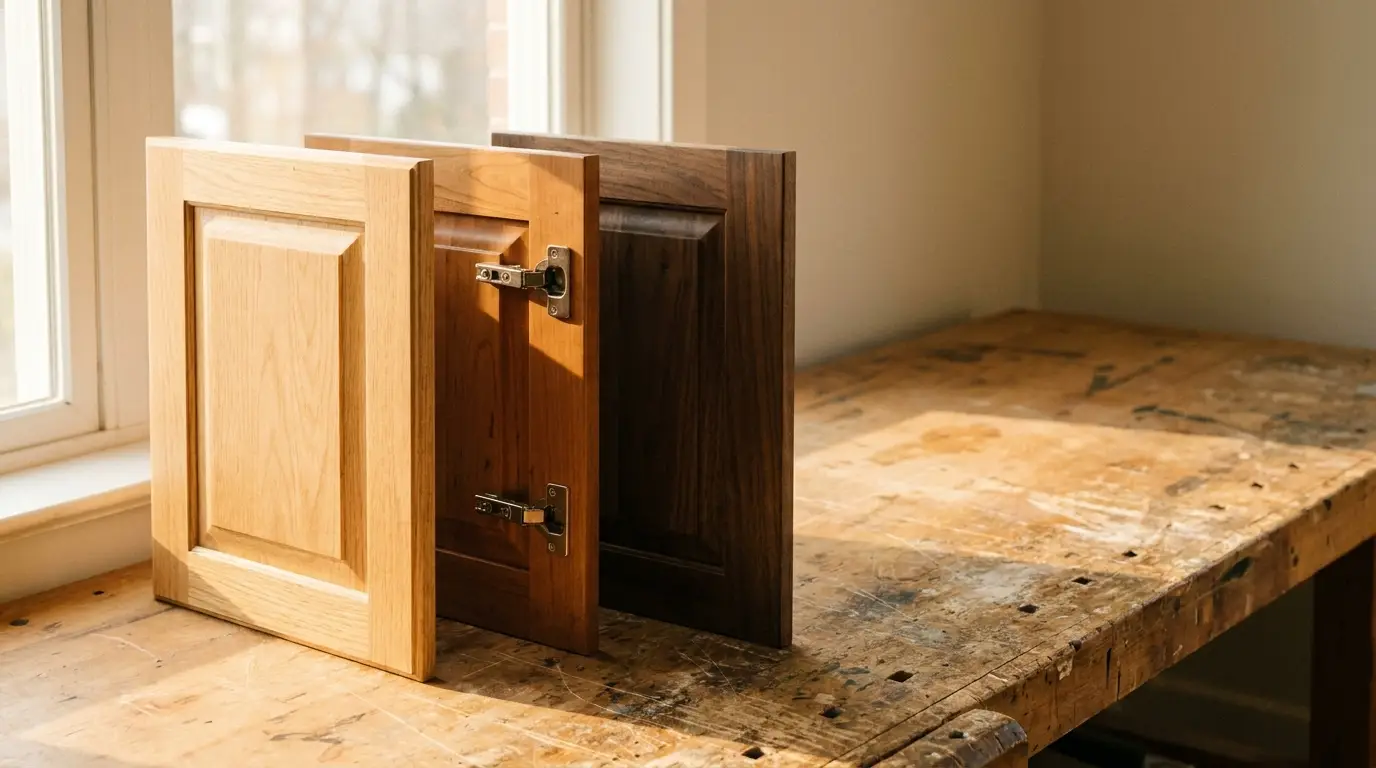
Cabinetry is the single largest line item in almost every kitchen, which makes it the single biggest lever for budget control. A custom cabinet quote and a stock or RTA quote can differ by $15,000 on the same kitchen and the finished result is often hard to tell apart.
Three cabinet tiers, in plain English:
- Custom cabinets: built to spec for the exact kitchen footprint. Beautiful, slow, expensive. Lead times of 8–12 weeks are normal.
- Semi-custom cabinets: stock cabinets with optional sizing and finish tweaks. The best balance for most renovations.
- Stock and RTA cabinets: pre-sized, pre-finished, ready to ship. Cheapest, fastest, surprisingly close in finished quality if chosen well.
For homeowners working with a tight budget, RTA kitchen cabinets are worth a serious look before writing off the cabinet line. Ready-to-assemble cabinets ship flat, get assembled on site, and routinely come in 40–50% under big-box equivalents – sometimes more, depending on the supplier. Quality RTA lines use solid wood face frames and plywood boxes with soft-close hinges, which matches what a mid-tier semi-custom line offers at twice the price.
How to Measure for Kitchen Cabinets Without Costly Mistakes
Mismeasured cabinetry is one of the top three causes of kitchen remodel cost overruns. The issue isn’t installation – it’s that cabinets get ordered wrong, then either returned (with restocking fees, freight, and project delays) or modified on site by a finish carpenter charging $85+ per hour.
Anyone ordering their own cabinets – even partially – should work through a proper how to measure for kitchen cabinets before placing an order. The four measurements that most often trip up homeowners:
- Wall lengths at multiple heights – walls are rarely plumb, and a kitchen wall can vary by half an inch from floor to ceiling
- Window and door rough openings, not trim-to-trim measurements
- Soffit height and ceiling variations across the room
- Outlet, vent, and plumbing locations relative to a fixed reference point
For any kitchen that isn’t a simple rectangle, professional measuring is worth the cost. A licensed installer or designer typically charges $150–$300 for a measure-up – easily ten times less than the cost of a mismeasured cabinet order.
The “Small” Decisions That Quietly Eat a Kitchen Remodel Budget
This is where most projects actually go off the rails. The cabinet quote came in fine. The countertop quote came in fine. Then, over six weeks, the homeowner makes eighty smaller decisions, each one a couple hundred dollars. By the time it’s time to pick out cabinet pulls, the project is so far along that “$18 a knob is fine, we have 32 of them” sounds reasonable. That’s $576 on knobs.
The categories that tend to creep:
- Backsplash. Subway tile runs $2/sqft. Handmade zellige tile runs $25/sqft. Same wall, very different invoice.
- Faucets. A reliable kitchen faucet costs around $180. A brushed-brass pull-down with magnetic dock can run $620.
- Lighting. Recessed cans plus a single pendant cluster: roughly $400 in fixtures. Decorative pendants over an island: $1,200–$3,000.
- Appliances. A mid-tier appliance package costs $4,500–$6,000. A 36-inch induction range plus a counter-depth panel-ready fridge can push the appliance line past $14,000 before anything is turned on.
- Hardware. $3 knobs versus $20 knobs across a 30-cabinet kitchen is the difference between $150 and $1,000.
None of these are wrong choices on their own. The problem is making twelve of them in a row without checking the running total.
The Contingency Rule: 15%, Not 10%
Most guides recommend a 10% contingency. For older homes especially, 15% is safer and 20% is sensible for any home built before 1980. Once the drywall comes off, the surprises in older homes tend to be expensive ones: galvanized plumbing that has to come out, a subfloor with rot under the sink, wiring that doesn’t pass current code and now must be brought up to spec because the wall is open.
A 15% contingency on a $40,000 kitchen remodel is $6,000. If it goes unused, it becomes an end-of-project cushion for nicer light fixtures or upgraded hardware. If it gets used, it absorbs exactly the surprises it was meant for, without putting the homeowner into debt.
The One Discipline That Actually Keeps Kitchen Remodels On Budget
Across hundreds of completed remodels, one habit separates the projects that finish on budget from the ones that don’t: a single running spreadsheet with three columns. Estimate, actual, and difference. Updated the day every quote arrives or every receipt is signed.
Most homeowners skip this step. They look at individual line items and feel fine about each one. The spreadsheet is the only thing that catches the cumulative coverage in real time – the moment in week four when the project is already $4,200 over and the appliances haven’t been ordered yet. That’s when there’s still time to swap from quartz to a quartz-look laminate, or from imported tile to a domestic version. By week eight, those swaps are no longer available.
Frequently Asked Questions About Kitchen Remodel Budgets
How much should be budgeted for a kitchen remodel? Plan to spend 5–15% of the home’s value on a kitchen remodel. For a typical $400,000 home, that’s $20,000–$60,000. The 2026 national median sits around $27,000 for a mid-range remodel. Long-term homeowners can lean toward the higher end of the range; those remodeling to sell should stay near the lower end.
What is the 30% rule for kitchen remodels? The 30% rule refers to cabinets typically consuming around 25–35% of the total kitchen remodel budget – making them the largest single category. Knowing this upfront helps homeowners decide whether to splurge on custom, save with semi-custom, or choose RTA cabinets and reallocate the savings to countertops or appliances.
What is the most expensive part of a kitchen remodel? Cabinets, by a wide margin. They typically account for 25–35% of the total budget, followed by labor (20–30%), countertops (10–15%), and appliances (10–20%). Reducing cabinet cost is the fastest way to reduce overall remodel cost without visibly downgrading the kitchen.
Are RTA cabinets worth it for a kitchen remodel? For most budget-conscious remodels, yes – provided the measurements are accurate and the supplier offers solid wood face frames, plywood (not particleboard) boxes, and soft-close hinges as standard. Quality RTA cabinets cost 40–50% less than big-box equivalents and roughly half what semi-custom runs, with a finished look most guests can’t distinguish from higher tiers.
How can homeowners avoid going over budget on a kitchen remodel? Five rules cover most of the risk: build in a 15–20% contingency from day one; track every quote and receipt in a single spreadsheet; lock in the design before demo so change orders don’t multiply; cap the small-ticket finishes (hardware, faucet, lighting) before shopping for them; and re-check the running total before approving any “while we’re in there” upgrades the contractor proposes.
Is it cheaper to refinish or replace kitchen cabinets? Refinishing or refacing existing cabinets typically costs 30–50% of full replacement, so it’s almost always cheaper. The catch: it only works if the existing cabinet boxes are structurally solid and the layout still works. If either of those is wrong, refacing is money spent on a kitchen that will be redone again in five years.

NKBA-certified designer Harper Williams holds a degree in Interior Architecture from Auburn University and has specialized in high-function kitchens and spa-inspired baths since 2011. She joined us in 2024 to simplify layout planning, fixture selection, and budget tricks for remodelers. Away from CAD files, Harper restores vintage cookstoves and crafts small-batch soaps.