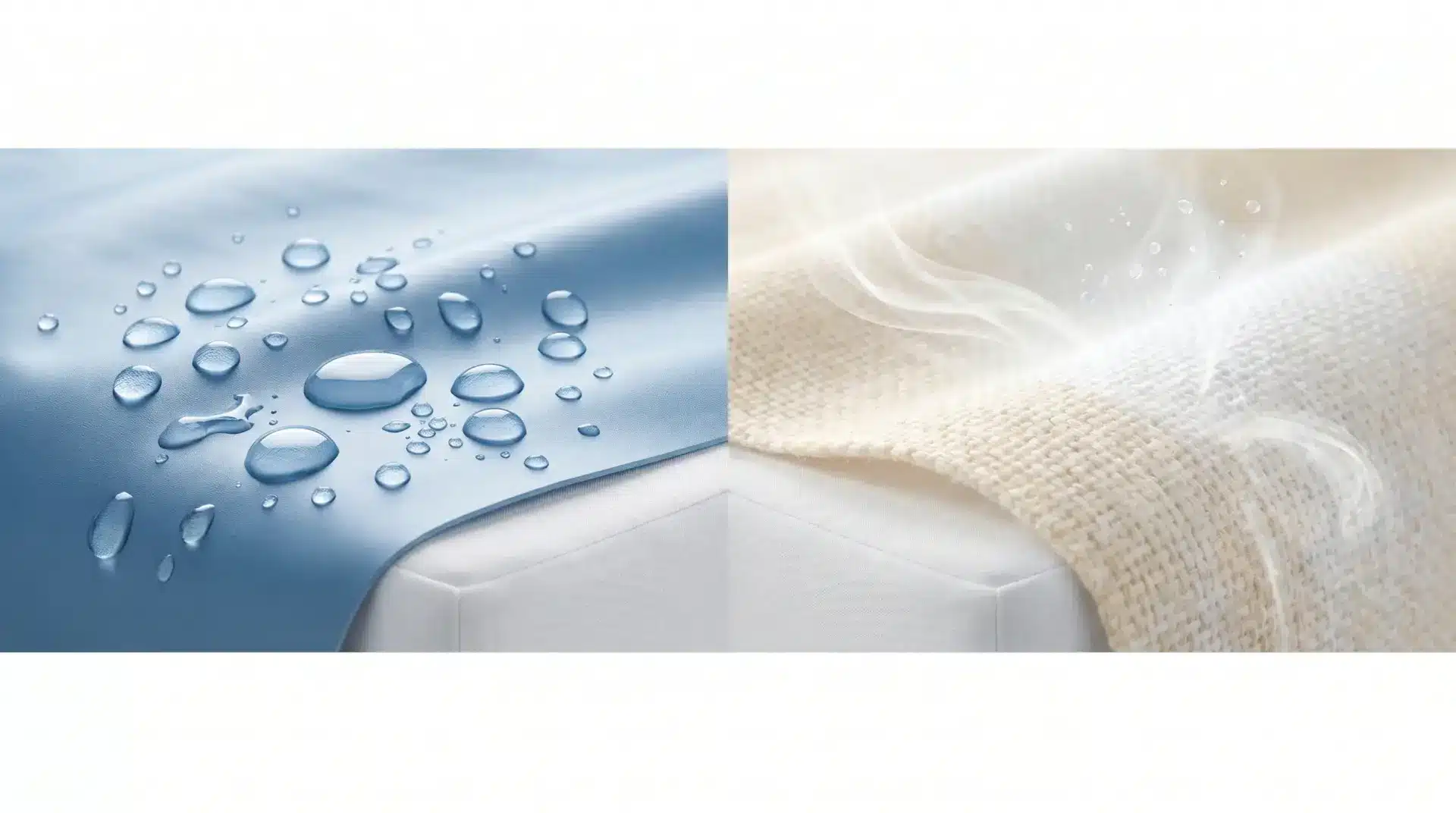

“Waterproof” and “breathable” sound like opposite properties, and historically they were. If a fabric blocked water, it also blocked air; if it let air through, it let water through too. The mattress protector market split along this binary for decades, with customers forced to choose between protection and comfort. Modern membrane technology has collapsed this trade-off somewhat, but not completely, and the marketing language has outrun the underlying engineering in ways that make shopping confusing. What these terms actually mean, and which protector is right for your situation, depends on what trade-offs you’re willing to make.
What Waterproof Actually Means
A waterproof mattress protector blocks liquid water from reaching the mattress underneath. This is the primary protection function, and it’s what distinguishes a true protector from a simple mattress cover or pad. Without this, the protector isn’t doing its main job.
Older waterproof protectors achieved this through a vinyl or polyurethane film layer bonded to the fabric. The film is completely impermeable, not just to water but also to air and water vapour. This works extremely well at blocking spills but creates the closed microclimate against the sleeper that makes these protectors uncomfortable for anyone who runs warm. The protection is total but the thermal cost is significant.
These vinyl-backed protectors still exist and are still sold, usually at the cheaper end of the market. They’re sometimes the right choice for specific situations (children who wet the bed, elderly family members with incontinence concerns, guest beds where occasional heavy-duty protection matters more than thermal comfort), but they’re a poor choice for regular adult use.
What Breathable Actually Means
“Breathable,” in the context of mattress protectors, means the material allows air and water vapour to pass through it. A breathable protector lets the heat and moisture from your body dissipate into the mattress and eventually the room, rather than trapping it at the surface.
The challenge is that traditional breathable fabrics (like cotton alone) don’t block liquid water. Water soaks right through, which defeats the protective purpose. For most of bedding history, this meant that truly breathable materials couldn’t be protective, and protective materials couldn’t breathe.
Modern breathable fabrics use pore sizes small enough to block liquid water molecules (which are larger and held together by surface tension) while letting water vapour molecules through (which are smaller and move individually). This is the same principle that makes Gore-Tex and similar outdoor fabrics function, and the technology has migrated into mattress protectors over the last decade.
Waterproof and Breathable Together
The ideal mattress protector is waterproof AND breathable, not one or the other. This combination addresses the historic trade-off by using materials that block liquids while allowing vapour and airflow.Waterproof mattress protectors for large bedsare built around this principle, with a waterproof membrane that still allows the moisture and air movement needed to keep the microclimate against the sleeper comfortable.
The quality of the combination varies significantly across price points. At the cheap end, “waterproof breathable” protectors often sacrifice one or both properties: they may be less effective at blocking liquids than the label suggests, or their breathability may be marginal. At the higher end, the combination is genuine, with membranes that provide near-total liquid protection and meaningful air and vapour permeability.
The underlying materials matter. Polyurethane film technology has advanced considerably in the last ten years, and modern thin polyurethane membranes perform much better on breathability than older thicker films. Membrane protectors with microporous structures allow more vapour movement than solid-film alternatives. The differences don’t always appear on the label, which is why reading reviews and examining specifications carefully matters for this category.
When Pure Waterproof Makes Sense
There are situations where maximum waterproof protection matters more than breathability. Beds used by young children who haven’t fully achieved nighttime dryness benefit from pure vinyl or polyurethane protection, because the volume of liquid involved is greater than any breathable membrane handles reliably. Medical situations involving incontinence, particularly for adults, are similar.
Guest beds that see occasional heavy use where the primary concern is preserving the mattress from spills or accidents can justify maximum waterproofing even at thermal cost. If the bed isn’t being slept in nightly, the thermal trade-off matters less.
Mattresses being stored or transported may benefit from full waterproof covers rather than breathable protectors, because the goal isn’t comfort during storage but complete protection from environmental moisture.
When Breathability Matters More

For regular adult use on a mattress used nightly, breathability matters most of the time. Night sweating, thermal regulation, and the general comfort of the microclimate against the body are ongoing concerns that breathability addresses. Spills and major liquid events are rare; heat and moisture accumulation happen every night.
If you sleep warm, breathability is essential. A vinyl-backed protector on a mattress marketed as “cooling” is likely to undermine the mattress’s thermal performance substantially; this is one of the most common silent sleep problems in bedding, where the mattress is fine but the protector is creating the heat issue.
For combination sleepers, sleepers with mild to moderate sweating, and anyone in warm climates or seasonal heat, breathability is the feature that matters most of the time. A protector that provides substantial protection alongside genuine airflow is worth paying slightly more for, because the nightly comfort benefit is large compared to the marginal extra cost.
How to Evaluate Claims
Mattress protector marketing tends toward confident promises that don’t always hold up under examination. A few signals help you read the claims more accurately.
Price is a rough proxy for quality in this category. Protectors under £20 are usually vinyl-backed or cheap polyurethane film with limited durability and minimal breathability. Protectors between £40 and £100 usually use better membrane technology and offer more credible combined waterproof-breathable performance. Above £100 is usually high-end materials or premium branding; performance improvements taper off.
Care label information tells you something. A protector that can only be washed cold probably has a cheap membrane that won’t survive hot washing, which is also a sign the membrane isn’t high-grade. Protectors that can be washed at 60°C repeatedly tend to use more durable materials.
Reviews that specifically mention thermal performance (or the absence of thermal issues) are more informative than reviews that focus only on whether the protector protected against a specific spill. Thermal issues show up over weeks and months of use, not in a single stress test, so longer-term reviews often capture what the marketing language doesn’t.
Third-party testing certifications, where they exist, add credibility. A protector certified by a recognised body as meeting specific breathability or waterproof standards is more trustworthy than one making unverified claims.
The Fabric Layer
Beyond the waterproof membrane itself, the top fabric of the protector affects how it feels against your body through the fitted sheet. Cotton top layers breathe well and absorb some moisture before it reaches the membrane. Bamboo blends are marketed as cooling with mixed evidence. Polyester blends are cheaper but trap more moisture.
The best combination is a breathable waterproof membrane underneath a natural-fibre top layer. This gives you both the protection of the membrane and the thermal comfort of the fabric in direct contact with the sheet. Combinations that pair a cheap membrane with a synthetic top fabric produce the worst thermal performance; combinations that pair a good membrane with natural fibres produce the best.
The Size and Fit Factor
Protector fit matters for protection as well as comfort. A protector that’s too large bunches up under the sheet and fails to cover the mattress properly; one that’s too small won’t fit over the mattress at all or will stretch to a compromised shape.
Mattress depth varies significantly, and protector depth should match. Modern mattresses are often 25-30cm thick, and protectors need to accommodate this. Many cheap protectors are sized for older, thinner mattresses and won’t fit properly on contemporary ones.
A fitted-style protector with a good elastic fit stays in place better than a cover that simply drapes over the mattress. For encasement-style protectors, zipper quality and seam sealing matter; the best protection comes from a fully enclosed mattress with no gaps where allergens or moisture could escape or enter.
The Bottom Line
For most adult sleepers using the bed nightly, a waterproof-and-breathable protector is the right choice. Match the depth to your mattress, make sure it can be washed at 60°C, and check that the membrane technology is genuine rather than cheap vinyl backing marketed as breathable.
For specific high-liquid protection needs (children, medical situations, guest beds with occasional heavy use), pure waterproof protectors remain appropriate despite their thermal cost. Using them short-term or in specific circumstances is fine; using them full-time for a regular sleeper usually introduces thermal problems that weren’t necessary.
For allergy prevention, a waterproof-and-breathable encasement that covers all six sides of the mattress adds the barrier function that top-only protectors don’t provide. The trade-off is slightly reduced airflow around the mattress as a whole, but for allergic sleepers the benefit typically outweighs this.

With a Master’s in Architecture from the University of California, Berkeley, Mitchell Green has spent over two decades dedicated to the study and practical application of home fixture design. His career started in an architectural firm, providing him a strong foundation in the structural and aesthetic aspects of home interiors. Mitchell brought his comprehensive knowledge to our platform, where he has been an influential voice in our home fixtures and fittings section. Since 2018, he has been guiding our readers through the intricacies of selecting and installing fixtures, combining technical know-how with design flair. In his spare time, Mitchell is a keen photographer, capturing architectural details and design elements, an interest that complements his professional focus.