
Have you ever compared two Roman shades that looked almost identical when closed, only to notice that they looked completely different once raised?
That is exactly what happens with flat fold and relaxed Roman shades.
Both styles give you the softness of fabric without taking up the floor space of full-length curtains. Both can be customized with different fabrics, linings, colors, and lift systems.
But they create very different windows.
A flat fold Roman shade looks clean, tailored, and controlled. A relaxed Roman shade forms a soft curve through the lower center, giving the window a more decorative and drapery-like appearance.
Here is the quick answer:
Choose a Flat Fold Roman Shade when You Want Clean Lines, Clear Pattern Display, and Visual Alignment. Choose a Relaxed Roman Shade when You Want a Soft Central Curve that Remains Decorative when The Shade Is Raised.
To compare the two styles across linen fabrics, privacy and blackout linings, and different operating systems, take a look at MorraHome’s custom Roman shades collection.
In this guide, you will learn how flat fold and relaxed Roman shades differ, which fabrics work best with each one, and how to choose the right fold for your room.
How This Guide Was Put Together
Before getting into the details, it helps to explain how the comparison was developed.
This guide combines:
- qualitative customer comments about flat fold and relaxed Roman shades;
- the visible construction and intended shape of each fold;
- current made-to-measure options, including fabric, lining, sizing, and operating systems.
General compliments such as good quality, accurate sizing, easy installation, helpful customer service, and reasonable pricing were not counted as reasons to choose one fold over another.
Those qualities matter when buying any Roman shade. They do not explain why a homeowner prefers flat fold rather than relaxed fold.
The customer comments discussed in this guide are qualitative. They show recurring themes in the reviews examined, but they are not a statistical survey of every Roman shade buyer.
Flat Fold vs. Relaxed Roman Shades at A Glance

| Feature | Flat fold Roman shades | Relaxed Roman shades |
|---|---|---|
| Overall look | Clean, tailored, and restrained | Soft, curved, and decorative |
| Bottom profile | Comparatively level | Curves downward through the center |
| Main visual focus | Fabric, pattern, and alignment | Shape, movement, and drape |
| Look when raised | Repeated horizontal folds | One central swoop with higher sides |
| Best pattern types | Stripes, checks, grids, and geometric repeats | Solids, textures, botanicals, and organic prints |
| Multiple windows | Easier to coordinate visually | Curves may show natural variation |
| Role in the room | Quiet architectural layer | More noticeable decorative feature |
| Best for | Visual order and pattern continuity | Softness and drapery-like movement |
| Main consideration | May feel too restrained for a feature window | May feel too informal where exact symmetry matters |
These are general design tendencies.
The final appearance will also depend on the fabric, lining, width, height, fold spacing, hardware, and overall workmanship.
What Is a Flat Fold Roman Shade?

A flat fold Roman shade looks like a broad panel of fabric when fully lowered.
As you raise it, the fabric gathers into a series of horizontal folds.
Its main features include:
- a clean fabric face;
- a comparatively level bottom edge;
- repeated horizontal folds when raised;
- a tailored rather than draped shape;
- less interruption of the fabric pattern.
A flat fold is different from a hobbled Roman shade, which keeps rows of projecting fabric loops across the front even when lowered.
It is also different from a relaxed Roman shade, which forms a soft downward curve through the center.
The easiest way to think about it is this:
A flat fold presents the fabric as a clean surface.
That does not mean every flat fold shade will look modern.
A neutral linen-blend flat shade may feel simple and contemporary. The same construction made from a floral or traditional striped fabric may look much more classic.
The fold controls the way the fabric is displayed. The fabric still controls much of the overall style.
What Is a Relaxed Roman Shade?

A relaxed Roman shade can also look fairly flat when fully lowered.
The main difference appears when you raise it.
As the fabric lifts, the center of the bottom edge falls into a soft curve. The sides sit slightly higher, creating one gentle swoop across the window.
That curve is intentional.
It is not a crooked hem or an uneven edge that needs to be pulled into a perfectly straight line.
A relaxed fold usually has:
- visible drape;
- a softer shape;
- an attractive half-raised position;
- more movement in the fabric;
- a less rigid relationship with the window frame;
- some natural variation.
When raised, it can look similar to a soft fabric valance or restrained swag.
Unlike a fixed valance, however, a relaxed Roman shade remains fully operable. You can still lower it for privacy, glare control, or light reduction.
A simple way to remember the difference is:
A flat fold presents fabric as a surface. A relaxed fold presents fabric as a shape.
The Biggest Difference Shows when The Shade Is Raised
Many product photographs show Roman shades completely closed.
That is useful for seeing the fabric color and texture, but it does not always show the most important difference between flat and relaxed folds.
When lowered, the two styles may look more alike than expected.
Raise them halfway, and the difference becomes much clearer.
Flat Fold Creates Horizontal Order
A flat fold rises into repeated horizontal layers.
The result feels organized, controlled, and closely connected to the straight lines already found in a room.
This style works especially well with:
- several windows positioned side by side;
- symmetrical room layouts;
- window grids;
- wall paneling;
- horizontal cabinetry;
- geometric fabrics;
- clean contemporary or transitional interiors.
The raised folds relate naturally to square window frames, rectangular molding, and other architectural details.
The main benefit is visual order.
That does not mean every flat fold automatically has the smallest physical stack.
Stack size also depends on:
- total shade height;
- fabric thickness;
- lining weight;
- fold depth;
- hardware;
- lift system.
A tall flat Roman shade made from thick fabric with blackout lining may create more volume than a shorter, lighter treatment.
A neat-looking stack and a physically small stack are not always the same thing.
Relaxed Fold Becomes More Decorative as It Opens
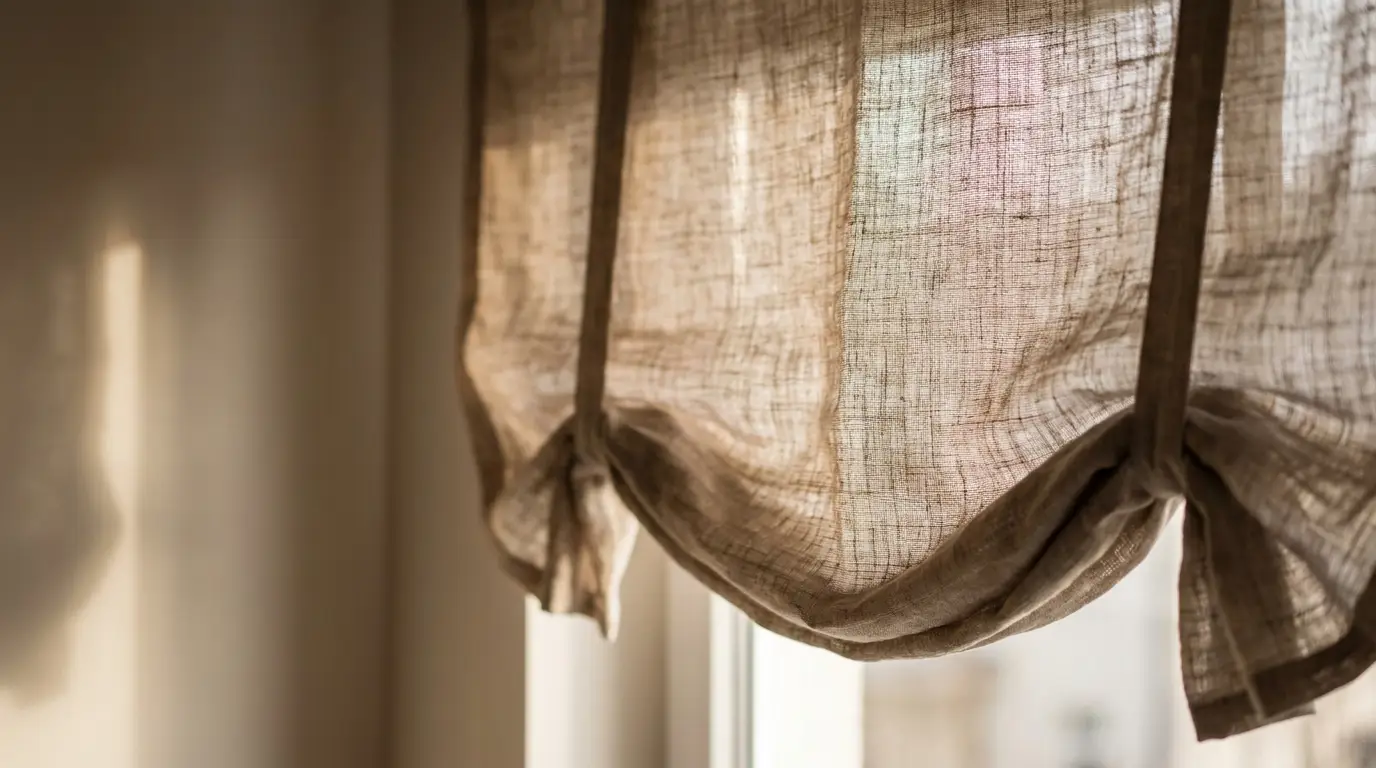
A relaxed Roman shade works in almost the opposite way.
Its personality becomes more noticeable as the fabric rises.
The central curve gradually forms, turning the half-raised shade into a visible decorative shape.
Opening the shade is not simply about clearing the glass. It creates the silhouette that makes the relaxed style special.
This is why relaxed Roman shades often work beautifully on individual windows that deserve attention, such as:
- a window above a kitchen sink;
- a breakfast nook window;
- a dining-room feature window;
- a reading corner;
- a guest-bedroom window;
- a window between built-in cabinets;
- a small window that needs softness without floor-length curtains.
The shade continues to decorate the window even while allowing in daylight.
For a relaxed Roman shade, the raised position is part of the design.
Why Choose Flat Fold Roman Shades?
Flat fold Roman shades are usually chosen for visual reasons rather than because they offer completely different operating features.
Custom sizing, cordless controls, motorization, privacy lining, and blackout lining may be available with several Roman shade styles.
The real appeal of flat fold is its clean presentation.
1. It Gives the Window a Cleaner Look
Flat fold does not have the permanent projecting loops of a hobbled shade.
It also does not have the curved bottom profile of a relaxed shade.
The result looks simpler and more controlled.
In the customer comments examined, recurring descriptions included:
- clean;
- tailored;
- sleek;
- simple;
- elegant;
- not bulky.
These words point to the same preference.
The homeowner wants the softness of fabric but does not want the fold itself to become a major decorative feature.
“Restrained” is a better description than automatically calling flat fold modern.
A neutral flat fold can feel modern. A floral flat fold can feel traditional. The construction creates order, but the textile still determines the wider aesthetic.
2. It Shows Fabric and Pattern More Clearly
Flat fold is usually the better choice when the fabric itself is the main feature.
When lowered, it creates a broad and comparatively uninterrupted surface.
That allows patterns to remain easier to read.
Flat fold works particularly well with:
- vertical stripes;
- horizontal stripes;
- checks;
- grids;
- geometric repeats;
- centered motifs;
- large-scale prints;
- directional patterns;
- coordinated patterns across multiple windows.
Imagine a strong geometric print.
On a flat fold, it reads as one clear graphic surface. On a relaxed fold, the lines near the bottom may bend with the central curve when the shade is raised.
That movement is not necessarily wrong. It simply creates a different effect.
Flat fold also does not guarantee a perfectly smooth, factory-like surface.
Linen, linen blends, and other woven materials may still show:
- slubs;
- fine wrinkles;
- subtle color variation;
- natural texture.
The benefit is not absolute flatness.
It is clearer fabric presentation.
3. It Creates a Neater Raised Profile
As a flat Roman shade rises, the fabric forms repeated horizontal sections.
This regular rhythm works well with:
- square window frames;
- rectangular molding;
- paneled walls;
- linear cabinetry;
- built-in shelving;
- several aligned windows.
The effect feels architectural without looking as hard or functional as a roller shade.
Customer descriptions such as “neat folds” and “folds cleanly” support this preference for order.
However, these comments do not prove that every flat shade will fold exactly the same way or never need occasional adjustment.
Roman shades are textile products. Fabric weight, construction, and daily use still affect how they behave.
4. It Is Easier to Coordinate Across Several Windows
Multiple windows are where flat fold often becomes the more practical visual choice.
If several shades need to look like one coordinated group, the repeated horizontal structure makes it easier to aim for:
- similar raised heights;
- level-looking lower profiles;
- coordinated fabric placement;
- consistent pattern alignment;
- a balanced wall.
This does not mean every shade will behave with mechanical precision.
Fabric is flexible, and small differences can still appear.
However, visual repetition is built into the design language of flat fold.
Relaxed fold is intentionally less exact. When strict alignment matters, flat fold is usually the more natural choice.
5. It Adds Softness without Taking Over the Room
Flat fold sits comfortably between a simple roller shade and a more decorative Roman shade.
It brings:
- woven texture;
- visible fabric;
- softness around the window;
- a custom-made appearance;
- more warmth than a purely functional blind.
At the same time, the fold shape remains comparatively quiet.
This makes flat fold easy to use in:
- contemporary homes;
- transitional interiors;
- Scandinavian-inspired rooms;
- restrained traditional spaces;
- rooms that already contain plenty of pattern or softness.
That does not mean a flat fold will disappear.
A bold color, large print, or oversized outside mount can still make it a major feature.
The difference is that most of the visual impact comes from the fabric rather than the fold shape.
Why Choose Relaxed Roman Shades?
Relaxed Roman shades solve a different design problem.
They are not chosen because they offer an entirely different form of privacy or light control.
They are chosen because the raised silhouette has decorative value.
1. The Central Curve Is the Main Feature
The defining characteristic is the soft downward curve through the middle of the lower edge.
Flat fold creates repeated horizontal layers.
Hobbled fold creates rows of fabric loops.
Relaxed fold creates one main swoop.
In the customer comments examined, style-specific praise often focused on:
- gentle curves;
- visible softness;
- natural movement;
- an attractive open position;
- a less rigid-looking window.
These observations matter because they explain why buyers selected the relaxed construction.
The curve is not a small detail.
It is the main reason the style exists.
2. It Feels More Like Drapery
Relaxed Roman shades combine the compact shape of a shade with some of the movement associated with curtains.
They do not replace full-length curtains in every room.
However, they can soften a space without requiring fabric to reach the floor.
This works particularly well in rooms filled with straight architectural elements, such as:
- square cabinetry;
- rectangular window trim;
- wall paneling;
- angular furniture;
- linear shelving;
- strong tile grids.
The curve breaks up those lines and makes the window feel less rigid.
For rooms that need even more softness or fullness around the window, Roman shades can also be layered with MorraHome’s custom linen curtains.
This gives you the light control of a shade along with the fuller appearance of fabric panels.
The relaxed effect comes from the relationship between the fabric and the fold. It does not come from linen alone.
3. The Half-Raised Position Is Part of The Look
This is one of the strongest reasons to choose a relaxed fold.
With a flat shade, raising the fabric mainly reveals the window while maintaining horizontal order.
With a relaxed shade, raising the fabric also creates the signature central curve.
The half-raised position may be the most attractive position of all.
The window remains open to daylight while the lower swoop gives the shade the appearance of a soft decorative valance.
Before choosing a relaxed Roman shade, look at it in at least three positions:
- fully lowered;
- approximately half raised;
- raised high enough to expose most of the glass.
It also helps to view the shade from the front and from an angle.
A product photograph showing only the fully closed shade does not reveal the feature that most clearly separates it from flat fold.
4. Natural Fabric Variation Works with The Style
Relaxed Roman shades often pair well with fabrics that have visible texture and natural movement.
These may include materials with:
- an open weave;
- slub texture;
- tonal variation;
- soft drape;
- subtle irregularity;
- botanical or organic patterns.
On a highly structured surface, a small irregularity may attract attention.
Within a relaxed silhouette, the same detail may feel intentional and appropriate.
This does not mean relaxed Roman shades must be made from linen.
Cotton, linen blends, and other textiles can work when their body and drape suit the construction.
Linen alone also does not guarantee a beautiful curve.
A stiff fabric, heavy coating, thick blackout lining, or very wide finished shade can all change how the swoop forms.
The important quality is drape, not simply fiber content.
5. It Combines a Valance-Like Look with Full Operation
When raised, a relaxed Roman shade can resemble a soft fabric valance.
Unlike a fixed faux Roman shade, it remains fully functional.
You can still lower it for:
- privacy;
- glare reduction;
- light filtering;
- room darkening;
- blackout, when the specific construction supports it.
That is one of the most useful qualities of the style.
A relaxed Roman shade offers some of the softness and decorative character of custom drapery while keeping the compact shape and operation of a shade.
It gives the window a dressed and finished appearance without requiring a separate blind behind a decorative valance.
Which Fold Is Best for Patterned Fabric?
When working with patterned fabric, the choice comes down to one question:
How important is straight alignment to the design?
Choose Flat Fold for Structured Patterns
Flat fold is generally the safer choice for:
- stripes;
- checks;
- grids;
- geometric repeats;
- centered motifs;
- directional prints;
- designs repeated across several shades.
The broad front surface allows the pattern to remain easier to read.
A strong vertical stripe stays straighter.
A centered motif is easier to position.
A repeated print across several windows is easier to coordinate visually.
Choose Relaxed Fold for Organic Patterns and Texture
Relaxed Roman shades often suit:
- solid fabrics;
- linen-look textures;
- tonal weaves;
- abstract designs;
- botanical prints;
- irregular or organic patterns.
These designs do not depend as much on perfect horizontal or vertical alignment.
The central curve becomes part of the overall composition rather than an interruption.
These are guidelines, not fixed rules.
A striped relaxed Roman shade can still look beautiful. Just remember that the stripes near the bottom will follow the curve when the shade is raised.
The real question is whether that movement works with the look you want.
Which Fold Is Better for Multiple Windows?

For a row of coordinated windows, flat fold is usually the more predictable option.
Its repeated horizontal structure helps create:
- aligned raised positions;
- stronger symmetry;
- coordinated pattern placement;
- one consistent rhythm across the wall.
Relaxed Roman shades can also be used across several windows.
However, their curves may show small natural differences.
In a casual, coastal, farmhouse, or organic room, that variation may look soft and appropriate.
In a formal space built around exact repetition, it may feel distracting.
The choice is not about one fold working better in every multi-window installation.
It is about whether the room needs precision or welcomes natural variation.
Which Fold Is Better for a Wide Window?
Width alone should not decide the fold style.
A wide flat Roman shade can create a calm and continuous surface of fabric.
It can work especially well when a large print or woven texture needs enough space to be seen.
However, a wider shade also carries more fabric.
That makes the following details more important:
- fabric weight;
- lining;
- internal support;
- operating system;
- maximum product dimensions.
A wide relaxed Roman shade will usually create a more noticeable central curve.
That can look beautiful when the homeowner wants a strong swoop.
It can be disappointing when the expected result is a nearly level bottom edge.
Before ordering either fold for a wide opening, confirm:
- the supported maximum width and height;
- the weight of the face fabric;
- the lining type;
- lift-system limits;
- the intended raised profile;
- the amount of natural fabric variation you are comfortable with.
For grouped windows, the relationship between the shades may matter more than the width of one individual opening.
How Lining Changes the Fold
Lining is often treated as a light-control decision.
It also changes the way the fabric behaves.
Depending on its weight and construction, lining can affect:
- opacity;
- thickness;
- body;
- stiffness;
- raised volume;
- the shape of the lower edge.
Flat Fold With Lining
On a flat fold, heavier lining can make the lowered shade look fuller and more substantial.
It may improve privacy and reduce light.
However, it can also add volume to the horizontal folds when the shade is raised.
A flat fold with blackout lining may not stack in exactly the same way as the same face fabric with a lighter privacy lining.
Relaxed Fold With Lining
On a relaxed Roman shade, lining may make the central curve:
- fuller;
- firmer;
- heavier;
- more structured.
It may also reduce some of the light, airy movement of the outer fabric.
That does not mean lining is unsuitable for relaxed shades.
It means the fabric, lining, width, and fold construction need to be considered together.
The same outer fabric may create a noticeably different silhouette with privacy, room-darkening, and blackout linings.
Flat Fold or Relaxed Roman Shades: Which One Should You Choose?
Still deciding?
Use this simple checklist.
Choose Flat Fold If:
You want clean and controlled lines.
Flat fold adds order instead of a strong decorative curve.
Your fabric has stripes, checks, or geometric repeats.
The broader surface shows structured patterns more clearly.
Several windows need to align.
Repeated horizontal folds are easier to coordinate across a symmetrical wall.
You want the fabric to be the main feature.
The fold remains quiet and allows color, texture, and pattern to lead.
You prefer a comparatively level bottom profile.
Flat fold looks straighter and more tailored than relaxed fold.
The room already contains plenty of softness.
If the space already has rugs, upholstered furniture, curtains, and rounded forms, flat fold can add useful visual structure.
Choose Relaxed Fold If:
You want the raised shade to remain decorative.
The central swoop gives the open window a soft, valance-like appearance.
The room needs movement.
The curve creates contrast against cabinetry, molding, tile, and other straight surfaces.
The fabric is solid, textured, or organically patterned.
Natural weaves and irregular patterns work comfortably with the softer silhouette.
You want the window to become a feature.
Relaxed fold creates a more expressive profile than a standard flat panel.
Natural textile variation suits your room.
The style is meant to look controlled but not rigid.
You will often use the shade half raised.
This is where the relaxed fold shows its strongest decorative advantage.
Still Unsure?
Compare both folds in the same fabric and at the same raised height.
Do not make the decision using only:
- a small fabric swatch;
- a fully closed product photograph;
- a room image showing only one fold style.
Look at:
- the bottom profile;
- the fabric pattern;
- the amount of movement;
- the raised stack;
- the relationship with nearby windows;
- the way the shade looks at half height.
Once both styles are shown under the same conditions, the better choice usually becomes much clearer.
Common Mistakes to Avoid
Choosing Relaxed Fold but Expecting a Straight Bottom
The central curve is not a defect.
Choose relaxed fold only when you genuinely like the swooping profile.
Assuming Flat Fold Always Has the Smallest Stack
Flat fold often looks visually orderly, but physical stack size depends on fabric, lining, shade height, and construction.
Selecting a Geometric Pattern Without Checking It Raised
Straight lines may curve or shift as a relaxed Roman shade rises.
Always review the fabric in the actual fold style.
Comparing Only Fully Closed Shades
The biggest differences appear when the shades are partially raised.
Expecting Several Relaxed Shades to Look Identical
Small natural differences may appear across adjacent windows.
That may suit a casual room but may not work in a highly symmetrical design.
Choosing Fabric by Fiber Content Alone
Two linen blends can behave very differently.
Weave, thickness, finish, lining, and shade dimensions all influence the final result.
What This Guide Does Not Claim
This comparison does not assume that:
- every flat fold has a smaller stack than every relaxed fold;
- every relaxed shade needs frequent manual adjustment;
- linen is the only suitable material for relaxed Roman shades;
- flat fold is always modern;
- relaxed fold is always traditional;
- every flat shade will align perfectly across several windows;
- every relaxed curve will look identical;
- one fold style is better for every room;
- qualitative customer comments represent every buyer.
The goal is to explain the trade-offs so homeowners can choose the right style for their windows.
It is not to declare one fold universally superior.
Frequently Asked Questions
Are Flat Fold Roman Shades Always More Modern?
No.
Flat fold has a cleaner and more restrained construction, but the overall style depends on the fabric, color, pattern, mounting position, and surrounding room.
A neutral woven flat shade may look contemporary.
A floral or traditional striped flat shade may feel classic.
Do Flat Roman Shades Always Have a Smaller Stack?
No.
Their raised profile often looks more orderly, but actual stack size depends on:
- shade height;
- fabric thickness;
- lining;
- fold spacing;
- hardware.
Visual neatness and physical stack size are not the same thing.
Do Relaxed Roman Shades Always Need Manual Adjustment?
Not necessarily.
Some fabrics and constructions may need occasional shaping, especially when newly installed.
Others settle into their intended curve more consistently.
The actual fabric and construction are more important than the fold name alone.
Can Relaxed Roman Shades Use Blackout Lining?
They may be available with blackout lining.
However, blackout lining can change the weight, body, and shape of the central curve.
Blackout performance also depends on the mounting method, side gaps, and specific product construction.
Confirm the details of the selected configuration before ordering.
Which Fold Is Better for Patterned Fabric?
Flat fold is generally better for patterns that depend on straight alignment, including:
- stripes;
- checks;
- grids;
- geometric repeats.
Relaxed fold often works more naturally with solids, textures, abstract prints, and botanical or organic patterns.
Which Fold Is Easier to Coordinate Across Several Windows?
Flat fold is generally more compatible with visual repetition because it is built around horizontal layers.
Relaxed folds may show slight differences in their curves.
This can suit a casual interior but may be less appropriate where exact symmetry is required.
Which Fold Is Better for a Wide Window?
Neither fold is automatically better based on width alone.
Flat fold creates a more controlled surface.
Relaxed fold creates a more noticeable central curve.
Fabric weight, lining, lift system, and product size limits should determine whether the chosen construction is suitable.
Final Thoughts
Flat fold and relaxed Roman shades may look similar at first, but they create very different results once raised.
Flat fold gives you:
- clearer pattern display;
- horizontal order;
- easier visual repetition;
- a quieter and more tailored profile.
Relaxed fold gives you:
- a soft central curve;
- visible fabric movement;
- a more drapery-like appearance;
- a decorative half-raised position.
The best choice comes down to what you want the fabric to do.
Choose flat fold when the fabric should look controlled and aligned. Choose relaxed fold when the raised curve should remain part of the room’s decoration.
Neither style is better in every situation.
The right Roman shade is the one that looks considered when fully closed, half raised, and open—and whose fabric, lining, dimensions, and operating system suit the actual window.
Have you used flat fold or relaxed Roman shades in your home? Which shape worked better with your windows and room style?
Research and Product Information Note
The customer-review observations in this guide are qualitative and should not be treated as population-wide statistics.
Available fabrics, colors, lining options, operating systems, and supported dimensions may change over time. Confirm current specifications, measurement requirements, and configuration limits before ordering.

Ava Taylor, holding a Bachelor’s degree in Interior Design from the Pratt Institute, has made her mark in creating engaging and functional living spaces for over 14 years. She began her career with a New York-based design studio, where she gained a reputation for her innovative and user-centric designs. Ava joined our team in 2019, bringing a blend of artistic flair and practicality to our home improvement section. Since the she has been the lead contributor to our room transformation series, inspiring readers with her unique approach to maximizing space utility and aesthetic appeal. Beyond her professional work, Ava is a passionate collector of vintage furniture, a hobby that enriches her design perspective.