

TL;DR
- A dining chair offers exactly one seated position. That is its failing at a desk, not the position itself.
- OSHA’s workstation criteria ask for a backrest that reclines at least 15 degrees from vertical, a height-adjustable lumbar support and a five-legged base.
- Fixed armrests at the wrong height are worse than no armrests, because you cannot correct them.
- The useful spend is between roughly $200 and $600. Above that you are buying refinement, not function.
Short version: no chair holds you in a correct posture, because there isn’t one. What a good chair sells you is the ability to keep moving without leaving the desk.
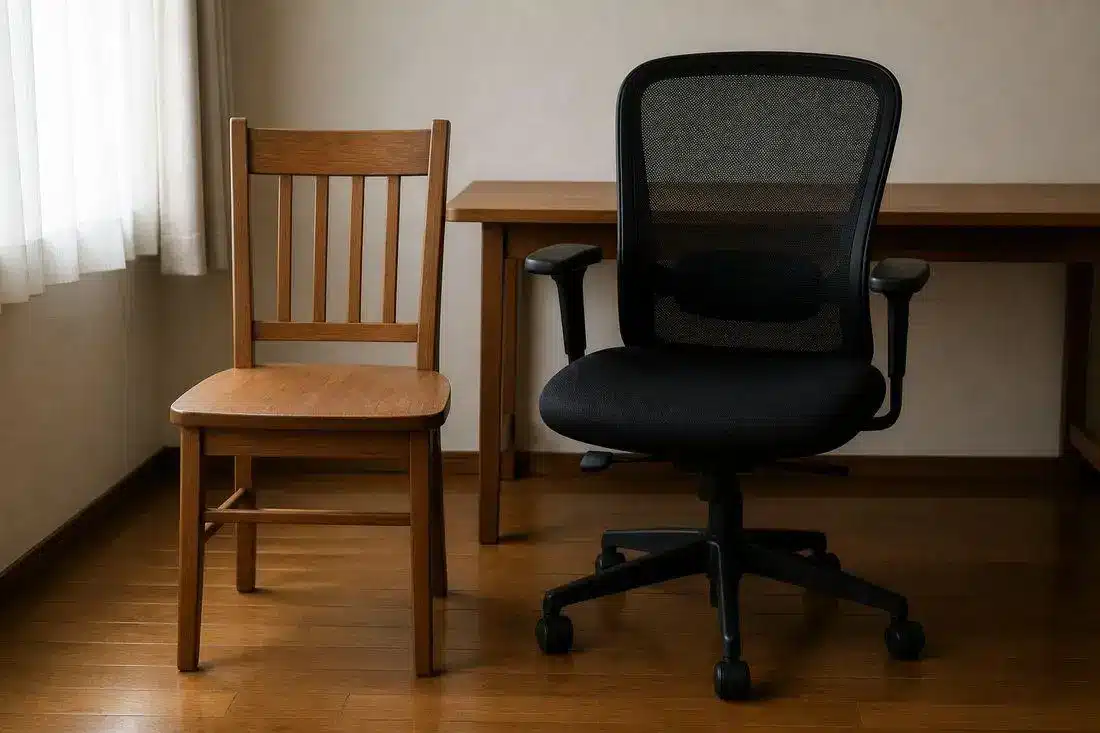
Both are chairs. Only one of them can be changed halfway through the afternoon.
Buy From Somewhere That Publishes the Adjustment Range
The suppliers worth browsing are the commercial ones, and the reason is documentation rather than price.
Commercial sellers such as FindOfficeFurniture publish the specification for each chair, including how far each part actually moves, and they sell single units rather than only to businesses. Consumer retailers tend to describe a chair as ergonomic and leave it there, which tells you nothing you can compare.
Range of adjustment is the number to compare, because it is the thing doing the work.
Why One Position Is the Problem
The common assumption is that a good chair holds you in the correct posture. It does not, and there is no single correct posture to hold.
Holding any one position for hours is the part that hurts. What an adjustable chair provides is the ability to change without getting up: recline while reading, come forward to type, drop the seat an inch after lunch, raise the lumbar support when your back starts to complain. Each change redistributes load, and the accumulation of small changes across a day is the difference people notice.
A dining chair offers one position for eight hours. Not a wrong position. The only one.
If your back pain is persistent, severe, or new, a chair is not the first thing to address and this article is not the right source. Speak to a clinician. What follows is about furniture selection.
The Criteria Worth Checking
OSHA publishes seating criteria in its Computer Workstations eTool, which is more useful than a showroom conversation because it is specific and it is not selling anything.
| What to check | What good looks like |
|---|---|
| Seat pan depth | Supports most of the thigh, no contact behind the knee |
| Front edge | Rounded and padded, often called a waterfall edge |
| Lumbar support | Height adjustable, not a fixed curve |
| Recline | At least 15 degrees from vertical |
| Base | Five legs |
| Casters | Matched to the floor type |
Seat pan depth is the one most dining chairs fail, usually by an inch or two, and it is the common cause of a numb leg by mid-afternoon.
Recline is the criterion people dismiss. Sitting bolt upright at 90 degrees was never the goal. A chair that will not let you lean back is missing a function rather than enforcing discipline.
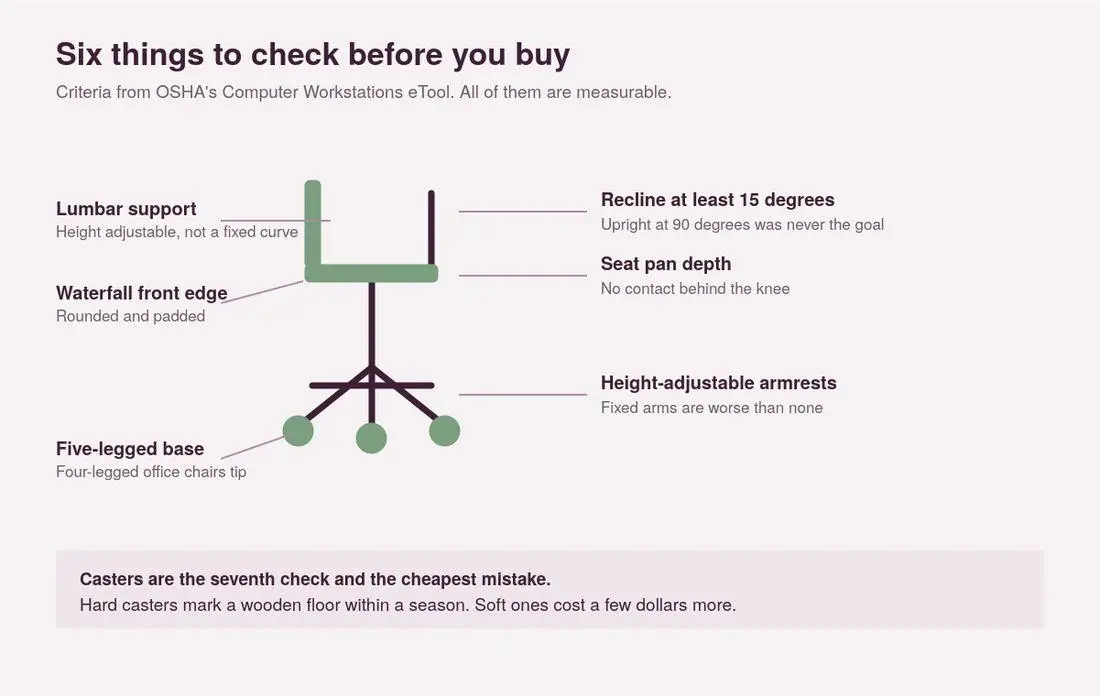
Every one of these is measurable in a showroom. Seat pan depth is the one most dining chairs fail.
What Not to Spend Money On
Some of the price in this category buys nothing you will feel.
Mesh is not automatically better than foam. It breathes well and it sags eventually. Good foam outlasts cheap mesh comfortably. Choose mesh because you run hot, not because it looks technical.
Fixed armrests are worse than none. At the wrong height they lift your shoulders all day and there is no remedy. Height-adjustable arms are worth paying for; non-adjustable arms are worth actively avoiding.
Headrests are optional. They matter if you recline often and many people never touch them.
The top of the market is refinement. The gap between a $200 chair and a $600 one is large and obvious. The gap between $600 and $1,500 is real but much smaller, and it is not where a first purchase belongs.
Fitting One Into a Room That Is Also a Bedroom
Most home workspaces are a corner of a room doing another job, which constrains the choice in ways a product page will not mention.
A five-legged base has a wider footprint than a dining chair and it does not tuck under a desk the same way. Casters need either a hard floor or a mat. A high backrest is visually dominant in a small room in a way the photographs never show, and a mid-back chair often suits a shared room better while meeting the same criteria.
The space-planning ideas in this piece on small 10×12 bedroom layouts apply directly here, particularly the pull-out desk approach, which pairs badly with a large task chair and well with a compact one.
Measure the clearance behind the desk before ordering. Two feet is workable and three is comfortable.
Test It for Longer Than Feels Necessary
Every guide, this one included, is generalising about an object that has to fit one specific body.
Sit in the chair for more than the two minutes a showroom invites. The problems this article describes appear at hour three, not minute two, which is precisely why they get bought wrong. Where a retailer offers a return window, treat it as the actual test and use it properly rather than deciding on the first afternoon.
And if you sit at that desk for ninety minutes a day, the dining chair is genuinely fine. The case for a proper chair scales with hours, and below roughly four hours a day it does not clear.

Holding a Master’s in Architecture from the University of Texas at Austin, Emily Rodriguez has dedicated more than two decades to the art and science of building renovation. Starting her journey in historic preservation, she developed a profound respect for blending old with new in building design. Emily became a vital part of our team in 2019, renowned for her insightful and innovative renovation tips. She has been leading our DIY home improvement series since ever since, where she shares her wealth of knowledge in turning outdated spaces into modern havens. When not engaged in writing or consulting, Emily is a passionate advocate for heritage conservation and enjoys exploring vintage architecture, a hobby that complements her professional expertise.