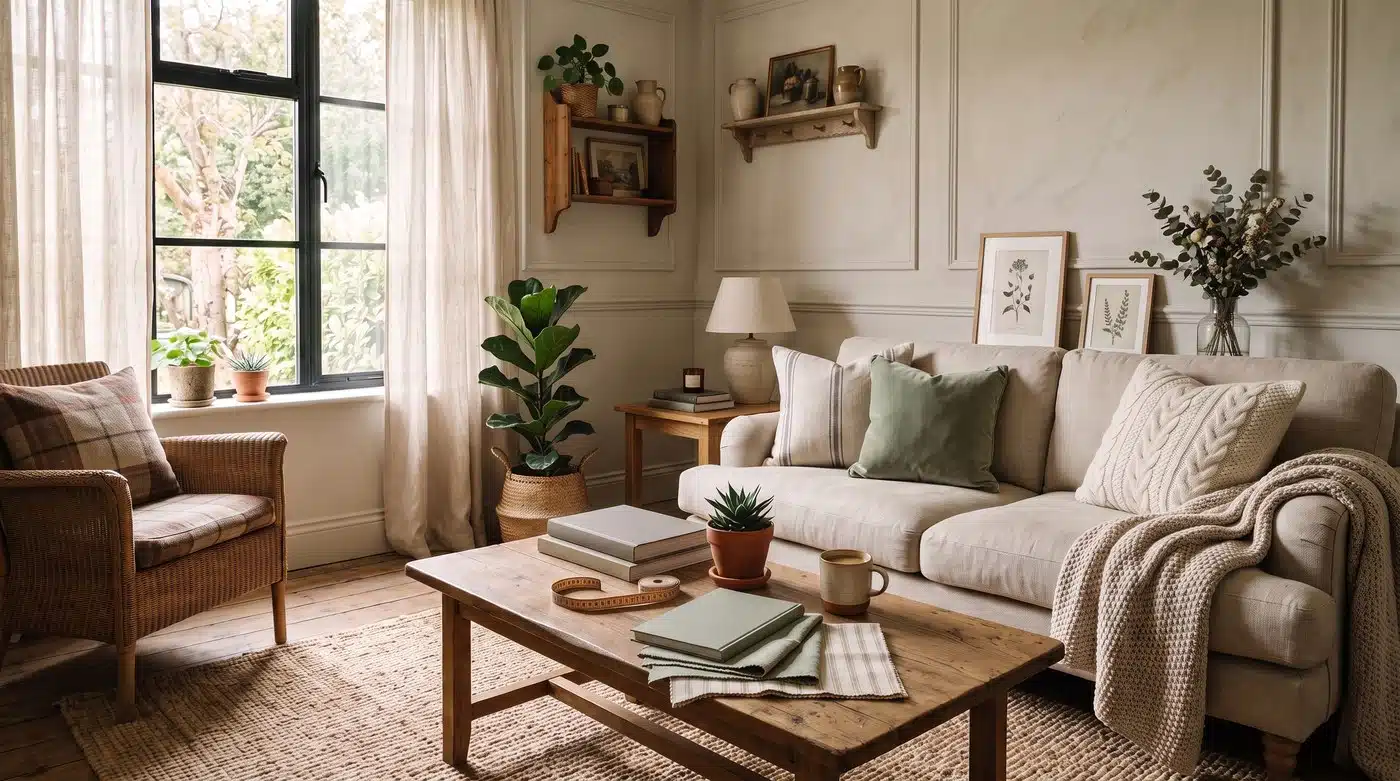

Buying furniture is one of the few home decisions that is genuinely hard to undo. Paint can be repainted over a weekend. A sofa that arrives two inches too wide for the alcove becomes a problem you live with, or a return process involving a delivery company and a restocking fee.
The good news is that almost every furniture mistake is predictable before the order goes in. Most of them come down to the same handful of causes: the piece was the wrong size, the color read differently at home, or the layout only worked on paper. Each one can be tested in advance, usually in an afternoon and usually for free.
Here is how to find out whether a piece works in your room before you pay for the privilege of finding out.
Start With the Room You Actually Have
Most people start furniture shopping by browsing. That is the wrong end of the process, because it means you are choosing pieces before you know what the room can accept.
Start instead with the room’s fixed constraints. Where are the windows, radiators, and outlets? Which direction does the door swing? Where does traffic cross the room on the way to somewhere else? These are the things you cannot move, and they eliminate more options than any style preference will.
Write them down. A rough sketch of the room with the immovable things marked on it will do more to prevent a bad purchase than any amount of scrolling.
Measure Before You Fall in Love
Measuring after you have chosen a piece is how people talk themselves into believing that eighty-eight inches is basically the same as eighty-four.
Take the measurements first, and take more of them than feels necessary:
- Wall length for each wall you might place something against, measured at floor level rather than eye level
- Ceiling height, particularly if you are considering shelving, a tall headboard, or anything with a canopy
- Doorway width, and the width of every doorway and turn between the front door and the room
- Stairwell width and landing depth if the piece has to go up
- Window sill height, if furniture will sit under a window
- Distance from the wall to the nearest fixed obstacle, such as a radiator or a floor outlet
That fourth one catches people out constantly. A sofa can fit a living room perfectly and still be impossible to get into the house. Delivery teams will not take a door off its hinges for you, and many will not attempt a tight stairwell at all.
Map the Layout on the Floor
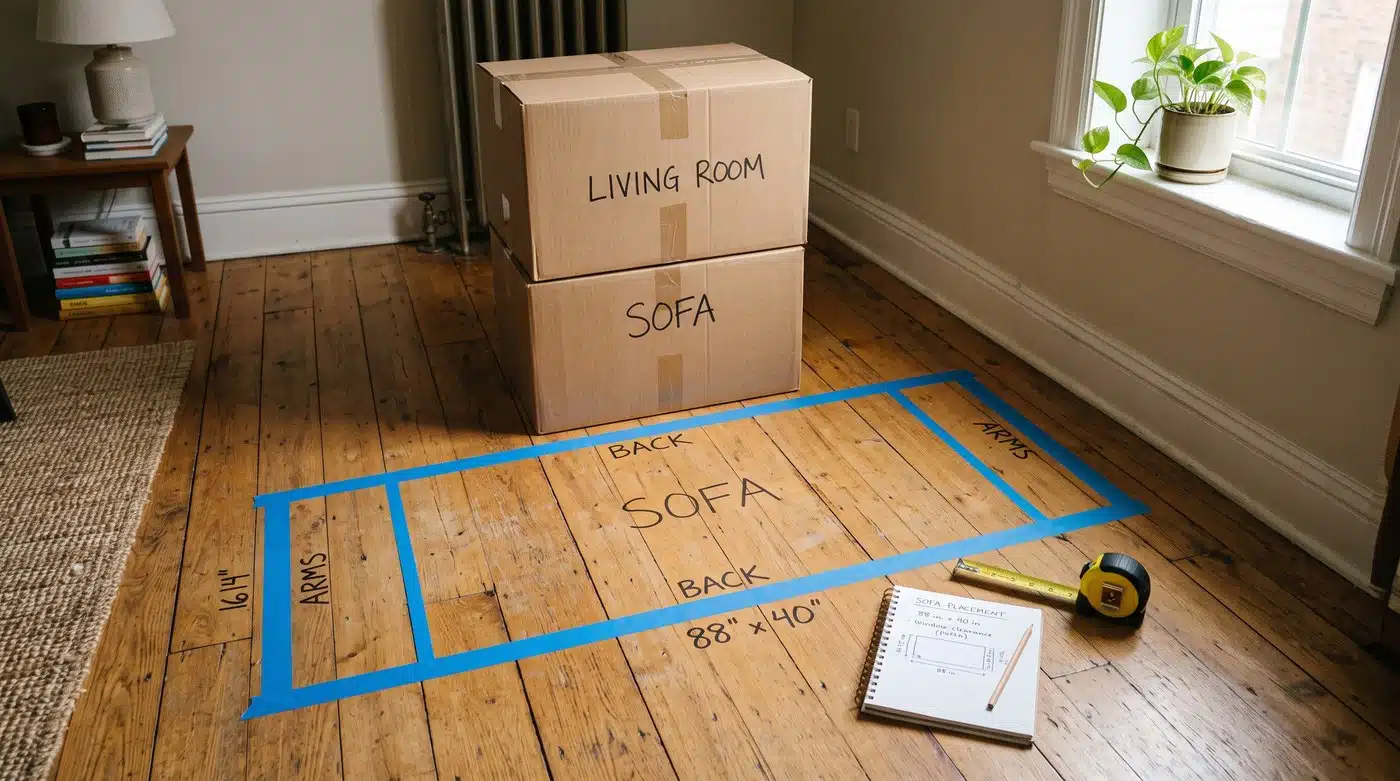
Tape gives you the footprint. Boxes stacked to the right height give you the volume, which is the part people misjudge.
Once you have dimensions for a piece you are considering, put those dimensions in the room. Painter’s tape on the floor is the oldest version of this and still one of the best. Mark the footprint of the sofa, the table, the bed, whatever you are weighing up.
Then live with it for a couple of days. Walk the room. Open the door. Sit where you would sit and see whether you can reach the side table or whether you have to stand up to put a cup down.
Cardboard boxes stacked to the height of the piece work even better than tape, because furniture takes up volume rather than area. A coffee table that looks fine as a taped rectangle can feel enormous when you can see how much of the room it fills at knee height.
See the Room Before You Commit
Tape tells you whether something fits. It does not tell you whether it looks right, and that is usually the harder question.
This is where visualization tools have become genuinely useful for ordinary homeowners rather than just designers. Tools such as RoomLab.app let you upload a photograph of the room as it currently is and see furniture, finishes, or a whole style direction swapped into that same space, keeping your walls, windows, and proportions as they actually are. Because it works from your own photo rather than a generic room, what you are looking at is your room with the change applied, not a showroom that happens to be a similar shape.
That distinction matters more than it sounds. A sofa photographed in a catalogue sits in a room with nine-foot ceilings, enormous windows, and nothing else in it. Seeing the same piece against your actual wall color, in your actual light, next to the furniture you are keeping, answers a question the catalogue photograph cannot.
It is also the cheapest way to test the options you would never order on spec. Most people will consider two or three variations of a purchase seriously. Being able to see eight costs nothing but a few minutes, and the one you end up choosing is frequently not the one you started with.
Test Colors and Materials Against Your Real Light
Every material changes with the light it sits in. A gray that reads warm and soft in a south-facing showroom can turn flat and blue in a north-facing room, and fabric is as susceptible to this as paint.
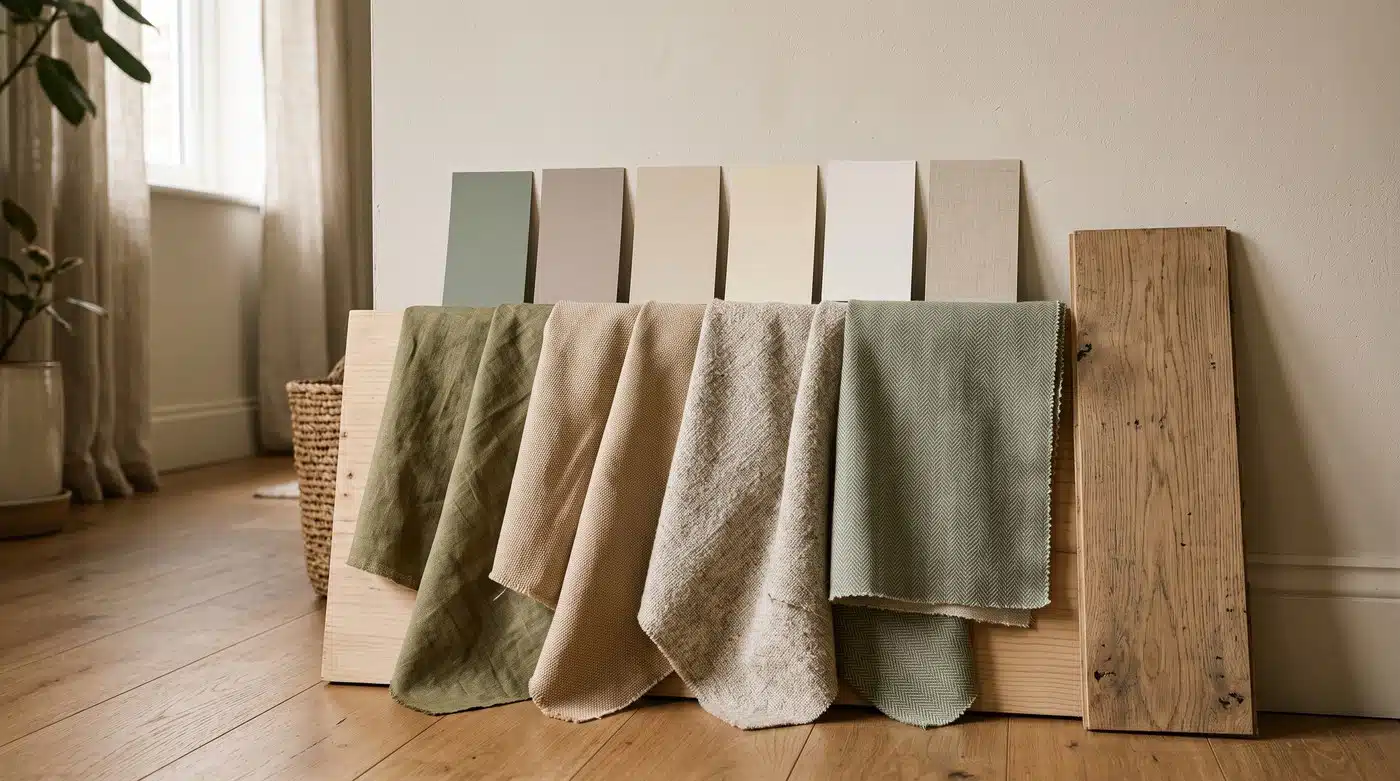
Test fabric, paint and flooring together, in the room they are going into.
Order swatches wherever they are offered, and most furniture retailers will send them. Then look at them in the actual room, on the actual wall or floor where the piece will sit, at three different times of day: morning, mid-afternoon, and under your evening lighting.
That last one is the one people skip and the one that matters most, because the evening is usually when you are actually in the room. A fabric chosen entirely in daylight can look completely different under warm bulbs.
Hold swatches against what you are keeping, too. The question is rarely whether a color is nice. It is whether it works with the rug, the curtains, and the wood tone you are not replacing.
Get the Scale Right Before the Style
Scale is the thing that separates a room that looks considered from one that looks like a collection of individually nice purchases. It is also the mistake people are least likely to spot in a catalogue photograph, because everything in a catalogue has been chosen to match everything else in the frame.
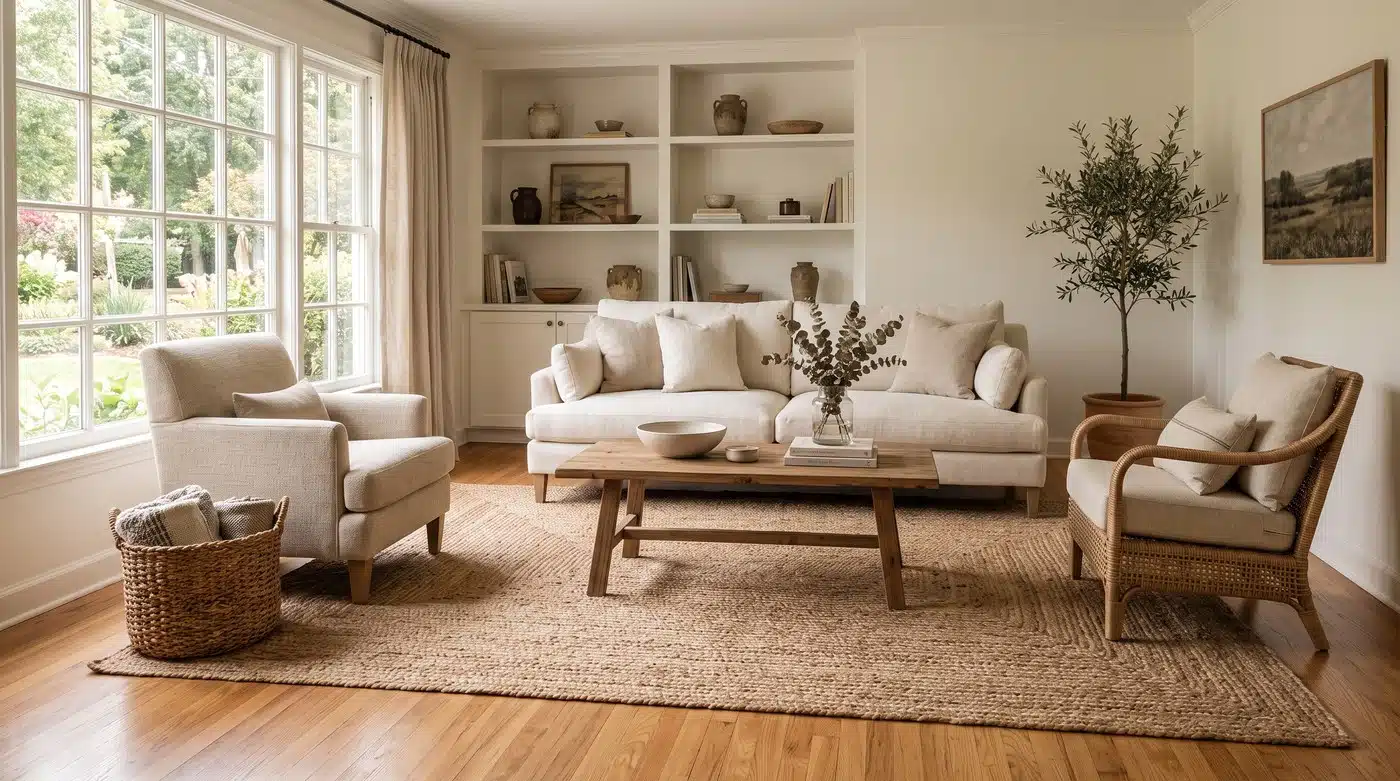
A rug large enough to catch the front legs of every seat pulls the arrangement together.
The most common scale error is buying too small. A rug that stops short of the furniture makes a room feel smaller rather than larger, and it is the single most frequent regret in living room purchases. As a rule, the rug should be large enough that at least the front legs of every seat sit on it, which usually means a size up from whatever felt reasonable in the shop.
Sofas go wrong in the opposite direction. A deep, high-backed sofa in a small room fills it visually long before it fills it physically, and low-backed designs make the same footprint feel considerably lighter. If the room is tight, the back height matters as much as the width.
Height is worth thinking about across the whole room, not piece by piece. A room where every item stops at the same level feels flat, so a mix of low, mid, and tall gives the eye somewhere to travel. That is the actual reason a plant or a tall lamp so often fixes a room that felt vaguely wrong.
Think in Sightlines, Not Just Floor Plans
A floor plan is a view no one in your house will ever have. You experience a room from the doorway, from the sofa, from the kitchen looking through.
So check the arrangement from the places you will actually stand. Walk in through the door and see what the first thing you notice is. Sit down and see what is in front of you. If the room opens onto another room, look at it from there, because the two will be seen together far more often than either is seen alone.
This is where a lot of technically correct layouts fall apart. Everything fits, the spacing follows the rules, and the room still feels wrong because the first thing you see walking in is the back of a chair.
Pay attention to what the seating faces, too. A pair of chairs angled slightly towards the sofa makes a room feel conversational, while the same chairs squared off against the wall make it feel like a waiting area. The difference is a few degrees of rotation and costs nothing to test.
It is also worth checking the room at night. Daylight is forgiving and comes from a large, even source, so almost any arrangement looks reasonable at two in the afternoon. Lamplight is directional and creates pools of light and shadow that can leave half a carefully planned layout sitting in the dark.
Give Yourself a Way Out
Even with careful testing, some decisions will be wrong. Plan for that before you order rather than after.
Check the return policy specifically for large items, which are frequently excluded from the standard terms. Find out who pays return shipping, whether there is a restocking fee, and how long the window is. On custom or made-to-order pieces there is often no return option at all, which is worth knowing before rather than after you commit.
Keep the packaging until you are certain. Many retailers will not accept a return without it, and a sofa box is not something you can recreate.
Where a room needs several new pieces, buy the largest and least reversible one first and live with it for a few weeks before ordering the rest. It is far easier to choose a side table that works with the sofa you own than to choose both at once and hope.
Making the Final Call
The pattern behind all of this is simple: move the risky part of the decision earlier, when it is still cheap to change your mind.
Measuring, taping the floor, ordering swatches, and previewing the room in a photograph are all ways of buying information before you buy furniture. None of them takes more than an afternoon. Between them they catch nearly every mistake that otherwise arrives on a delivery truck.
And if after all of that a piece still feels uncertain, that hesitation is usually worth listening to. The pieces people keep for decades are rarely the ones they had to talk themselves into.

With a Master in Architectural Studies from University of Pennysylvania, Marwa Haydar has pioneered living spaces since 2005. Her expertise, initially honed in a prestigious architectural firm, is evident in her approach to creating environments. Marwa became part of our team in 2019 and has since been a driving force in our home improvement section, known for her practical yet stylish solutions. She’s been spearheading our design workshops since then, infusing her passion for teaching into her work. In her leisure time, Marwa enjoys exploring historic architecture and is an enthusiastic pottery hobbyist, further enriching her understanding of form and texture.