


Skylight stayed bone-dry for years, until that new roof went on. A slipped flashing bend, a nudged aging frame, or plain condensation can turn the first winter thaw into a stain on your ceiling. Omaha’s freeze-at-night, thaw-by-day winter rhythm gives melt-water plenty of chances to creep inside. In the pages ahead, we spotlight the five best skylight leak-repair companies in Omaha, explain how each earned its spot, and list what you should confirm before you call.
The Five Best Options at a Glance
When water is already dripping, you want a shortlist, not a sales pitch. The table below compares the five best skylight leak repair companies in Omaha on the factors you care about first: how fast they answer the phone, where they excel, and the smartest question to ask before scheduling.
Rank | Company | Best for | Response to confirm | First question to ask |
|---|---|---|---|---|
1 | ReThink Construction & Claims | Storm-related leaks plus other exterior damage | Free inspection | “Which skylight brands and mount types do you service?” |
2 | Royalty Roofing and Siding | Factory-flashing fixes on asphalt roofs | Ask about active-leak timing | “What written warranty covers this repair?” |
3 | Turtle Roofing | Rapid diagnosis with multiple repair paths | Ask about appointment timing | “Does the first visit include a permanent fix or only an assessment?” |
4 | Hometown Roofing | Long-standing roof-and-skylight integration | Ask about emergency service | “Does your workmanship term apply to skylight repairs?” |
5 | Millard Roofing | Complex roof systems and claim documentation | Ask about emergency service | “How long is the isolated skylight-repair warranty?” |
Scan the Best for column; one description usually matches your situation in seconds. In the next sections we’ll explain why each company earned its rank, and how their strengths translate to a drier living room.
1. Rethink Construction & Claims: best for storm-related leaks and one-contractor repairs
Rethink Construction & Claims starts every skylight-leak call with a free inspection to find the source of the leak, whether that is damaged flashing, worn seals, or a skylight that has reached the end of its life. The company holds a City of Omaha Class A contractor license, and its BBB profile shows an A+ rating.
Because Rethink also handles gutters, siding, windows and doors, and interior painting and drywall, you sign one contract instead of juggling multiple crews after hail or wind. That scope helps when a skylight leak is only one part of the damage, and the team specializes in tough insurance claims.
Rethink Omaha publishes a written workmanship warranty on its site, so ask for the term that covers skylight flashing and installation labor before work begins and keep a copy with your claim file.
Questions to ask before committing:
- Which skylight brands and mount types do you keep factory flashing kits for?
- What is the written workmanship term for a flashing-only repair?
If a storm punched holes from ridge cap to baseboard, Rethink’s full-exterior approach can shorten both the timeline and the claims paperwork.
2. Royalty Roofing and Siding: best for a flashing-first repair approach
Royalty Roofing and Siding centers every skylight fix on the factory flashing kit that locks into each shingle, with no surface caulk and no guess-and-hope sealant.
Crews arrive with metal brake, underlayment, and replacement shingles, then lift only what is necessary to rebuild the water path. Because Royalty also installs gutters and siding in-house, you can bundle small exterior touch-ups while the ladders are set.
Ask how quickly they can respond to an active leak, and confirm whether the first visit means a full flashing rebuild or a temporary dry-in until parts arrive, and ask for the exact workmanship term on a stand-alone skylight repair.
Choose Royalty when the roof is sound and all signs point to reused or poorly lapped flashing as the culprit. Their kit-driven method aims to solve the leak for good, not just mask it until the next hard rain.
3. Turtle Roofing: best for fast inspection and multiple repair paths
Turtle Roofing has a skylight team that can rebuild flashing, repair a curb, install fresh underlayment, swap a fogged glass unit, or replace the entire skylight if age or rot requires it. That range helps when a “quick caulk” turns into something bigger.
Before you book, confirm three points:
- Does the first visit include a permanent repair or only a temporary dry-in?
- Are parts for your skylight model stocked or special-ordered?
- What workmanship term covers a flashing-only fix?
Choose Turtle when speed matters and the right solution is not yet clear. They diagnose first, then fix what the inspection proves.
4. Hometown Roofing: best for long-established roof-and-skylight integration
Hometown Roofing is a long-established Omaha roofer. Their skylight page highlights reflashing, resealing, and blending new work into surrounding shingles so the patch disappears into the roof.
Ask whether their workmanship warranty applies to a flashing-only skylight repair and get it in writing. Also confirm which skylight brands they service, from vintage bubble domes to modern VELUX glass, so the crew arrives with the right flashing kit.
Choose Hometown when you prefer a local team that has likely fixed a leak on your street and knows how to blend new metal into an existing roof without leaving a visual scar.
5. Millard Roofing: best for complex roof systems and claim documentation
Millard Roofing tackles skylights that cut through metal valleys, adjoin chimneys, or meet low-slope tie-ins. Technicians inspect the deck, underlayment, and ventilation before touching the skylight so you don’t chase the same leak twice.
Ask whether they provide photo reports that trace water paths in plain English, which helps when an adjuster questions whether the drip is “just condensation.”
Ask whether emergency service is available, confirm the response window, and ask for the written workmanship term on an isolated skylight repair.
Choose Millard when your roof isn’t textbook simple or when you need documentation solid enough to satisfy a second look from the insurer.
Why skylights leak after a re-roof
Flashing was reused or rebuilt the wrong way
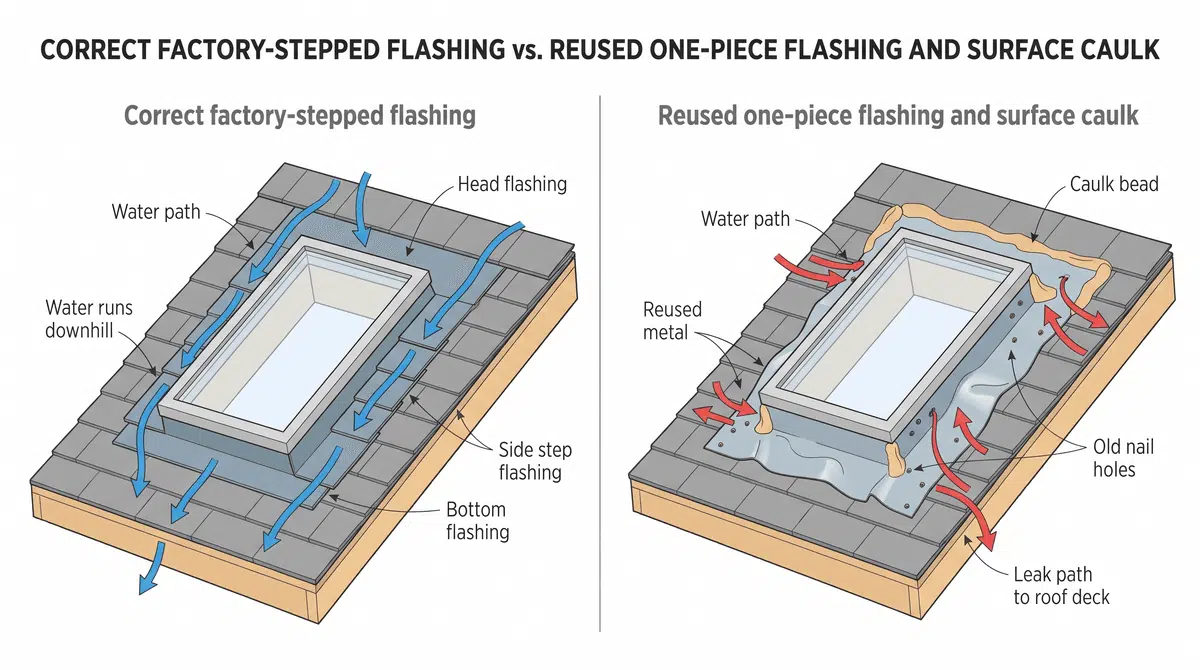
Flashing, the factory-formed metal that directs water around a skylight, should be replaced, not improvised, when you reroof. Building codes require flashing at roof openings, and manufacturers call for a bottom, side, and head sequence so each piece overlaps the one below and water always drains downhill. Reusing old metal leaves hidden bends and nail holes, while site-bent “one-piece” flashing and exposed caulk ignore that rule and can draw meltwater under shingles.
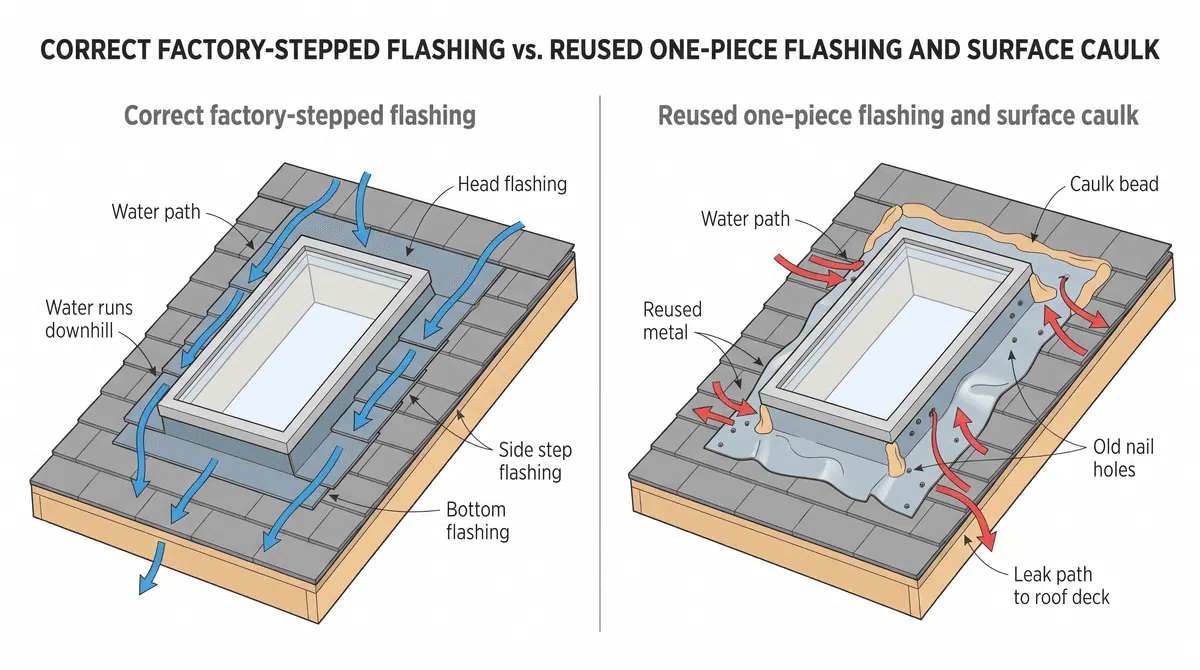
Ask to see the flashing-kit box or part number that matches your skylight model, roof pitch, and roofing material. A pro will have it on hand; if the answer is “we’ll bend something on site,” pause the job and insist on the correct kit before work continues.
Underlayment wasn’t wrapped and lapped correctly
Think of the skylight curb as a tiny chimney. The manufacturer’s fix is a self-adhered membrane, typically rubberized asphalt, that climbs the curb, folds around the corners, and laps onto the roof deck before any metal flashing appears. If a crew reverses those laps by sliding an upper piece under a lower one, runoff finds the seam and drains straight onto the sheathing.
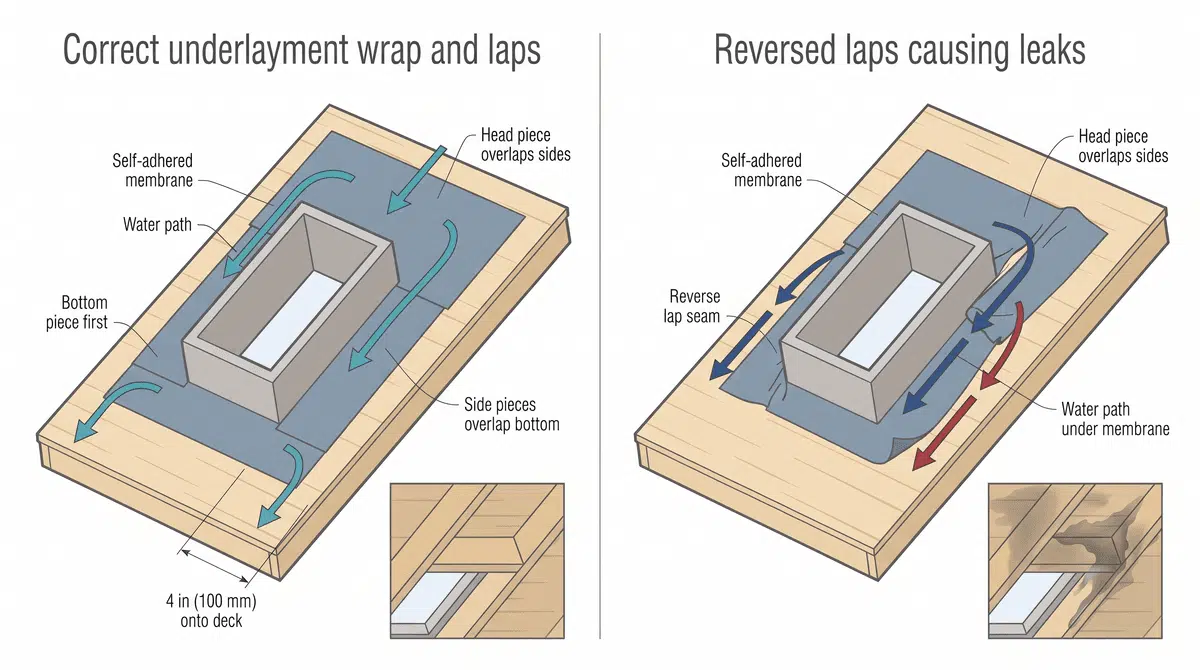
Manufacturer installation instructions are clear: bottom first, sides next, head last, each layer overlapping the one below so gravity does the work. Ask your contractor to describe that sequence; anyone who can’t list it in 30 seconds probably shouldn’t touch your skylight.
In the attic, bad laps look like dark water trails that start above the curb. A lasting repair strips back shingles, rewraps the curb in the right order, and reinstalls factory flashing, with no half fixes and no surface caulk.
An older skylight frame was disturbed during tear-off
Skylights age like any exterior window. After about 20 years, aluminum cladding can loosen, wood curbs shrink, and factory gaskets harden. The prying and foot traffic of a tear-off twist that brittle assembly, cracking corner welds or breaking the glass-to-frame seal.
Replacing an aging skylight during the reroof means the roof around it is opened and paid for only once.
Red flags for an aged-out frame:
- Water dribbling from the top of the skylight, not around the flashing
- Persistent fog between panes
- New ceiling stains that appear only after someone walks the roof
The long-term cure is full replacement; patching corroded cladding or re-glazing a failed insulated unit rarely lasts through one Nebraska winter. Ask the contractor for a written price comparison before shingles go back down.
The flashing kit doesn’t match the roof material or pitch
Flashing kits are engineered for three variables: roofing material, skylight mount, and roof pitch. Each kit lists the slopes and roofing materials it is rated for. Use a kit outside its printed slope range, or a tile kit on shingles, and wind-driven rain can slip through gaps thinner than a dime.
Deck-mounted skylights need a different kit than curb-mounted models. If your roof’s material or pitch falls outside the printed limits, the manufacturer can void the leak warranty.
Ask two direct questions:
- “What is my roof pitch?” (They should answer in degrees or rise-over-run.)
- “Which flashing-kit part number covers that pitch and material?”
Verify both in the manufacturer’s online guide before shingles go back down.
Water is sneaking in farther upslope
Rain that slips under shingles above the skylight can ride the decking until it finds daylight at the opening, making a remote leak look like a skylight failure. A zone hose test finds it: wet the roof in two-foot bands moving upward, and when the interior drip stops, you’ve passed the entry point.
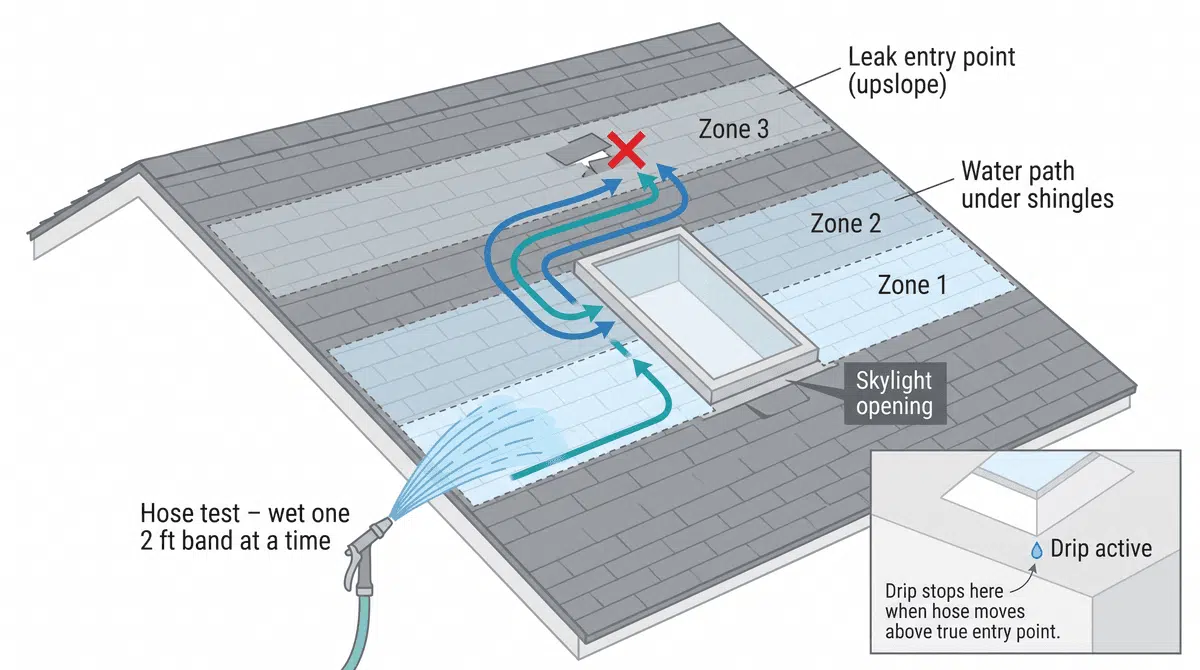
The breach may hide well above the curb. Repairs can be as small as one shingle or as large as a rebuilt valley, while the skylight itself may need nothing at all.
Insist on that systematic test before you approve a skylight replacement. Fixing the true source up the slope keeps you from paying twice when the next thunderstorm rolls through.
Repair or replace: deciding the smarter move
The question is simple (stop the leak by rebuilding flashing, or swap the skylight outright), but the stakes include labor, warranty, and how soon you want to see ladders again. Use these two checklists to frame the call.
When a targeted repair makes sense
- Sound hardware. The glass is clear, the frame square, and curb lumber solid.
- Interface failure. Water tracks to flashing laps, torn membrane, or one soft decking board.
- Parts still exist. Your skylight model has a current factory flashing kit.
- Age under 10 years. Newer units in good shape can usually stay.
- Proof test. Contractor rebuilds the water-control layers, then runs a hose test before leaving.
When full replacement is the smart money
- Twenty-plus years old. Replacing an aging unit during the reroof means paying for roof labor once.
- Permanent fog or cracked cladding. No flashing fix cures failed insulated glass or split aluminum.
- No compatible kit. If the brand folded or never made a kit for your roof, custom flashing can void any leak warranty.
- Interior work already planned. Swapping the unit while drywall and paint crews are on site means one disruption, not two.
- Cost delta is narrow. Paying once for a replacement can cost less than two repair trips.
Bottom line: repair wins when the skylight is healthy and the leak lives in the roof assembly; replacement wins when age, damage, or part scarcity raises doubts about durability. Choose the path that lets you close the ceiling for good, then check our winter skylight-maintenance checklist to keep it that way between storms.
What a proper skylight-repair quote should include
A leak fix is a mini construction project involving flashing, deck, insulation, and sometimes insurance, so use this checklist to be sure nothing slips through.

- Diagnosis line items. Skylight brand, model, mount (deck or curb), approximate age, roof pitch, and visible damage. Anything less invites the wrong flashing kit.
- Exterior scope.
- Square feet of shingles to remove and replace
- Factory flashing-kit part number
- Self-adhered membrane type and lap direction
- Deck or curb repair allowance
- Shingle-color match disclaimer
- Interior scope. List wet insulation removal, drywall or paint repair, and disposal fees in the same document so you are not hiring a second trade later.
- Workmanship warranty. Note the duration in years, what triggers coverage (new leaks, interior damage), and exclusions for hail, ice dams, or condensation. The word “guaranteed” alone means nothing.
- Documentation. Before-and-after photos plus a hose test with timestamp prove the assembly was built to spec and help if you ever file a storm claim.
Quotes that cover these five areas let you compare true cost and hold the contractor accountable for results, not just a line labeled “skylight repair labor.”
How to check an Omaha skylight contractor
Five minutes online can separate a pro from a pretender. Run these four checks before signing:
- State registration. Search the Nebraska Department of Labor contractor registry and confirm the status reads Active. An expired record is a stop sign.
- City license. Look up the company on Omaha’s contractor-licensing list and confirm the license class covers the work you need.
- Insurance certificates. Request current general-liability and workers’-comp forms, then call the agent number on the certificate to verify they’re still in force. The call takes 60 seconds and protects you if a ladder slips.
- Review patterns. One bad post is noise; clusters of complaints about “leaks after repair” signal trouble. Focus on themes: communication, cleanup, and honoring the written warranty.
Check all four boxes and you’ll hire someone who can legally work, carry the right insurance, and answer the phone if a spring storm pounds Omaha again.
Omaha storm claims: what homeowners should know
1. Confirm it’s claim-worthy before calling the insurer
Wind-hail deductibles can run into the thousands. Filing a claim for less than yours can leave a mark on your claims history with no payout. First, ask a qualified roofer whether the leak stems from sudden hail impact or from workmanship or age, which insurers routinely deny. Pull your policy, locate the “Wind/Hail Deductible” line, and compare it to the repair estimate before you call.
2. Document everything before permanent work
Take wide and close photos with a date marker, bag any hail-dented flashing, save invoices for tarps or fans, and request an itemized contractor estimate (labor, materials, permit, tax).
3. Know your protections
- Never let a contractor “eat the deductible.” Ask your insurer or the Nebraska Department of Insurance about any offer like that.
- Insist on a line-item estimate before insurance-funded work starts.
- Read any assignment of claim rights twice. Signing them over to a roofer can cost you leverage.
Know these points and you choose when, and whether, to involve the insurer instead of letting paperwork drive the decision.
What to do in the first 24 hours of an active leak
Speed limits damage and preserves evidence. Follow this 10-point checklist and you’ll move from crisis to control in one afternoon.
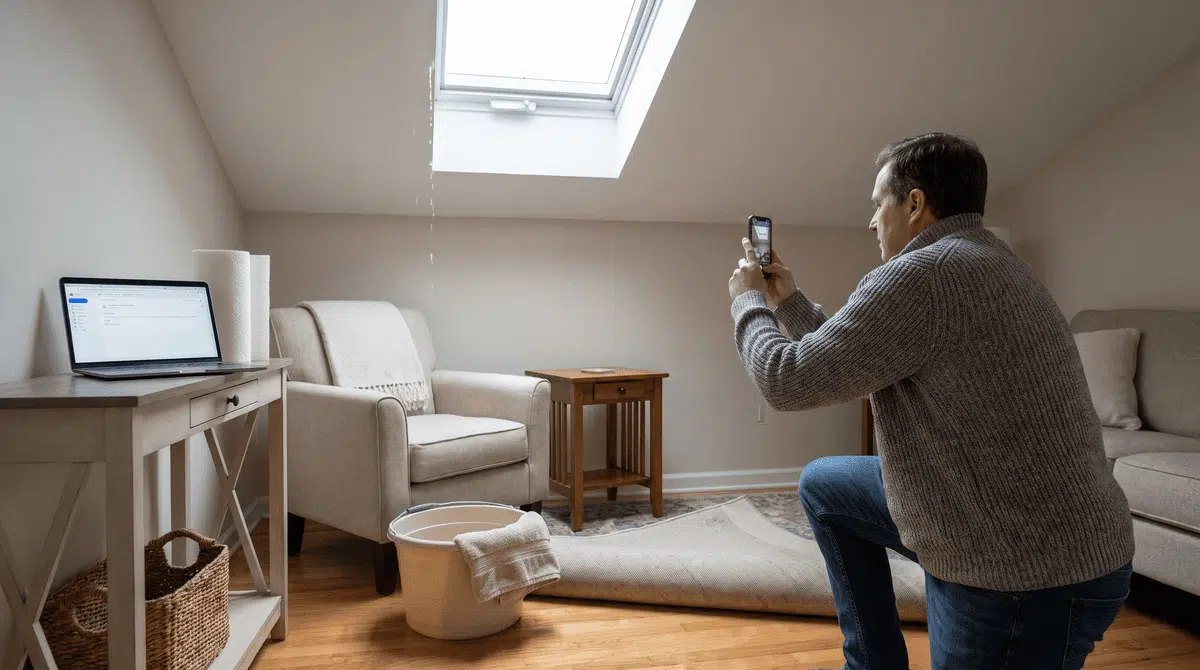
- Move valuables. Shift furniture, rugs, and electronics out of the splash zone.
- Catch the drip. Place a bucket or plastic tub under the leak, and drop a towel inside to quiet the plink.
- Document damage. Take wide and close photos of stains, puddles, and belongings, time-stamped on your phone.
- Check the attic (only if safe). Look for active drips or water trails, and skip the climb if footing is questionable.
- Stay off the roof. Wet shingles plus adrenaline are a hospital trip waiting to happen.
- Notify the reroofing contractor in writing. Email or text creates a dated record for any workmanship-warranty claim.
- Request temporary mitigation. Ask for a tarp or plastic sheeting; most policies expect reasonable steps to prevent further loss.
- Save physical evidence. Bag fallen shingles, flashing, or soaked drywall; adjusters often want samples.
- Keep receipts. Fans, tarps, and emergency labor are often reimbursable as mitigation expenses.
- Call the insurer only if the cost exceeds your deductible. Have photos and a contractor estimate in hand first.
Frequently asked questions
Why did my skylight start leaking right after a new roof?
Roof work around the unit is the usual cause. Crews may have reused old flashing, lapped membrane backward, or flexed an aging frame just enough to crack a seal, and those problems show up with the first rain.
Should the original roofer fix the leak?
Usually, yes. If your workmanship warranty is still active and the issue traces to their flashing or membrane work, notify the roofer in writing, include photos, and give them a chance to inspect.
Can caulk permanently fix a leaking skylight?
No. Caulk hides symptoms but doesn’t replace the stepped metal layers that shed water. Use it only as a short-term stopgap until proper flashing is rebuilt.
Is fog inside the skylight a roof leak?
Not usually. Fog between panes means the insulated glass seal has failed, while moisture on the room-side surface is indoor condensation. Neither starts in the roof deck, but both often need glass or full skylight replacement.
Will homeowners insurance cover a leaking skylight?
Usually only when a sudden peril such as hail, wind, or a fallen branch caused the damage. Age, wear, and installation errors typically fall under exclusions. Check your policy’s wind-hail deductible and talk to your agent before filing.
How much does skylight repair cost in Omaha?
It depends on the source of the leak, the condition of the skylight, and the surrounding roof damage. Minor flashing or seal repairs typically cost less than replacing the whole skylight, so start with a free inspection.
Should a skylight be replaced when the roof is replaced?
Older units are often worth replacing during the reroof so you pay for roof labor once. Newer models in good shape can usually stay.
Conclusion
Storms and reroofs test every skylight. You now have a shortlist of five Omaha contractors, each suited to a different scenario, plus a checklist to vet their quotes and credentials.
- Rethink Construction & Claims: best when a hail claim includes gutters, siding, or interior repairs.
- Royalty Roofing and Siding: the flashing-first crew for otherwise healthy skylights.
- Turtle Roofing: quick diagnosis with multiple repair paths.
- Hometown Roofing: a long-established local roofer for blend-in repairs.
- Millard Roofing: a fit for complex roofs and insurer scrutiny.
Match the contractor to your leak, confirm active licenses and written warranties, and insist on the itemized quote elements we outlined. Take those steps and the next hard rain will stay outside, right where it belongs.

Holding a Master’s in Architecture from the University of Texas at Austin, Emily Rodriguez has dedicated more than two decades to the art and science of building renovation. Starting her journey in historic preservation, she developed a profound respect for blending old with new in building design. Emily became a vital part of our team in 2019, renowned for her insightful and innovative renovation tips. She has been leading our DIY home improvement series since ever since, where she shares her wealth of knowledge in turning outdated spaces into modern havens. When not engaged in writing or consulting, Emily is a passionate advocate for heritage conservation and enjoys exploring vintage architecture, a hobby that complements her professional expertise.