
Maintaining attractive outdoor areas around commercial properties can be challenging. Constant foot traffic, changing weather conditions, limited sunlight and ongoing maintenance demands can leave natural lawns looking worn or patchy. For businesses, property managers and facility operators, these problems can affect both the appearance and usability of outdoor spaces.
Commercial synthetic grass offers an alternative to natural turf in locations where consistent ground coverage, reduced mowing requirements and surface durability are priorities. It can be used in office landscapes, childcare centres, hospitality venues, retail spaces and selected recreational facilities.
However, not every artificial grass product is suitable for commercial use. Traffic levels, drainage, surface temperature, accessibility and installation quality all influence how well the finished area performs.
Choosing the right system requires understanding more than the appearance of the grass fibres. The base preparation, backing material, pile characteristics, infill and maintenance requirements can all affect its service life.
This guide explains the benefits of commercial synthetic grass, common applications, installation methods, costs and practical factors that property owners should review before starting a project.
What Is Commercial Synthetic Grass?
Commercial synthetic grass is a manufactured turf surface designed for use in business, institutional, public-facing and other non-residential environments. It typically consists of synthetic fibres attached to a backing material, installed over a prepared base with drainage provisions suited to the location.
Unlike natural grass, synthetic turf does not require regular mowing, fertilising or irrigation to maintain green coverage. However, it still needs cleaning, inspections and occasional maintenance to keep the surface safe and functional.
For property managers exploring commercial synthetic grass, product selection should reflect how the space will be used rather than appearance alone.
A decorative installation outside an office may have different requirements from turf installed in a busy courtyard, childcare play area or frequently used hospitality venue.
How Is Commercial Synthetic Grass Different From Natural Turf?
Natural grass is a living surface that depends on suitable soil, sunlight, moisture and ongoing care.
Commercial synthetic grass uses manufactured fibres to provide a consistent grass-like appearance without active plant growth. This allows it to maintain ground coverage in locations where natural turf may struggle because of shade or repeated use.
However, synthetic turf does not provide all the environmental benefits of living vegetation. It does not cool its surroundings through plant transpiration, and its surface can become hot in direct sunlight.
These differences should form part of the decision-making process, particularly where comfort, landscaping performance and environmental outcomes are priorities.
How Does Commercial Turf Differ From Residential Turf?
Commercial and residential turf products can share similar materials and manufacturing methods, but their intended applications may differ.
Commercial installations often need to accommodate heavier pedestrian traffic, more frequent cleaning and demanding operating conditions.
By comparison, residential synthetic grass may be selected primarily for home lawns, private courtyards and decorative landscaping.
Neither label automatically guarantees better performance. Product specifications, installation quality and suitability for the expected traffic should guide selection.
What Are the Main Benefits of Commercial Synthetic Grass?
Commercial synthetic grass can provide practical advantages for properties where maintaining natural lawn coverage is difficult or expensive.
Its benefits are most apparent when the product and installation method match the intended use. A properly planned system can reduce some routine landscaping tasks while creating an attractive surface for suitable commercial environments.
1. Reduced Routine Lawn Maintenance
One of the main advantages of synthetic turf is that it does not require regular mowing, edging or fertilising.
For commercial property managers, this can reduce some recurring lawn care activities and the scheduling involved in maintaining natural grass.
However, artificial grass is not maintenance-free. Leaves, litter, spills and other debris still need to be removed, while heavily used areas may require periodic brushing or professional cleaning.
The maintenance savings will depend on the size of the area, traffic levels and the condition of the previous landscaping.
2. Consistent Appearance Throughout the Year
Natural lawns can become patchy or muddy after repeated use, particularly where soil compaction and shade limit growth.
Synthetic grass can maintain consistent visible coverage without relying on grass regeneration.
This may be useful for office entrances, retail landscapes and hospitality spaces where appearance matters throughout the year.
The surface can still become flattened, stained or damaged, so suitable product selection and ongoing care remain necessary.
3. Better Resistance to Repeated Foot Traffic
Commercial areas often experience repeated pedestrian movement.
A turf system with suitable fibre construction, backing and installation can tolerate this use more consistently than natural grass that struggles to recover from wear.
For example, a busy commercial courtyard may benefit from a synthetic surface that does not develop bare soil patches along frequently used routes.
However, turf intended for decorative landscaping may not be suitable for heavily trafficked walkways or activities involving wheeled equipment.
4. Reduced Irrigation Requirements
Synthetic grass does not require routine watering to support plant growth.
This can be useful for properties seeking to reduce irrigation demand in selected landscaped areas.
Water may still be needed for cleaning, cooling the surface or removing contaminants, particularly where animals use the turf.
Any environmental benefit should be weighed against manufacturing impacts, material lifespan, end-of-life disposal and the loss of living vegetation.
5. More Reliable Coverage in Shaded Areas
Natural grass may struggle beneath buildings, covered walkways or other locations receiving limited sunlight.
Synthetic turf does not depend on sunlight for growth, making it suitable for some shaded spaces.
However, drainage, moisture retention and cleaning requirements still matter.
A consistently damp shaded area may require additional attention to prevent odours and biological growth on accumulated debris.
6. Flexible Landscaping Applications
Commercial synthetic grass can be installed in a range of suitable spaces, including courtyards, landscaped borders, indoor displays and selected recreational areas.
Different pile heights, colours and fibre constructions allow designers to create different appearances.
The selected turf should match the actual conditions of the installation rather than being chosen only for its visual finish.
Where Is Commercial Synthetic Grass Commonly Used?
Commercial synthetic grass can serve different purposes depending on the property type, traffic levels and required surface characteristics.
Some installations are primarily decorative, while others need to accommodate people walking, sitting or participating in recreational activities.
Understanding the intended use helps determine the required base, drainage, turf specification and maintenance plan.
Office Buildings and Commercial Landscapes
Office complexes often include entrance landscaping, outdoor seating areas and courtyards.
Synthetic turf can provide consistent greenery in selected areas without the mowing and irrigation requirements of natural grass.
For example, a shaded courtyard between buildings may benefit from synthetic turf where conventional lawn growth is unreliable.
However, drainage, accessibility and the effect on surrounding landscaping should be reviewed before installation.
Retail Centres and Shopfronts
Retail properties may use synthetic grass in decorative landscaping, seasonal displays or selected customer seating areas.
A consistent grass-like surface can provide visual contrast against paving, concrete and building facades.
High pedestrian movement requires attention to wear resistance and cleaning access.
Where shopping trolleys, wheelchairs or other wheeled equipment regularly travel, a firmer accessible surface may be more suitable than turf.
Hospitality Venues and Outdoor Dining Areas
Restaurants, cafés and hospitality venues sometimes use synthetic turf to create a softer outdoor appearance.
It may suit selected seating areas, decorative spaces or sheltered courtyards.
However, food spills, grease and frequent furniture movement can increase maintenance demands.
The layout should allow surfaces to be cleaned thoroughly and should maintain suitable access routes.
Childcare Centres and Play Areas
Synthetic turf can provide consistent ground coverage for some childcare and play environments.
However, the selected product and underlying system must be suitable for the intended activities.
Where play equipment creates a fall risk, ordinary landscaping turf should not be assumed to provide adequate impact attenuation.
The complete surface system, including any shock-absorbing underlay, needs to meet applicable safety requirements for the relevant fall heights and equipment.
Heat exposure is another concern, as synthetic grass can become uncomfortable or unsafe during hot weather.
Schools and Educational Facilities
Schools may use synthetic turf in selected courtyards, learning areas or recreational spaces.
The surface may reduce muddy patches and provide consistent coverage in areas where natural grass struggles.
However, school installations should be evaluated for usage intensity, drainage, supervision needs, heat exposure and ongoing cleaning.
Sports facilities require systems designed for the particular sport rather than standard decorative turf.
Gyms and Fitness Facilities
Some gyms use specialised synthetic turf for functional training zones.
These products may be designed for activities such as sled pushes and other equipment-based exercises.
They differ from conventional landscaping turf in pile construction, backing and intended performance.
Gym operators should confirm that the selected product is suitable for their equipment, flooring system and expected loads.
Rooftops and Balconies
Synthetic grass may be used on selected rooftop terraces and balconies to create a softer visual appearance.
However, rooftop applications require careful planning.
Drainage, waterproofing protection, wind exposure, surface loads and access for inspection should be reviewed.
Turf should not be installed in a way that blocks drainage outlets or prevents necessary maintenance of waterproofing systems.
How to Choose the Right Synthetic Grass for Commercial Use
Different commercial settings place different demands on synthetic grass.
A product suitable for decorative landscaping may not perform well in a high-traffic courtyard, childcare facility or gym.
The following characteristics can help guide product comparisons.
Pile Height
Pile height refers to the length of the synthetic grass fibres.
Shorter pile products may be easier to clean and can suit some high-use or specialised applications.
Longer fibres can create a softer, fuller lawn appearance but may require more grooming in heavily used areas.
Pile height alone does not determine durability. Fibre construction, density and backing quality also influence performance.
Fibre Material
Synthetic grass commonly uses polyethylene, polypropylene or nylon fibres, sometimes in combination.
Each material has different characteristics relating to flexibility, resilience and wear.
The appropriate product depends on its manufacturing design and intended use.
Rather than selecting turf based on fibre material alone, request performance information relevant to the application.
Stitch Density and Construction
Stitch density describes how closely fibres are incorporated into the turf backing.
A dense construction may contribute to coverage and appearance, but density alone does not guarantee long service life.
Fibre durability, yarn shape and installation conditions also affect how the grass performs.
Backing and Drainage
The backing holds the fibres in position and forms part of the turf’s drainage system.
Some products allow water to pass through drainage holes or permeable backing materials.
However, water must still move through the underlying base and into an appropriate drainage outlet.
A permeable turf product installed over a poorly drained base can still experience water accumulation.
UV Resistance
Outdoor turf is exposed to sunlight, which can affect the appearance and condition of synthetic materials over time.
Products intended for outdoor use may incorporate UV stabilisation.
Ask about the manufacturer’s specifications and warranty conditions rather than assuming that all synthetic grass offers equivalent UV performance.
Fire Performance
Fire behaviour can matter in commercial buildings, indoor venues and locations near heat sources.
Products may have different fire-test classifications, and the applicable requirements depend on the installation location and building use.
Where required, obtain relevant fire-performance documentation and confirm compliance with the applicable building requirements.
Commercial Synthetic Grass vs Natural Grass
Synthetic and natural grass each have advantages and limitations.
The better option depends on the site’s intended use, environmental conditions, maintenance resources and long-term objectives.
Feature | Commercial Synthetic Grass | Natural Grass |
Mowing | Not required | Regular mowing usually required |
Irrigation | No water needed for growth | Depends on climate and lawn conditions |
Appearance | Consistent coverage when maintained | Changes with growth, seasons and wear |
Heavy foot traffic | Depends on product specification | May become worn or compacted |
| Shaded locations | Does not require sunlight to grow | Growth may be limited |
| Surface temperature | Can become very hot in direct sun | Often cooler through evapotranspiration |
| Drainage | Depends on turf and base construction | Depends on soil and site conditions |
| Environmental characteristics | Manufactured material requiring eventual disposal | Living vegetation supporting biological processes |
| Maintenance | Cleaning, grooming and repairs | Mowing, watering, fertilising and lawn care |
Synthetic grass may suit locations where natural turf repeatedly fails or routine lawn maintenance is difficult.
Natural grass may be preferable where cooling, biodiversity, soil health and living landscaping are priorities.
Some commercial properties benefit from combining both materials rather than using synthetic turf throughout the entire site.
What Is Involved in Commercial Synthetic Grass Installation?
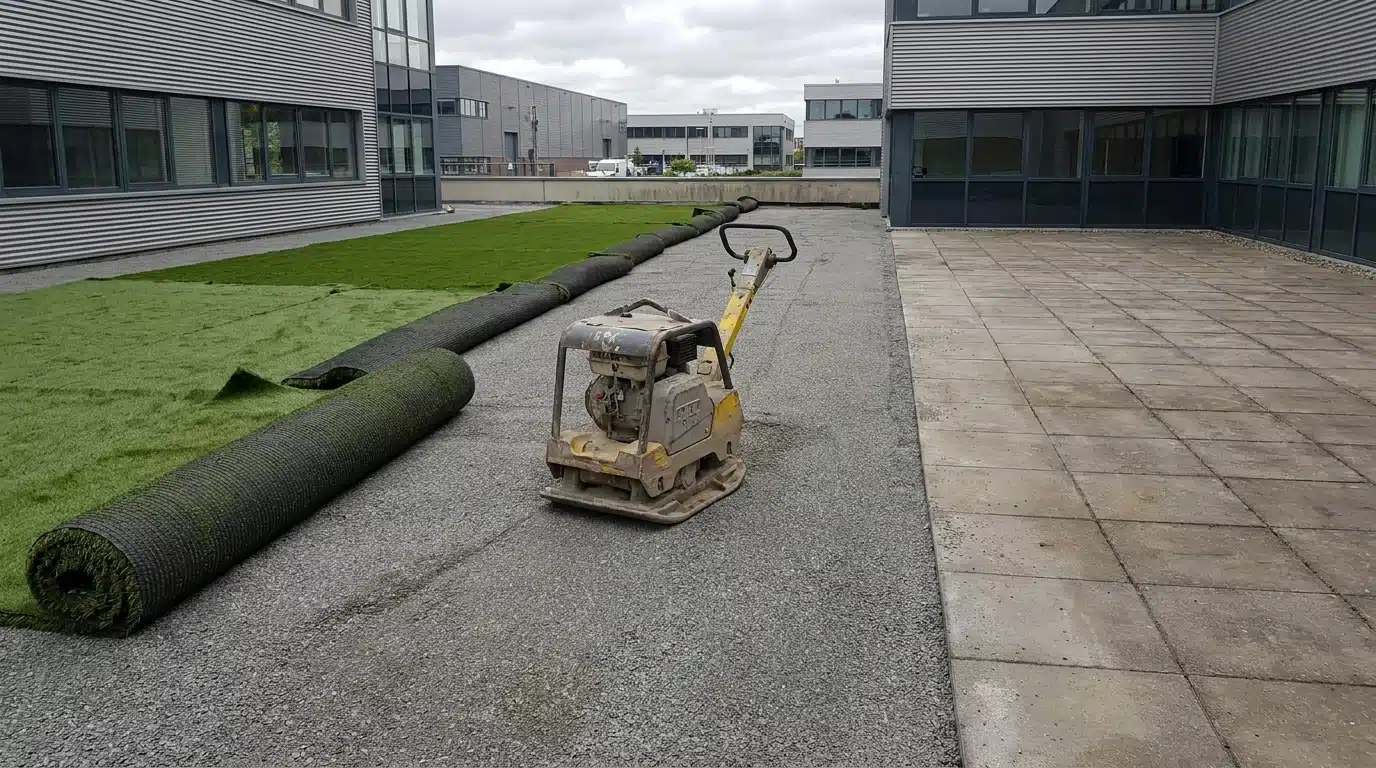
Installation quality has a major influence on the appearance, drainage, stability and service life of commercial synthetic turf.
Even a suitable product can fail to perform as expected when the base is poorly prepared or the drainage design is inadequate.
Commercial installation should begin with a site assessment and a clear understanding of how the surface will be used.
Step 1: Site Inspection and Planning
The installation area should be assessed for dimensions, existing surface condition, drainage, access and expected traffic.
Underground services, nearby structures and surrounding surface levels may also need to be identified.
For commercial projects, additional requirements may apply to accessibility, fire safety, surface performance or building approvals.
These should be identified before materials are ordered.
Step 2: Removal of Existing Materials
Existing grass, unsuitable soil or other surface materials may need to be removed.
The removal depth depends on the base design and site conditions.
The aim is to provide a suitable foundation for the turf system, not simply to replace the visible lawn surface.
Step 3: Base Preparation
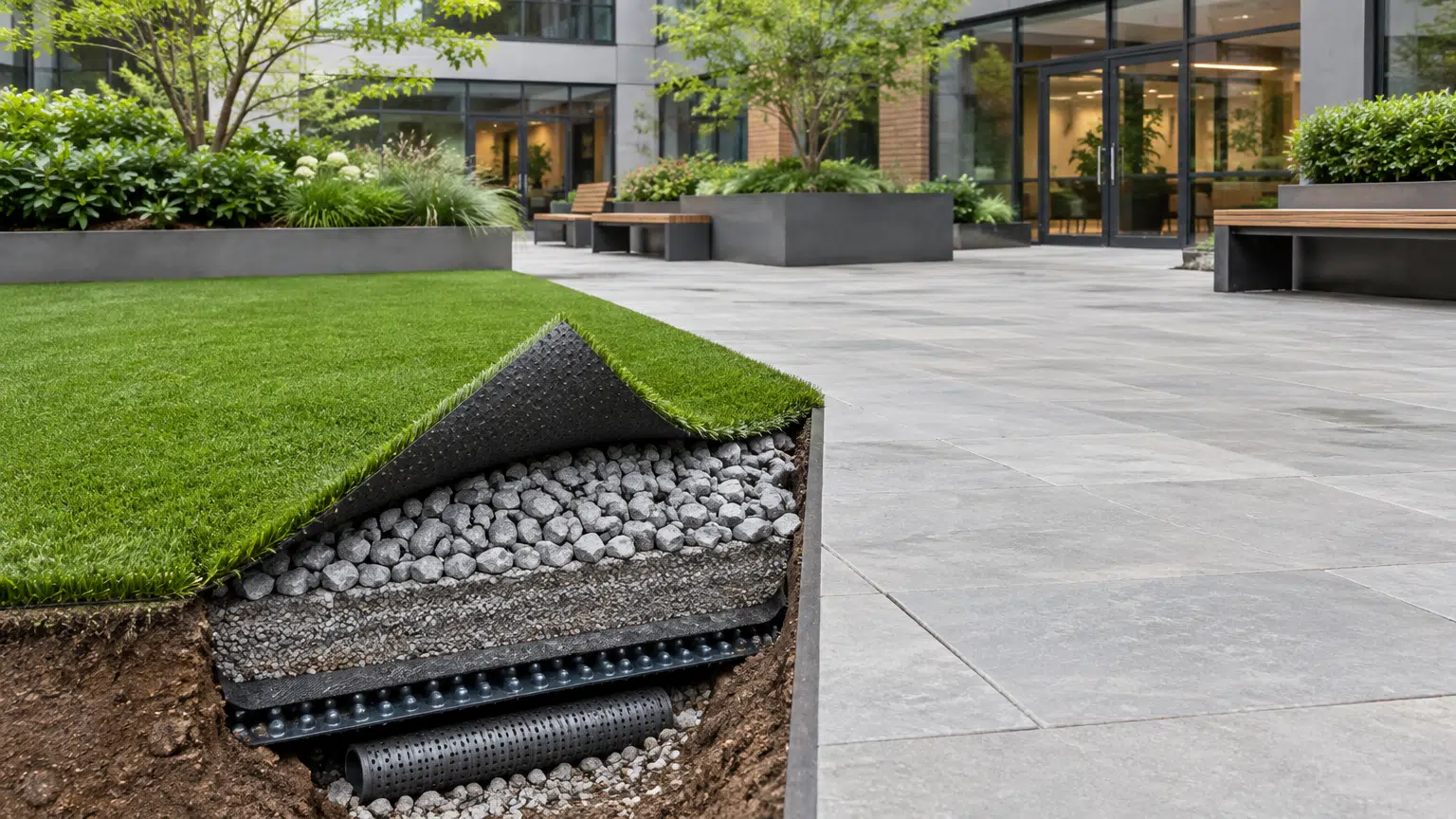
A stable base helps reduce movement, settlement and unevenness.
Depending on the application, installation may involve suitable granular material, compaction and a designed surface fall.
The base specification should reflect expected traffic and local ground conditions.
For example, a frequently used commercial courtyard may need a different base design from a low-traffic decorative strip.
Step 4: Drainage Installation
Drainage should be planned to prevent unwanted water accumulation.
The design may use a permeable base, suitable falls, existing drainage outlets or additional drainage infrastructure.
The correct arrangement depends on the surface beneath the turf and the site’s stormwater requirements.
Water should not be directed towards building foundations or neighbouring properties in an uncontrolled manner.
Step 5: Turf Placement and Joining
Synthetic turf is positioned according to the planned layout.
Where multiple rolls are required, seams should be aligned and joined using suitable methods and materials.
Careful fibre orientation can help maintain a consistent appearance across the finished area.
Poor seam installation may result in visible joins, lifting or premature wear.
Step 6: Securing and Finishing
The turf is secured using fixing methods appropriate for the base and location.
Edges should be finished to reduce lifting and provide a suitable connection to surrounding surfaces.
Some turf systems require infill, while others are designed for installation without it.
Any infill material and quantity should follow the product and system specifications.
Step 7: Final Inspection
Before the area is opened for use, the finished surface should be checked for stability, drainage and visible defects.
Edges and seams should be secure, and any installation debris should be removed.
Commercial operators should also receive appropriate cleaning and maintenance guidance.
Key Installation Considerations for Commercial Synthetic Grass
Commercial installations involve practical requirements that may be less demanding in low-traffic residential landscaping.
A successful surface needs to accommodate the expected users, environmental conditions and operational requirements of the property.
Drainage and Stormwater Management
Drainage is one of the most important parts of a synthetic turf installation.
Even permeable turf can experience standing water if the underlying base prevents drainage.
Commercial sites should be evaluated for rainfall exposure, existing drainage infrastructure and the direction of surface runoff.
Where changes affect stormwater arrangements, relevant approvals or specialist design input may be necessary.
Pedestrian Access and Accessibility
Commercial areas may need to provide suitable access for people using wheelchairs, walking aids or other mobility equipment.
Synthetic turf is not automatically an appropriate accessible pathway surface.
The required firmness, stability, slip resistance and surface continuity depend on the application and applicable accessibility requirements.
A compliant hard-surfaced route may be necessary alongside the turf.
Surface Temperature
Synthetic grass can become very hot under direct sunlight.
This is especially relevant for childcare facilities, hospitality venues and spaces where people may sit or play on the ground.
Shading, appropriate layout planning and surface temperature monitoring can help manage exposure.
However, no turf product should be assumed safe for barefoot use during hot weather without checking actual surface conditions.
Trip Hazards and Edge Details
Loose turf edges, uneven joins and poorly finished connections to paving can create trip hazards.
Commercial installations should provide secure transitions between different surfaces.
Regular inspections are also necessary because wear or movement can develop over time.
Fire and Building Requirements
Indoor and certain external applications may need to meet specific fire-performance or building requirements.
These depend on the building classification, installation location and proposed use.
Property owners should confirm applicable requirements with suitably qualified building professionals before installation.
Cleaning and Operational Demands
A decorative office lawn may require occasional cleaning, while a hospitality area exposed to spills could need much more frequent attention.
The maintenance plan should reflect actual use.
Choosing turf without considering cleaning requirements can lead to odours, staining or premature deterioration.
How Much Does Commercial Synthetic Grass Cost?
Commercial synthetic grass installation costs vary because projects differ in size, surface conditions, product specifications and installation complexity.
A small landscaped entrance may have a relatively straightforward installation, while a large courtyard or rooftop project may require extensive base preparation, drainage work and specialist materials.
Comparing quotations is more useful when the same scope of work is included.
Turf Material and Product Specification
The selected turf can influence project costs through its construction, intended use and performance characteristics.
Products designed for specialised applications may have different requirements from decorative landscaping turf.
Ask for clear product specifications rather than selecting turf solely on appearance or price per square metre.
Site Preparation
Removing existing surfaces, correcting levels and preparing a stable base can affect installation costs.
Sites with poor drainage or unsuitable ground conditions may need additional work.
These requirements should be identified during the site assessment.
Drainage and Supporting Materials
Drainage infrastructure, base materials, edging and joining products can add to the total project cost.
Their suitability is important for long-term performance.
Reducing preparation costs by omitting necessary components can increase the risk of later problems.
Access and Installation Complexity
Restricted vehicle access, elevated installations and irregularly shaped areas may involve additional labour or equipment.
Projects that must be completed outside normal business hours may also have different scheduling requirements.
What Should a Commercial Turf Quote Include?
Before accepting a quotation, confirm that it identifies:
- Turf product and specifications.
- Total installation area.
- Removal and disposal of existing materials.
- Base preparation and compaction.
- Drainage arrangements.
- Joining, edging and fixing methods.
- Any required infill or underlay.
- Installation access requirements.
- Applicable warranties.
- Maintenance instructions.
- Exclusions and possible additional work.
A detailed written quote makes it easier to compare suppliers and understand the full project scope.
How to Maintain Commercial Synthetic Grass
Commercial synthetic grass needs regular maintenance to remain clean, presentable and suitable for use.
The maintenance schedule should reflect traffic levels, environmental exposure and the activities taking place on the surface.
A high-use public-facing area will generally require more attention than a decorative landscaped section.
Remove Debris and Litter
Leaves, food packaging, dirt and other debris should be removed regularly.
Suitable brushes or cleaning equipment can help prevent material from accumulating within the fibres.
Cleaning methods should follow the turf manufacturer’s guidance to avoid damaging the surface.
Manage Spills and Stains
Commercial areas may be exposed to food, beverages and other substances.
Spills should be addressed promptly using cleaning methods suitable for the turf system.
Avoid harsh chemicals or products that could affect the fibres, backing or drainage components.
Brush High-Traffic Areas
Repeated foot traffic can flatten synthetic grass fibres.
Some turf systems benefit from periodic brushing to improve fibre presentation.
The appropriate equipment and brushing direction depend on the product.
Inspect Seams and Edges
Regular inspections should identify loose seams, lifting edges and damaged sections.
These problems may create trip hazards if left unresolved.
Repairs should follow the turf manufacturer’s recommendations.
Monitor Drainage and Surface Conditions
Drainage outlets and surrounding areas should remain clear.
Standing water, persistent odours or unusual surface movement may indicate underlying problems.
These should be investigated rather than treated only through surface cleaning.
Common Mistakes to Avoid When Installing Commercial Turf
Many synthetic grass problems arise from unsuitable product selection or inadequate installation preparation.
Understanding common mistakes can help property owners protect their investment and avoid unnecessary maintenance.
Choosing Turf Based Only on Appearance
Two products may look similar but have different performance characteristics.
A decorative turf product may not withstand the same level of use as a system intended for high-traffic areas.
Ask about the product’s recommended applications and relevant performance information.
Ignoring Drainage Conditions
Installing turf over a poorly drained surface can cause water accumulation.
Even a permeable backing cannot compensate for an unsuitable base.
Drainage should be reviewed before installation begins.
Using Turf in Unsuitable Locations
Synthetic grass may not be appropriate for every commercial space.
Areas requiring accessible pathways, specialised impact protection or particular fire performance may need a different system.
Site requirements should determine whether synthetic turf is suitable.
Underestimating Heat Exposure
Artificial grass can reach uncomfortable temperatures in direct sunlight.
This can affect how people use outdoor seating areas and play spaces.
Shade and surface temperature management should be part of the design process.
Assuming the Surface Is Maintenance-Free
Synthetic turf does not need mowing, but it still requires cleaning and inspections.
Without maintenance, dirt, debris and damaged joins can affect appearance and usability.
A practical maintenance schedule should be established when the system is installed.
How to Plan a Commercial Synthetic Grass Project
Planning should begin with a clear understanding of what the space needs to achieve.
A decorative office landscape may prioritise appearance, while a school courtyard may require greater attention to traffic, surface comfort and user safety.
A structured process helps match the turf system to the property.
Step 1: Define the Intended Use
Identify who will use the area and how frequently.
Consider whether people will walk, sit, play or use equipment on the surface.
The intended activity determines which performance characteristics are needed.
Step 2: Review the Existing Site
Examine the ground conditions, drainage, sunlight exposure and surrounding structures.
Check for access restrictions, existing services and nearby drainage outlets.
These factors can influence installation methods and costs.
Step 3: Compare Suitable Turf Products
Request product information covering fibre construction, pile height, backing, drainage and intended applications.
Where relevant, ask for documentation relating to fire performance, impact attenuation or other specialised requirements.
Step 4: Confirm Installation Details
Review the proposed base preparation, drainage, joining and fixing methods.
Clarify any required permits, engineering input or specialist work.
A clearly defined installation scope can reduce misunderstandings during the project.
Step 5: Develop a Maintenance Plan
Determine how frequently the area will need cleaning and inspection.
Assign responsibility for monitoring seams, edges, drainage and surface wear.
Include any manufacturer-recommended maintenance activities.
Is Commercial Synthetic Grass the Right Choice for Your Property?
Commercial synthetic grass can provide consistent ground coverage, reduce mowing requirements and improve the appearance of suitable outdoor or indoor spaces.
However, it is not the best solution for every location. Surface temperature, accessibility, drainage, environmental impact and expected traffic all influence whether synthetic turf is appropriate.
A successful project starts with selecting a product designed for the intended application and installing it over a properly prepared base.
Before proceeding, arrange a site assessment and request a detailed installation quote that covers product specifications, drainage, preparation and maintenance requirements. This will help determine whether commercial synthetic grass is a practical long-term solution for your property.
Frequently Asked Questions About Commercial Synthetic Grass
1. Is Commercial Synthetic Grass Suitable for High-Traffic Areas?
Commercial synthetic grass can be suitable for high-traffic areas when the turf product and installation system are designed for the expected level of use. Fibre construction, backing quality, base preparation and maintenance all influence durability. However, decorative turf may not perform well under constant pedestrian movement or wheeled equipment. Property owners should explain the intended activities to the installer and request product specifications suited to those conditions. Regular inspections can also help identify flattened fibres, loose edges or developing wear.
2. How Long Does Commercial Synthetic Grass Last?
The service life of commercial synthetic grass depends on product quality, traffic levels, environmental exposure, installation and maintenance. A decorative area with limited foot traffic may experience different wear from a busy commercial courtyard. Sunlight, cleaning practices and the condition of seams and backing can also influence performance. Rather than relying on a general lifespan estimate, property owners should review the manufacturer’s specifications, warranty exclusions and recommended maintenance programme for the selected turf system.
3. Does Commercial Synthetic Grass Require Maintenance?
Yes, commercial synthetic grass requires ongoing maintenance even though it does not need mowing or fertilising. Cleaning helps remove litter, leaves, dust and spills, while inspections can identify loose seams, damaged edges or drainage problems. High-traffic areas may also need periodic brushing to maintain fibre presentation. The required cleaning frequency depends on the type of business and how the surface is used. Following the manufacturer’s maintenance instructions can help preserve appearance and reduce avoidable damage.
4. Can Commercial Synthetic Grass Be Installed Over Concrete?
Commercial synthetic grass can be installed over some concrete surfaces, provided the substrate is suitable and the system is designed for that application. The concrete should be evaluated for surface condition, drainage, falls and moisture issues. Depending on the intended use, an appropriate underlay or drainage arrangement may be necessary. Turf should not be installed in a way that traps water or blocks existing drainage outlets. A professional site inspection can determine the required preparation and fixing methods.
5. How Much Does Commercial Synthetic Grass Installation Cost in Australia?
Commercial synthetic grass installation costs in Australia vary according to the turf specification, total area, site preparation, drainage requirements and installation complexity. A simple decorative landscape may involve less groundwork than a heavily used commercial space requiring a specialised base. Restricted access, removal of existing materials and additional safety requirements may also affect pricing. For a reliable estimate, request an itemised quotation that includes the turf product, preparation work, drainage, installation materials, labour and applicable warranties.

With a Master’s in Architecture from the University of California, Berkeley, Alexander Martin has dedicated the last 18 years to enhancing outdoor living through thoughtful and robust structure design. His career kicked off in urban planning, giving him a unique perspective on integrating structures into diverse environments. In 2019, Alexander brought his expertise to our website, offering insights into creating versatile outdoor spaces. Since then, he has been the lead advisor for our outdoor design projects and is known for his ability to merge functionality with environmental consciousness. Alexander enjoys rock climbing outside of work and participates in community development projects, activities that reflect his passion for the outdoors and sustainable design.