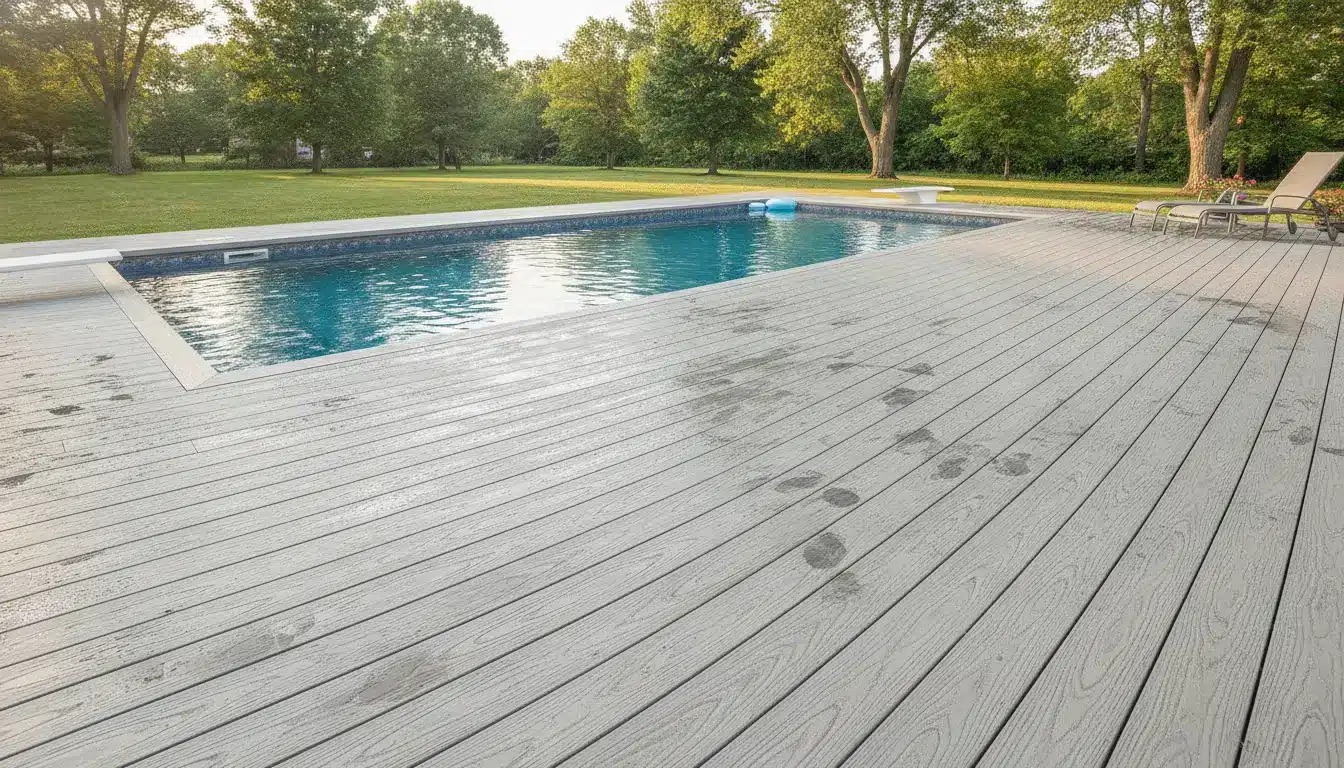

A local deck builder on why the boards around a pool fail differently than the rest of your deck, and what he’d talk you out of.
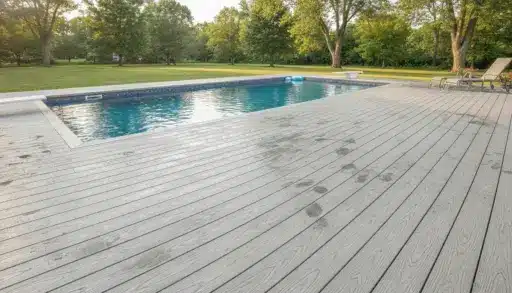
Every backyard pool in Naperville sits inside a ring of decking that takes a beating nobody plans for. Splashout lands on the same stretch of boards all summer. Kids cross it barefoot at two in the afternoon in July. Whatever chemistry keeps the water clean ends up on the surface, in the gaps, and on the hardware underneath.
We asked Radu Oprea what holds up. Oprea runs Wolf Spirit Deck out of an office on Calamos Court in Naperville, and his crews have installed hundreds of composite decks across Naperville and the western suburbs since 2018. He has also torn out his share of pool decks that didn’t make it, which is the part of the job that shapes his opinions.
The interview has been edited for length and clarity.
What Kills a Pool Deck That Doesn’t Kill a Regular Deck?
Two things, and they work differently.
The first is water with chemistry in it. Rain hits a regular deck and dries clean. Pool splashout hits the same stretch of boards over and over and leaves something behind, chlorine or salt depending on the pool.
The second is heat, and heat is a comfort problem, not a durability problem. The board is fine. Nobody wants to stand on it.
Then there’s everything underneath, which nobody thinks about. The surface gets the attention. Ask me what I’d worry about in year ten and it’s the framing, the fasteners, and the flashing where the deck meets the house.
Does chlorine damage composite decking?
At the strength it’s in your pool, no. But homeowners get a flat yes from one source and a flat no from another, and the argument is really about three different things, so let me split them.
Swimming water carries a few parts per million of chlorine. Splashout at that concentration doesn’t touch the cap on a modern capped composite or PVC board, salt systems in the normal range included. That’s not me being generous to the product. It’s what the cap is engineered for, and it’s why you see the same boards on docks and waterfront builds.
Concentrated chemicals are a different story, and this is where the yes answers are right. A chlorine puck left sitting on a board, a spilled scoop of shock, undiluted anything. That can bleach a mark into any cap, so a spill gets rinsed when it happens, not on Saturday. I also tell pool clients to hose down the splash zone every week or two in season. The residue that dried splashout leaves behind won’t eat the board, but let it build all summer and you’re scrubbing a film off in September.
The reputation has one more source, and it’s history. The first generation of composite, the uncapped boards from the 2000s, had wood fiber exposed right at the surface, and pool water grayed and chalked it the way it grays cedar. When somebody tells me chlorine wrecked their composite deck, my first question is what year it went in.
What splashout genuinely destroys today is everything that isn’t the board. Chloride plus moisture makes a weak acid that goes after metal, which is how box-store screws end up corroded down to nothing. I’ve pulled boards and found exactly that. Around a pool it’s stainless or properly coated hardware, and that’s not an upgrade, that’s the minimum. Bare wood is the other casualty. Chlorine chews through sealer, and then the wood grays and splinters right where the splash lands.
There Are a Lot of Brands out There. How Should Someone Actually Choose?
Start with the three families instead of the brand names. Wood-plastic composite, WPC in the industry, has wood fiber in the core under the cap and is usually the cheapest of the three. Polymer boards, what everyone calls PVC, have no wood in them at all. Mineral-based composite, MBC, is the newest family and doesn’t take on water.
We install all three, and we carry more than one line on purpose. Stocking a single brand means selling you whatever’s in the warehouse. Carrying several means matching the board to the lot, because a shaded yard backing onto the DuPage River is a different moisture situation than a full-sun backyard off 95th Street. Freeze-thaw is the first thing we weigh on any board we recommend here, pool or no pool.
For the pool question specifically: any capped board in the three families handles the water, so the real decision is heat and budget. Kids running barefoot all summer, I’m steering you toward a light color in PVC or a mineral board. Pool mostly shaded, the heat argument fades and wood-plastic starts winning on price.
How much does color matter for heat?
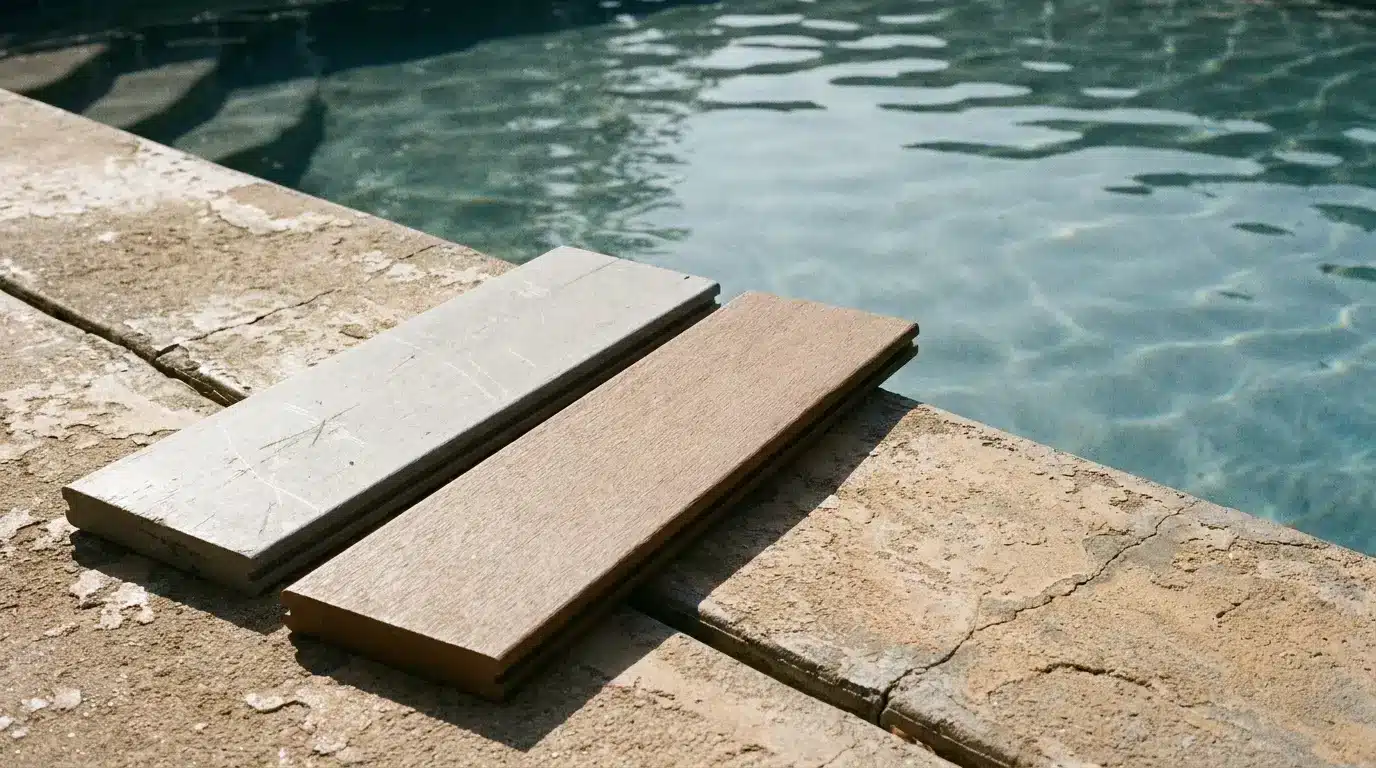
More than the material does. People show up ready to debate composite versus PVC, then you lay sample boards out in July sun and the light gray one is walkable in every family and the dark brown one is hot in every family. Every burnt-feet call I’ve taken was a dark surface in full sun.
Wood fibers act like little heat batteries. They soak up sun and hold it, which is why a wood-fiber composite stays warm into the evening while a PVC board lets its heat go the minute shade hits. On a west-facing pool deck that’s worth something.
What I do on almost every pool deck is a light field color where people actually walk, with the dark tone saved for the border. Same money either way. You just have to decide it before the order goes in.
Wet feet on a smooth board sounds bad. What about traction?
Textured composite grips better than sealed wood, which surprises people. A wood deck next to a pool needs sealer to survive the chemistry, sealer is exactly what gets slick when it’s wet, and then it wears off in the traffic path so you’re redoing that strip every couple of years. The texture on a capped board doesn’t wear off. You hose it down and that’s the maintenance.
Is There Ever a Case for Wood Around a Pool?
I’ll build what you want, but you’ll hear my opinion first, and next to a pool we almost always push composite. Chlorine eats wood sealer. So you’d be resealing a surface that gets splashed with treated water all season and then freeze-thawed all winter, and that’s a lot of your weekends. The failure is slow, too. Nobody notices how gray and splintered it’s gotten until they stand on the neighbor’s.
What do Naperville homeowners get wrong on permits?
Assuming a low deck doesn’t need one. In Naperville, any deck added to the house needs a building permit. So does replacing the structural parts of an existing one: beams, joists, stairs, railings. People hear thirty inches somewhere and figure low means exempt, and here that’s not the rule.
The mechanics: it all goes through the city’s Civic Access portal, plan review runs about two to four weeks, and total permit fees on a typical deck land around $400 to $600. We’ve pulled enough of them this year to know that range without guessing. Then come inspections. Footings, framing, and final at minimum, and most decks end up with four to six visits once lighting adds an electric rough and final. Footings here go 42 inches down for frost. And anything submitted since April 1 falls under the 2024 codes the city adopted, which tightened ledger flashing and guard loads, so the drawings have to show it or the reviewer sends them back.
If a contractor says the build starts next week, ask what the plan is for the permit. And if you’re in Tall Grass, White Eagle, or Ashbury, the HOA wants its own package before the city sees anything.
Does the deck railing count as the pool barrier?
Sometimes, and that’s exactly where pool projects go sideways. Naperville requires every outdoor pool to be enclosed by a barrier, above-ground pools and hot tubs included, and the rule applies to existing fences, not just new ones. The city’s guidelines for residential pools describe a barrier at least 48 inches high with gates that close and latch on their own.
So when a stretch of deck railing does double duty as barrier, the railing height, the picket spacing, and where the gate sits all have to pass pool code, not just deck code. I’d rather sort that out on paper than argue about it at final inspection, because the fix after the fact is rebuilding a railing. Bring your layout to the city, or make your builder walk you through how the barrier works before anything gets ordered.
What does a pool deck cost here?
Composite runs roughly $60 to $95 a square foot installed around Naperville. What moves a quote inside that range isn’t really the boards. It’s height first, then stairs, then railing choice, and most pool decks sit close to grade, so they skip the tall-post framing that pushes a project toward the top of the range. We publish planning ranges by deck size on our Naperville deck building page so you can set a budget before anyone comes out to measure. Those are planning numbers, not quotes. Two decks with the same footprint can land thousands apart on stairs and railings alone.
On warranties: the 20 to 25 year fade and stain coverage on the lines we carry comes through the manufacturer programs. We’re a TimberTech Gold contractor and a Deckorators dealer, and we put our own 10-year labor warranty behind the work. The fastest way to lose manufacturer coverage is an install that ignored the instructions, wrong gaps, wrong fasteners. Ask whoever bids your job what program they install under.
Last one. What would you check on an existing pool deck today?
The ledger, if the deck hangs off the house, and whether there’s flashing behind it. Water gets in there, it rots out of sight, and it’s the failure we find most.
Then the joists. We poke them with a pick. Firm wood, the structure’s fine. Soft wood is rot, and no new surface fixes a bad frame.
If the frame passes, resurfacing is a real option. New boards over your existing structure typically save 40 to 50 percent against a full rebuild, and it’s a three to five day job instead of weeks. I’d rather tell somebody that than sell them a tear-out they don’t need.
If you’re getting quotes this season
Naperville requires contractors to register with the city and carry insurance, so ask for both before anyone measures. Get the fastener spec for the pool zone in writing, stainless or coated. Have the bidder show you the ledger detail on the drawing rather than describe it. And settle the permit and the barrier question before you sign, because those two are where the expensive surprises live.

Robert Thompson, a proud alum of the University of Oregon with a degree in Landscape Architecture, has been a leading figure in outdoor space enhancement for over 17 years. He started his career with a landscape design firm, gaining invaluable experience creating functional and attractive outdoor living areas. Robert joined our website in 2018, where he quickly became known for his innovative yet practical advice on outdoor renovations. He has been the chief editor of our deck and patio section ever since then, helping readers transform their outdoor spaces into personal retreats. When not drafting designs or writing, Robert is an avid kayaker, often drawing inspiration from nature for his creative projects.