
There’s that one place in every house.
Perhaps it’s the 15cm space next to the fridge. The strange corner in the hallway. The area under the stairs where things mysteriously disappear forever. We typically don’t pay attention to these locations because they are small or awkward.
But small spaces add up. Much like a video compressor can make a bulky file easier to manage, a clever storage solution can make an awkward part of your home surprisingly useful.
The good news? You don’t need a huge renovation budget or advanced carpentry skills. Sometimes, a few boards, brackets, wheels, and a measuring tape are enough to turn an annoying gap into storage you’ll wonder how you lived without.
These are 7 ideas for DIY projects that you should give a try.
1. Build a Narrow Rolling Cart for Tiny Gaps
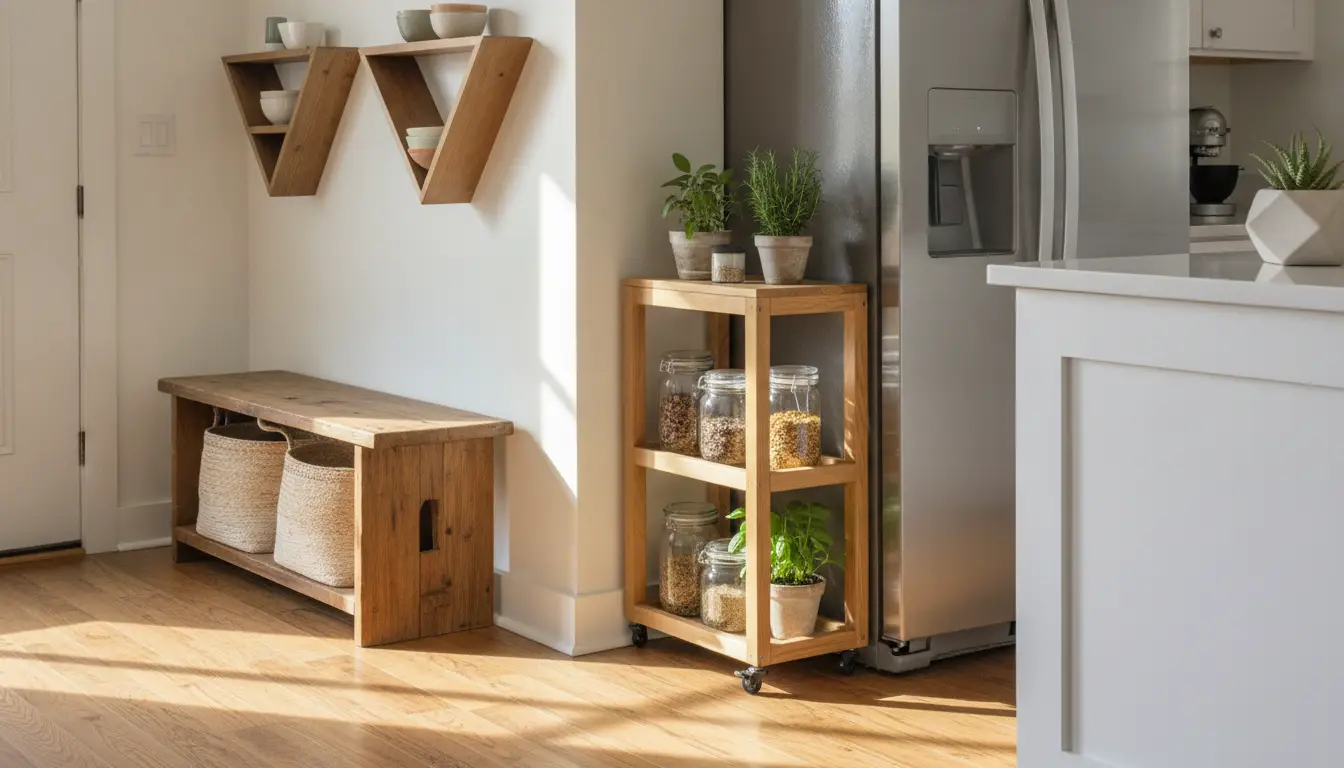
The narrow space between the refrigerator and the wall might seem like wasted space. However, if there is enough room to place a couple of bottles or jars, it can become one of the easiest areas to store them in your kitchen.
This tiny gap can be easily filled with a rolling cart constructed from a few thin boards and small caster wheels.
Use this for spices, cooking oils, cans, cleaning supplies, or those bottles you can’t find a place for!
Some tips:
- Take a few measurements of the distance. Not all walls and cabinets are straight.
- Make the cart slightly narrower than the smallest measurement.
- Place heavier objects at the bottom to stabilize.
- Attach a small handle to the front so it can be pulled out of the container easily.
- Consider a raised edge on each shelf to stop bottles from falling when you move it.
This concept can also be implemented in bathrooms, laundry rooms, and even next to a washing machine.
2. Turn the Space Under the Stairs Into Hidden Storage
There’s a ton of potential with under-stair storage, but there’s a problem: It can turn into a cluttered junk drawer in your house. You know the area: Christmas decorations, old shoes, random cables and something you purchased three years ago but thought you would need some day.
Instead, divide the space into useful zones.
Simple shelves for small baskets, pull out drawers or simple small cabinets can be constructed. If the space is deep, try to place the more often used items closer to the front, and seasonal items towards the rear.
The front compartment might be used as a shoe and bag station for the family, and further areas further forward might be used for winter coats, holiday decorations, or sports equipment.
It’s important to note here that you should not just blindly start drilling into the wall or floor. Before beginning, inspect plumbing, wiring, electrical panels and other utilities.
3. Put a Shelf Above a Doorway
Look above the doors in your home. There’s a good chance you’ve found a completely unused strip of wall.
A solid shelf over a doorway in a bedroom, bathroom or hallway can be a great space-efficient way to store things.
This can be very helpful for items that don’t get used on a daily basis, like extra towels, books, decorative items, baskets, or seasonal items.
For instance, extra toilet paper and towel can be stored on a shelf above the toilet door. Use lovely baskets in a bedroom to store scarves, handbags or accessories for the winter.
Just don’t make the mistake of putting your everyday essentials up there. If you’re standing on a chair each morning to get to your coffee mugs you have created a storage issue instead of solving it.
Always ensure the door is able to open completely and the wall is able to bear the load before installing a shelf. Always use a level and use the proper anchors for wall type. An unfinished look is created by a crooked shelf in an otherwise neat room.
4. Make a Back of a Door Work Harder
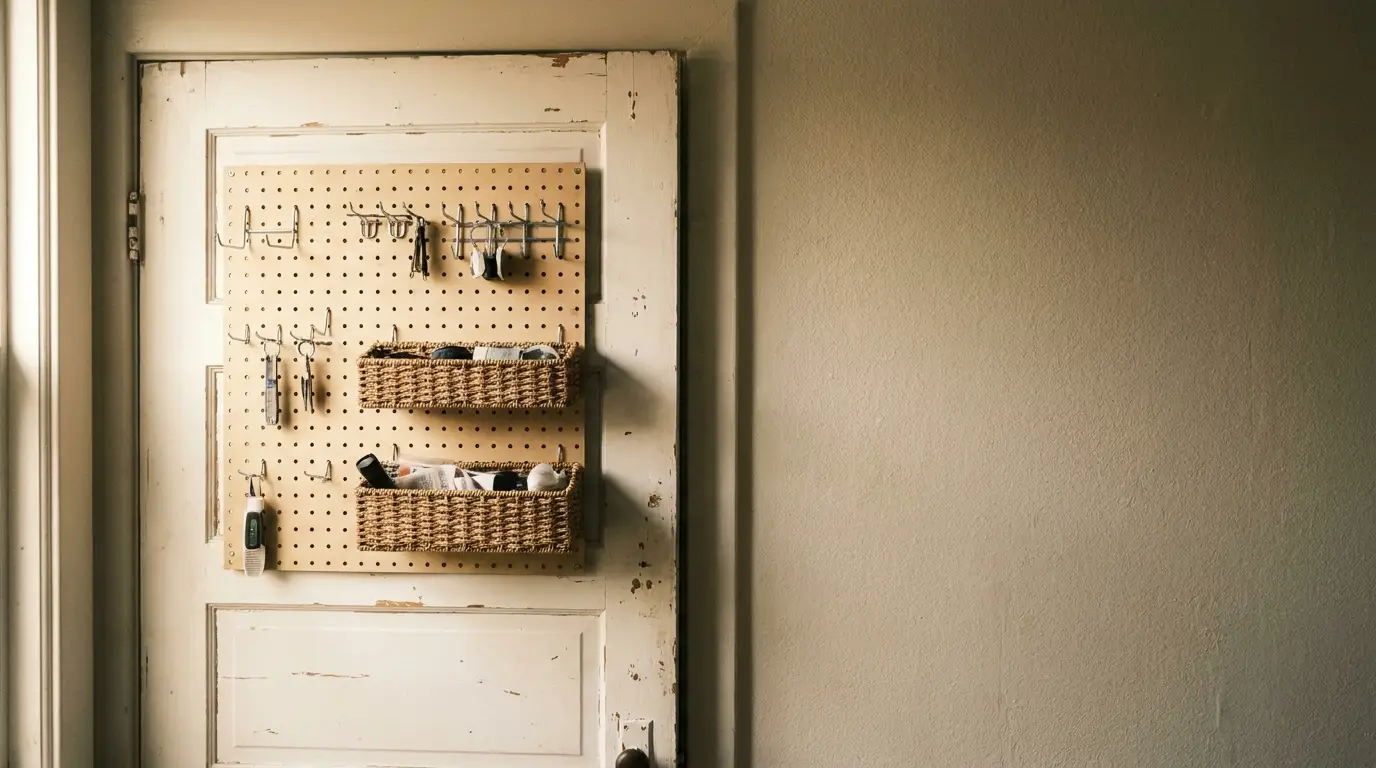
The doors are not only used to open and close. They are also vertical surfaces for storage that are rarely used for that purpose.
The back of a door can be turned into a handy organiser using a simple wooden frame, pegboard, hooks or a couple of narrow baskets.
Brushes, hair styling appliances and toiletries might be put in the bathroom. Cleaning supplies can be kept in a utility cupboard, if you are thinking about a different idea. A child’s door could be a space for art items, small toys or accessories.
The trick is to keep everything relatively lightweight.
Heavy bottles stacked on a door mounted storage system can strain the hinges and can lead to sagging doors. If you’re adding shelves, keep them shallow and make sure they are securely attached.
Remember to test the door before filling the organizer. Nothing is worse than finding your awesome new storage solution is making your door stay open!
5. Turn an Awkward Corner Into a Useful Shelf
Corners can be a challenge to decorate. The standard width of a bookcase might be too large, and cabinets can narrow the room.
The problem with corner shelves is that they’re built to a standard size, but DIY corner shelves can be crafted as large or as small as you desire.
Triangular wooden shelves are easy to make. Fit a few at varying levels and you’ve got valuable storage space – without losing much storage.
They can be used in a kitchen, for example, to store spices or little jars. They may keep their skin care items in the bathroom. In a home office, they can hold notebooks and stationery. In a child’s room they can be a book haven or a toy storage.
Maintain relatively shallow shelves, particularly in hallways and other high-traffic areas. If the shelf is protruding into the walking path, it will eventually become a bump in the road for everyone!
If there is a possibility for children to run around, try sanding and rounding sharp corners.
6. Build a Storage Bench
One of these kinds of do-it-yourself projects that deserve a place in the home is the storage bench.
You have a place to sit, and a place to put things.
An obvious place is an entryway. Can you envision sitting to put your shoes on and shoes, bags, umbrellas or winter accessories are on the bench below?
However, don’t just stop there. Another option is to place a storage bench under a window, at the end of a bed, in a dining room, or in a child’s room.
The construction is often surprisingly simple: Make a solid wooden structure, attach a top that slides up or off, and paint or stain.
If it is to be used by people, ensure that it is sufficiently robust for them to sit on it. A cushion is also a nice addition to an entryway bench to make it more comfortable to sit on.
A great solution, which can be very helpful, is placing baskets in the bench. Each basked can have a function (hats, shoes, toys, blankets, etc) rather than being used as one giant basket.
7. Use the Side of a Cabinet for Vertical Storage
Another often neglected area is a cabinet side.
You might have one or more square feet of vertical space in an unused side of a kitchen cabinet, bathroom vanity, wardrobe or home office unit.
It can be converted into a tool and utensils station with a small pegboard. Measuring cups or kitchen towels can be secured in the hooks. Small shelves can be used for storing toiletries, stationery, or spices.
A kitchen where there’s a cupboard side by the cooking surface with measuring spoons, oven gloves and the utensils you use regularly. Then one day, you’re no longer flipping open three drawers every night when you prepare meals.
Simply leave the installation shallow. Storing the items too far into the walkway area can make a room look narrower and make a very effective obstacle at hip level.
Before You Start, Measure Twice
It’s just as easy to destroy a self-built storage solution as it is to begin cutting without taking measurements.
Prior to purchasing materials, review:
- Width: How much space do you actually have?
- Depth: Will the finished storage stick into a walkway?
- Height: Are there shelves, doors, or windows in the way?
- Clearance: Can nearby doors and drawers still open?
- Structure: Is there any pipe, cable or other obstacles behind the wall?
If the space is very irregular, create a preliminary cardboard model. It may seem like a ludicrous idea, but it can uncover issues before you spend dollars on wood and hardware.
Look at Your Home Differently
Sometimes it is not the next big closet or costly shelving system that is the best solution. It can be a small cart next to the fridge, a shelf over a door or a few hooks on the side of a cabinet.
Get creative in your home by looking under furniture, under sinks, in corners and corners, and in unused vertical space.
You may find that you don’t require additional space. All you have to do is make the most of what you’ve got already.
That’s the actual great thing about making use of do-it-yourself storage: you’re not making your home appear like someone else’s. You’re designing solutions to fit the odd and unusual spaces that make up your home.

James McLaren, with a rich background in architecture from the University of Manchester, has been contributing his expertise to the world of creative construction and home innovation for over 20 years. His journey began as a project manager for a leading construction firm, where he honed his skills in bringing complex designs to life. James joined our platform as a freelancer in 2019, quickly becoming a favorite for his insightful and practical advice. He has been a pivotal force to our wing ever since, bringing our readers a blend of technical know-how and creative flair. Beyond his professional life, James is an avid woodworker and enjoys restoring vintage furniture, a hobby that complements his professional insights beautifully.