
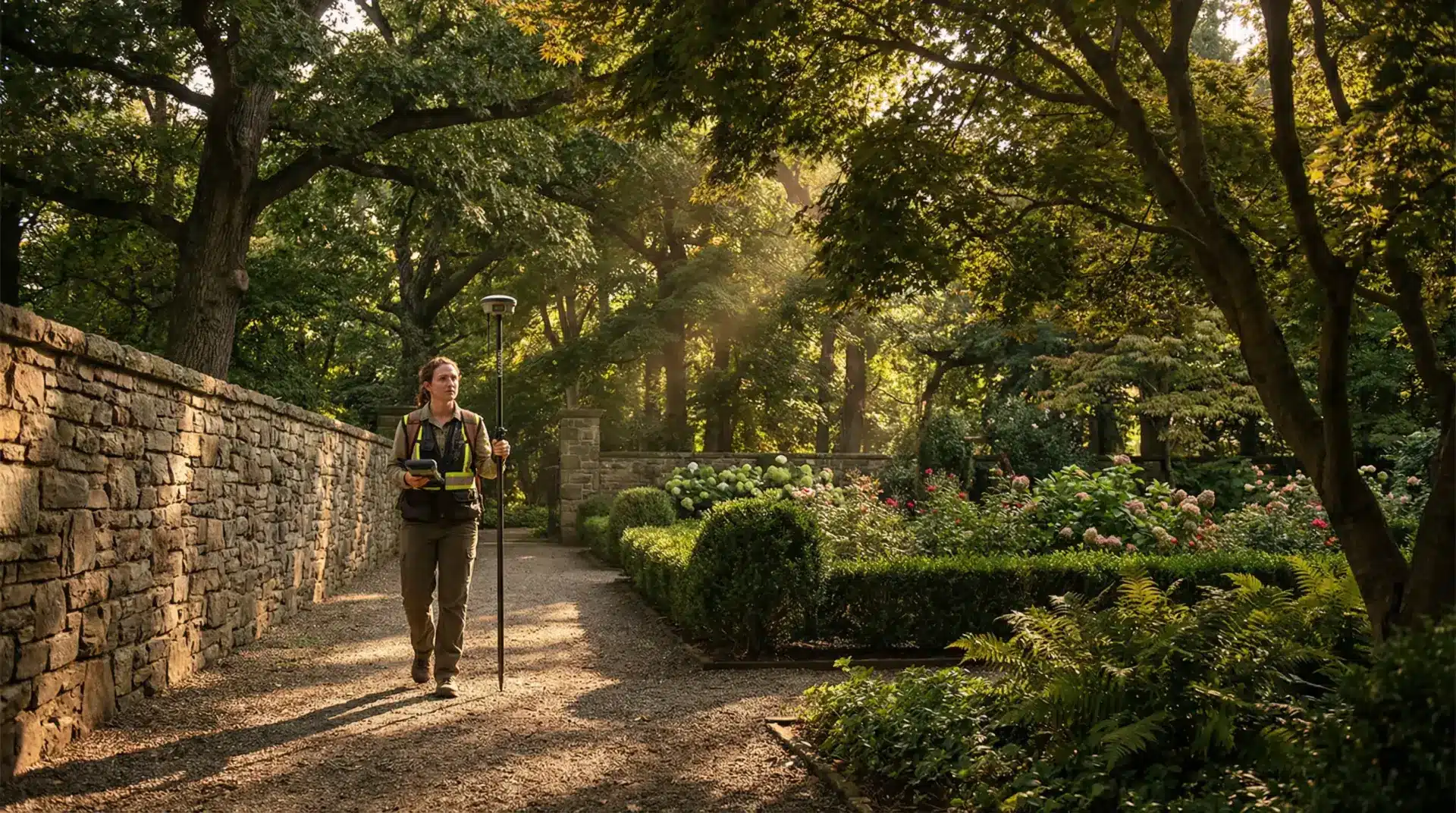
Field work has a way of changing the rules without warning. In the morning you’re in open sky and your points come back politely. After lunch you’re under wet branches, then beside a long glass façade, then between a fence and stacked containers where the “sky view” is basically a thin strip above your head. Nothing about your job description changed, but the environment did—and the environment is the part that never reads the spec sheet.
In those places, an rtk rover isn’t judged by what it can do on a perfect day. It’s judged by what your workflow can produce when conditions are messy: points that agree when you return tomorrow, lines that don’t wobble when the office overlays them on other layers, and decisions that don’t need a second site visit to be confirmed.
What Hard Conditions Do When They Don’t Look Like They’re Doing Anything
Under canopy, the problem often isn’t “no signal.” It’s “signal that changes every few steps.” Leaves and branches don’t behave like a switch; they behave like a filter. You can stand still and feel the solution breathe—good for a moment, then slightly worse, then good again. If you capture quickly, you can freeze the worst second of that rhythm and carry it home as if it were truth.
Near walls and façades, the trouble is more deceptive. Reflections can make the receiver hear the world twice. The number on screen can look calm and consistent, which is exactly what makes it dangerous. Multipath doesn’t always shout. Sometimes it whispers.
And then there are the “hot spots” nobody marked on the plan: a parked truck close to the antenna, a metal gate, wet pavement after rain, a steel frame on site. You don’t need a lab to recognize them. You need the humility to assume that anything shiny and close can become part of your signal path.
One Habit That Prevents Most Pain
Treat important points like they deserve a second opinion.
Not every point needs ceremony. But if a point is going to be built to, drilled from, or used to settle an argument later, don’t let it be a one-take performance. Give it a second chance to prove itself—either by re-occupying it after a short break, approaching it from a slightly different position, or tying it back to something you trust.
This is less about perfection and more about eliminating the worst kind of mistake: the confident one.
Before You Walk Into Trouble, Make Sure Your Setup Isn’t the Trouble
Hard environments amplify small setup errors. If your reference is wrong, canopy will not forgive it. If your antenna height entry is sloppy, a wall won’t reveal it; it will politely let you be wrong.
So start with something that can’t be argued with: a known point. Hit it early. If it doesn’t come back as expected, you don’t have “tough conditions.” You have a setup issue wearing a disguise. Fix that before you collect a single feature.
Under Trees: Work With the Rhythm, Not Against It
Canopy work becomes manageable when you accept that it’s variable and plan for that variability.
A common field scene: you step under trees, the solution still looks usable, and you start capturing quickly to “get through it.” Ten minutes later you notice that points near the canopy edge don’t quite line up with the open-sky segment you captured earlier. The data isn’t wildly wrong—it’s just inconsistent enough to ruin confidence.
The simplest counter-move is strategic patience:
- linger a little longer on points that matter,
- avoid capturing critical points at the most unstable transitions (canopy edges) unless you can re-check,
- and use small open gaps when you find them—moving a few meters can change the quality dramatically.
Canopy doesn’t demand slow work everywhere. It demands careful work at the moments where quality changes quickly.
Near Walls: Distance Is a QA Tool
Walls don’t only block the sky; they create reflection geometry. The closer you are to reflective surfaces, the more you invite delayed signal copies into the solution.
If you can step away from a wall—even modestly—do it. If you can’t, use a deliberate offset approach rather than trying to “force” a direct occupation in a reflection corridor. This isn’t admitting defeat. It’s choosing a method you can explain later.
A quick self-test that works in the field: take the same point, then shift your body position a meter and take it again. If the coordinates change noticeably, the environment is asserting itself. You don’t argue with it; you respond by re-occupying, extending the observation, moving to a better spot, or using an offset.
Multipath Hot Spots: Learn to Recognize the Situations, Not the Theory
Multipath is easiest to manage when you stop thinking of it as a mysterious phenomenon and start treating it as a set of repeatable situations: shiny surfaces nearby, metal structures, close vehicles, narrow corridors, wet ground, steel frames.
The problem isn’t that multipath exists. The problem is when you don’t notice you’re standing in a multipath-friendly arrangement. Once you notice, you can do something simple and effective: step away, change the angle, or re-check.
If you ever find yourself thinking, “It looks fine, but I don’t like it,” you’re probably right. That discomfort is usually your pattern-recognition working before your logic catches up.
“Clean Data” Is Also About Meaning
conditions tempt people into sloppy capture: quick points with vague codes, missing attributes, and no notes about why a feature was hard to occupy. Later, the office receives a dataset that may be geometrically close but operationally unclear. Then comes the worst stage of all: interpretation.
Keep discipline even when the site is chaotic. Use consistent feature definitions (“center” vs “edge”), consistent coding, and short notes for exceptions: blocked access, unsafe occupation, heavy reflections, canopy instability. These notes aren’t decoration; they tell the next person how much to trust a point and why.
When to Stop Wrestling and Switch Tactics
There’s a point where “try again” becomes a waste. If repeated occupations keep disagreeing, or quality never stabilizes, you’re not failing—you’re being told something about the environment.
Switch tactics before frustration becomes your method:
- capture from a clearer nearby position with a documented offset,
- rely more on local control where GNSS conditions are consistently poor,
- or return at a time when the site is less obstructed.
Good field work isn’t stubborn. It’s adaptable.
The End Goal: Coherence You Can Defend
Hard places don’t make good data impossible. They make wishful thinking expensive. When you build a routine around control checks, second looks for high-consequence points, and honest documentation of hard conditions, your dataset stays coherent across days and across teams.
That coherence is the real prize. Not “centimeter accuracy” as a slogan, but measurements that behave consistently enough that nobody has to re-measure them just to feel safe.

Liam Bennett holds a degree in Computer Science from the University of Edinburgh and has over 15 years of experience in technology and digital innovation. He began his career in software development, focusing on user-friendly systems and backend architecture. Liam joined our platform in 2025 to lead our Tech section, where he simplifies complex topics—from smart home devices and AI tools to cybersecurity and troubleshooting tips. Known for his clear, practical advice, he helps readers navigate today’s fast-evolving tech landscape. Outside of work, Liam enjoys building custom PCs and contributing to open-source projects.