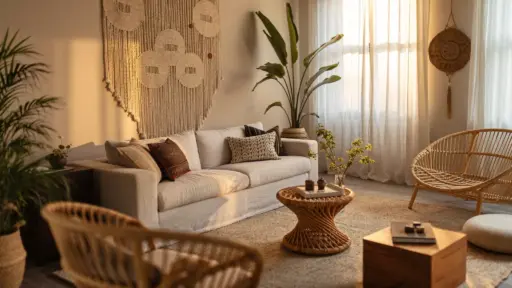
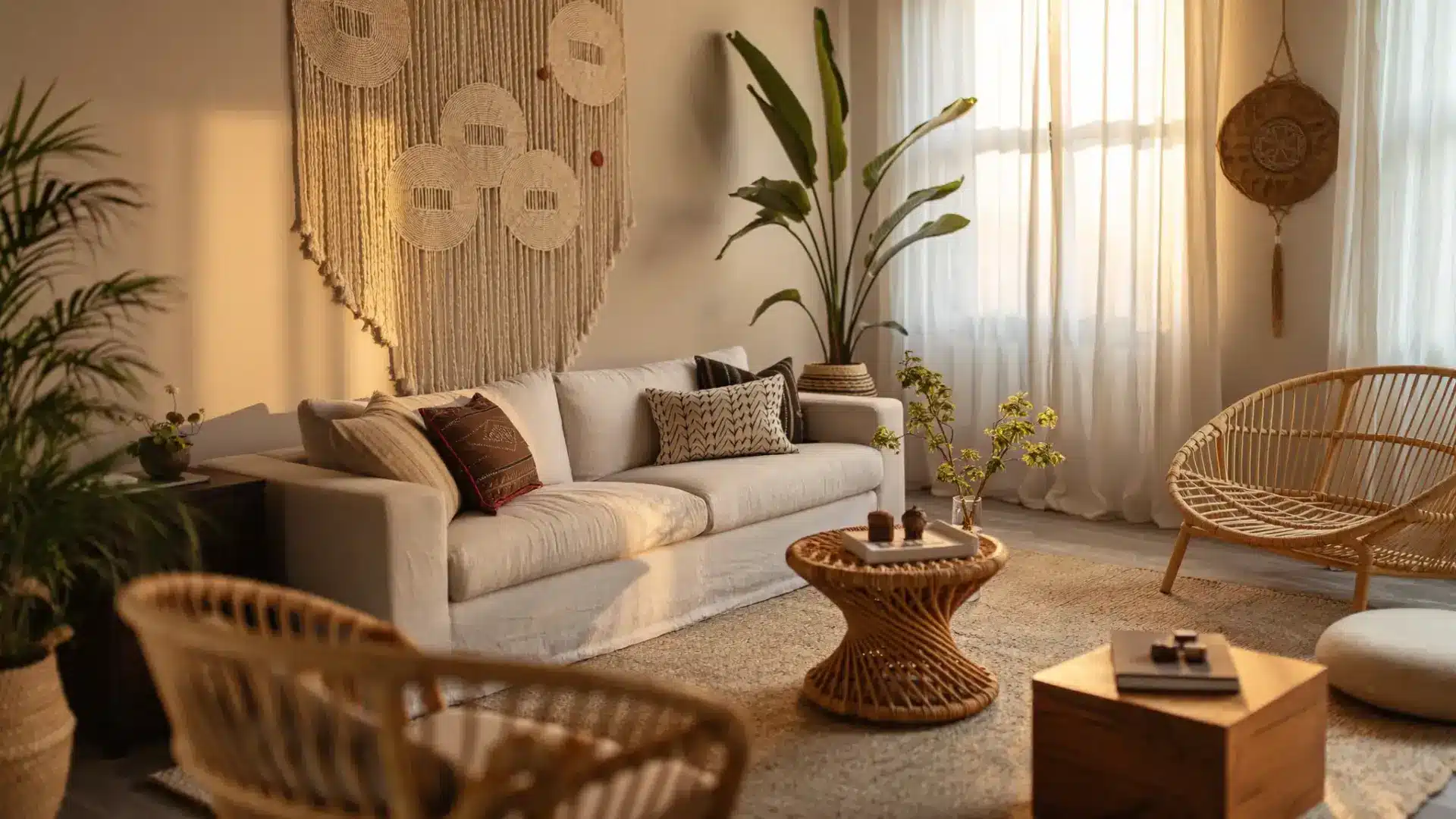
Your living room has the rattan chair. The macrame is on the wall. You even layered the rugs.
But something still feels off, like a costume rather than a home.
That feeling has a cause. Bohemian interior design fails in specific, predictable ways: the wrong bulb temperature flattens warm tones, pattern scales compete rather than converse, and plants sit in vessels that are too large.
Small errors, but they undo everything around them.
Fix those, and the same room you already have stops looking assembled and starts feeling lived-in.
What is Bohemian Interior Design?
Boho style is a free-spirited approach to decorating that celebrates individuality, cultural richness, and layering.
It resists planning and matching. Also, it actively rewards neglecting the worn edge of a kilim rug, the sun-faded throw, the ceramic that chips slightly and looks better for it.
There are no strict rules.
Bohemian design is the only interior style that gets uglier when you try too hard.
At its core, it is a collection of objects that each earned its place through travel, memory, craft, or time.
Not a style you buy. Not a look you replicate. A home that gradually reveals who lives there.
The Origins of Boho Style and Why It Still Matters
Bohemian traces its roots to the 19th century, with an irregular lifestyle that valued creativity over materialism.
The Core Philosophy Behind Boho Spaces
Bohemian design didn’t start in homes. It started with a refusal.
19th-century Paris. Artists and writers who couldn’t afford bourgeois life stopped pretending to want it.
Mismatched furniture. Collected objects. Walls covered in work, not wallpaper.
That refusal became a look. What looked like poverty from the outside felt like radical freedom from within. The 1960s deepened it. Travel replaced shopping. Cultural exchange replaced catalogs.
The 1960s Hippie Revival and Global Influences
The Bohemian style had a powerful second wave in the 1960s.
Moroccan rugs, Indian embroideries, and Czech gypsy textiles entered the design vocabulary. Handwoven fabrics, brass lanterns, and earthy ceramics brought global craft traditions into everyday interiors.
Travel, cultural exchange, and a rejection of mass production shaped this era.
The result was a richer, more layered version of bohemian design, one that influences the style today.
Why Boho Interiors are Trending in Modern Homes
Boho style is resonating strongly with today’s lifestyle and design preferences.
This shift toward expressive, lived-in spaces reflects global design trends and consumer behavior.
- Pinterest’s trend report highlights African-boho fusion as one of the fastest-rising interior trends globally, with searches for afrobohemian home decor up 220%.
- Growing interest in sustainability boosts demand for natural, handcrafted, vintage pieces, key to boho design.
- Millennials and Gen Z are rejecting sterile, uniform interiors in favor of spaces that reflect personal identity.
As homes become multifunctional spaces for work, rest, and socializing, people are leaning towards interiors that feel comfortable rather than overly polished.
The Essential Characteristics of Bohemian Interior Design
Bohemian Design is built on a set of consistent visual principles.
Each element works in harmony with the next. Understanding these building blocks makes it far easier to design a boho interior that feels intentional, balanced, and entirely your own.
A Relaxed Color Palette that Still Feels Cohesive
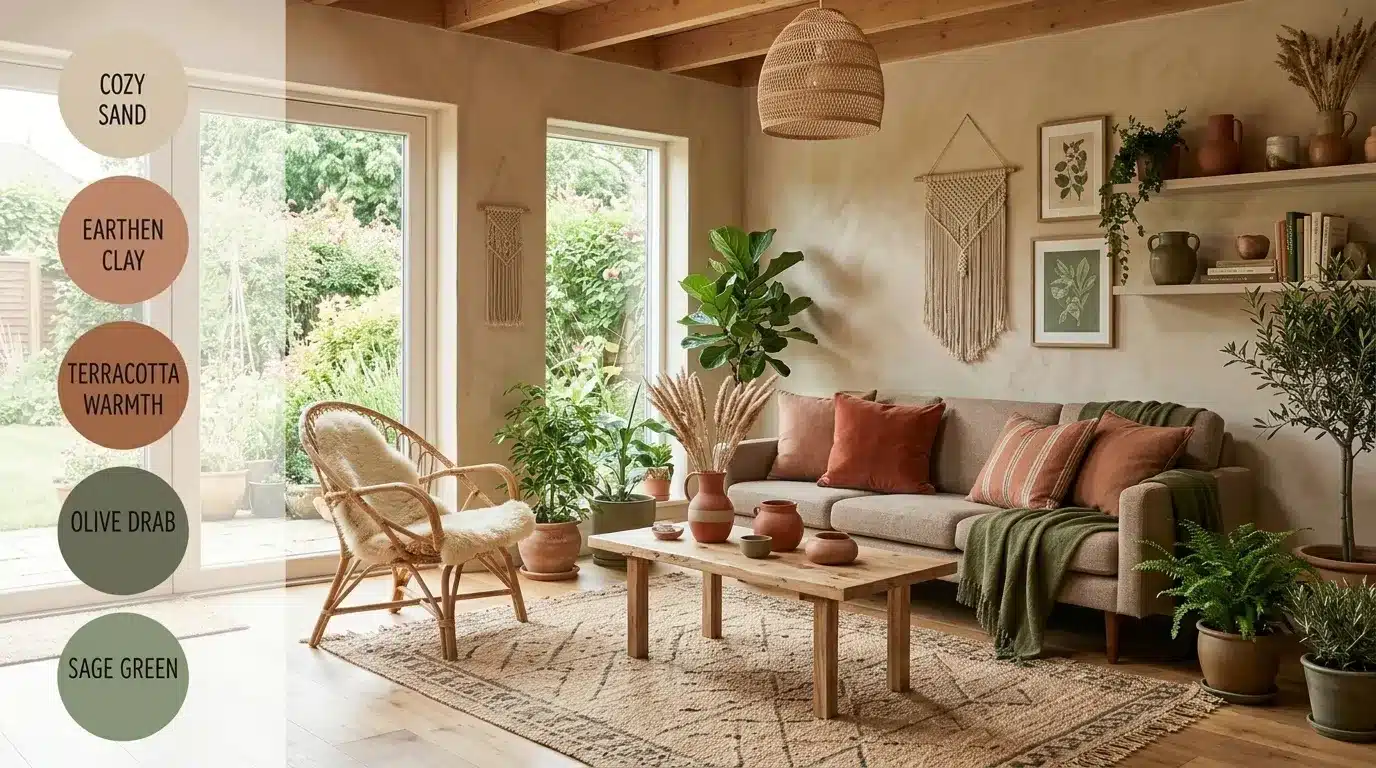
Earthy base tones: terracotta, clay, warm sand, and olive. Layered on top are jewel-toned accents: sapphire, emerald, deep plum, and mustard. These appear in smaller doses: a cushion, a rug border, a ceramic vase.
The mistake most people make is treating these accents as interchangeable. They aren’t.
Pick one dominant jewel tone and repeat it in at least three places across the room.
That repetition is what makes the palette feel deliberate rather than accidental. Saturation matters too.
Your jewel-toned pieces shouldn’t all compete at the same intensity.
Use one saturated statement, a deep emerald throw, or a plum ceramic, and tone others down.
Layering without Creating Visual Chaos
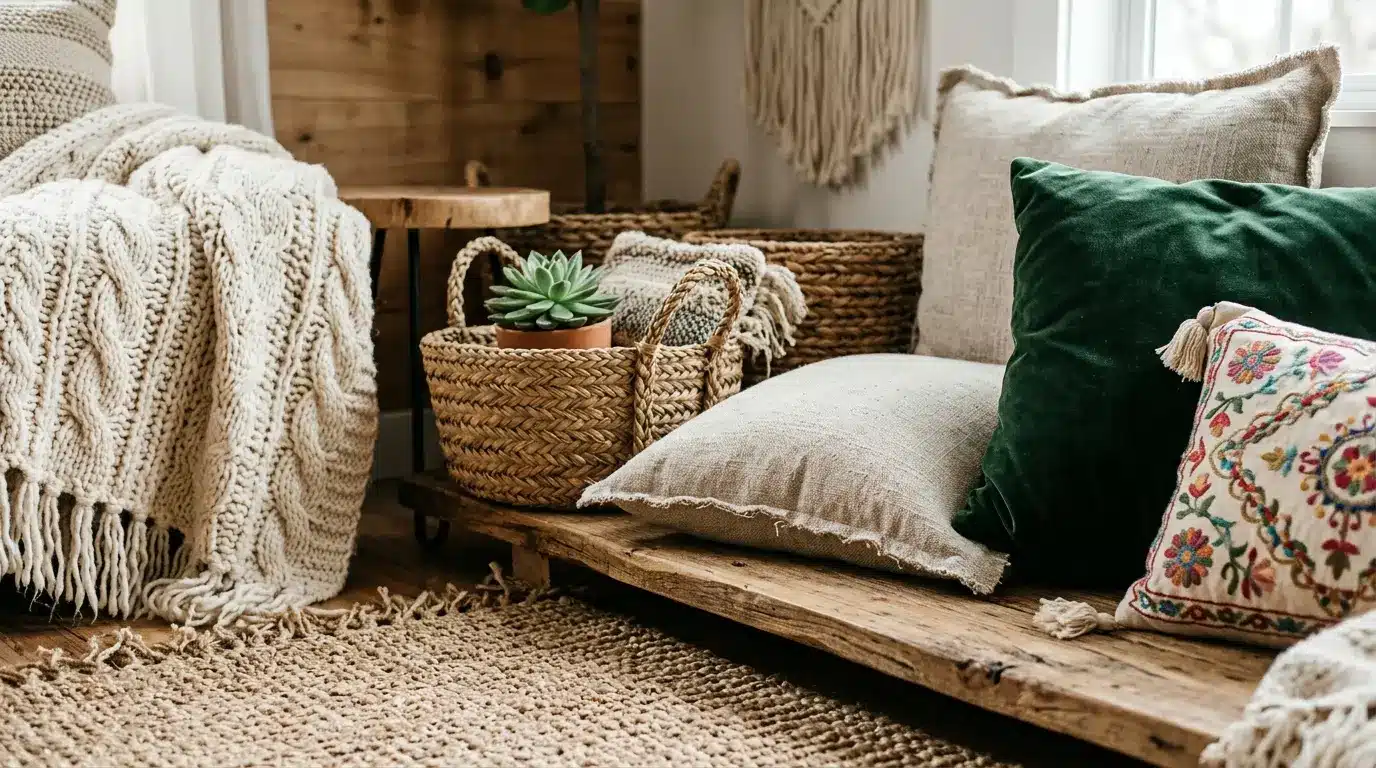
Texture is what separates a flat, forgettable room from a boho interior that invites you to stay.
The technique islayering, combining different tactile surfaces, so the eye moves across the room with interest.
Jute and Sisal bring roughness and earthiness. Linen and cotton add softness and breathability. Knits, velvet, and embroidered fabrics introduce heat and depth.
Mud cloth and woven pieces carry cultural weight and visual character.
The guiding rule is contrast: mix rough with smooth, worn with new, matte with subtle sheen.
No single texture should dominate; the layering itself is the design statement.
Pattern Mixing: Tribal, Floral, and Geometric
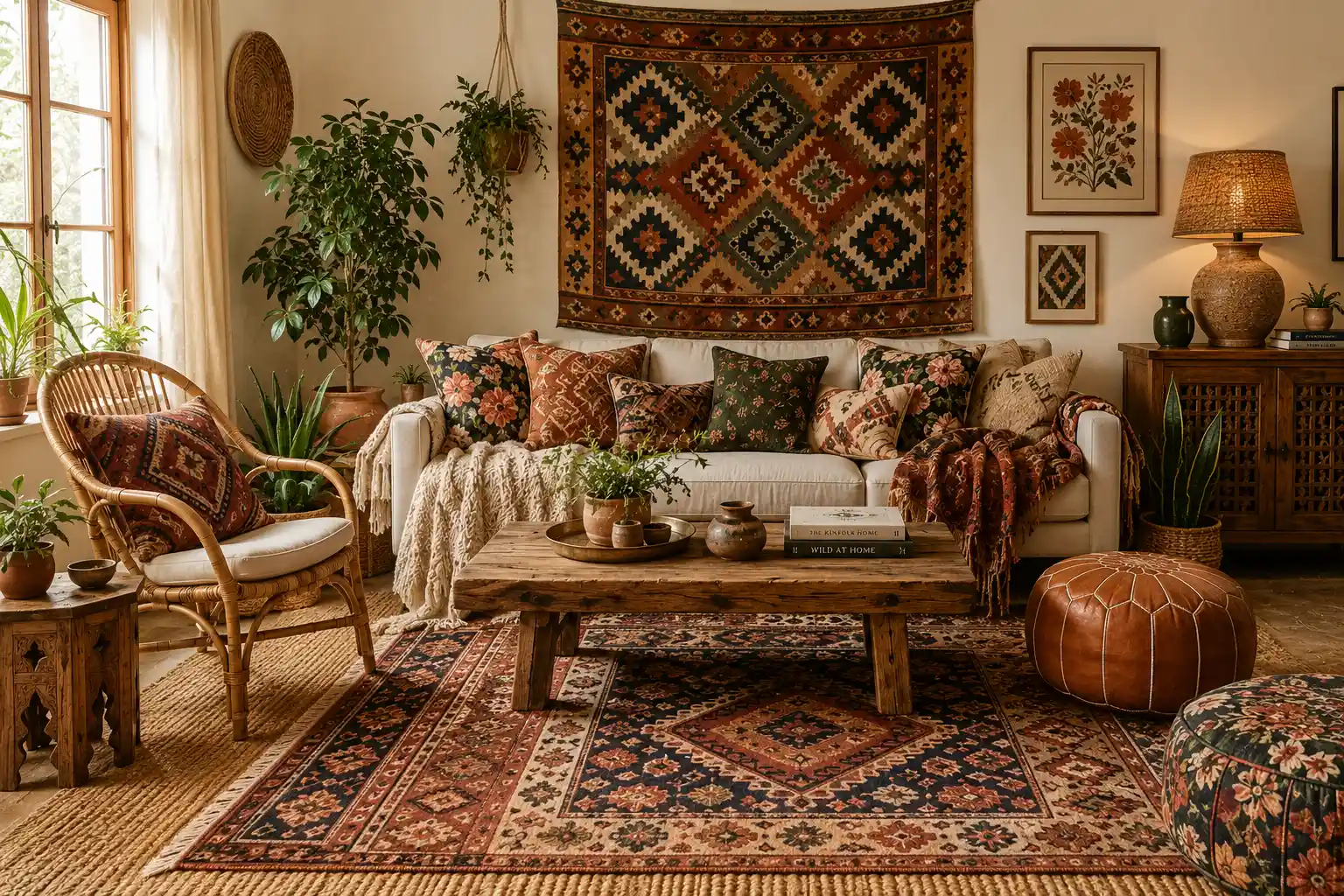
Pattern mixing is one of the most rewarding and most misunderstood aspects of bohemian interior design.
The anchor principle makes it manageable.
The anchor principle: one dominant pattern + supporting layers that share a color
Start with one dominant pattern: typically a large-scale rug, tapestry, or statement textile.
Every other pattern you introduce should share at least one color from that anchor piece. Scale matters too: pair a large geometric with a smaller floral, or a bold tribal print with a subtle stripe.
This prevents any two patterns from competing at the same visual volume.
Natural Materials: Rattan, Bamboo, Jute, Reclaimed Wood
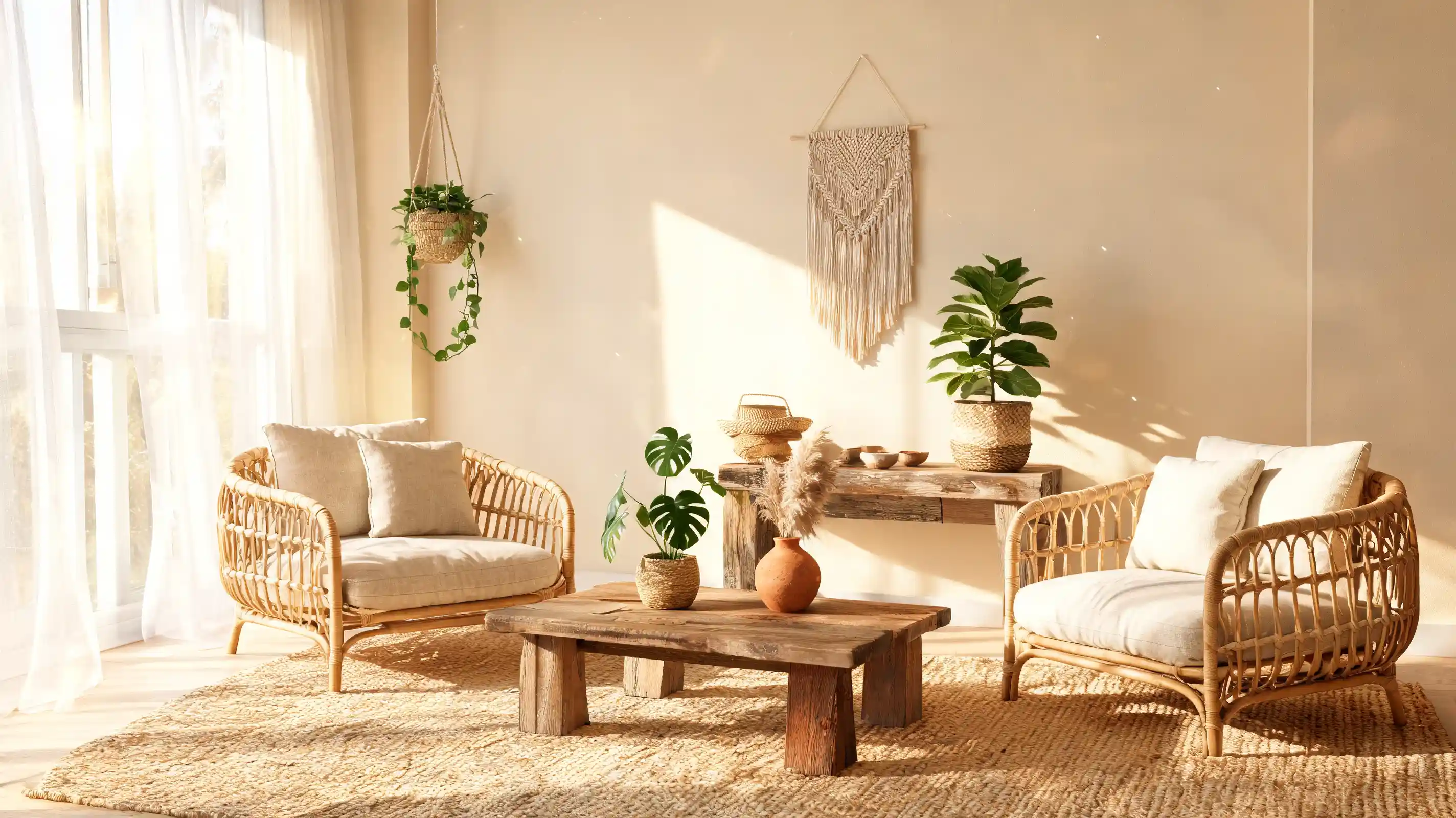
Natural materials are the backbone of boho style interior design, and their relevance has never been stronger.
Rattan, bamboo, jute, and reclaimed wood are the core materials in the style’s vocabulary. They bring heat, organic texture, and a handcrafted quality that synthetic alternatives cannot replicate.
Plants and Greenery: a Non-Negotiable Boho Element
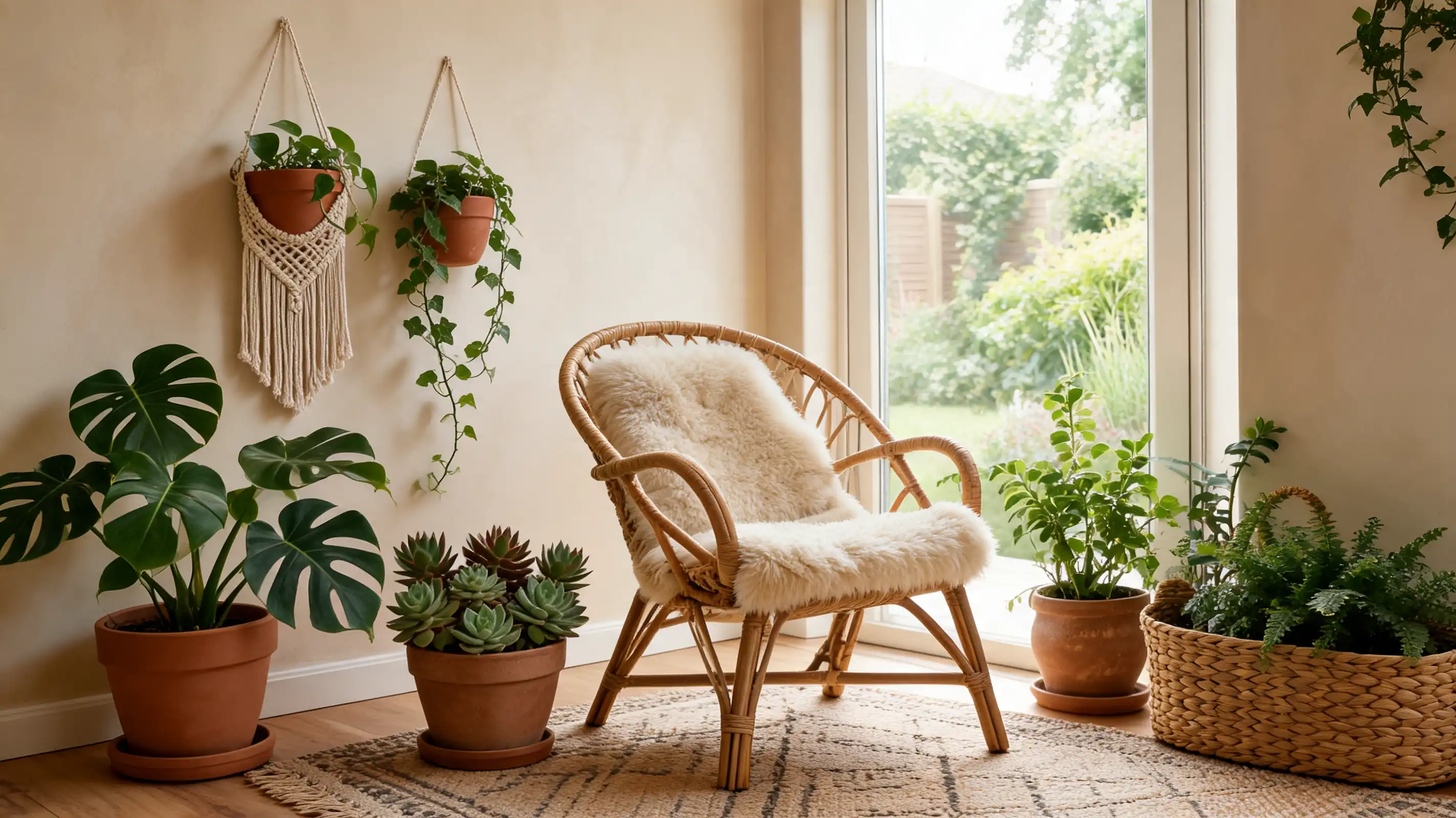
Plants are not decorative extras in a boho interior; they are essential. In a boho space, greenery softens hard edges, adds natural color, and reinforces the connection to the living world that the style is built around.
Start with at least 3 plants at varying heights.
Mix trailing varieties like pothos and ivy, statement plants like monstera, and smaller potted succulents.
Vary the vessels too, terracotta pots, wicker baskets, and macramé hangers all belong here.
Furniture Choices that Define Original Boho Interiors
In a bohemian interior design, the walls, floors, openings, and structural details are not just a backdrop; they are active participants in the design. Together, they create a space that feels rooted, warm, and deeply considered.
Boho Architectural Signatures: Arches, Exposed Beams, and Alcoves
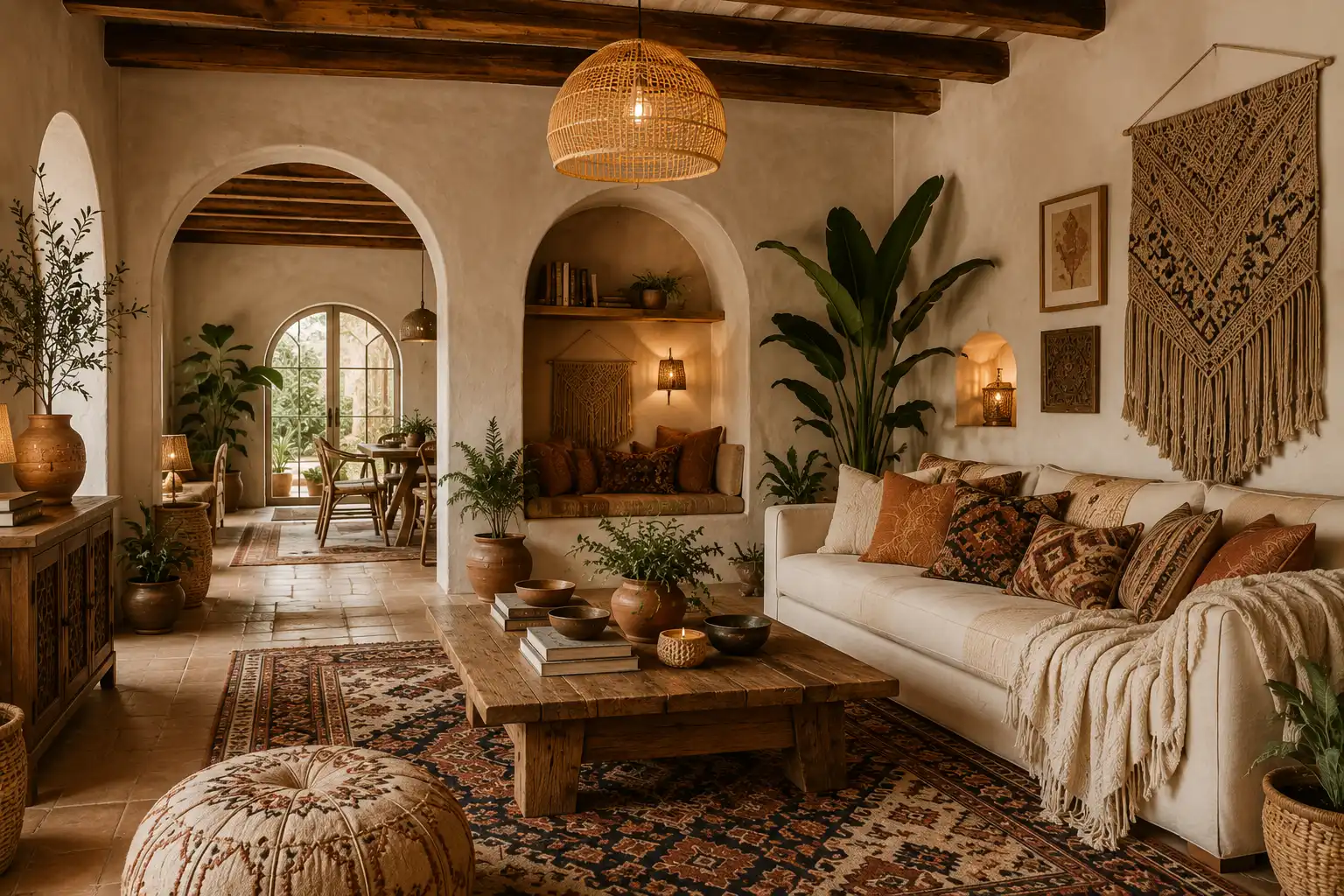
Boho architecture favors softness over sharp lines. Arched doorways are the most recognizable signature of their curved form, which brings an organic, inviting quality that straight-edged frames simply cannot.
Exposed wooden beams add heat and a sense of craft to ceilings.
Built-in reading nooks and alcoves add intimacy, small, enclosed spaces that invite slowing down.
Indoor-Outdoor Flow and Maximizing Natural Light
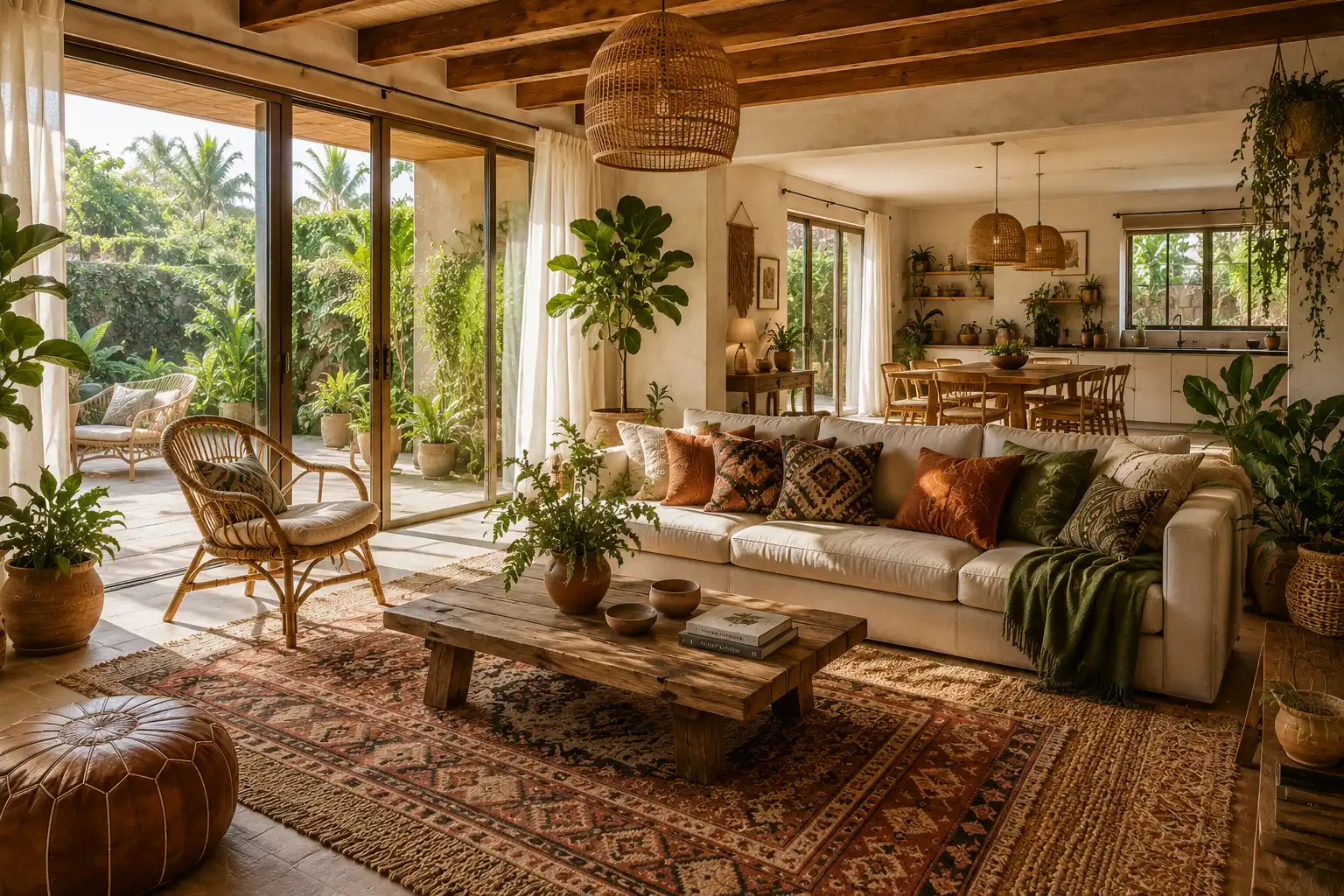
Boho interiors embrace openness and natural light, creating spaces that feel airy and connected to nature.
Open-plan layouts, large windows, and glass panels help blur the boundary between indoors and outdoors while enhancing earthy tones and natural textures.
Even without major renovations, the same effect can be achieved by removing heavy curtains, using glass-paneled doors, and placing mirrors opposite windows to reflect light.
The focus is on creating a warm, relaxed, and spacious atmosphere.
Flooring and The Layered Rug Technique
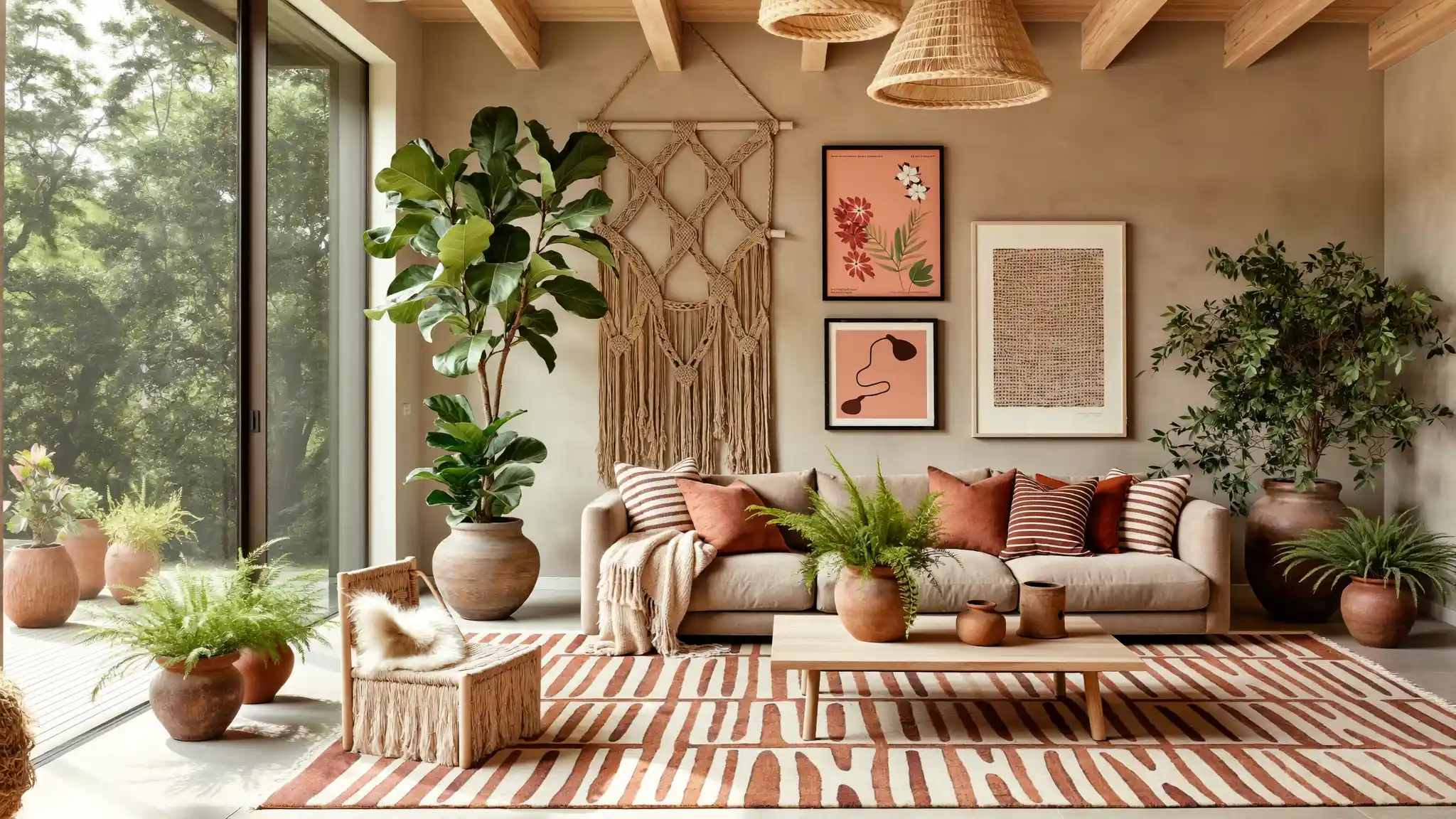
Flooring sets the foundation of boho interiors, with terracotta tiles, hardwood, cement tiles, and polished concrete adding warmth and texture.
One of the most defining boho styling techniques is rug layering.
This instantly adds depth, pattern, and character while creating a relaxed, lived-in feel in any space.
Where to Find Boho Furniture and What to Look for
The best pieces carry history, craft, and character qualities that thrift stores, artisan markets, and global online platforms offer far more reliably than mainstream retail.
1. Etsy: Independent Artisan Marketplace
Filter strictly by ‘handmade.’ Genuine sellers name their materials and describe their process specifically.
High-volume shops producing thousands of items monthly rarely deliver original craft quality despite the language they use.
2. Anthropologie: Curated Boho Home Collection
Consistently reliable for textiles, ceramics, and furniture with genuine craft quality. Higher price point, but construction holds up.
Their sale section regularly carries pieces worth far more than the discounted price.
3. World Market: Global Home Furniture
Affordable entry point for internationally sourced furniture and accessories.
Their woven textiles and ceramic vessels greatly outperform their flatpack furniture. Worth visiting in person rather than ordering without seeing the piece.
4. Chairish: Antique Home Marketplace
Curated vintage platform with strong rattan, carved wood, and globally inspired pieces.
Condition descriptions are generally accurate, making it safer than general resale platforms for purchases.
5. NOVICA: Artisan Global Marketplace
Every piece traces back to a named maker. Partnered with National Geographic.
Genuinely handcrafted, culturally original, and fairly priced relative to quality. Best source for textiles, ceramics, and wall art with verifiable provenance.
How to Design Each Room in a Boho Style
Each space in the home offers a different opportunity to layer texture, heat, and personal character.
From the kitchen to the bathroom to the outdoor space, the same core principles apply: start with a natural foundation, layer with intention, and let each room tell its own story.
| Room | Start here | Key elements | Single biggest impact |
|---|---|---|---|
| Living room | The rug | Layered seating, gallery wall, clustered plants, rattan or beaded pendant | Rug layering anchors the entire color story |
| Bedroom | The bed base | Embroidered throws, patchwork quilt, macramé headboard, mismatched nightstands | Low-profile bed with layered textiles creates a sanctuary feel |
| Kitchen | Open shelving | Hand-thrown ceramics, terracotta tiles, brass fittings, hanging dried herbs | Open shelves turn everyday objects into decor |
| Bathroom | Accessories | Woven baskets, stone soap dish, linen towels, rattan mirror, trailing plant | Swapping plastic for natural materials transforms the mood instantly |
| Outdoor | Outdoor rug | Rattan chairs, earthy cushions, string lights, mixed-height potted plants | A defined rug turns any patio into a room |
Lighting in Boho Interiors: Softness Over Brightness
Lighting is the most underestimated decision in a boho interior.
The number to remember is 2700K or below. That is the bulb temperature range that produces genuinely warm light. Anything above 3000K works directly against every earthly, organic element you have introduced.
- Never rely on a single overhead light source.
- Position lamps at a minimum of three different heights.
- Dimmer switches cost little and change everything.
- Candles are not decorative; they are functional light sources in a boho space.
- The fitting itself should be treated as a decor piece, not hardware.
A rattan pendant or a Moroccan brass lantern does two jobs simultaneously: it lights the room and furnishes it.
That dual function is exactly the kind of efficiency boho design rewards.
The rule is simple: if a light source feels harsh or clinical, it does not belong in a boho interior.
Expert Styling Tips Interior Designers Use in Boho Homes
Stop arranging. Start clustering.
Objects grouped in odd numbers, three, five, and seven, create visual tension that even numbers never achieve.
Always style from the floor up. Rugs and large plants first. Everything else finds its place around them.
Introduce one deliberately worn or damaged piece per room. A chipped ceramic. A frayed textile edge. Perfection reads as artificial in a boho space. Turn functional objects into decor.
Stacked books, folded throws, grouped bottles, nothing in a boho interior should serve only one purpose
The most common professional advice: buy one considered piece at a time, live with it, then layer the next.
How Boho Style Differs from Other Interior Design Styles
Boho borrows from everywhere and belongs to nothing. Here is exactly where it parts ways with its closest neighbors.
| Style | Colour | Materials | Patterns | Mood |
|---|---|---|---|---|
| Boho | Earthy tones + jewel accents | Rattan, jute, reclaimed wood, textiles | Bold tribal, floral, and geometric mixed | Warm, personal, globally inspired |
| Scandinavian | White, pale grey, muted neutrals | Light wood, wool, linen | Minimal, clean, restrained | Cool, calm, edited |
| Maximalism | All colours, no restraint | Mixed anything for visual impact | Intense multiple bold patterns | Dramatic, abundant, deliberate |
| Coastal | White, sand, soft blue | Linen, whitewashed wood, light rattan | Subtle stripes, natural textures | Breezy, light, uniform |
| Mid-Century Modern | Warm neutrals, muted retro accents | Teak, walnut, leather, molded plastic | Geometric, structured, precise | Refined, functional, structured |
The clearest distinction is that every other style listed above has a finish line.
A Scandinavian room is complete when it is clean. A coastal room is complete when it is light. A boho room is never quite finished, and that is entirely the point.
Budget-Friendly Ways to Create a Boho Interior
Boho is the only interior style where spending less often yields better results than spending more.
- Buy ceramics from local pottery markets rather than homeware chains.
- Dried botanicals last for years, cost almost nothing, and add genuine texture.
- One quality handwoven cushion outperforms four cheap printed ones.
- Brass hardware handles, hooks, and knobs cost under £10 and shift an entire room’s tone.
- Frame pressed leaves or vintage maps instead of buying wall art.
- A secondhand brass or ceramic lamp base rewired costs a fraction of the retail equivalent.
- Linen fabric from a fabric store makes better curtains than ready-made alternatives at twice the price.
- Layer mismatched thrifted plates on open shelving, functional and visually rich simultaneously.
- One large statement plant costs less than most decorative accessories and does more visual work.
Final Thought
Bohemian interior design is not a trend to follow; it is a philosophy to live by.
From the architecture to the furniture, from the living room to the outdoor space, boho design rewards intention over impulse. It draws from global traditions, honors natural materials, and grows more beautiful over time.
It is the only interior style that gets better the more you live in it.
Ready to adopt the effortless charm of boho living?
Find out more inspiration, styling ideas, and décor trends to create a space that feels uniquely yours.
Frequently Asked Questions
Is There a Difference Between Boho and Bohemian?
No. Boho is simply the shortened, modern version of bohemian.
What are the Five Types of Bohemian Style?
Modern boho, boho chic, boho zen, dark boho, and coastal boho.
What is the Best Color for a Boho Room?
Terracotta. It anchors earthy tones while naturally welcoming every accent color.
What Color Not to Paint Your Bedroom in Boho Design?
Avoid cool greys and stark whites; they actively fight boho’s heat.
What is the Best Boho Home Decor?
Handwoven textiles, terracotta ceramics, rattan furniture, layered rugs, and live plants.

Iris Delgado, BA in Interior Styling from SCAD, has spent a decade staging holiday and special-event interiors for hotels and film sets. She joined us in 2025 to offer theme-ready palettes, prop lists, and timeline checklists that simplify celebratory makeovers at any budget. She also co-hosts community parade-float workshops and collects vintage ornaments.