
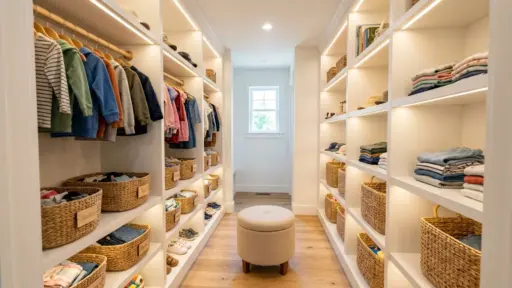
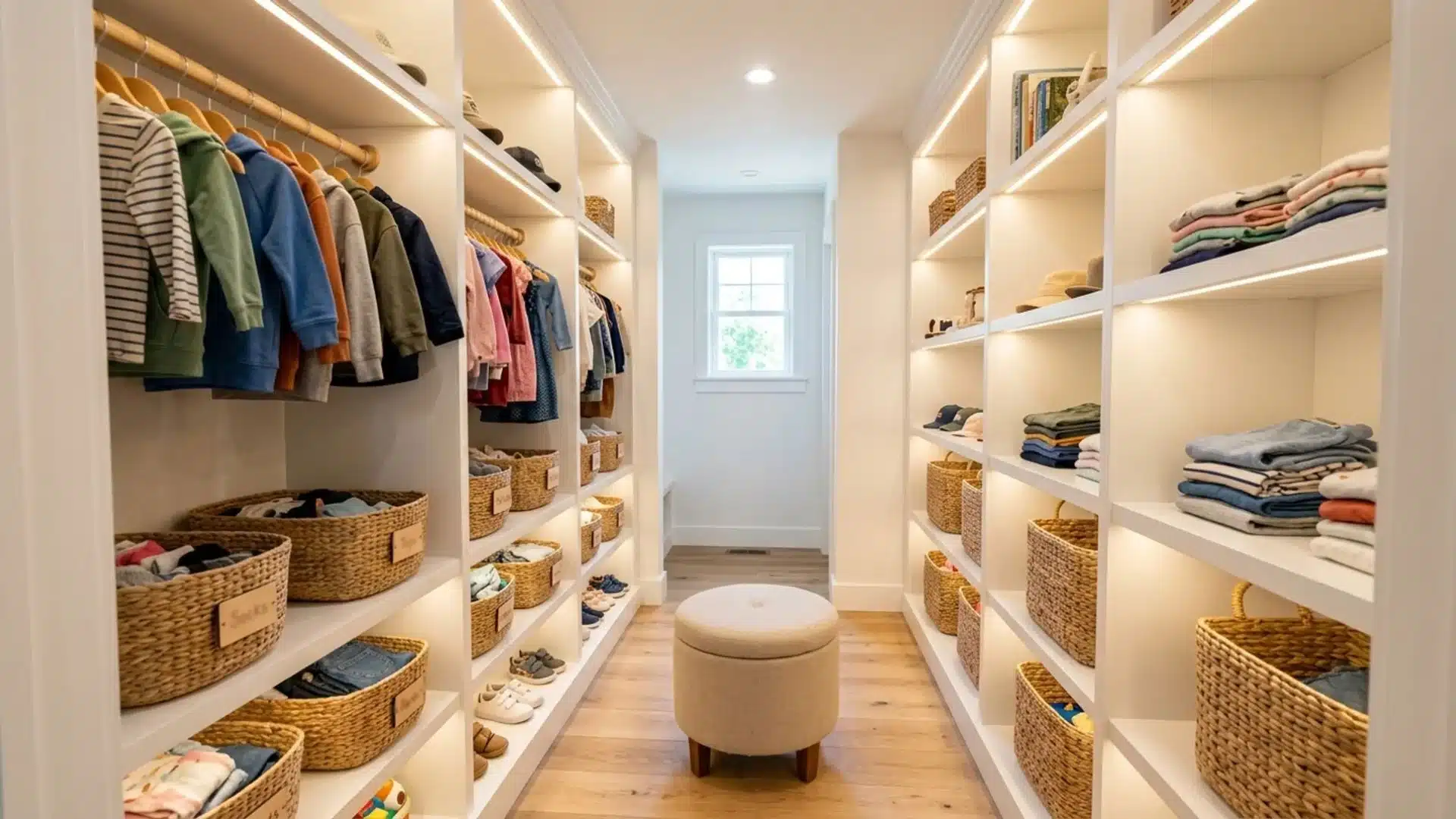
Clothes on the floor, missing shoes, and a drawer that never closes properly. Sound familiar?
A poorly set-up kids’ closet creates these problems every single day.
This blog covers organizing strategies that take minutes to set up and DIY design tips that improve how the closet looks and functions in the long term. These kids’ closet ideas are built to change that completely.
Every idea is practical, budget-friendly, and tested for kids and real spaces of all sizes.
Start reading and find the ones that work best for you.
The Reason Most Closet Organization Attempts Fail
Many closet makeovers fail because they focus on appearance rather than how children use the space.
Kids rarely put items back exactly where they belong. Instead, they place things on the nearest shelf, floor spot, or basket. Another common issue is storage placed too high for a child to reach comfortably.
Lidded bins may look neat, but children often stop using them because they require extra effort.
Deep shelves create another problem since items disappear from view and are quickly forgotten.
A closet should be simple, visible, and easy for a child to access every day.
Check Out the Quick Measuring Guide
Take a few basic measurements before buying storage products.
| Area to Measure | What to Measure |
|---|---|
| Closet Width | Measure wall to wall inside the closet |
| Closet Depth | Measure from the back wall to the front edge |
| Hanging Space Height | Measure from the rod to the floor |
| Upper Shelf Space | Measure from the shelf to the ceiling |
| Open Floor Area | Measure any empty floor space available for bins or baskets |
| Shelf Width | Measure each shelf separately if sizes vary |
Keep these measurements on your phone or notepad while shopping so storage products fit properly the first time. Small changes in dead zones can add useful storage and keep the closet neat and easy to maintain.
The 20-Minute Audit that Changes Everything
This simple audit helps you spot unused areas, storage problems, and easy ways to create more room.
1. The Three-Question Audit
Before reorganizing anything, stop and ask three simple questions.
- Does your child know where everything in the closet goes? Add labels to all bins, shelves, and drawers first. Labels are the quickest way to keep a closet tidy.
- Can they reach at least half the items without asking for help? Lower the hanging rod, move daily-use items to mid-height shelves, and add a child-safe step stool for out-of-reach items.
- Is there anything sitting in there that hasn’t been touched for three months? Remove them from the closet immediately. Store off-season clothes in labeled boxes and donate items that no longer fit.
Answering these three questions honestly reveals what the closet needs before you buy new storage products.
2. The Reachability Test
A kid’s closet should be easy for your child to use on their own.
Ensure everyday items like clothes, shoes, pajamas, and backpacks are within easy reach. Move items your child struggles to access to lower shelves or bins, and store less-used items higher up.
A reach-friendly layout helps children stay organized and makes daily routines much easier.
It also encourages independence, reduces clutter, and makes it simpler for kids to put things away after use.
3. The Dead Zone Diagnosis
Many kids’ closets contain storage space that is rarely used. These overlooked spots often collect clutter or remain completely empty, even though they can hold a surprising amount of clothing, toys, and accessories.
Taking a few minutes to identify these areas helps optimize your closet space without adding furniture.
Check for:
- Empty space above hanging clothes
- Gaps between shelves
- Unused floor corners
- Space beside dressers or storage units
- Deep shelves where items get pushed to the back
Once you identify these unused areas, match them with the right storage solution.
What to Buy, What to Skip, and What’s a Total Waste of Money
Spend smart; the right $15 item beats the wrong $150 system every time.
| Category | Buy it | Skip it |
|---|---|---|
| Hangers | Slim velvet hangers | Bulky plastic hangers |
| Bins | Open-front fabric bins | Decorative lidded bins |
| Shelving | Adjustable shelf standards | Fixed pre-drilled shelving |
| Shoes | Over-door shoe organizer | Stacked shoe boxes |
| Labels | Photo or icon labels | Word-only labels for young kids |
| Hooks | Command hooks | Under-shelf hanging baskets |
| Systems | Modular expandable units | Over-engineered small compartment sets |
| Rods | Dual adjustable rods | Single fixed-height rod |
Design the Closet Around the Child, Not the Closet
Getting a kid’s closet organized does not need a full renovation.
These kids’ closet ideas offer simple strategies to streamline everyday routines and keep clothing in its place.
1. Use Double Hanging Rods
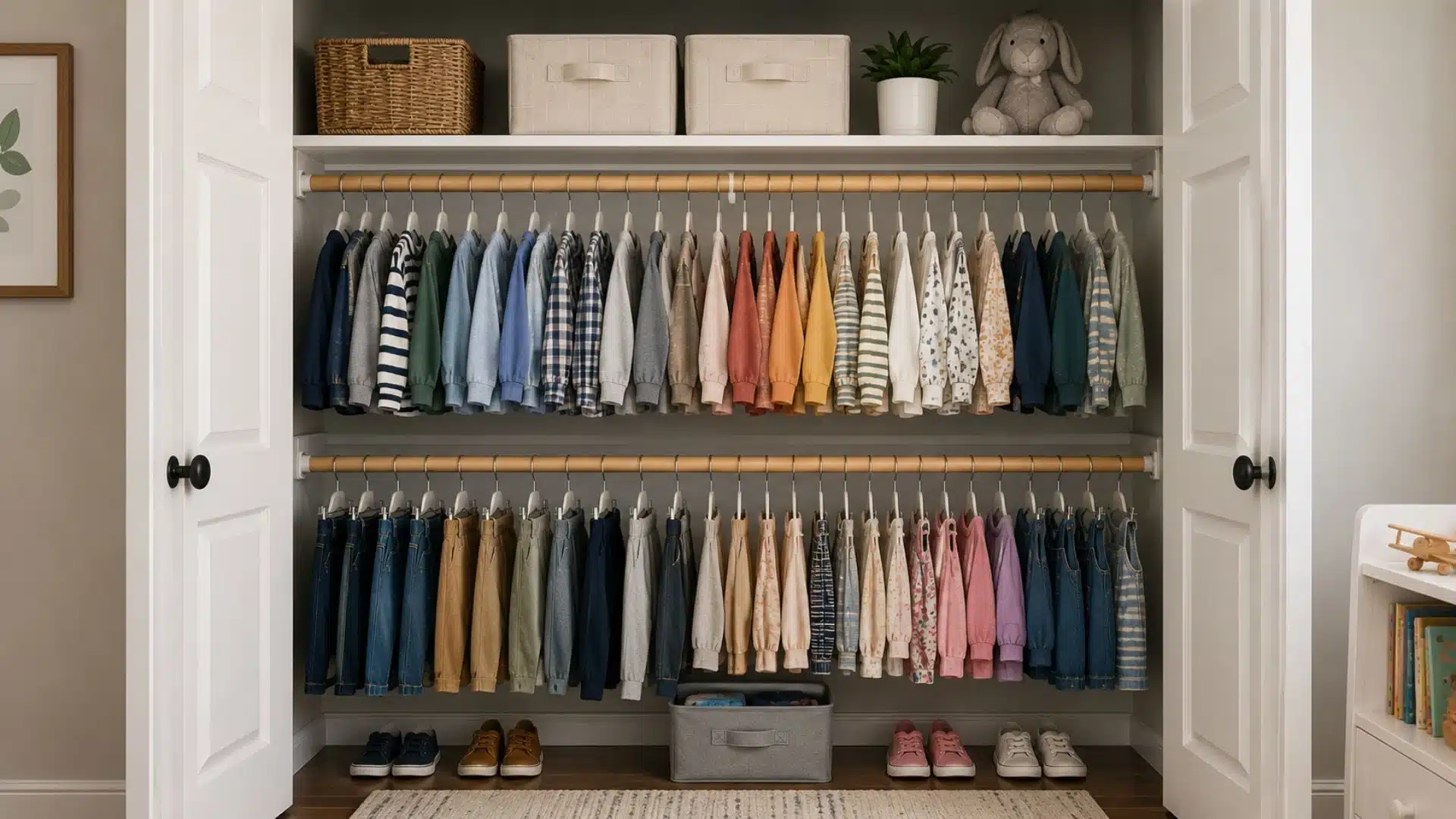
A single rod wastes all the empty space below it.
Adding a second rod underneath doubles your hanging space right away. Hang tops, school shirts, and jackets on the upper rod. Use the lower one for pants, skirts, and shorter items. Kids can reach the lower rod on their own.
It works especially well in small closets where shelf space is already limited and every inch counts.
- Time to Set Up: 20 to 30 minutes
- Works Best For: Small closets, school-age kids
2. Sort Clothes by Category
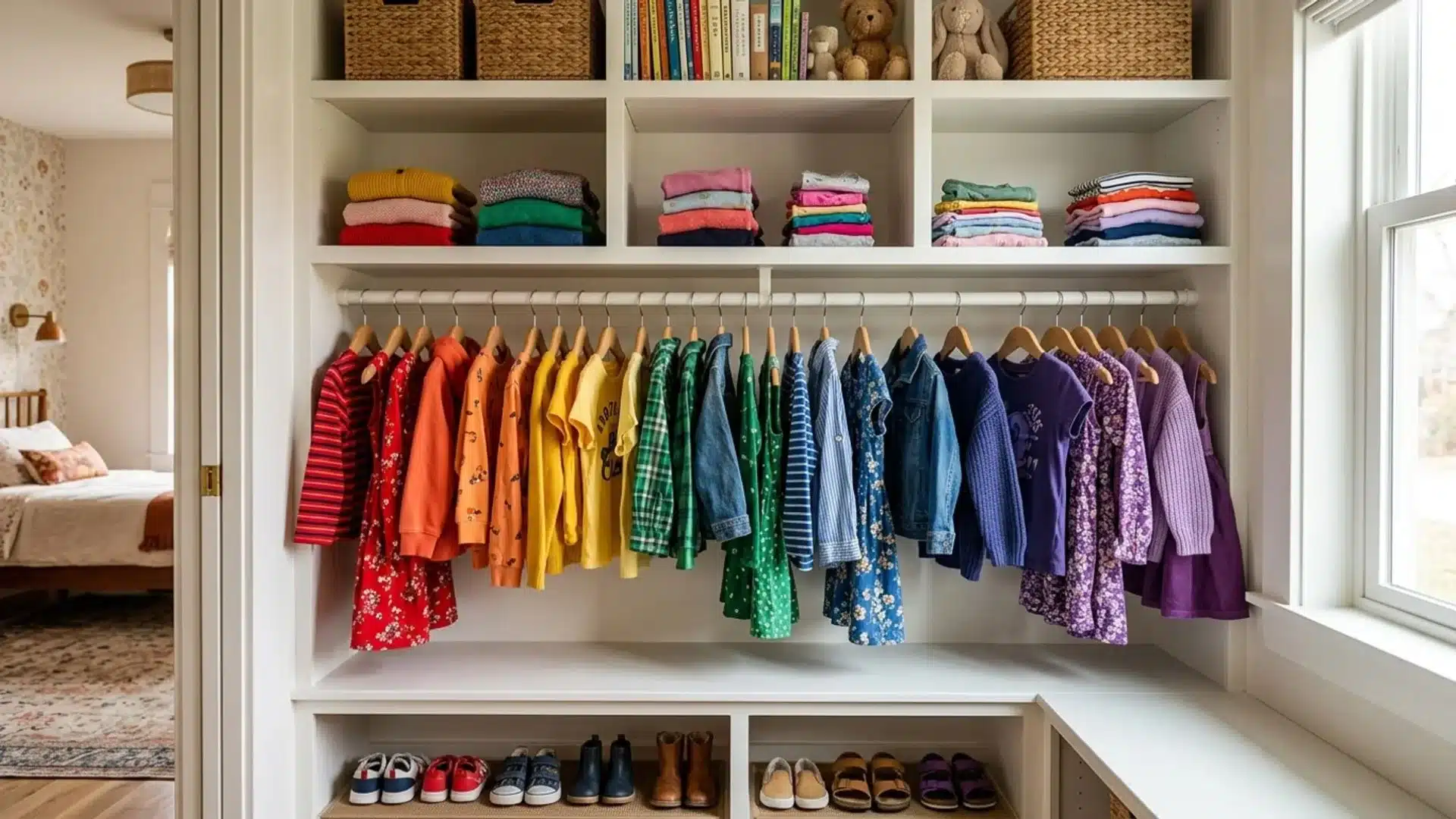
Group clothes by type inside the closet. Keep tops together, bottoms together, uniforms in one section, and sleepwear in another. This makes it easy for kids to find what they need without having to pull everything out.
It also makes putting laundry away much simpler and faster.
Once the system is in place, kids can maintain it independently without parental guidance.
- Time to Set Up: 20 to 30 minutes
- Works Best For: School-age kids, kids with large wardrobes
3. Label Everything
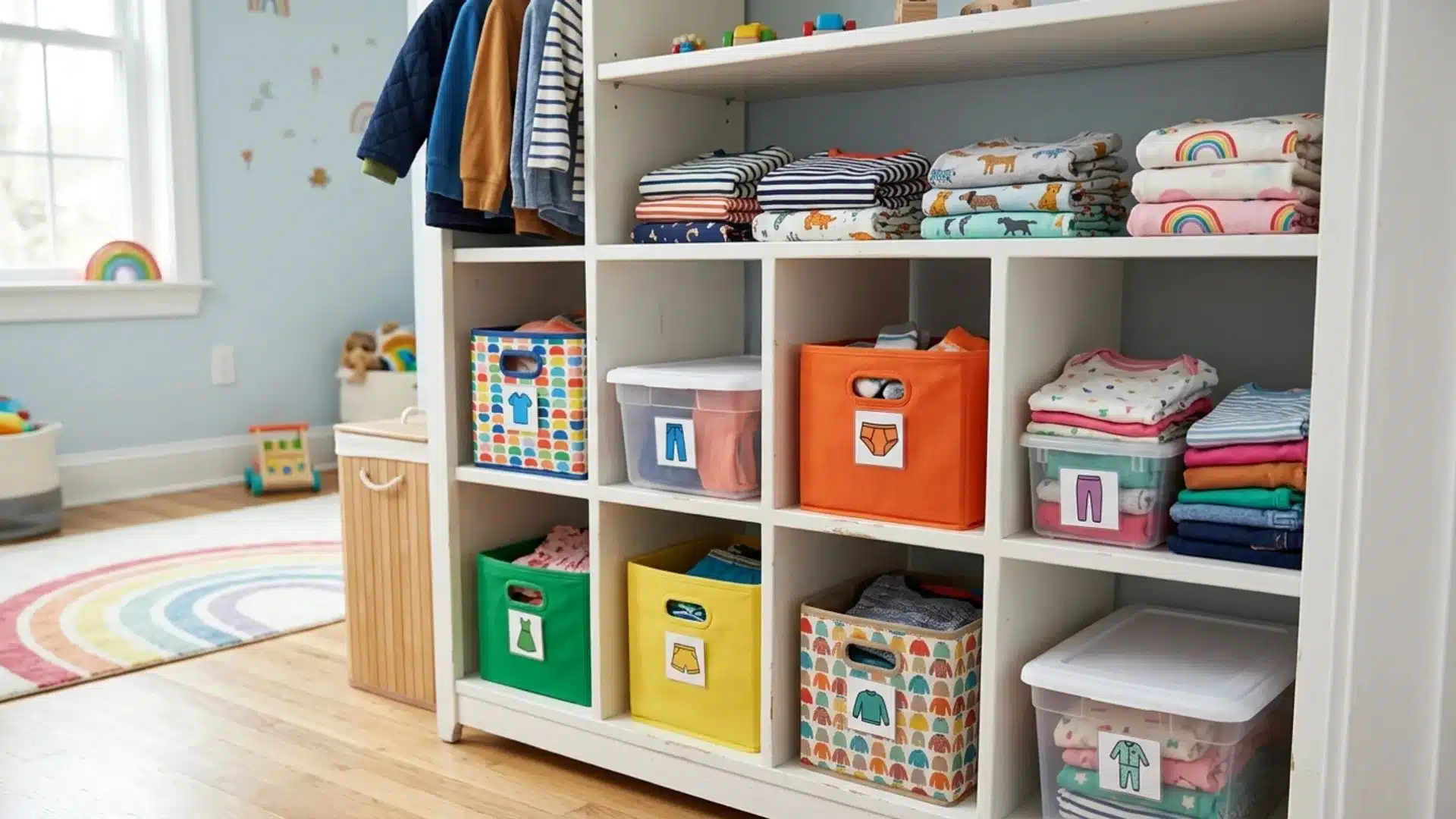
Labels tell kids exactly where things go. Stick them on bins, shelf edges, and drawer fronts.
Use picture labels for younger kids and word labels for older ones. This works well in shared closets where two children use the same space. Once labels are up, kids can put things back without asking for help every single time.
It removes all the guessing and keeps the closet tidy and organized for much longer than without them.
- Time to Set Up: 15 to 20 minutes
- Works Best For: Toddlers, early readers, shared closets
4. Use Shelf Dividers
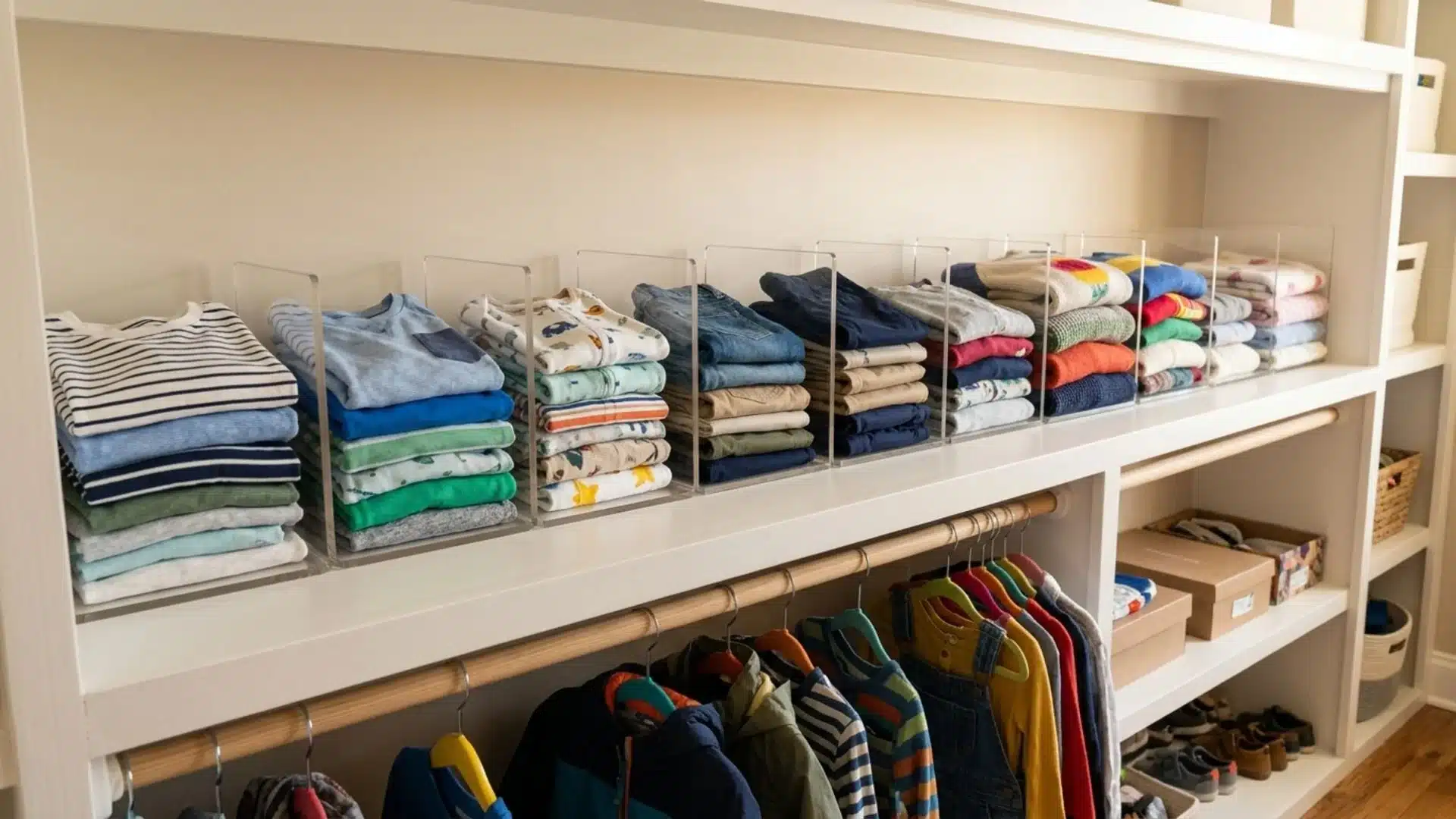
Folded clothes tend to fall and mix together on open shelves without any separation.
Shelf dividers clip between stacks, keeping each pile in its own space.
They are easy to add and remove whenever needed. Place one divider per category on each shelf.
This keeps things neat without needing extra bins or boxes taking up more room. A very small fix that makes a noticeable difference on any open shelving setup.
- Time to Set Up: Under 10 minutes
- Works Best For: Open shelving, kids with folded clothes
5. Add Drawer Organizers Inside Dressers
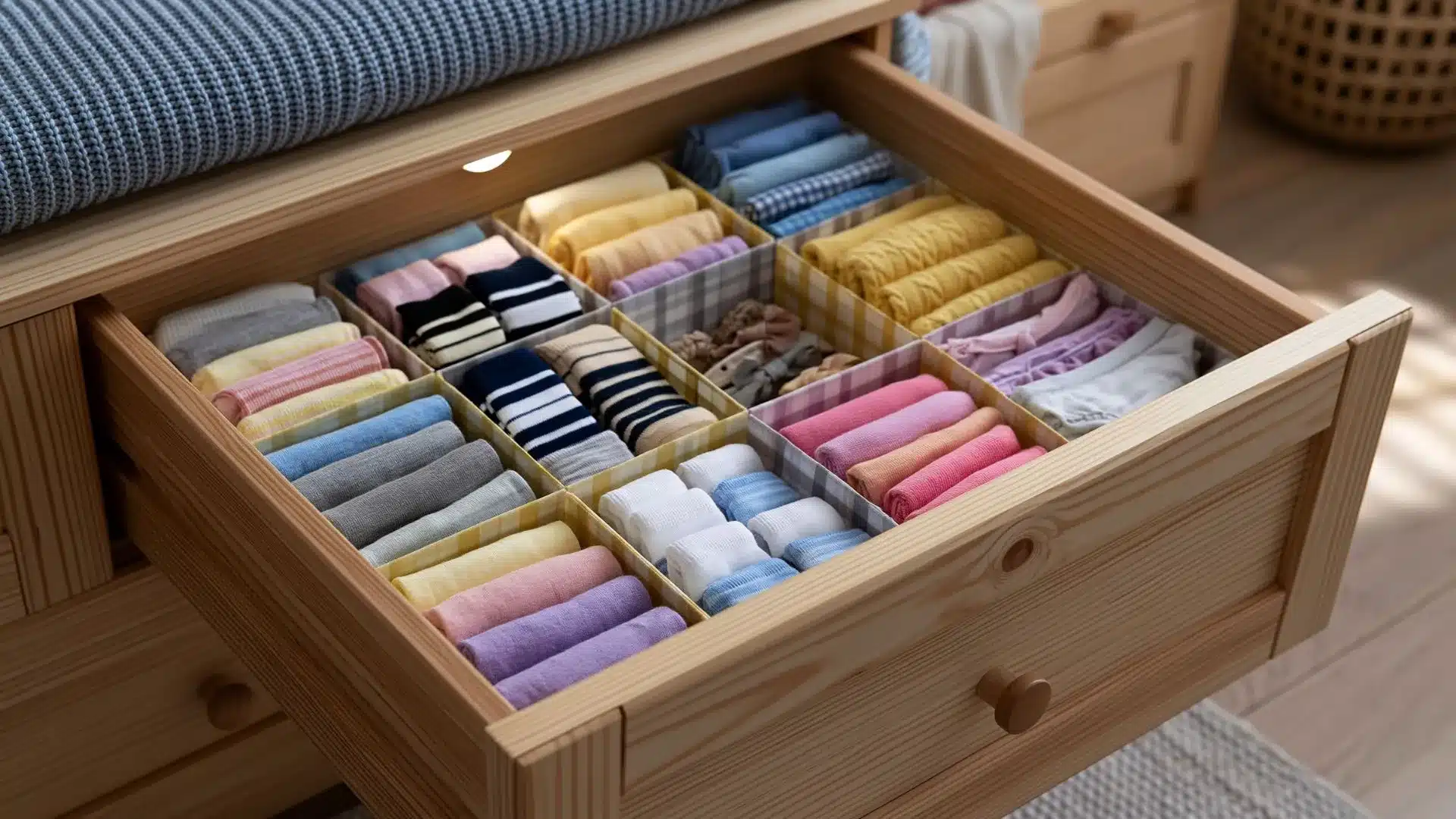
Drawers without organizers turn into a jumbled mess very fast. Small inserts divide the drawer into separate sections. Each section holds one type of item, like socks, underwear, or hair ties.
Kids can see everything at once and grab what they need without pulling the whole drawer apart to find it.
Works with any standard dresser; most inserts are adjustable to fit various drawer sizes and items.
- Time to Set Up: Under 10 minutes
- Works Best For: All ages, kids with lots of small items
6. Use Clear Bins for Toys and Accessories
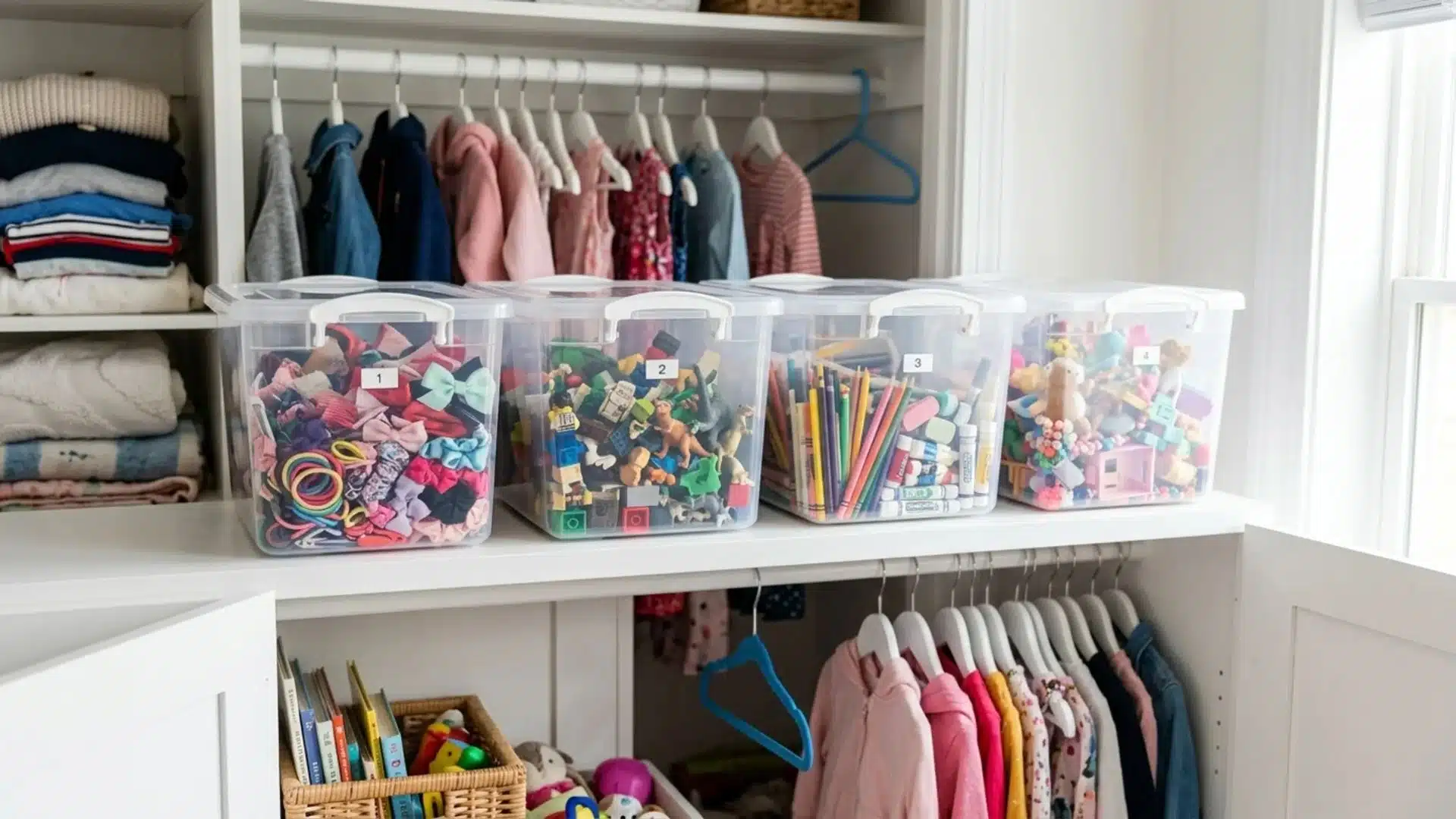
Clear bins let kids see exactly what is inside without opening every single container. Use them for hair accessories, belts, small toys, and art supplies stored in the closet. Stack them on shelves or line them up side by side.
No more pulling everything out just to find one thing.
They are easy to clean and come in sizes that fit most standard closet shelves without taking up too much space.
- Time to Set Up: Under 10 minutes
- Works Best For: Toddlers, kids with lots of accessories
7. Set Up a Donation Bin Inside the Closet
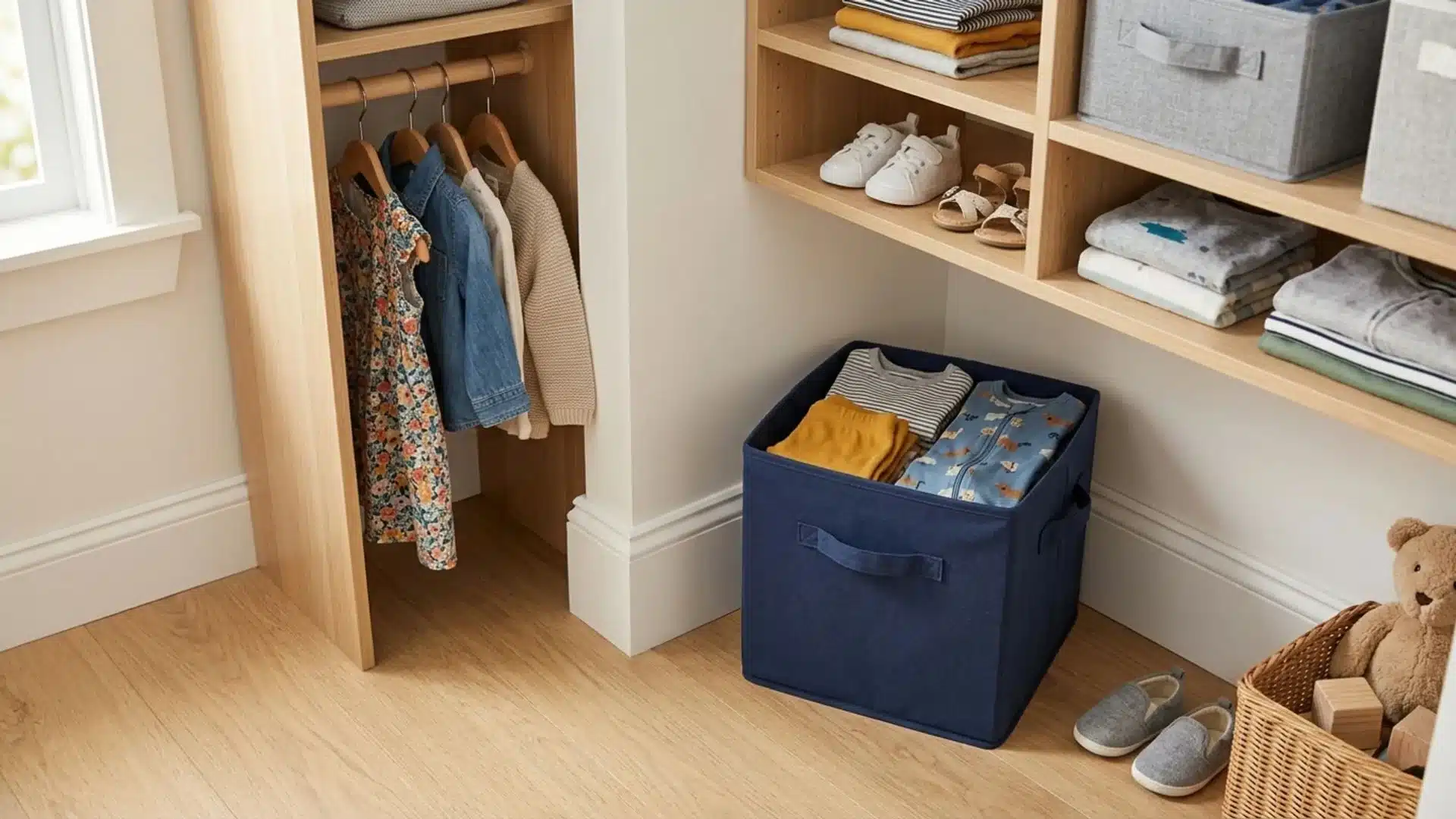
Keep one bin in the closet specifically for outgrown clothes. When something no longer fits, it goes straight into the bin. No extra sorting needed later on. Once the bin is full, it is ready to donate without any additional work.
This keeps the closet from slowly filling up with clothes that are never worn.
Involve kids in the process so they get comfortable with regularly letting go of things.
- Time to Set Up: Under 5 minutes
- Works Best For: All ages, growing kids, large wardrobes
8. Store Shoes on a Rack or in Pockets
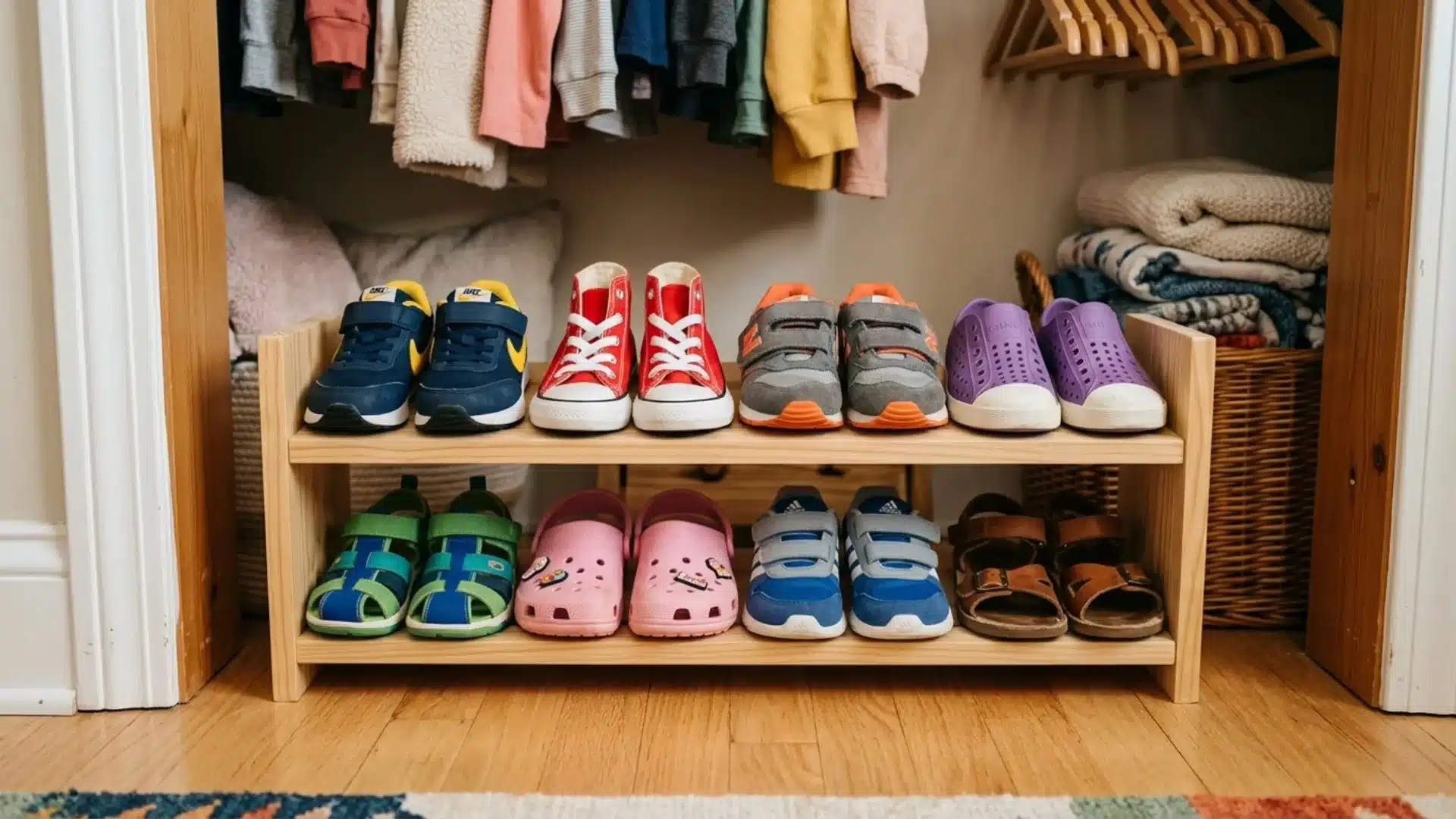
Shoes left on the floor create clutter very fast.
A floor rack or over-the-door shoe organizer keeps every pair in one dedicated spot.
Kids can find their shoes quickly without searching through a pile.
Pocket organizers work better for smaller kids’ shoes and sandals. Either option frees up floor space inside the closet and makes mornings considerably less stressful for everyone.
- Time to Set Up: Under 15 minutes
- Works Best For: All ages, closets with limited floor space
9. Use Vertical Space with Stackable Bins
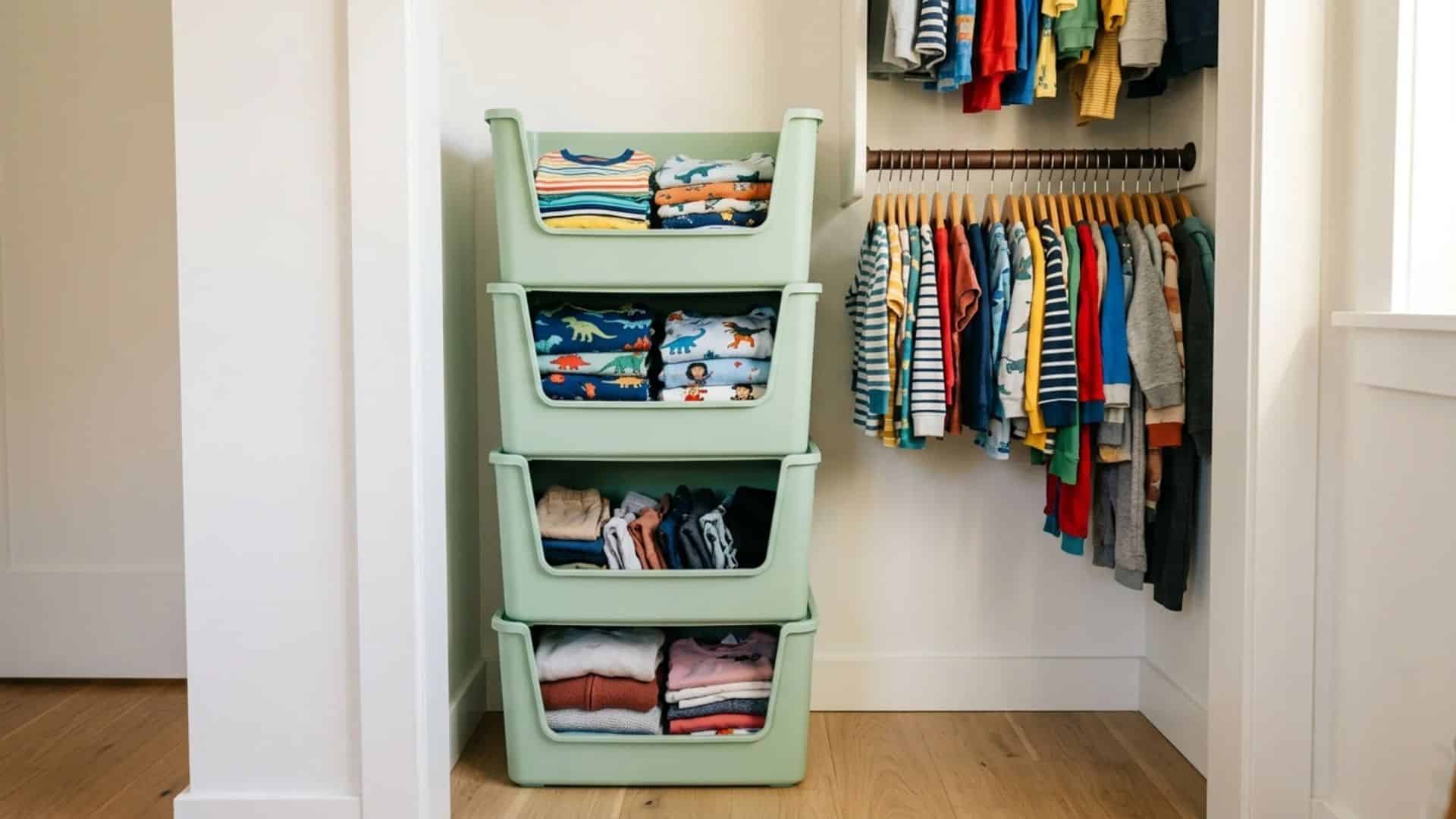
Most closets have unused space sitting between the mid-shelf and the floor.
Stackable bins fill that gap without any installation work. Line them up along the side wall of the closet.
Use them for off-season clothes, extra bedding, or bulky items that do not hang well. Choose bins with lids to keep contents dust-free. Label the front of each bin clearly so kids always know exactly what goes where.
- Time to Set Up: Under 15 minutes
- Works Best For: Small closets, off-season storage
10. Rotate Seasonal Clothes
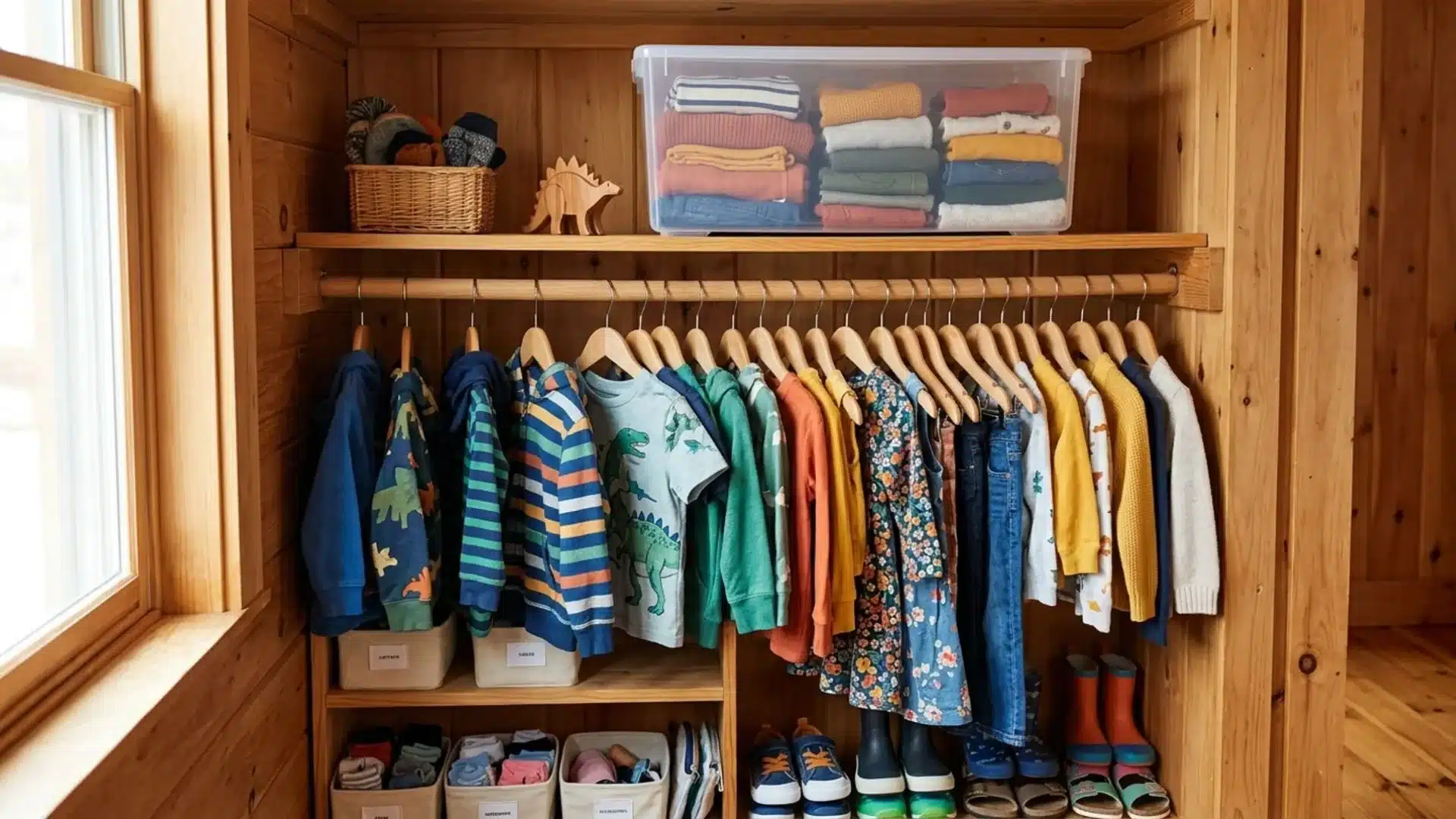
Keeping all clothes in the closet year-round makes it harder to quickly find current items.
Move off-season clothes to a storage box or the back of the shelf.
Bring them back out when the season changes again. This keeps only the relevant clothes within easy reach at all times. It makes it easier to spot what no longer fits before the next season and shopping.
- Time to Set Up: 30 to 45 minutes
- Works Best For: All ages, closets with limited hanging space
11. Keep a Step Stool Inside the Closet
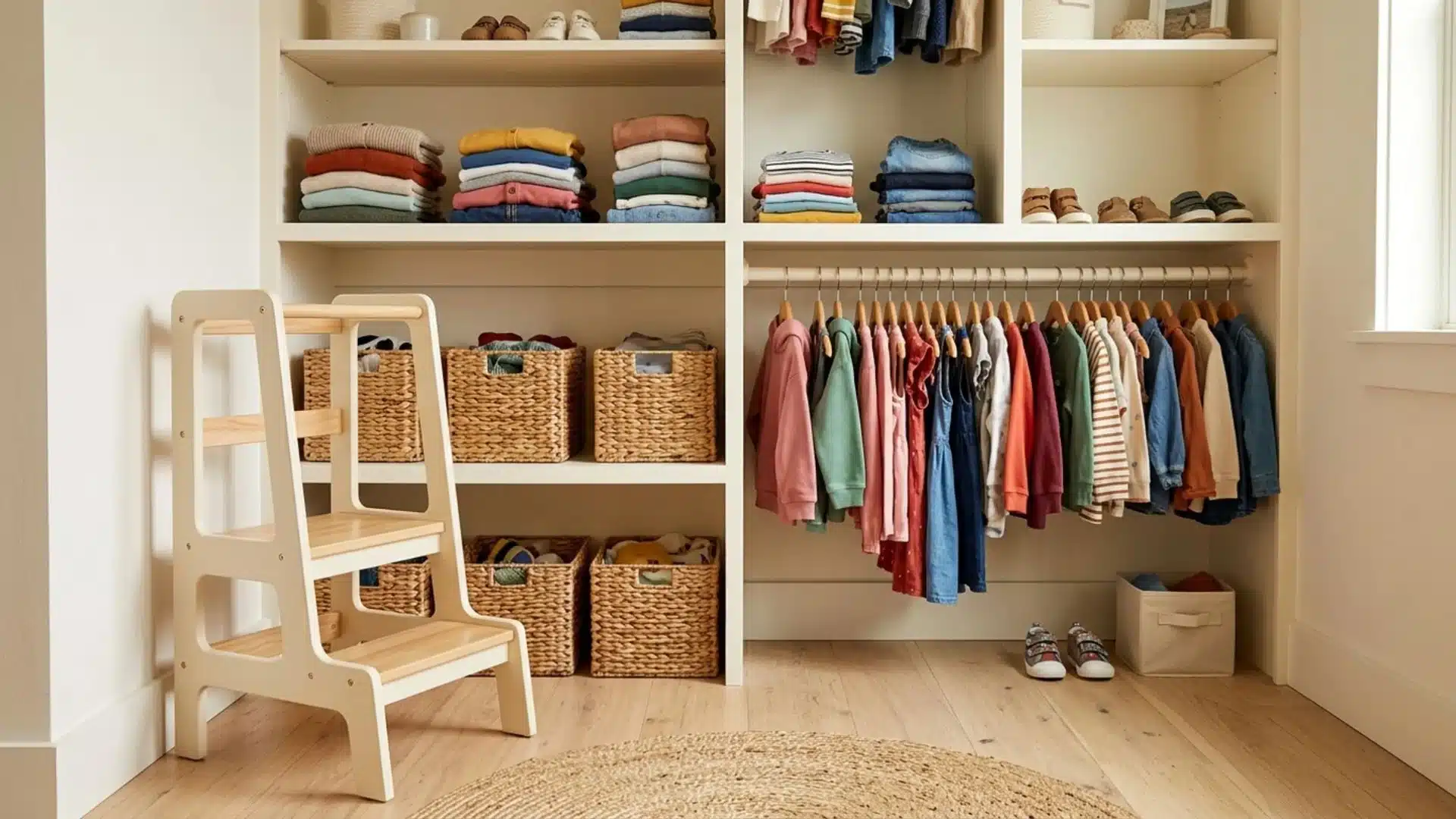
Kids often pull things down while trying to reach shelves that are set too high for them.
A child-safe step stool with side railings kept inside the closet fixes that problem completely. It lets kids reach mid-height shelves fully on their own. Choose a stool that takes up minimal floor space inside and is kid-safe.
This small addition reduces mess and helps kids become more independent in managing their closet.
- Time to Set Up: No setup needed
- Works Best For: Toddlers, kids aged 3-8
13. Keep a Weekly Outfit Planner in the Closet
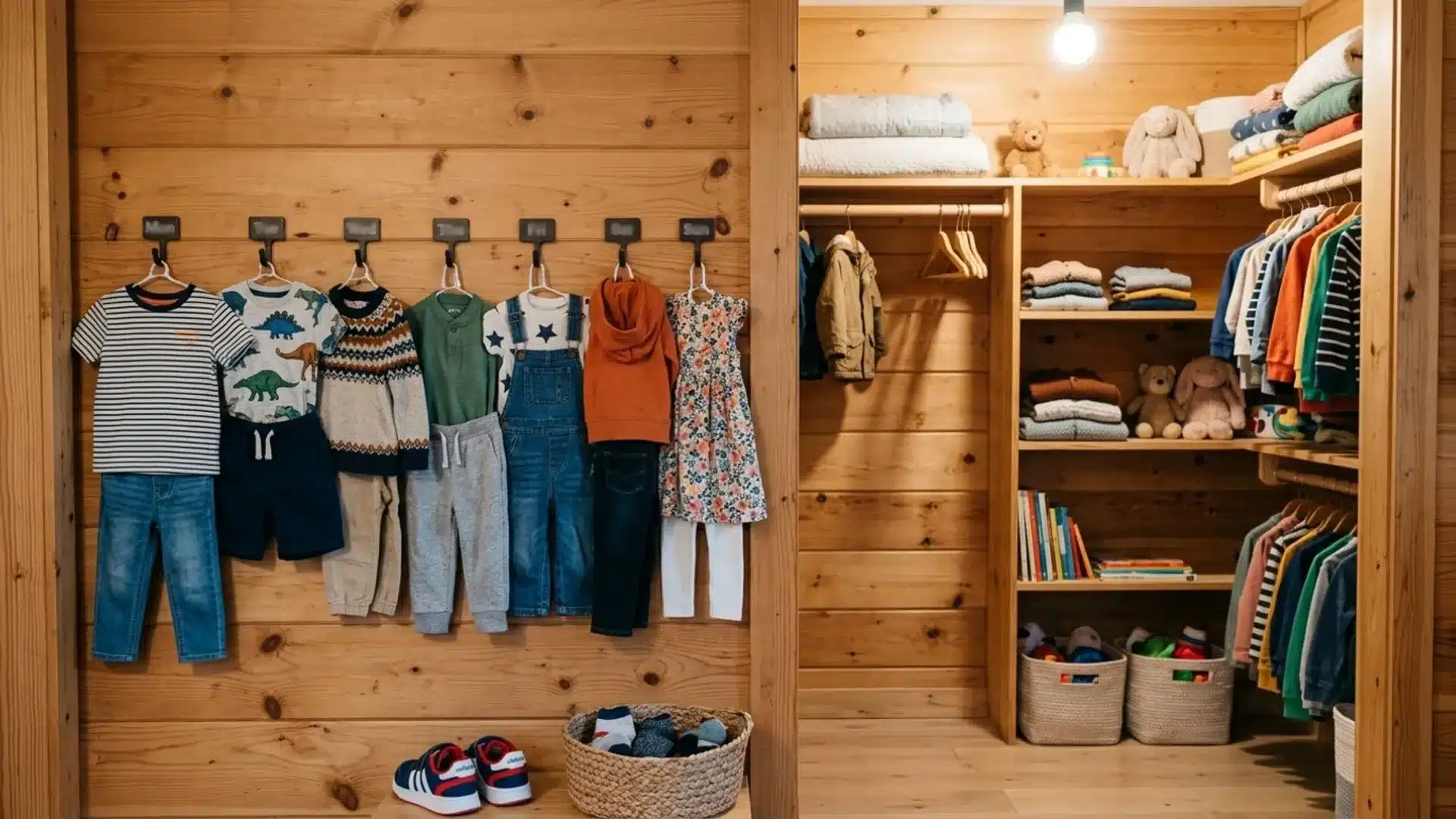
A small rack or set of hooks labeled with the days of the week lets you plan outfits well in advance.
Set clothes out on Sunday for the entire week ahead.
Kids know exactly what to wear each morning without any back-and-forth discussion. It reduces daily decision-making and makes school mornings run noticeably faster and more smoothly.
Older kids can completely take over planning their own outfits.
- Time to Set Up: 15 to 20 minutes
- Works Best For: School-age kids, busy morning routines
DIY Tips for Designing a Kids’ Closet Ideas
This section takes kids’ closet ideas further with hands-on DIY projects.
Install adjustable shelving, add LED lights, paint a chalkboard wall, and create a space that grows with your child.
14. Paint the Inside of the Closet a Fun Color
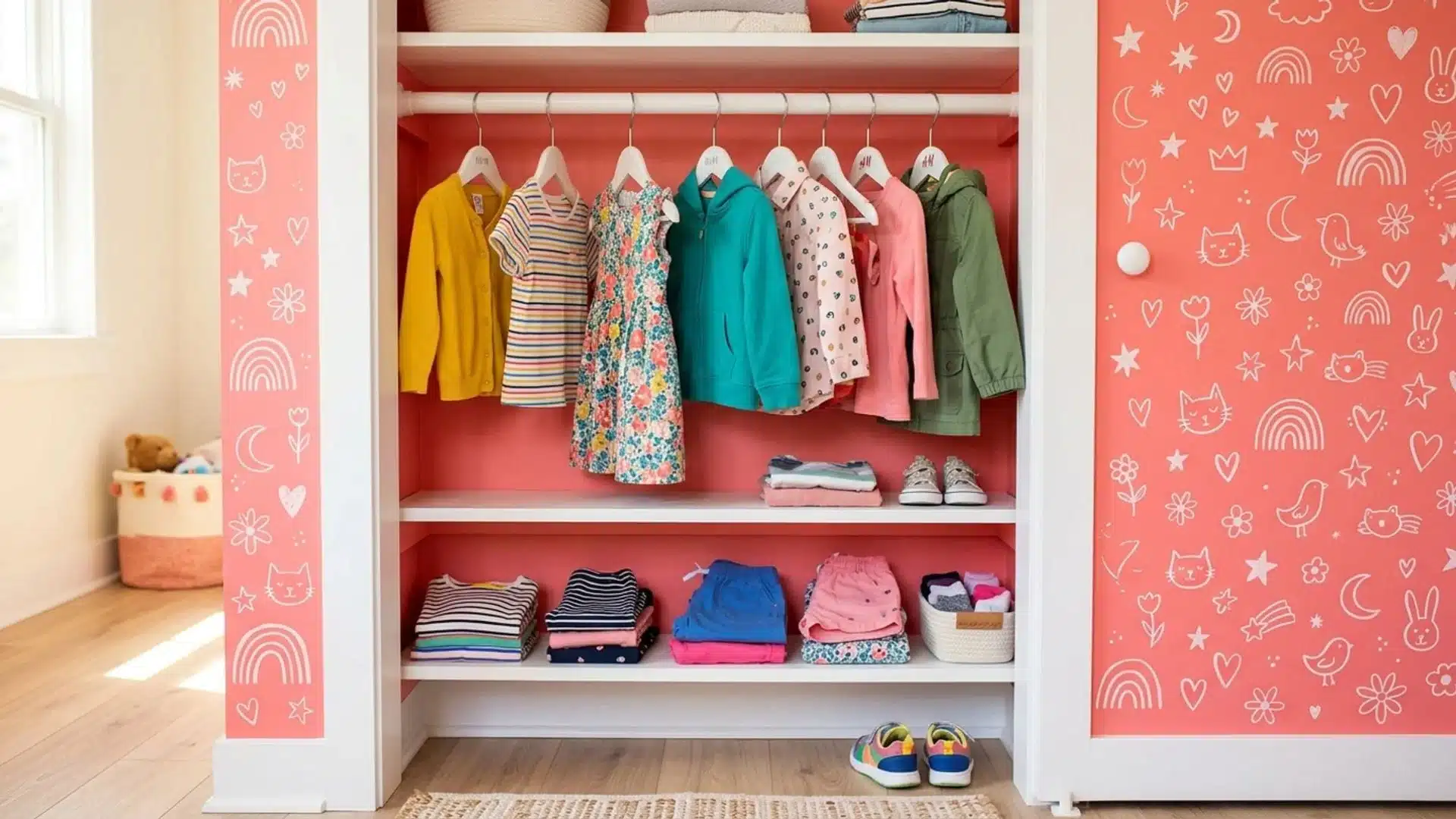
A plain white closet feels like plain storage and nothing more. A painted one feels like a real part of the room.
Pick a color your child genuinely likes and paint the back wall or all interior walls.
Kids are far more likely to keep a space tidy when it feels personal and special to them.
Use washable paint so marks and scuffs stay easy to clean. No special painting skills are needed for this project.
Estimated Budget: $15 to $30
15. Add Pegboard for Flexible Storage
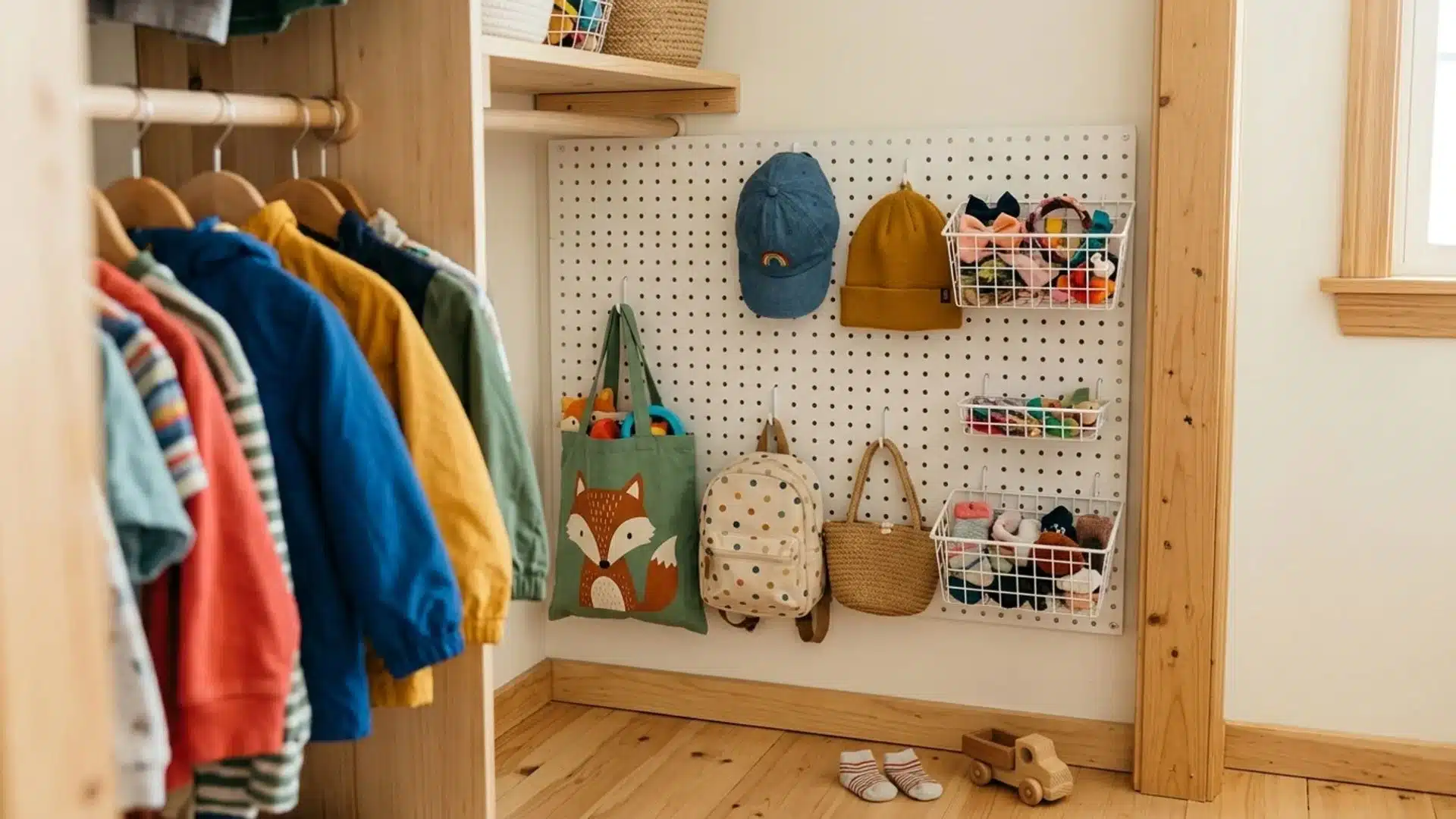
Pegboard mounts flat against a closet wall and holds hooks, small baskets, and shelves in any arrangement.
The positions can be changed at any time without drilling new holes in the wall.
Use it to hang bags, hats, craft supplies, or sports gear neatly. It works well on the side walls of a closet where regular shelving simply does not fit. A flexible storage system that adapts as the child grows.
Estimated Budget: $20 to $40
16. Repurpose a Bookshelf as a Closet Organizer
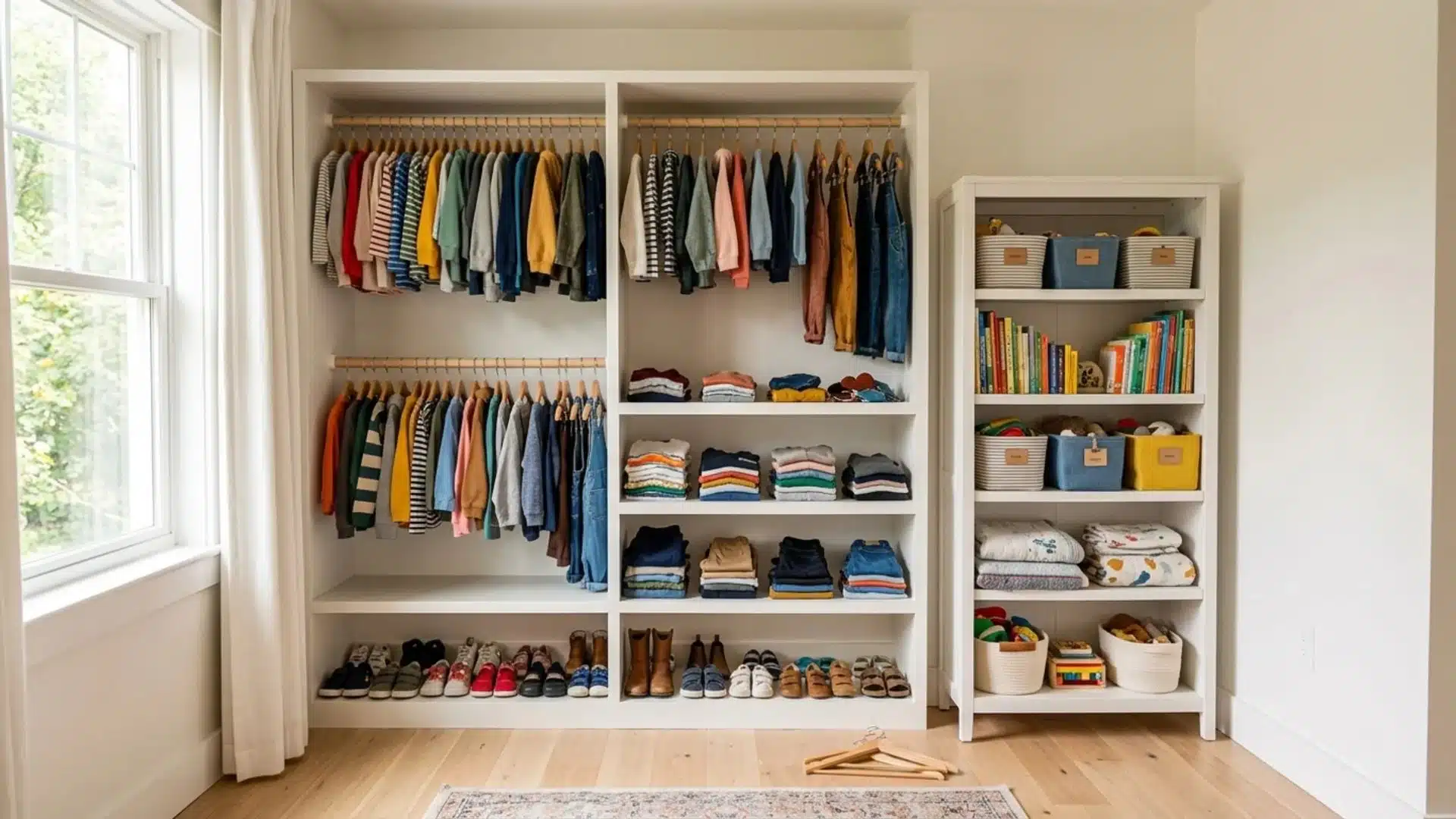
A freestanding bookshelf placed inside the closet adds shelving without any wall installation.
Use the shelves for folded clothes, bins, or shoes depending on what is needed most. It works especially well in open or doorless closet setups where there are no walls to mount shelves onto.
Look for a shelf that fits the closet width well.
Second-hand bookshelves work just as well and help keep the overall cost very low.
Estimated Budget: $0 to $40
17. Install Adjustable Shelving
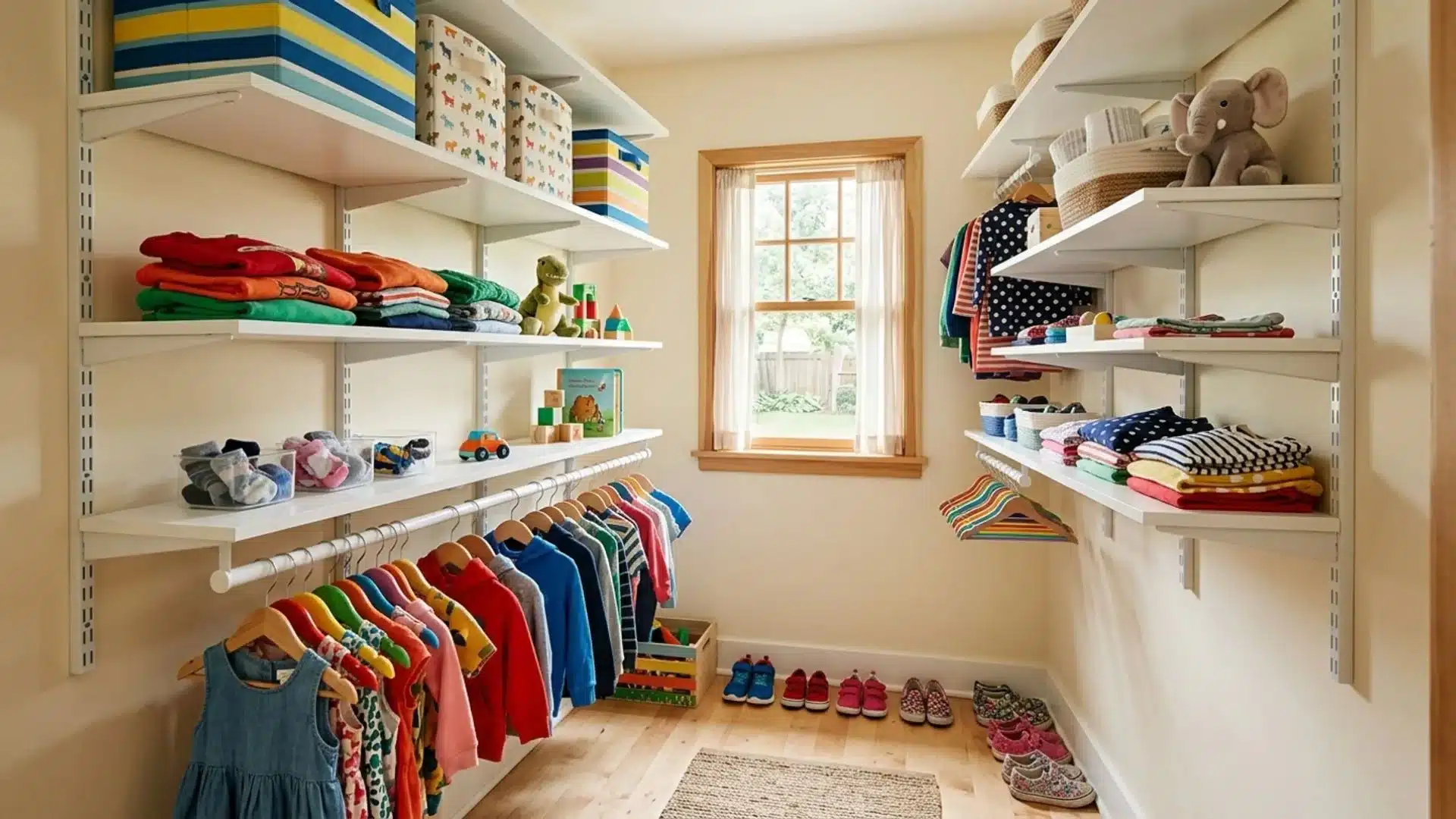
A track-and-bracket shelving system lets you move shelves up or down as your child grows taller.
Install the wall tracks once, then adjust the shelf heights anytime after that without any extra drilling.
This means the closet layout can change completely without having to start over from scratch. It is one of the most practical and long-lasting investments you can make for a kids’ closet that will be used for many years to come.
Estimated Budget: $25 to $60
18. Add a Small Bench or Ottoman With Storage
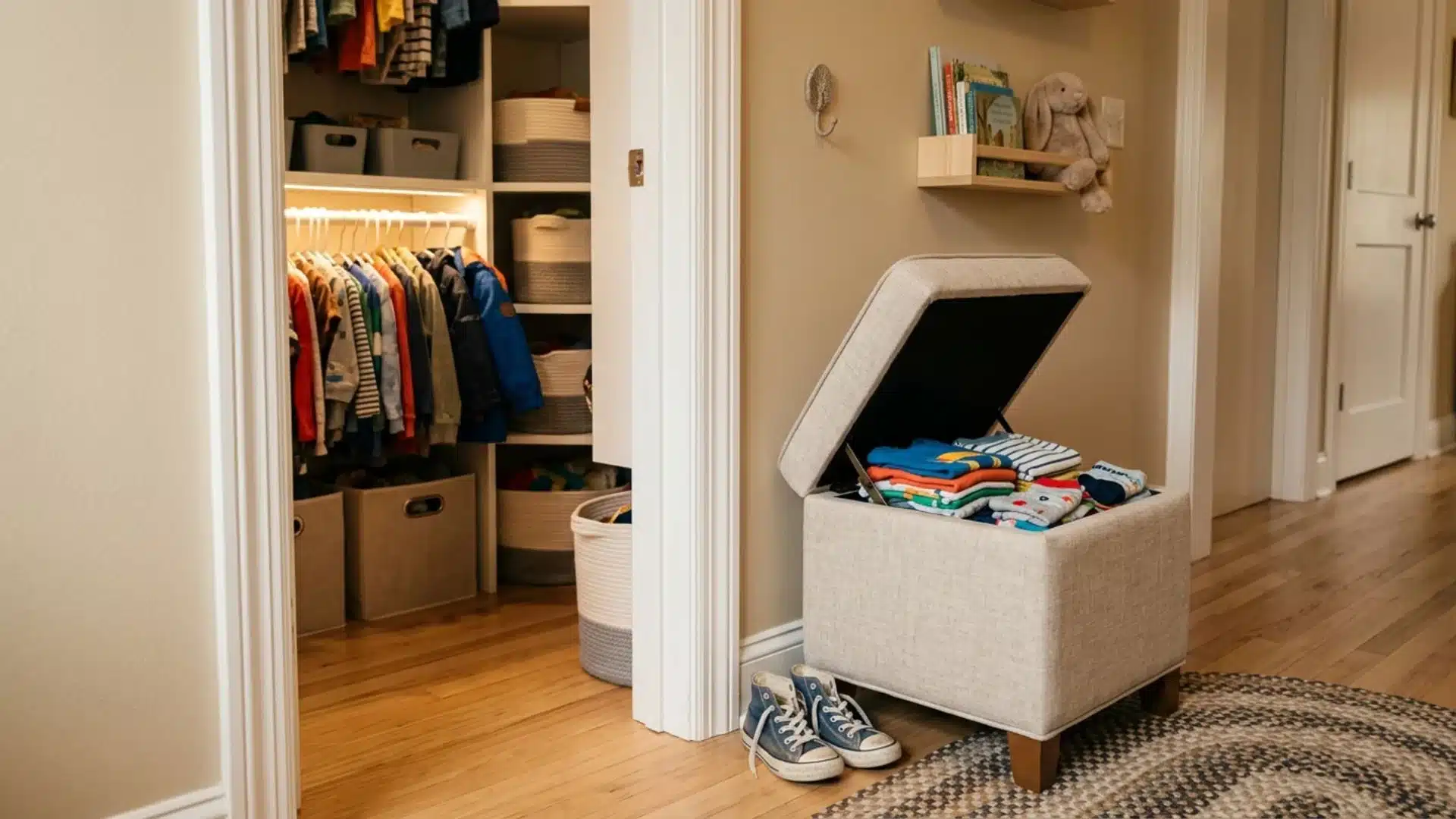
A storage bench placed at the base of the closet or just outside it gives kids a spot to sit while they put on their shoes. The inside of the bench holds folded items, extra bedding, or accessories that do not fit elsewhere.
Choose one with a hinged lid for easy access every time. It adds a useful function without occupying much space.
Works well in larger closets or positioned just outside a smaller one.
Estimated Budget: $30 to $80
19. Add LED Strip Lights Inside the Closet
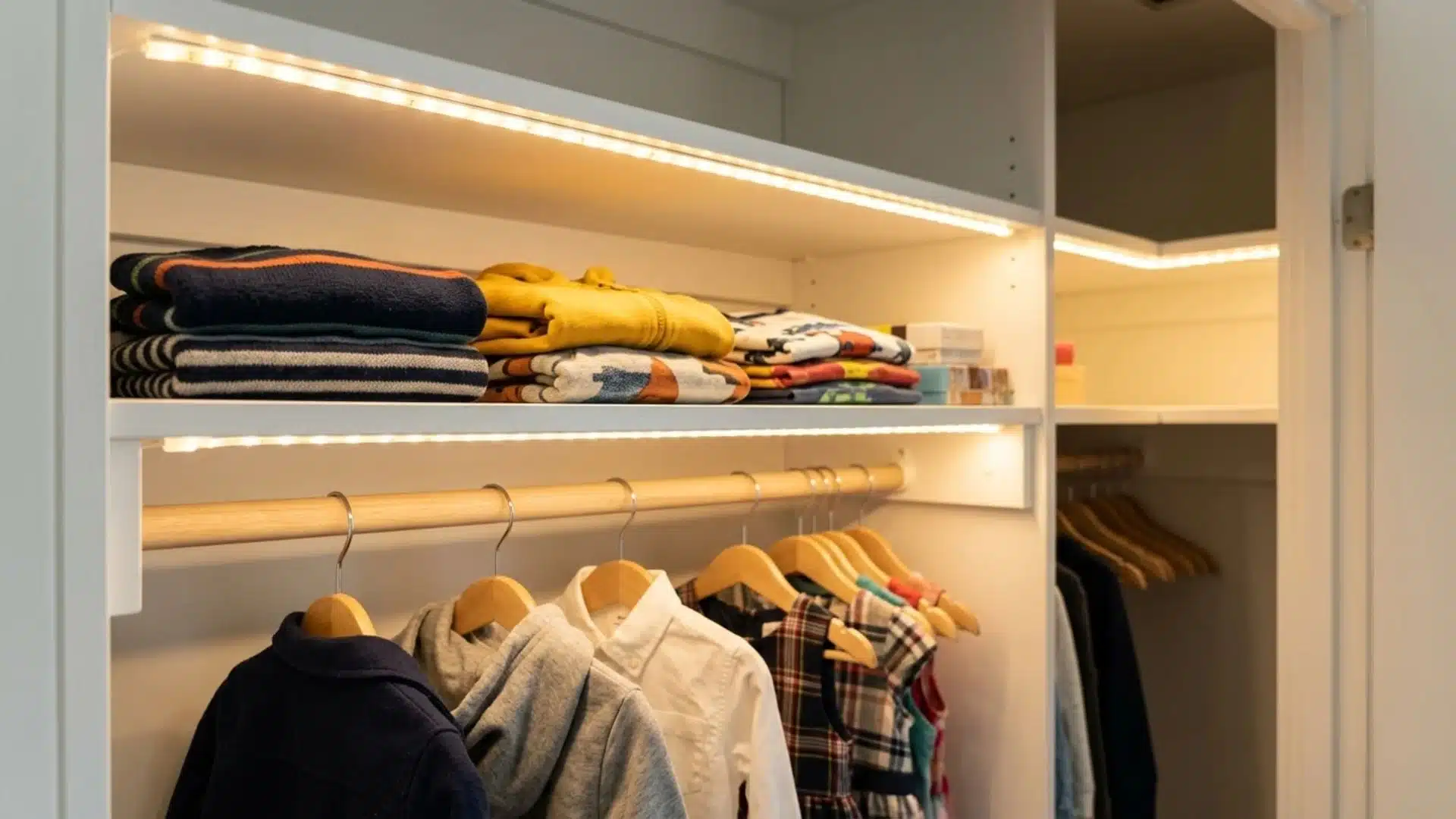
Dark closets make it genuinely hard for kids to quickly find what they need. Stick-on LED strip lights fix that problem without any wiring or electrical work. Press them along the top shelf edge or along the side walls of the closet.
Kids can see everything clearly and spend far less time searching through the dark.
Most LED strips run on batteries or plug into a USB port. They are safe, easy to install, and long-lasting.
Estimated Budget: $10 to $25
20. Mount Wall Crates or Baskets as Open Storage
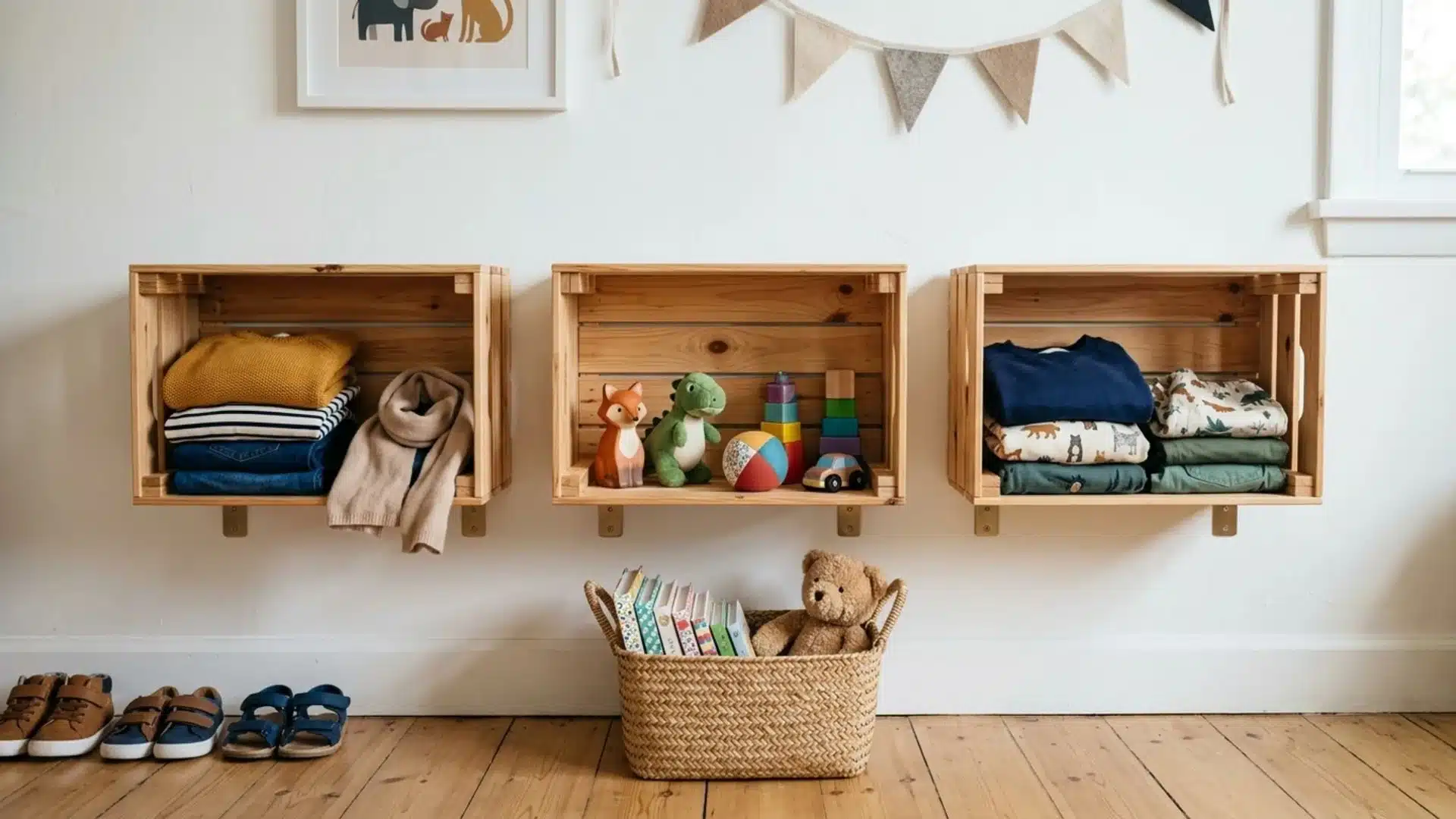
Wooden crates or wire baskets mounted low on the closet wall create open storage that kids can easily reach on their own. Each crate or basket clearly holds one category of items.
No doors or lids to deal with at all.
Kids can drop things in and grab them out very fast. Paint or stain wooden crates to match the room.
This works particularly well in smaller closets where floor space is already quite limited.
Estimated Budget: $20 to $50
21. Build a DIY Fold-Down Desk Inside the Closet
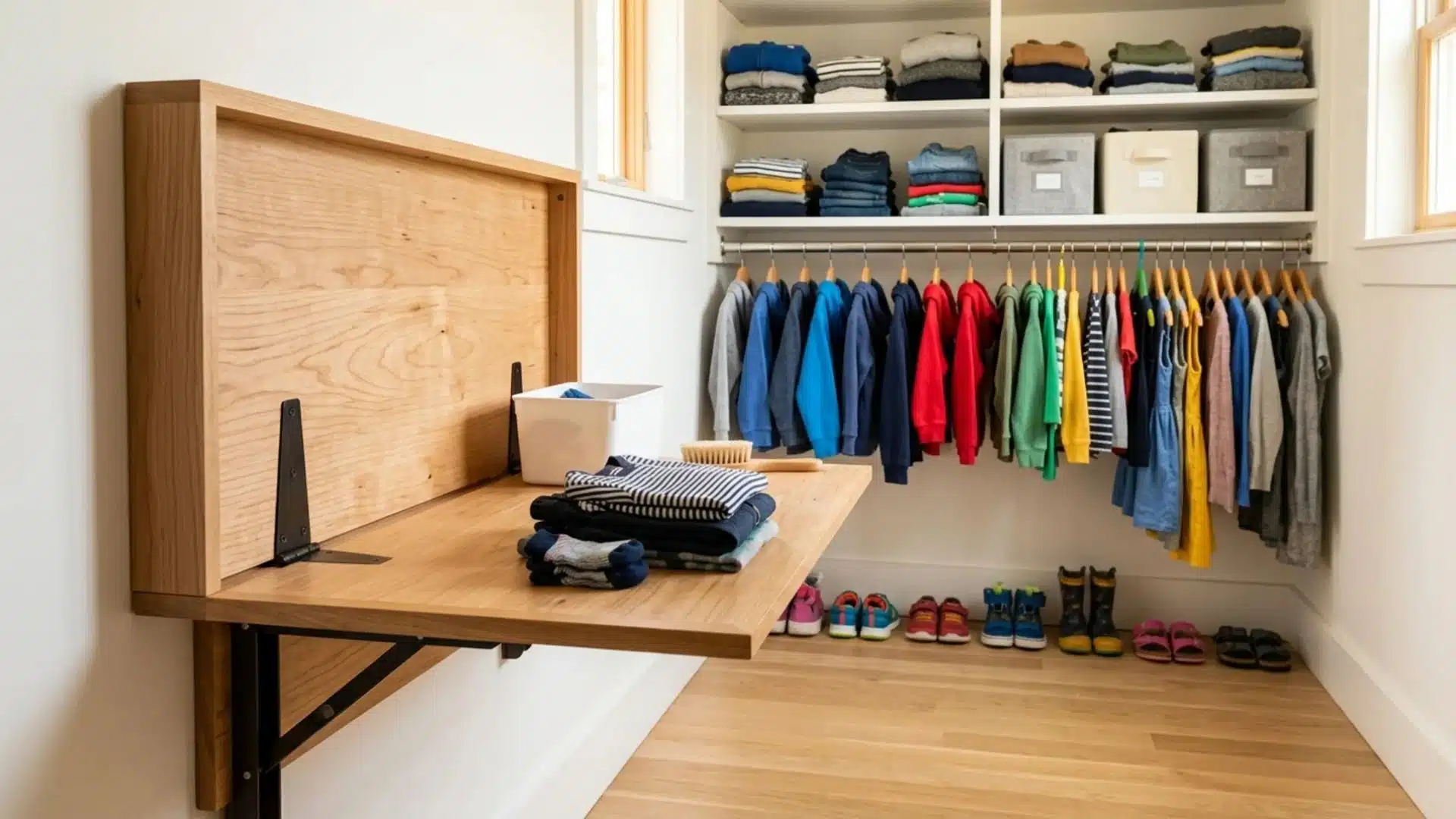
A fold-down closet wall desk provides kids with a compact homework or drawing space that folds away when not in use.
Attach a wooden board to the wall with heavy-duty hinges and add a small latch to keep it flat when folded.
It works well in walk-in closets or larger wardrobe setups, where a corner often goes unused.
Kids get a functional workspace without taking up any bedroom floor space.
Estimated Budget: $20 to $50
22. Add Chalkboard Paint to One Closet Wall
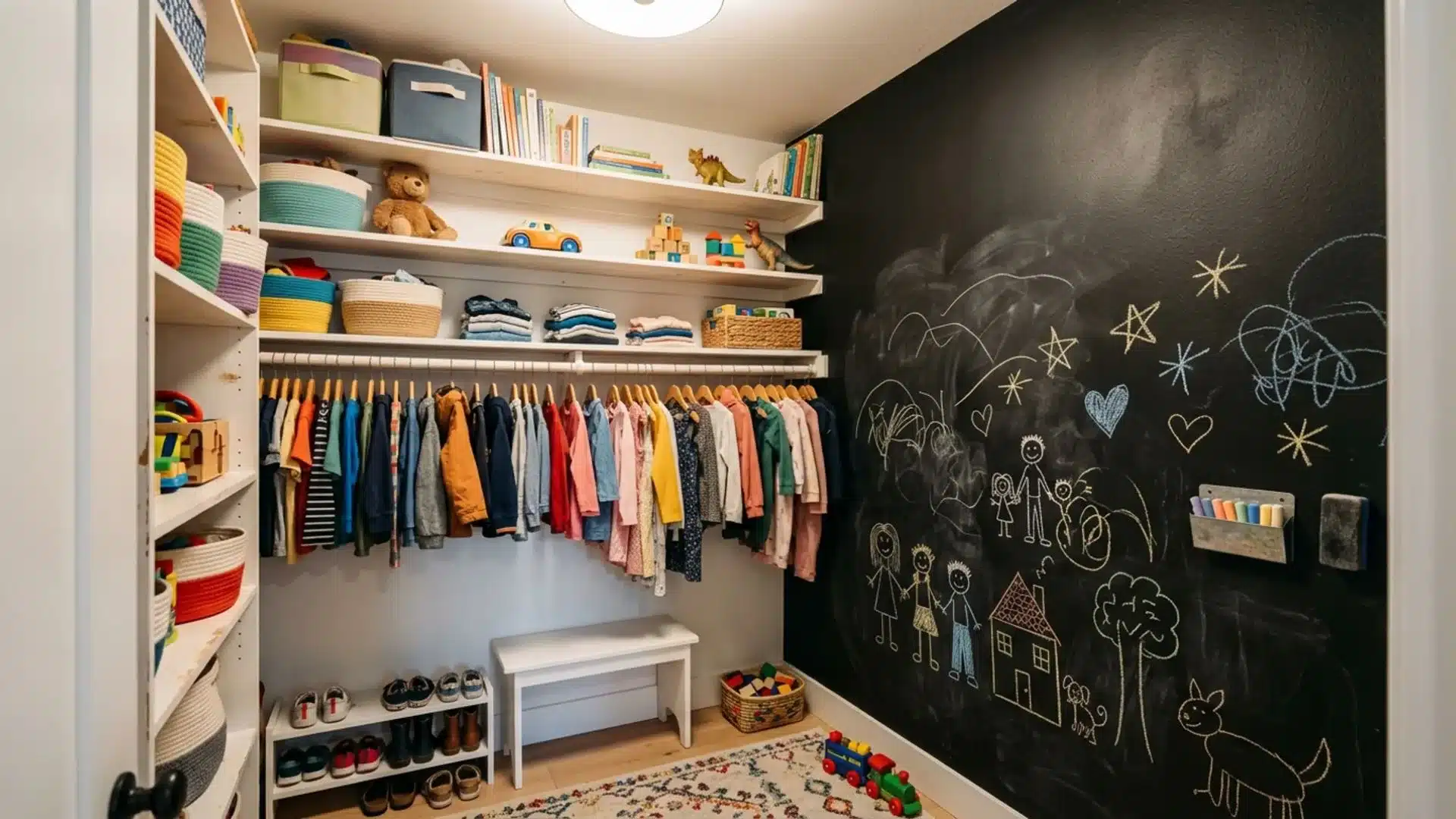
Chalkboard paint applied to one interior wall gives kids a surface to write or draw on directly inside the closet.
Use it to write labels, reminders, or weekly outfit schedules directly on the wall.
Kids can update it themselves with chalk whenever they want to. It adds a personal touch and makes the closet feel far less like a plain storage space. Easy to apply over any existing paint with no special tools or skills needed.
Estimated Budget: $15 to $25
23. Add a Mirror With Hidden Storage Inside the Closet
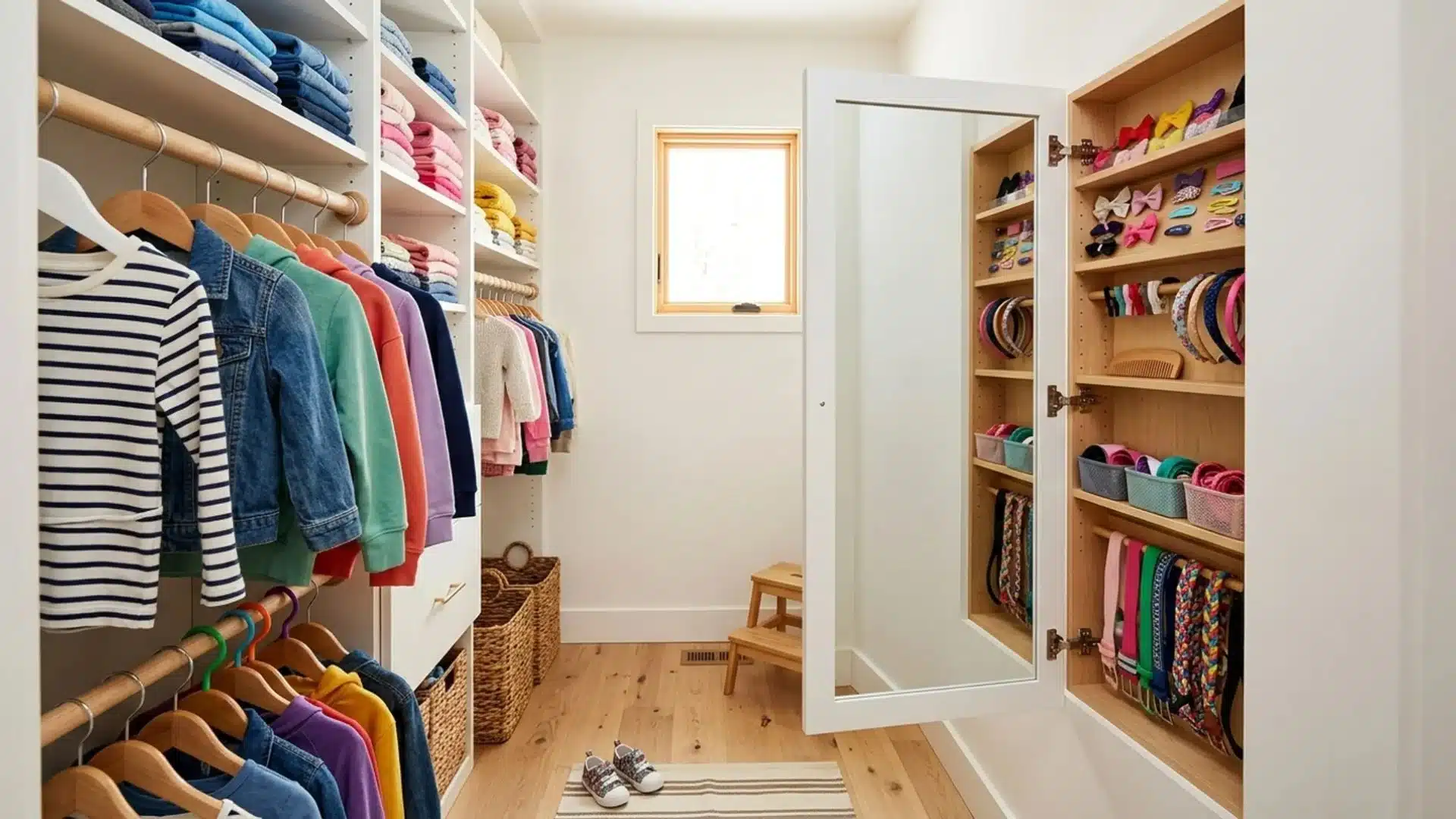
A full-length mirror mounted on the closet wall that opens like a door to reveal hidden shelves or hooks behind it.
Kids can check their outfit while the mirror stores hair accessories, belts, and small items out of sight.
It saves wall space and adds a functional element that most standard kids’ closets lack. A simple hinge-and-wall-mount installation makes it a manageable DIY project.
Estimated Budget: $40 to $80
Note: The budgets mentioned are rough estimates and may vary based on your location, the materials you choose, and where you purchase supplies.
Use these kids’ closet ideas as a starting point and adjust each project to fit your space, budget, and child’s needs.
The Age-by-Age Closet System
No single setup works forever; adjust as your child grows.
| Age | Focus | Storage Approach | Avoid |
|---|---|---|---|
| 1–3 | Simplicity | Low open bins, picture labels, wall hooks | Lids on bins |
| 4–6 | Independence | 5-hook outfit system, color-coded hangers | Too many categories |
| 7–10 | Gear management | Gear zone, laundry basket inside closet | Ignoring their input |
| 11–13 | Ownership | Style zones, shoe space, mirror | Rigid systems |
| 14+ | Self-management | Capsule wardrobe, personal layout | Managing it for them |
The Part Everyone Ignores: Keeping it Organized After Day One
Most closets look great on day one. The real test is week four.
The secret isn’t a better system; it’s smaller, consistent actions that take less than 5 minutes each day.
- Return items immediately rather than placing them for now.
- Fix one thing every time you open the closet door.
- Rearrange zones when a new hobby or school year begins.
- Reset the whole closet whenever it takes more than 30 seconds to find something.
A closet that’s maintained daily never needs a full overhaul
Start Here, Not at the Store!
The right closet setup changes more than just the room. These kids’ closet ideas give you practical tools to reduce clutter, save time, and build a space that children can actually manage on their own.
From labeled bins to pegboards to fold-down desks, this article has covered it all. Now it is your turn to act.
Choose the idea that best fits your space, start with one small change, and build from there.
A better closet and a calmer morning routine are closer than you think.
Frequently Asked Questions
Can I Organize a Kids’ Closet without Buying Anything New?
Yes. Begin decluttering, group clothes by category, and use existing bins or baskets before buying anything.
How Often Should a Kid’s Closet Be Fully Reorganized?
Twice a year works for most families. Align it with seasonal clothing changes so it feels natural and doesn’t pile up.
Is It Better to Fold or Hang Kids’ Clothes?
Hang items that wrinkle easily, like uniforms and jackets. Fold the rest of the casual wear to save space.
What Type of Hangers Work Best for a Kid’s Closet?
Slim velvet hangers save space, prevent clothes from slipping, and are lightweight for kids to use independently.

Iris Delgado, BA in Interior Styling from SCAD, has spent a decade staging holiday and special-event interiors for hotels and film sets. She joined us in 2025 to offer theme-ready palettes, prop lists, and timeline checklists that simplify celebratory makeovers at any budget. She also co-hosts community parade-float workshops and collects vintage ornaments.