
If you are building a new home, replacing a dying furnace, or renovating a property you just bought, the heating system question will find you sooner or later. And when it does, the sheer number of opinions — from contractors, neighbors, Reddit threads, and your brother-in-law who “knows a guy” — can make the decision feel impossible.
The truth is that there is no single best heating system. There is only the best system for your specific home, your climate, your budget, and how you plan to use the space. A boiler that is perfect for a century-old brownstone in Boston would be a poor choice for a new ranch-style build in North Carolina. A heat pump that saves thousands in Atlanta might struggle during a polar vortex in Minnesota without backup support.
This guide breaks down the three most common whole-home heating systems — boilers, furnaces, and heat pumps — across the factors that actually matter to homeowners: how they work, what they cost to install and operate, how long they last, and which homes they fit best. No sales pitch, no agenda. Just the information you need to make a smart decision.
How Each System Works: The 60-Second Version
Before diving into comparisons, it helps to understand the fundamental difference in how these systems deliver heat to your home. Each one uses a completely different mechanism, and that mechanism drives everything else — efficiency, comfort feel, installation requirements, and maintenance needs.
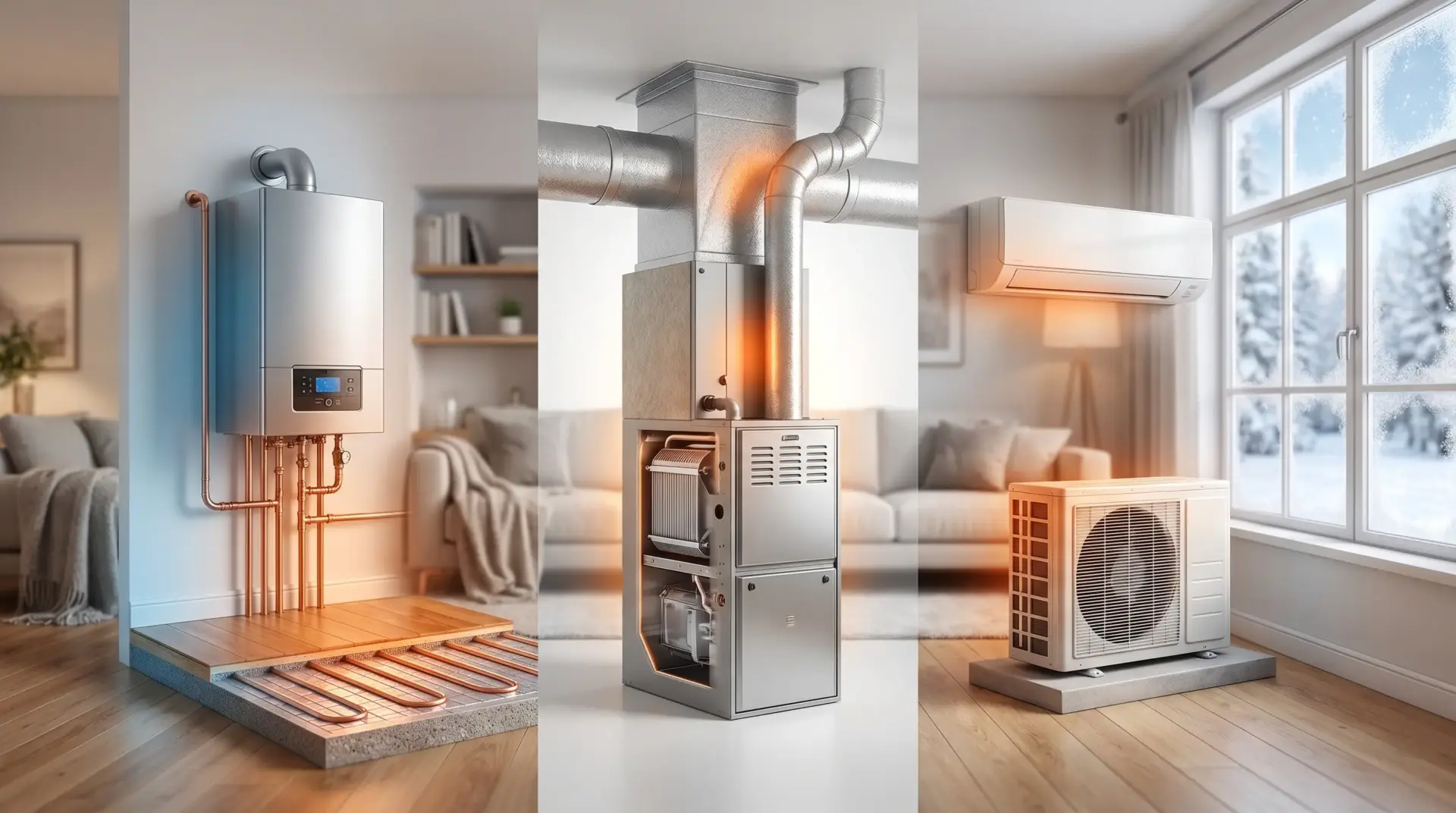
Boilers heat water and distribute it through pipes to radiators, baseboard heaters, or radiant floor systems. The heat radiates from these surfaces into the room. Boilers can run on natural gas, oil, propane, or electricity. They do not use ductwork and do not blow air. The result is a steady, even warmth without drafts — a heating experience that many homeowners describe as distinctly comfortable.
Furnaces burn fuel (usually natural gas, but also propane or oil) to heat air directly. A blower fan pushes that heated air through a network of ducts and out of registers in each room. Furnaces heat quickly and are the most common heating system in American homes, particularly in areas with existing ductwork. However, forced-air heating can create temperature inconsistencies between rooms and stir up dust and allergens.
Heat pumps do not generate heat at all. They move it. Using a refrigerant cycle — the same basic technology as your refrigerator, but in reverse — a heat pump extracts heat from the outdoor air (or, in geothermal systems, from the ground) and transfers it inside. Because moving heat requires far less energy than creating it, heat pumps can deliver two to four times more heating energy than the electricity they consume. Most heat pumps also reverse direction in summer, providing air conditioning through the same unit.
Efficiency: Where Your Energy Dollar Actually Goes
Efficiency is the single biggest factor in long-term heating costs, and it is where the three systems diverge most dramatically.
A modern gas furnace achieves an Annual Fuel Utilization Efficiency (AFUE) of 90 to 98 percent. That means for every dollar of gas burned, 90 to 98 cents is converted into usable heat. High-efficiency condensing furnaces sit at the top of this range and represent the best a combustion system can do. But even at 98 percent AFUE, a furnace is limited by physics: you can never get more energy out of fuel than what you put in.
Modern boilers achieve similar AFUE ratings — 85 to 95 percent for conventional models, and up to 95 to 98 percent for condensing boilers that recover heat from flue gases. Oil-fired boilers typically fall in the 86 to 92 percent range. Boilers lose some efficiency through the distribution system (heat loss from pipes), but this is generally modest in well-insulated installations.
Heat pumps shatter the efficiency ceiling entirely. Because they move heat rather than create it, their effective efficiency — measured as Coefficient of Performance (COP) — routinely exceeds 300 percent. For every unit of electricity consumed, a heat pump delivers three to four units of heat. Even in cold weather, modern cold-climate heat pumps maintain COPs above 2.0 down to temperatures well below freezing. This is a thermodynamic advantage that no combustion system can match, regardless of how well it is engineered.
The practical takeaway: in most climates and at current energy prices, a heat pump costs significantly less to operate per heating season than either a furnace or a boiler. The gap is largest in regions with moderate winters and competitive electricity rates, and narrowest in areas with very cold winters and cheap natural gas.
Installation Cost: What You Will Actually Pay
Upfront cost is where many homeowners start — and often where the analysis stops. That is a mistake, because the cheapest system to install is frequently the most expensive to own over 15 years. But installation cost still matters, so here are realistic ranges for 2026.
A gas furnace, installed, typically costs between $3,500 and $8,000 for a standard-efficiency unit, and $5,000 to $12,000 for a high-efficiency condensing model. If your home already has ductwork, installation is straightforward. If it does not, adding ducts can add $5,000 to $15,000 to the project.
A boiler installation runs $5,000 to $15,000 on average, depending on fuel type, capacity, and whether the home already has a hydronic distribution system (radiators, baseboards, or radiant floor loops). Replacing an existing boiler with a modern unit is usually simpler and cheaper than installing a boiler system from scratch. Oil-fired and dual-fuel boiler installations tend to fall at the higher end of this range due to additional fuel storage and handling requirements.
A heat pump system costs $4,500 to $12,000 for a ducted air-source unit, and $6,000 to $15,000 or more for a ductless mini-split system covering a whole home. Ground-source (geothermal) systems are significantly more expensive, typically $15,000 to $35,000, but deliver the highest efficiency and longest lifespan. The federal 25C tax credit under the Inflation Reduction Act offers up to $2,000 per year for qualifying heat pump installations, and many states and utilities stack additional rebates on top — in some cases reducing the net cost to parity with or below a furnace-plus-AC combination.
Comfort: How the Heat Actually Feels

This is the factor that rarely appears in spec sheets but matters enormously in daily life. Each system delivers a distinctly different kind of warmth.
Boiler heat is radiant. It warms surfaces and objects in the room rather than blowing hot air. There are no drafts, no dust circulation, and no noise from ductwork. Radiant floor systems, in particular, produce an exceptionally even and comfortable warmth that many homeowners consider the gold standard. The trade-off is response time: boilers and hydronic systems take longer to change the temperature in a room compared to forced-air systems.
Furnace heat is fast and direct. When the thermostat calls for heat, a furnace can raise the temperature in a room within minutes. However, forced air creates temperature stratification (warm air rises to the ceiling while floors stay cold), can feel drafty near registers, and circulates dust, pet dander, and allergens through the ductwork. Noise from the blower and duct expansion is also common.
Heat pump heat is gentler and more sustained. Rather than blasting very hot air in short cycles, a variable-speed heat pump delivers a continuous flow of moderately warm air that maintains an even temperature. Some homeowners accustomed to the “blast” of a gas furnace initially perceive heat pump air as cooler, but objective measurements show the room temperature is equivalent or better — just delivered differently. Modern inverter-driven heat pumps are also remarkably quiet, both indoors and outdoors.
Climate Considerations: What Works Where
Climate is the single most important variable in the boiler-furnace-heat pump decision.
In mild to moderate climates (most of the southern United States, the Pacific coast, and mid-Atlantic regions), heat pumps are the clear efficiency winner. They provide both heating and cooling from a single system, operate at peak efficiency in moderate temperatures, and benefit most from available tax credits.
In cold climates (the upper Midwest, New England, northern Plains), the decision is more nuanced. Modern cold-climate heat pumps can now operate effectively down to -15°F or lower, but their efficiency drops as temperatures fall. Many cold-climate homeowners opt for a dual-fuel setup: a heat pump handles heating during moderate cold (above 25 to 30°F), and a gas furnace or boiler takes over during extreme cold snaps. This hybrid approach captures the efficiency of a heat pump for 80 percent of the winter while maintaining the reliable, high-output heat of a combustion system for the coldest days.
For homes in very cold regions that already have hydronic distribution systems — radiators, baseboard heaters, or radiant floors — boilers remain an excellent choice. Replacing an old, inefficient boiler with a modern condensing unit can dramatically reduce fuel consumption while preserving the comfortable radiant heat delivery that these homes were designed around.
Choosing the Right Boiler: It Matters More Than You Think
For homeowners who determine that a boiler is the right fit — whether for a new build with radiant floor heating, a historic home with existing radiators, or a property in a region without natural gas where oil-fired systems are the practical choice — the next decision is which boiler to buy. And this is where many homeowners underestimate the importance of manufacturer expertise.
Unlike furnaces, which operate within a narrow and standardized set of parameters, boilers vary significantly in combustion design, heat exchanger configuration, control systems, and suitability for different fuel types and distribution systems. A boiler matched to the wrong application — undersized for the load, poorly configured for the fuel, or lacking adequate controls for the home’s demand pattern — will underperform regardless of its efficiency rating on paper.
This is why selecting a manufacturer with deep experience across a range of boiler types and applications matters. EPCB, for example, has been engineering and manufacturing boilers since 1953, with over 20,000 installations delivered across more than 100 countries. That kind of depth — spanning gas, oil, biomass, and electric boiler systems across residential, commercial, and industrial applications — translates into design refinements that homeowners benefit from directly: optimized heat exchangers that extract more energy from every unit of fuel, automatic control systems that modulate output to match real-time demand, and build quality backed by ISO 9001, ASME, and CE certifications. When evaluating boiler options, look beyond the headline efficiency number and consider the manufacturer’s track record, the quality of their control systems, and whether they offer configurations specifically suited to your fuel type and distribution setup.
Lifespan and Maintenance: The Long Game
Heating systems are 15-to-25-year commitments, so durability and maintenance requirements deserve serious weight.
Boilers have the longest average lifespan of the three systems. A well-maintained cast iron or steel boiler can last 20 to 30 years, and some last significantly longer. Boilers have fewer moving parts than furnaces or heat pumps, which reduces mechanical failure risk. Annual maintenance includes water pressure checks, inspecting for leaks, flushing the system, and servicing the burner. Boilers also add some beneficial humidity to indoor air during winter — a notable comfort advantage in dry climates.
Furnaces typically last 15 to 20 years. They require annual filter changes (monthly during heavy use), blower motor lubrication, burner cleaning, heat exchanger inspection, and gas safety checks. A cracked heat exchanger is the most serious failure mode and requires immediate replacement due to carbon monoxide risk.
Heat pumps last 12 to 20 years on average, somewhat less than boilers and furnaces because they operate year-round (heating in winter, cooling in summer), doubling the wear on the compressor and other components. Maintenance includes biannual tune-ups, coil cleaning, refrigerant level checks, and filter replacement. The trade-off is that a single heat pump replaces both a furnace and an air conditioner, so the total system maintenance burden is comparable.
Environmental Impact: The Carbon Question
If reducing your household carbon footprint is a priority, the three systems rank differently.
Heat pumps produce zero direct emissions at the point of use. Their carbon impact depends entirely on the electricity grid powering them. In regions with clean grids (hydro, wind, solar, nuclear), a heat pump is effectively zero-carbon heating. Even on fossil-fuel-heavy grids, a heat pump’s high efficiency means it produces less CO₂ per unit of heat delivered than a gas furnace or boiler.
Gas furnaces and gas boilers produce roughly similar direct emissions — approximately 117 pounds of CO₂ per million BTU of heat delivered. High-efficiency condensing models are modestly better because they extract more heat from the same amount of fuel.
Oil-fired boilers produce the highest carbon emissions of the three, at approximately 161 pounds of CO₂ per million BTU. However, for homes in areas without gas infrastructure, modern high-efficiency oil boilers still represent a significant improvement over older, non-condensing units — and in some geographies, they remain the most practical and reliable heating option available.
The Decision Framework: Matching System to Situation
Rather than declaring a universal winner, here is a practical framework for matching the right system to the right home.
A heat pump is likely your best choice if: your climate is mild to moderately cold, your home has existing ductwork (or you are willing to install ductless units), you want both heating and cooling from one system, you qualify for federal and state incentives, or you are building new and want the most energy-efficient option available.
A furnace makes sense if: you live in a very cold climate with cheap natural gas, your home already has ductwork, you want the lowest possible installation cost, or you are pairing a gas furnace with a heat pump in a dual-fuel configuration for maximum efficiency and cold-weather reliability.
A boiler is the right choice if: your home has an existing hydronic distribution system (radiators, baseboards, or radiant floors), you are building new with radiant floor heating, you value the draft-free comfort of radiant heat, your home is in a region without natural gas and relies on oil or propane, or you live in a historic home where adding ductwork is impractical or would compromise the structure’s character.
The Bottom Line
There is no single heating system that wins across every scenario. The right choice depends on your climate, your home’s existing infrastructure, your budget horizon, and how you personally experience comfort. What has changed in 2026 is that all three technologies have improved dramatically. High-efficiency condensing boilers extract more heat from less fuel than ever before. Variable-speed furnaces deliver smoother, quieter performance. And cold-climate heat pumps have extended the viability of heat pump technology into regions that were previously considered off-limits.
The worst decision you can make is a reactive one — waiting until your current system fails in January, then accepting whatever your emergency HVAC contractor has on the truck. The best decision starts now, with research, honest assessment of your home’s needs, and conversations with qualified professionals who can help you model the total cost of ownership over the life of the system. Your future self — warm, comfortable, and looking at a reasonable energy bill — will thank you.

Holding a Master’s in Architecture from the University of Texas at Austin, Emily Rodriguez has dedicated more than two decades to the art and science of building renovation. Starting her journey in historic preservation, she developed a profound respect for blending old with new in building design. Emily became a vital part of our team in 2019, renowned for her insightful and innovative renovation tips. She has been leading our DIY home improvement series since ever since, where she shares her wealth of knowledge in turning outdated spaces into modern havens. When not engaged in writing or consulting, Emily is a passionate advocate for heritage conservation and enjoys exploring vintage architecture, a hobby that complements her professional expertise.