
Charts tell you which companion plants are best to grow with peas, but skip why and whether it is even worth it. I tried all of them, and my yield looked nothing like what these guides promised, especially the nitrogen-fixing claims for our pea vines.
The companion plants I keep going back to are radishes, carrots, lettuce, spinach, and low herbs and flowerslike cilantro, thyme, marigold, nasturtium, and alyssum. The ones I keep away are onions, garlic, leeks, and shallots, which have shallow roots, plus big brassicaslike cabbage and broccoli.
Read on for the layout, the timing, and the reason behind each pairing, so you can set your bed up once and get it right. And find out whether that nitrogen really is the free food they promised you.
Companion Planting (Meaning & History)
Companion planting is growing two or more crops close together, so at least one does better than it would alone. Better can mean fewer pests, more food from the same soil, free climbing support, or using empty ground.
The idea goes back to the Native American Three Sisters, where corn, beans, and squash shared a mound. A study of farmers in south-east Romania found that mixed plantings gave clearly bigger harvests than the same crops grown alone.
The same logic runs across the whole vegetable patch, so it is worth knowing which plants grow better together before you plan a single bed.
What Qualifies as a Good Pea Companion?
Peas are a cool-weather crop, sown early in spring before the last frost. Planting timedepends on soil temperature, not the calendar.
They want full sun, well-drained soil, and steady water. They have wide, spreading roots and don’t mind being packed close together.
That gives you four things companion plants should share with peas and their growth requirements.
It should grow at the same time. If it needs heat to grow, it will still be tiny when the peas come out.
It has to use space the peas are not using. Climbing peas go up, which leaves the ground below free for weeks.
It must not fight the peas for root room. Shallow-rooted plants get squeezed out, which is why the onion family fails here.
It also helps if it repels pests. Peas get thrips, and in some gardens, aphids and Mexican bean beetles.
Worth Noting! The season, the roots and the trellis decide the whole list of companion plants for peas.
Best Companion Plants for Peas and Why Each One Helps
These are the ones I keep coming back to, roughly in the order I’d add them.
1. Radish, Lettuce, and Spinach (Crops for the Bare Ground Under a Pea Trellis)

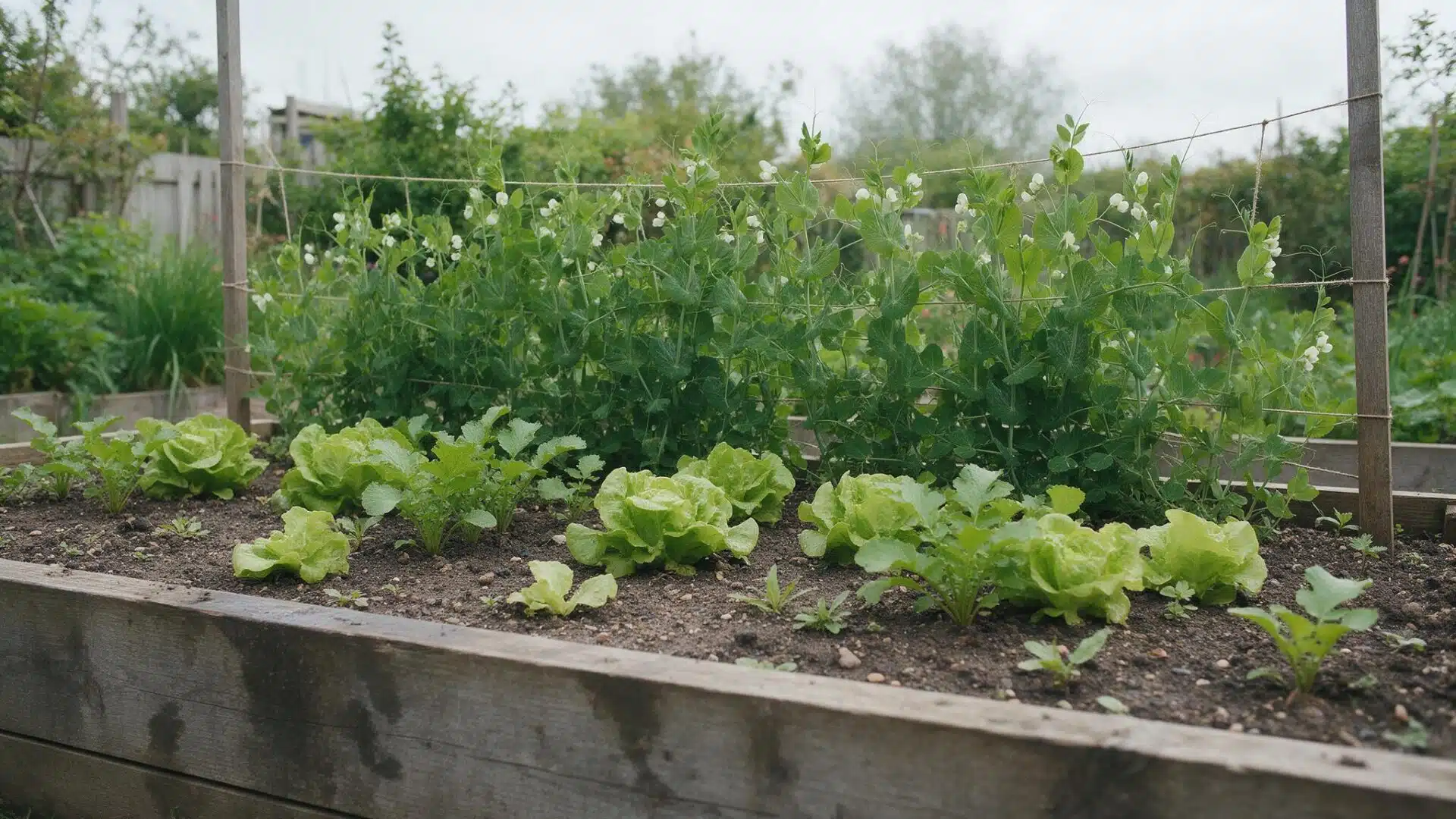
Radish, lettuce, and spinach turn empty soil into a second harvest before the vines fill out.
A pea trellis leaves bare ground beneath it for several weeks. Anything sown and harvested inside that window is free food.
Lettuce and spinach also work, because light shade keeps them tender for longer before they bolt. Arugula, mustard greens, and salads do the same job. Gardeners also suggest bok choy and joi choy under a pea trellis, both ready in about 45 days.
If you ask me, Radishes are best. They are ready in three or four weeks, long before the peas need the room, and their roots loosen the surface soil.
2. Carrots, Beets, Turnips (They Share the Soil Politely)

Carrots, beets, and turnips work beside peas because of root shape, not chemistry.
Pea roots spread sideways and stay shallow. Carrots send down one narrow taproot. They don’t reach for the same things in the same places, so neither crowds the other.
Beets and turnips work for the same reason. Just keep them away from the carrots, since carrots and beets are too similar and will compete.
3. Herbs (Cilantro, Sage, Thyme, etc.) that Repel the Pests

Cilantro, sage, thyme, rosemary, dill, and basil are all recommended against thrips and aphids. In my experience, they help butdon’tt fix everything. I still had thrips. I just had fewer.
Spotting thrips on plants early matters more than any herb in the bed, because the damage usually shows before the insect does.
Pests find food by color and smell, so a bed of mixed smells slows that search down.
Mint belongs on the list with a warning. It does repel insects. It also spreads underground and takes over everything. Grow it in a pot beside the peas.
What I Suggest! Spread the herbs through the bed rather than lining them up at one end.
4. Flowers like Cosmos, Marigold & Alyssum

A flower only earns its place if you do not compromise pea plants to fit it in.
Here is the trade-off nobody mentions. If a flower is big enough that you have to spread your peas out, you paid for it with peas.
So pick the ones that cost nothing. Alyssum stays low and brings in aphid eaters. Cosmos is narrow enough to poke in every couple of feet. Marigolds are best along the edge.
Nasturtium is the most useful. You can eat the leaves, flowers, and pickled seed pods, so it earns its space even if it doesn’t protect against pests.
5. Corn: The Tall Crop that Peas can Climb
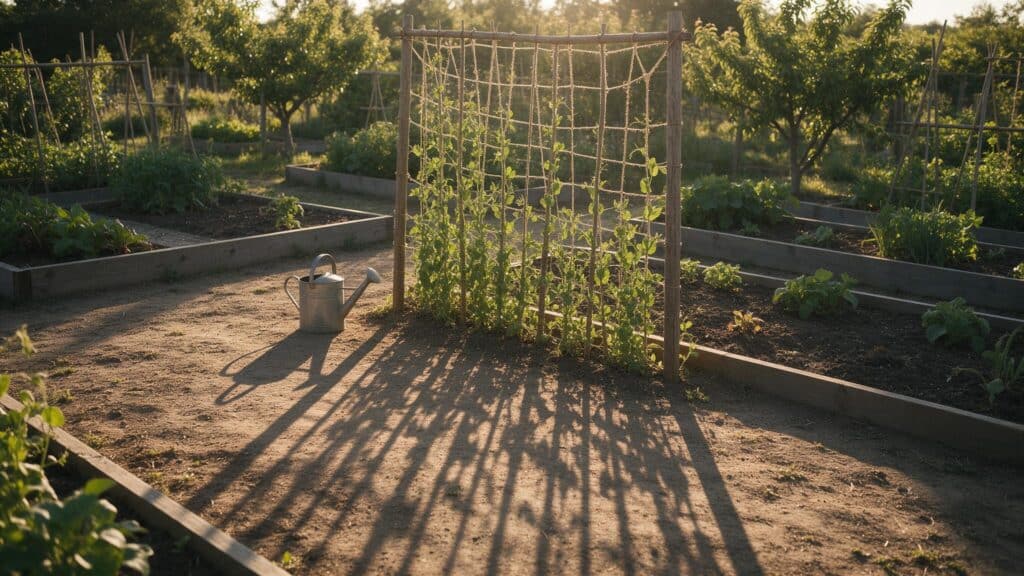
Corncan act as a living trellis and throws a little shade if you get an unexpected hot spell. The problem is timing. Corn has to be a foot tall before the peas start reaching, or the tendrils flop along the ground.
Peas go in early, and corn wants warm soil, so this only works in some climates. A simple wood trellis takes an afternoon and lasts several seasons.
The table below summarizes the benefits that make these the best companion plants for peas. Have a look!
Planting Option | Benefit |
|---|---|
Radish, arugula, salad turnip, bok choi, mustard greens | Gives you an extra harvest from space peas do not need yet |
Lettuce, spinach, bok choi | Uses the ground space under a pea trellis |
Carrot, beet, turnip | Grow below ground without competing heavily with pea roots |
Radish, carrot, turnip | Help keep the upper soil layer looser |
Cilantro, sage, thyme, rosemary, dill, basil, mint in a pot | Can help confuse pests and make the bed less attractive to them |
Alyssum, marigold, nasturtium, cosmos | Attract pollinators and beneficial insects that feed on aphids |
Corn, sunflower | Can provide natural climbing support |
Tomato, pepper, cucumber | Give you a follow-up crop after the peas are removed |
Do Peas Really Feed Nearby Plants Nitrogen? (Myth Debunked)

Peas really can pull nitrogen out of the air and convert it into nitrogen in the soil. Every chart says the plants beside them get some for free, but it is not that simple.
A 2018 study in the Journal of Integrative Agriculture injected a nitrogen tracer into broad beans growing next to garlic. A little reached the garlic while both were alive. Most other studies find no movement at all.
There is a simpler problem. Most of a pea plant’s nitrogen ends up in the pods, and you pick those and carry them off. The residue replenishes the soil for the plants sown afterward.
Do not put carrots next to peas expecting free food. Put them there because the roots reach different depths and do not compete with each other.
Tips for Companion Planting for Peas

These are the practical rules. I learned most of them by getting them wrong first.
1. Work out the shadow first
In most gardens that means the north side. Do this before you sow anything, because every other decision in the soil bed depends on where that shade lands.
2. One crop per row
Scatter peas and carrots into one row and you sow the peas far too thinly. You lose peas without gaining carrots.
3. Do not sacrifice pea plants
Peas like being crowded, roughly two inches apart. Give the companion plant its own line.
4. Ask what you gain
Squash two crops into half their space each, and you gain nothing. The gain only appears when the pairing gives you something extra, such as pest protection, support, or use of ground that was going to be bare anyway. Before you halve anything, name the extra thing, or skip the pairing.
5. Fit companions into existing gaps
Sow your peas as if they were alone. Anything the gaps give you is a bonus.
6. Give a climbing partner a head start
Corn or sunflowers need height before the peas start reaching.
7. Leave yourself room to walk
I have never seen this on a companion planting chart, and I regret ignoring it every year. Peas need picking every few days, and you cannot pick what you cannot reach.
8. Pull the quick-yielding crops on time
Radishes and lettuce only work because they leave. Forget them, and they become competition.
9. Companions help; they do not fix
Keep an organic pest-control method you trust on hand, because companions only buy you time.
10. Get the boring things right first
Soil, sun, water. This only improves a bed that already works.
11. Start with three plants, not thirty.
Marigolds, radishes, and one herb. See what happens, then tweak.
Companion Plants for Peas to Avoid

Root competition, space, season, and shade. Every plant in the table below does not qualify as a pea companion.
Plants | Problem |
Onion, garlic, leek, shallot (spring onions are fine if pulled young) | Both crops come out stunted |
Cabbage, broccoli, kale, Brussels sprouts | Takes the space and keeps it all season |
Tomato, squash, pumpkin, melon | Wrong season, too sprawling |
Peppers, bush beans, anything that needs full sun | Gets shaded out by the trellis |
Beans and other legumes | Same pests, same trellis, no real gain |
Bottom Line!
Companion planting peas is less about finding a magical plant combination and more about using space, timing, roots, and sunlight wisely.
The best pea companions include radishes, lettuce, spinach, carrots, herbs, and low-growing flowers, along with how each pairing helps. Corn and sunflowers make good climbing supports. Plants to include: onions, garlic, large brassicas, and sprawling summer crops
The practical layout rules can make or break a pairing. Most importantly, the nitrogen myth that peas do not simply “feed” nearby plants.
Start small with a few proven companions, keep the soil, water, and sunlight right, and observe what works in your garden.
Tell us in the comments which pairing worked in your garden and which one let you down!
FAQs
How Close Can Peas be Planted Together?
Peas can be planted about two inches apart within a row. Leave wider spaces between rows so you can easily reach and harvest the vines.
What Should I Plant with Peas In A Raised Bed?
Place the trellis on the north side, followed by peas, carrots, and quick crops like radishes or lettuce at the front for full sun.
Which Flowers Grow Well with Peas?
Marigolds, nasturtiums, alyssum, and cosmos grow well with peas. Alyssum attracts beneficial insects, while nasturtiums provide edible leaves, flowers, and seed pods.

Jordan Mathews, who has a degree in horticulture from Texas A&M University, has been a guiding force in plant health and sustainable gardening for over 16 years. His career began with a role at a renowned botanical garden, where he deepened his understanding of plant physiology and eco-friendly cultivation methods. Jordan joined our website as a freelancer in 2020, becoming a go-to expert for readers seeking advice on nurturing diverse plant species apart from offering insights grounded in scientific knowledge and practical experience. Beyond his professional achievements, Jordan is a keen nature photographer, capturing the beauty of flora in its immensely diversified forms.