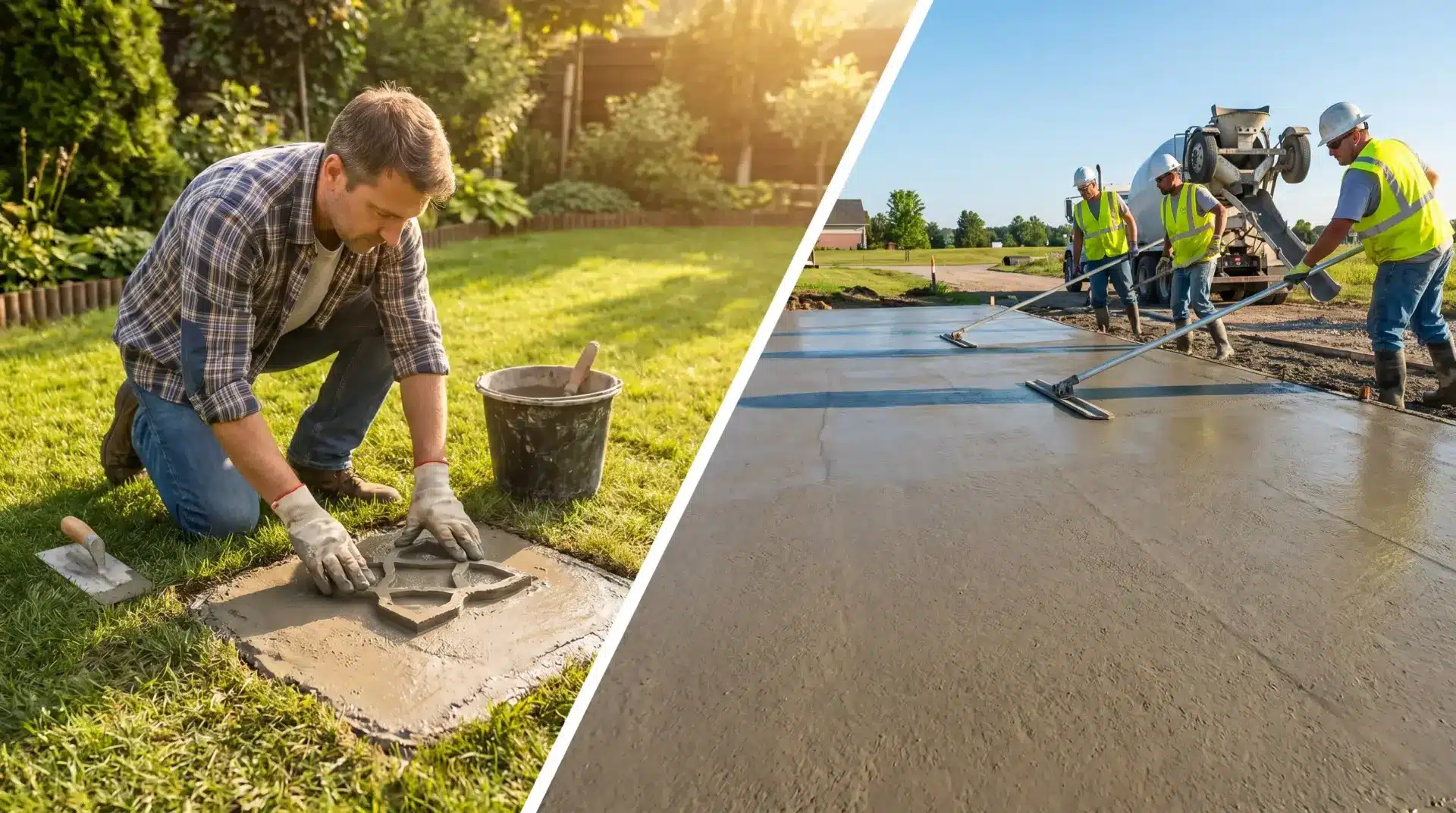

Concrete looks simple from the driveway. You mix it, pour it, smooth it, wait. Plenty of homeowners take that at face value and grab a few bags from the hardware store on a Saturday morning. Some of those projects turn out great. Others turn into a weekend that ends with a lumpy slab and a sore back.
The trick isn’t talent. It’s knowing which jobs reward a DIY effort and which ones quietly punish it. Here’s how to tell them apart before you open the first bag.
The Jobs Worth Doing Yourself
Small, low-stakes, forgiving work is where DIY shines. Setting a couple of fence posts. Pouring a stepping stone path. Patching a hairline crack in a walkway. Staining an existing slab to freshen it up. These share a few things in common: the area is small, the surface isn’t load-bearing, and a minor flaw won’t cost you anything but pride.
If the worst outcome is “it looks a little uneven and I’ll redo it next year,” that’s a green light. You learn the feel of the material, you save the labor cost, and the mistakes are cheap.
Where DIY Starts to Bite
Concrete is unforgiving about two things: time and volume. Once it starts to set, it does not wait for you to figure out the next step. A small patch gives you room to fumble. A large pour does not.
That’s the real reason big slabs go sideways on first-timers. A driveway or a full patio is a race against the cure clock, and it usually needs more hands, more tools, and more finishing speed than one person has. Get behind and you end up with cold joints, a rough surface, or sections that cured at different rates and now look like two different projects stitched together.
Then there’s the part nobody sees: what’s under the concrete. The base preparation, the grading, the compaction, the drainage. A slab is only as good as the ground it sits on, and that groundwork is where most DIY failures actually start. The pour gets the blame, but the prep is the culprit.
The Honest Cost Math
People go DIY to save money, which makes sense until you price the mistakes. A failed pour doesn’t just cost you the wasted bags. It costs the demolition to remove it, the disposal, and the redo. At that point you’ve paid for the job twice and still don’t have the result you wanted.
There’s also the gear. Edgers, floats, a bull float, a mixer for anything sizable, and the muscle to move it all on a clock. Rent or buy enough of that and the savings shrink fast. For a small project the math favors DIY. For a large one it often quietly flips.
When to Hand It Off
If the project is structural, large, visible from the street, or tied to your home’s value, that’s the moment to bring in someone who pours concrete for a living. A crew that does this every day moves fast enough to beat the cure, preps the base correctly, and finishes a big surface evenly in a single working window. You’re not just paying for the pour. You’re paying for the part you can’t easily redo.
A good rule of thumb: if a mistake would force you to rip it out and start over, it’s worth getting a quote before you commit to a weekend.
A Quick Gut Check Before You Start
Run your project through four questions:
- Size: Is it bigger than a few square feet of continuous pour? Lean toward hiring.
- Stakes: Would a flaw be cosmetic, or would it affect drainage, safety, or resale? Higher stakes, hire.
- Timeline: Can you finish before the concrete sets, with the help you actually have? Be honest here.
- Redo cost: If it fails, what does fixing it cost in money and hassle?
None of this means DIY is the lesser choice. Doing your own small projects is genuinely satisfying, and it builds skill you’ll use again. It just means matching the project to the right approach. Pour the stepping stones yourself. Get help with the driveway. Your weekend, and your home, will thank you.

Holding a Master’s in Architecture from the University of Texas at Austin, Emily Rodriguez has dedicated more than two decades to the art and science of building renovation. Starting her journey in historic preservation, she developed a profound respect for blending old with new in building design. Emily became a vital part of our team in 2019, renowned for her insightful and innovative renovation tips. She has been leading our DIY home improvement series since ever since, where she shares her wealth of knowledge in turning outdated spaces into modern havens. When not engaged in writing or consulting, Emily is a passionate advocate for heritage conservation and enjoys exploring vintage architecture, a hobby that complements her professional expertise.