
Loose glasses are one of those small problems that somehow manage to be irritating every single time.
Glasses sliding down your nose, falling off your ears, or sitting at an angle are all signs that something has shifted and needs attention.
Knowing how to fix loose glasses at home is simpler than most people think.
In the majority of cases, it comes down to a loose screw, stretched temple arms, or nose pads that need adjusting. None of it requires a trip to the optician unless the frame is cracked or a lens has visibly shifted.
What Actually Causes Glasses to Loosen Over Time?
Glasses loosen gradually, not all at once. The hinges open and close hundreds of times a day, slowly working the screws loose and putting pressure on the frame in ways that are easy to miss until the fit feels completely off.
Daily habits make it worse. Pulling glasses off with one hand, resting them on your head, or skipping the hard case are the most common things people mention when describing the problem on forums.
None of it feels significant in the moment, but over weeks it adds up.
Material plays a role, too. Metal frames bend gradually with use, while plastic frames are more prone to heat damage.
Diagnose the Problem First: Where Exactly Are Your Glasses Loose?
Before you grab a screwdriver, take 30 seconds to figure out where the looseness is actually coming from.
The fix for a wobbly hinge is completely different from the fix for arms that sit too wide on your head. Getting this right first saves you from making things worse.
- Loose Hinge or Screw: The tiny screw at the hinge tends to loosen with daily use. You might notice one arm feels floppy while the other feels fine. This is the most fixable problem at home, and the one forums mention most often.
- Stretched Temple Arms: Temple arms gradually stretch outward, especially if you put your glasses on your head or pull them off with one hand. The frames end up sitting loosely past your ears rather than gently gripping them.
- Ill-Fitting Nose Pads: When nose pads sit too far apart or are angled outward, there is not enough grip to hold the frame in place. This is especially common with metal frames, where the pads are adjustable.
- Bent or Warped Frames: Leaving glasses in a hot car, on a dashboard, or face-down on a hard surface is a common cause of warped frames. The entire frame can twist slightly, causing one arm to sit higher than the other.
How to Fix Loose Glasses at Home: 7 Easy Tightening Fixes
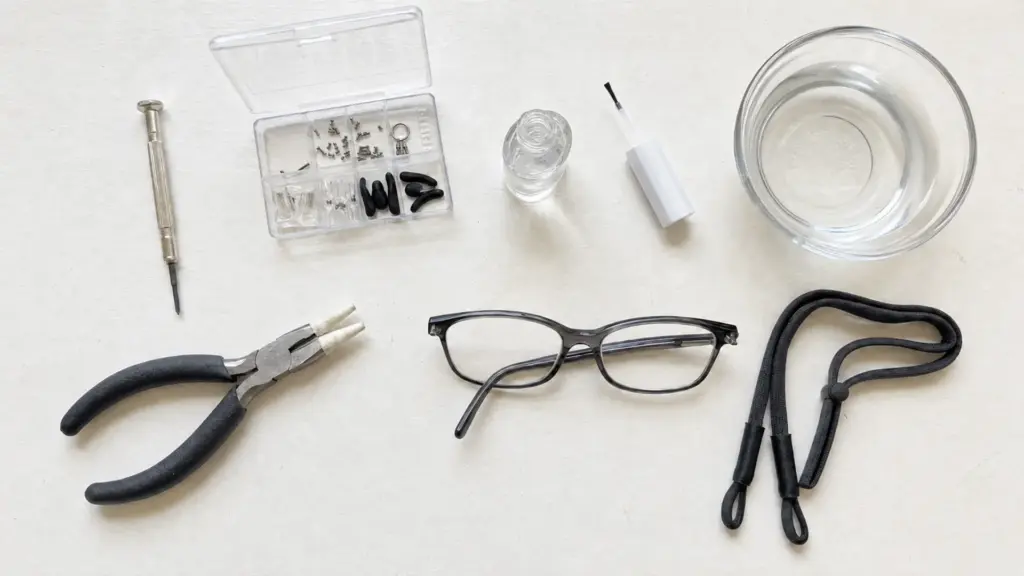
Now that you know where the problem is and what you need, here are the fixes.
Each one is written as a straight, step-by-step guide, so you can follow along without having to figure anything out as you go.
Fix 1: Tighten a Loose Hinge Screw
This is the fix most people need and the quickest one to try first.
Hold the frame steady with one hand, insert the screwdriver tip flush into the screw head, and turn the screw clockwise slowly.
Stop as soon as you feel resistance. Open and close the arm a few times to test. It should feel firm but still move smoothly.
If the screw tightens but loosens again within days, move on to Fix 3.
Fix 2: Replace a Missing or Stripped Screw
If the screw is gone or will not grip no matter how much you tighten it, it needs replacing.
- Use the kit you already have, or take your glasses to a pharmacy and ask to match the screw size.
- Insert the new screw by hand first to ensure it catches the threads cleanly, then tighten it with your screwdriver until it is firm.
- Test the arm movement before putting the glasses on.
Tip: Keep two or three spare screws somewhere easy to find. They are small and easy to lose at the worst moment.
Fix 3: Apply Clear Nail Polish to a Repeatedly Loose Screw
If tightening the same screw every week is getting old, this is the fix that sticks. Tighten the screw fully first.
Then dip a toothpick into clear nail polish and dab the smallest amount onto the thread where the screw meets the frame. Leave it for at least 10 minutes before wearing the glasses.
The polish acts as a light lock but is not permanent, so you can still remove the screw later if needed.
Fix 4: Bend Metal Temple Arms Inward
Use this if your glasses sit too wide and slide off your ears rather than resting on them.
- Hold the frame at the hinge with one hand to keep it stable.
- Apply slow, gentle inward pressure to the arm about halfway along its length with your other hand.
- Put the glasses on and check the fit. Repeat in small adjustments until they sit comfortably behind your ears without gripping too tightly.
Go slowly. Metal bends farther than you expect, and repeatedly bending it back can weaken it over time.
Fix 5: Reshape Plastic Temple Arms With Warm Water
Plastic arms cannot be bent cold without snapping. Run the temple arm under warm tap water for 20 to 30 seconds until it feels slightly soft, then gently bend it into the shape you need while it is still warm.
Hold the position for around 15 to 20 seconds as it cools and sets. Keep the water warm, not hot. Hot water can warp the frame unevenly or damage the lens coating.
Fix 6: Adjust Nose Pads to Stop Glasses Sliding Down
This fix is for metal frames with adjustable nose pads. Plastic frames with molded nose pads cannot be adjusted this way.
- Wrap the tips of your needle-nose pliers with tape or a small piece of cloth.
- Gently grip one of the nose pad arms and squeeze it slightly inward toward the nose.
- Put the glasses on and check the fit. The pads should rest flat against both sides of your nose with light, even pressure.
- Adjust the second pad to match the first.
Make small moves each time. A little adjustment goes a long way with nose pads, and it is easy to overdo it.
Fix 7: Use an Eyeglass Retainer as an Instant Temporary Fix
If you need a quick solution right now and do not have time to fix the root problem, a retainer or sports strap buys you time.
Attach it to both temple arms at the tips and wear the strap around the back of your head at the level that keeps the glasses in place without pulling them backward.
It works well for workouts, outdoor activities, or getting through a day while you sort out the actual repair.
Common Mistakes To Avoid
Most DIY glasses fixes are straightforward, but a few things keep coming up in forum threads where people make the problem worse instead of better.
These are worth reading before you start.
Mistake | What Happens | What To Do Instead |
Over-tightening the screw | Strips the thread or cracks the frame around the hinge | Stop turning as soon as you feel resistance. Firm is the goal, not tight |
Using superglue on the hinge | Permanently locks the pivot mechanism, making the frame unwearable | Use a drop of clear nail polish on the thread instead |
Bending plastic frames without warming them first | Cold plastic does not bend; it snaps | Run the arms under warm water or use a hairdryer on low for 30 seconds first |
Heating frames too aggressively | Warps the frame unevenly and distorts the lens coating | Stick to warm tap water only. If it is not softening, wait a few more seconds |
When to Skip the DIY Fix and See an Optician?
Some problems are beyond a home fix. Head to an optician if any of these apply to you:
- The Frame is cracked or Broken Near the Hinge: Tightening the screw will not hold if the material around it is already split or chipped. Forcing a fix here risks the arm snapping off completely.
- Your Vision Feels Blurry or Distorted: A shifted lens alters your optical alignment, affecting how clearly you can see. This needs professional correction, not a home adjustment.
- You Wear High-Prescription or Varifocal Lenses: These are sensitive to even small frame shifts, and the zones on varifocals rely on precise positioning to work properly. A professional realignment is the safer call.
- The Spring Hinge is Not Working: The internal mechanism is too small and precise to repair at home. An optician can replace the hinge or advise whether the frame is worth repairing.
How to Prevent Glasses from Loosening Again?
Small habits make the difference between glasses that stay put and ones you constantly have to fix.
| Habit | Dont’s | Do’s |
|---|---|---|
| Taking Your Glasses Off | Pulling them off with one hand, stretching one arm outward every time | Use both hands to keep the pressure even on both sides |
| Storing Your Glasses | Leaving them face down on a surface or loose in a bag | Put them in a hard case to remove pressure on the frame entirely |
| Wearing Them on Your Head | Pushing them up onto your head, which bends the arms outward every time | Set them down on a flat surface or use a spare hair clip instead |
| Maintaining The Screws | Waiting until the arm is fully floppy before doing anything about it | Check and tighten the screws every three to four weeks |
| Getting Them Checked | Assuming everything is fine because the glasses feel okay to wear | Visit an optician once a year for a free adjustment and realignment |
Getting into even two or three of these habits will make a real difference. Most loose glasses problems are not random; they are the result of the same small things done daily over months.
Frequently Asked Questions (FAQs)
1. Can I Tighten Glasses Without a Screwdriver?
In a pinch, the tip of a small butter knife or the edge of a coin can work to turn a flathead screw one turn. It is not ideal and risks stripping the screw, so pick up a precision screwdriver before the next time.
2. Why Do My Glasses Keep Getting Loose So Fast?
The most likely reason is that the screw thread is already worn or slightly stripped, so it cannot hold its position for long. Try the clear nail polish trick after tightening.
3. How Do You Fix Glasses That Are Too Wide For Your Face?
For metal frames, apply slow and gentle inward pressure to the temple arms. For plastic frames, warm them under tap water for 20 to 30 seconds first to soften them before bending.
4. Is It Free To Get Glasses Tightened at an Optician?
Most opticians will tighten and adjust your frames at no charge, even if you did not buy them there. It takes about 10 minutes and is worth doing once a year as part of your home maintenance.
5. How Do I Fix Glasses With No Screws?
Rimless and magnetic glasses use a different fixing system, usually a nut-and-bolt or a tension wire rather than a standard hinge screw. This is one case where an optician visit is the better call.
Final Thoughts
Most loose glasses come down to one of three things: a loose screw, stretched temple arms, or slipping nose pads.
A precision screwdriver handles the first, warm water or gentle bending handles the second, and a small nose pad adjustment handles the third.
None of it takes more than a few minutes once you know what you are dealing with.
If this helped, bookmark this page and come back the next time your frames start acting up. It is easier than searching all over again.

Stephanie Grace, a graduate with a degree in Fine Arts from the Savannah College of Art and Design, has been inspiring DIY enthusiasts with her creative and practical guidance for over 14 years. Her career in design and crafting began in a small artisan workshop, where she developed a passion for transforming everyday materials into beautiful and functional items. Stephanie joined our website in 2018, rapidly gaining popularity for her easy-to-follow DIY tutorials and innovative project ideas. Since then, she has been the creative mind behind our DIY section, helping readers bring their artistic visions to life. Outside her professional pursuits, Stephanie enjoys pottery and urban gardening, hobbies that showcase her love for hands-on creativity and nature.