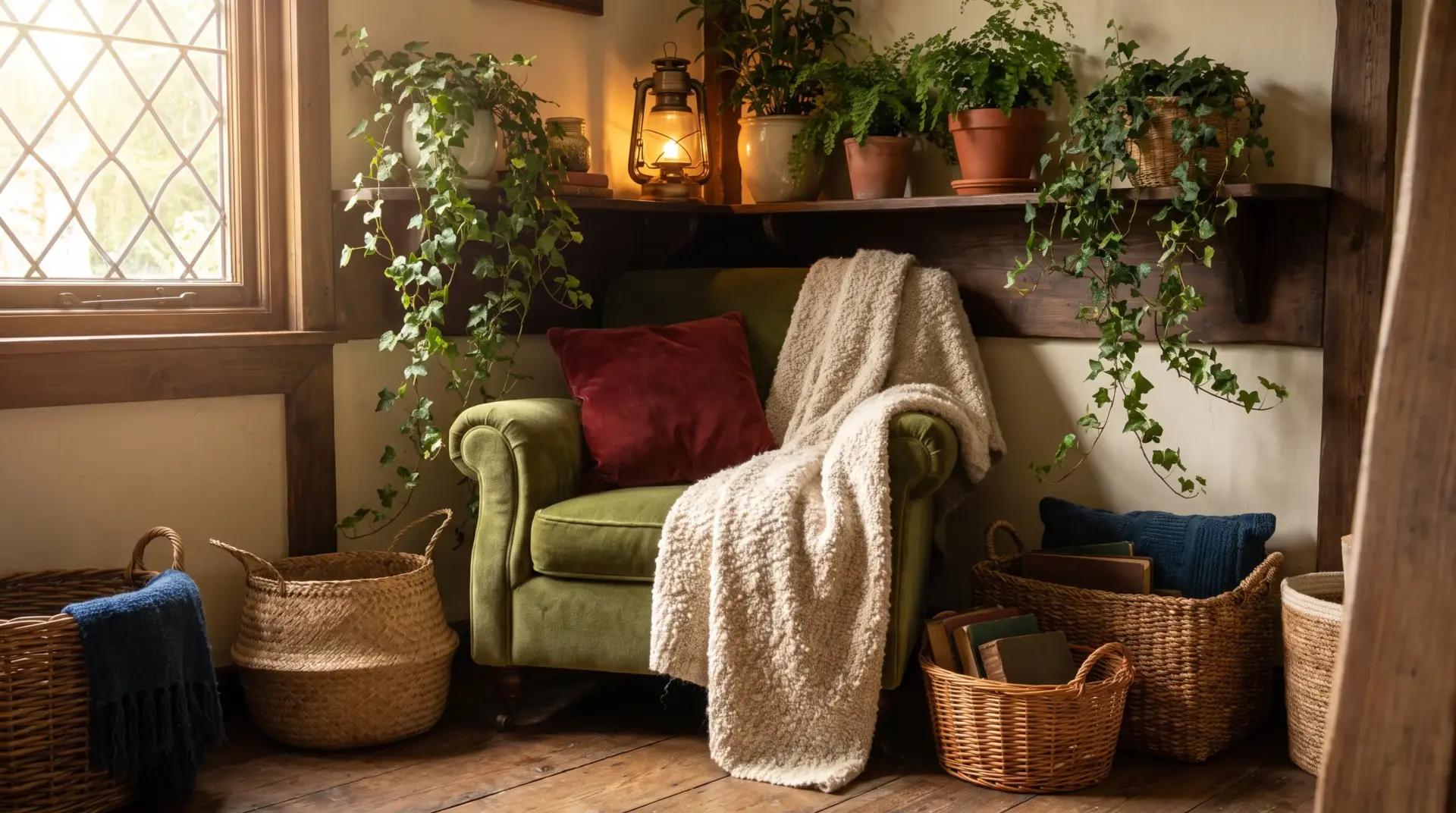

A woodland hideaway, a castle library, and a room at a school of magic each suggest a different place to read. The woodland room feels sheltered and informal. The library holds old maps and family histories. The school room looks as though someone has just left a lesson unfinished.
You can borrow one of those settings for a fantasy reading nook at home. Concentrate the details around a single seat and the shelf beside it. Even in a shared bedroom or living room, that small area can have a character of its own.
Find Room for a Seat and an Open Book
Choose a spot where you can sit comfortably and reach a reading light. Leave room to open nearby doors and walk past the seat with someone sitting in it. If a separate chair won’t fit, use one end of the sofa. A tray designed to fit securely over its arm can hold a mug without taking up the floor space of a side table.
Read a chapter there before buying furniture. You’ll notice whether the television distracts you or your elbows need more support. Measure the space once you’ve found a position you like, including any room you need to stretch your legs. Then choose the setting that suits it.
A Woodland Refuge
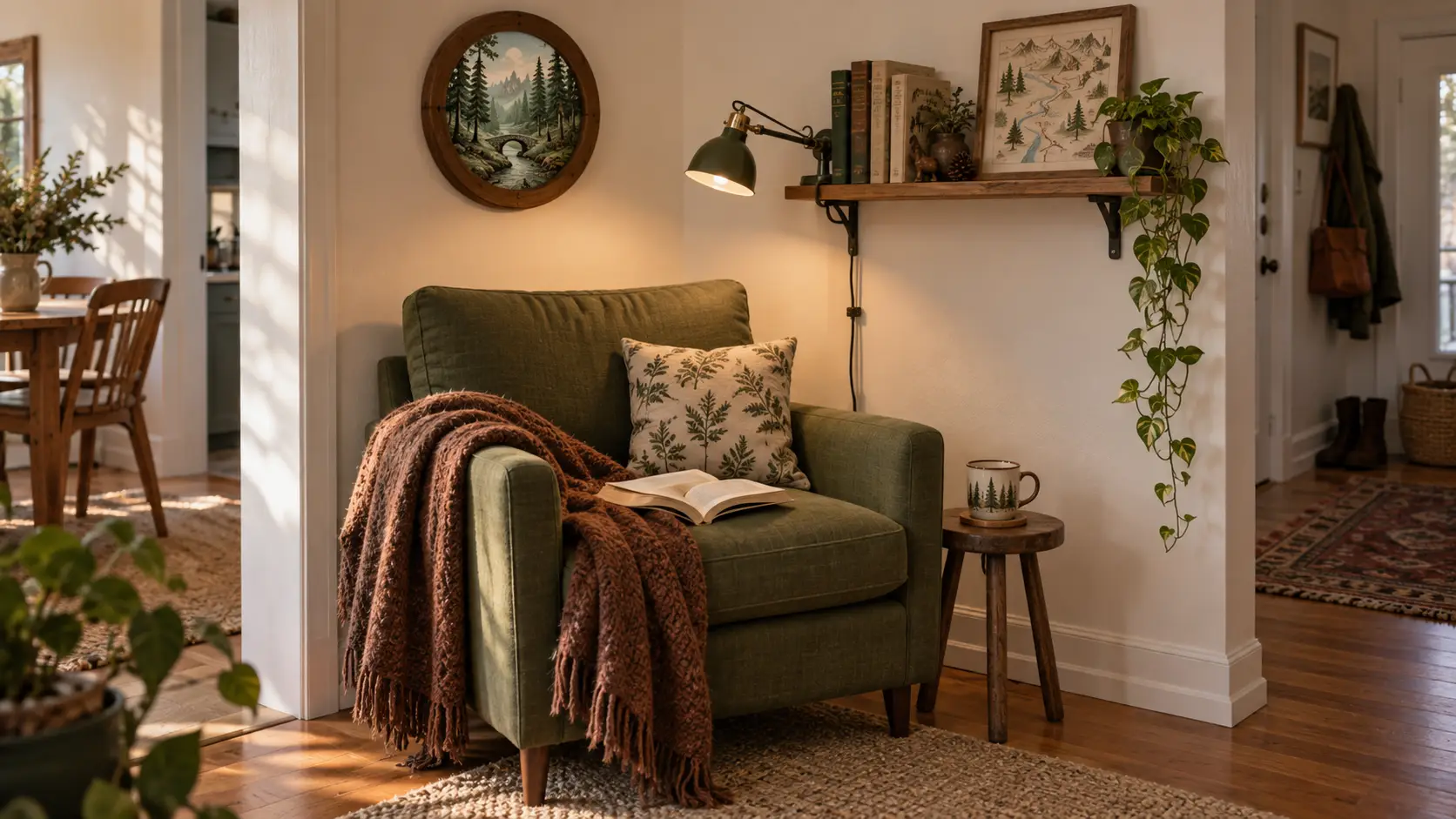
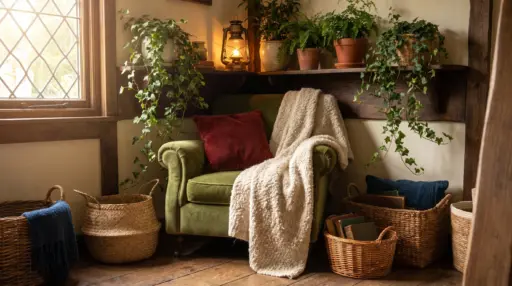
For a nook that feels tucked into a forest, start with moss green and warm brown, with cream to keep the corner from becoming too dark. Rough linen and woven baskets suit this setting. A nubby wool throw adds the sort of texture you might imagine in a traveler’s shelter.
Give the refuge a place in an imaginary world. Draw a trail map on cream paper, marking a river crossing and the inn where the journey ends. A few handwritten notes in the margins can make it look like something a traveler carried. Put it in a narrow wooden frame on the shelf beside your books.
If you love the comfortable homes of the Shire in The Hobbit, a small round frame can echo the shape of a hobbit-hole window. Fill it with a woodland picture. Hang it just above the chair, where it can suggest a view into the trees.
For a small reading nook, keep the forest details at eye level. A botanical drawing behind the chair uses less space than a large plant on the floor. If there is no room for a bookcase, a narrow wall shelf beside the seat can hold your current read and the framed map. Keep it clear of the space where you lean back or stand up.
An Old Castle Library
Choose a deep red or ink blue as the main accent, set against dark wood and parchment-colored paper. A velvet cushion gives a plain chair a richer texture. A woven throw with a border or faded floral pattern can suggest an old tapestry without needing a wall of its own.
Place the chair at a slight angle toward an existing bookcase, keeping the route past it open. From the seat, the books become the backdrop, giving the corner the feel of a private study inside a larger castle. Drape the patterned throw across the chair back so it is easy to pull around your shoulders.
Use one lower shelf for a lidded box that holds bookmarks and a spare blanket. Dark wood or a worn leather finish suits the library setting and keeps everyday clutter out of sight. Let the chair and bookcase do the work; a separate trunk or decorative chest would take up floor space you need for your feet.
Keep the richer colors on the cushion, throw, and storage box. Leaving the surrounding wall as it is gives the castle idea a clear boundary in a shared room.
A Room at a School of Magic
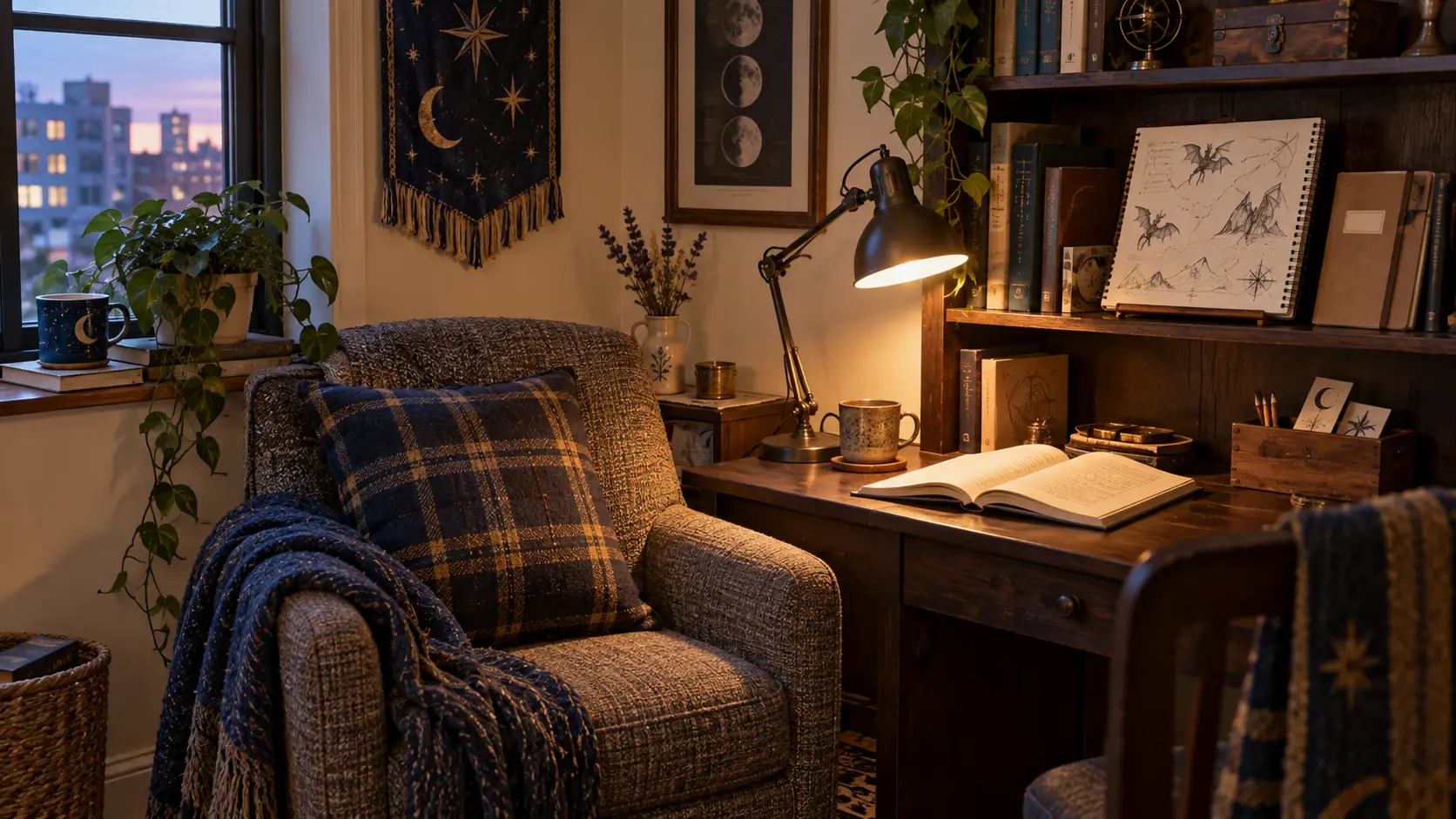
This setting works well beside an existing desk or a narrow bookcase. Try midnight blue with parchment cream and a little muted gold. Pinstriped or tweed fabric suggests a school uniform; a wooden pencil box adds the feeling of a student’s belongings.
Make a small piece of schoolwork the main decoration. A small notebook opened to your own notes on dragon migration is enough. Add a sketch and a few crossed-out observations, as though the lesson is still in progress. If you’d rather use the wall, frame a handwritten timetable with classes such as Herbology and Night Astronomy.
Keep the materials ordinary. Brown paper covers and handwritten labels can turn a pair of spare notebooks into imagined course books. Leave the books you actually read in their original covers so you can find them easily.
In a tight corner, place the notebook on a small stand at the back of the shelf. Use the pencil box for bookmarks. A plaid cushion on the reading chair can carry the school colors across to the seat, so the theme still feels connected if the desk is a few feet away.
Keep the Page Brighter Than the Scenery
A lantern-like glow suits the woodland refuge, while a battery candle fits the castle shelf. Those details set the mood, but the open book needs its own light. Use an adjustable lamp and aim it at the page from your seated position.
Move the lamp if your head casts a shadow or the bulb shines directly into your eyes. A shaded desk lamp can blend into the school setting. Where there is no room for a lamp base, use an adjustable clip-on reading light attached to a sturdy shelf edge. Check that it reaches the page and route its cord away from the walkway. Keep the switch within reach.
Choose Books That Belong in the Setting
Give the book that inspired the nook a visible place, then think about what you’d enjoy reading next. The setting can help you choose, but there is no need to match every spine to the room’s colors. Pick a book you want to open.
A castle-library nook might put you in the mood for court intrigue, while a woodland refuge suggests a journey beyond familiar paths. Keep that kind of story in mind as you explore Surprise Castle’s book collection, then check the format and dimensions of any edition you’re considering. A compact paperback can fit neatly on a narrow shelf and feel comfortable to hold while curled up in the chair; save a large illustrated edition for a spot where you can rest it on a table.
Keep that book easy to reach. Leave the maps and lesson notes behind it, and save the surface nearest your hand for an open book and a mug. Then settle in with the story that made you want this corner in the first place.

Ava Taylor, holding a Bachelor’s degree in Interior Design from the Pratt Institute, has made her mark in creating engaging and functional living spaces for over 14 years. She began her career with a New York-based design studio, where she gained a reputation for her innovative and user-centric designs. Ava joined our team in 2019, bringing a blend of artistic flair and practicality to our home improvement section. Since the she has been the lead contributor to our room transformation series, inspiring readers with her unique approach to maximizing space utility and aesthetic appeal. Beyond her professional work, Ava is a passionate collector of vintage furniture, a hobby that enriches her design perspective.