

Organizing a workshop or garage often leads to a common dilemma: choosing between pegboard and slatwall. While both are popular wall-mounted garage storage systems, neither is automatically the best choice for every space. The right option ultimately depends on six critical factors: the size and weight of the tools being stored, available wall space, budget constraints, garage moisture and temperature conditions, desired appearance, and how frequently the storage layout will change.
This article will not simply list generic pros and cons. Instead, it will compare the two systems using practical ownership factors, helping you turn your garage into a functional workspace. By evaluating structural mechanics, weight loads, and environmental vulnerabilities upfront, you will be better equipped to select a wall storage system that aligns with how you actually use your tools.
Pegboard vs Slatwall at a Glance: Fast-Track Comparison
Before diving into the mechanical details, this fast-track comparison outlines the baseline differences between the two panel systems. Generally, pegboard is well suited to dense hand-tool organization and workbench areas. Conversely, slatwall commonly performs better for larger accessories, baskets, shelves, and mixed garage equipment.
| Category | Pegboard | Slatwall |
|---|---|---|
| Best use | Dense hand-tool organization | Mixed, large-item storage |
| Common panel materials | Hardboard, plastic, metal, steel | MDF, PVC, metal |
| Relative initial cost | Low to medium | Medium to high |
| Types of tools supported | Wrenches, pliers, and small accessories | Bikes, garden equipment, and large storage accessories |
| Accessory variety | Standard hooks, holders, and small bins | Large baskets, brackets, and shelves |
| Installation requirements | Rear clearance usually required | Secure stud or suitable backing attachment |
| Moisture resistance | Varies; metal and plastic generally perform best | Varies; PVC is highly moisture-resistant |
| Ease of reconfiguration | High | High, depending on the accessory system |
| Appearance | Visible, utilitarian workshop grid | Continuous, finished horizontal lines |
| Overall suitability | Workbenches and precise layouts | Bulky or frequently changing layouts |
The Mechanics of Storage: How Pegboard and Slatwall Systems Work
Understanding how each system holds tools helps ensure you select an appropriate foundation for your storage needs.
How Pegboard Holds Tools
Pegboard relies on a repeated grid of holes that accepts hooks, brackets, holders, shelves, and bins. Common panel materials include traditional hardboard, moisture-resistant plastic, and heavy-duty metal or steel.
Many conventional pegboards use holes spaced one inch apart and accept standard pegboard hooks, although hole diameter, slot design, and accessory compatibility vary between systems.
Traditional pegboard normally requires clearance behind the panel so that hooks can pass through and engage properly. This is commonly created with furring strips or spacers, although some metal systems include an integrated mounting flange.
The grid design allows tools to be arranged closely together, creating dense and highly visible layouts. However, panel strength and durability vary considerably depending on the material, thickness, accessories, and installation method.
How Slatwall Holds Tools
Slatwall functions through horizontal channels or grooves that accept hooks, shelves, large baskets, brackets, and specialty holders. Panels are typically constructed from dense MDF, moisture-resistant PVC, metal, or reinforced composite materials.
Because the channels run horizontally, compatible accessories can usually be repositioned along the wall more easily than fixed shelving. However, locking accessories may need to be released or removed before they can be moved.
This flexibility is one reason slatwall is commonly used for larger or mixed storage needs. When evaluating attachments, users should also check for proprietary accessory systems, as some brands use unique channel designs that restrict cross-compatibility.
Precision Organization: When Pegboard Is the Better Choice
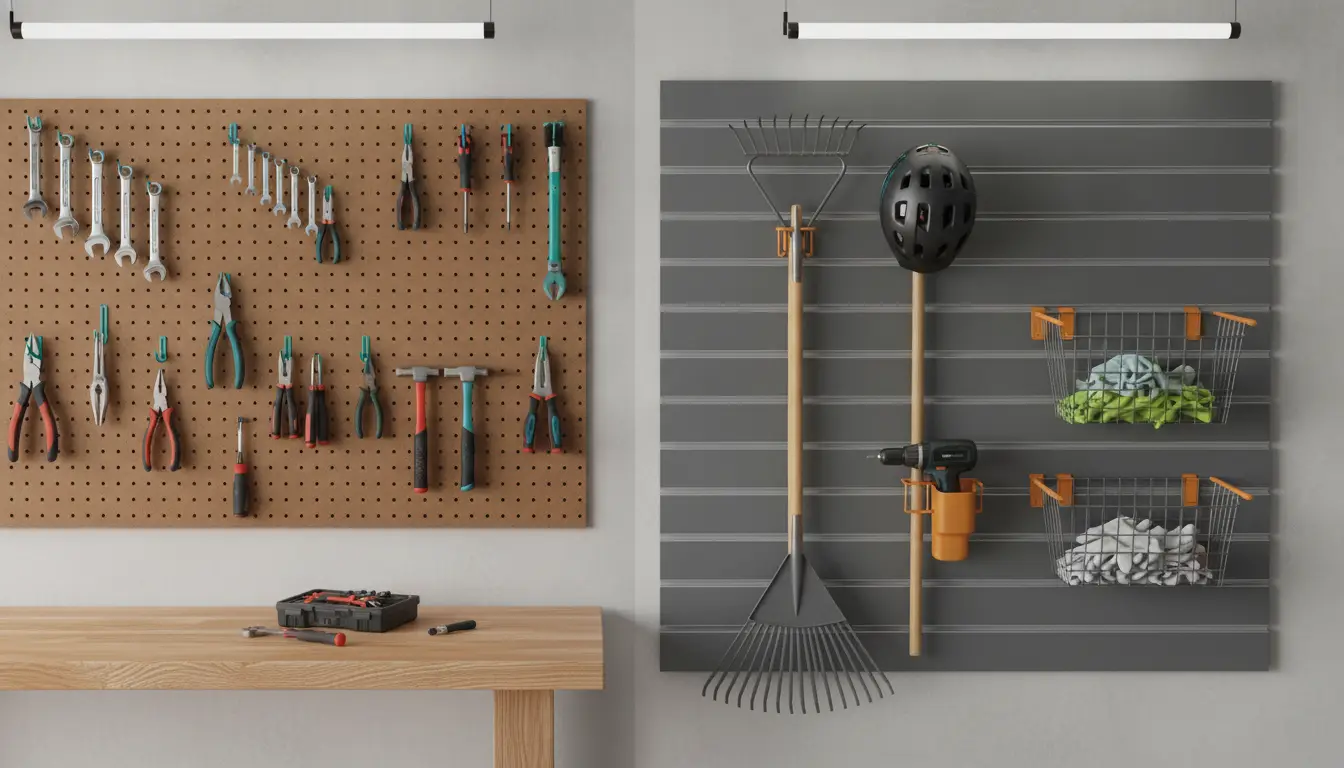
Pegboard is usually the better choice when a garage owner wants visible, compact, and highly accessible storage for hand tools. This system excels at organizing smaller items that benefit from a specific layout, such as wrenches, pliers, screwdrivers, hammers, measuring tools, precision instruments, frequently used workshop accessories, and small storage bins.
Pegboard works particularly well when mounted above a workbench because it allows closely grouped tools to remain visible and immediately within reach. This can reduce unnecessary movement when switching between tasks.
When outfitting an active workshop area, the selected material will influence the system’s durability. For garages centered on hand tools, measuring equipment, and frequently used accessories, a durable metal pegboard can provide a practical middle ground between basic hardboard and a full slatwall installation.
Metal and steel panels generally offer greater resistance to bending and everyday workshop wear, while compatible hooks, brackets, holders, and bins make it possible to create a dense, visible layout above a workbench.
The panel material, mounting method, fasteners, and accessories should always be matched to the weight of the tools being stored.
Mixed Utility: When Slatwall Is the Better Choice

Slatwall is often better suited to garages containing a wide range of large, awkward, and small items. Compatible horizontal tracks can support brackets, baskets, shelves, and specialty holders when the panel and hardware are installed within their rated capacities.
This makes slatwall useful for organizing garden equipment, sports gear, larger power-tool accessories, storage bins, and seasonal items that are not used regularly. Its horizontal channels also support flexible layouts that can be adjusted as storage needs change.
When applied across a large garage wall, slatwall can provide a continuous, finished, and built-in appearance that helps conceal underlying wall framing.
However, material selection strongly affects longevity. PVC slatwall is commonly used in damp or unconditioned garages because it resists moisture and is generally easy to clean. MDF products may be more affordable but require greater care around moisture because prolonged dampness can damage unsealed material.
The strength and durability of slatwall systems also vary significantly. Panel construction, reinforcement inserts, mounting methods, accessory design, and manufacturer ratings should all be considered before heavier items are installed.
The Head-to-Head Comparison: Cost, Load, and Installation
Total Installed Cost
Compare the cost of the complete installed system rather than panel prices alone. A full evaluation should include wall panels, hooks and holders, shelves and baskets, furring strips or backing, mounting hardware, edge trim, labor, and future accessories.
Basic pegboard installations are typically less expensive, while large slatwall systems often involve higher panel, accessory, and installation costs.
Tool Weight and Load Distribution
Neither system has one universal weight limit. Capacity depends on panel material, panel thickness, hook or bracket design, fastener type, stud placement, installation quality, load distribution, and manufacturer ratings.
Small hand tools can be stored on several types of pegboard, while heavier items may require metal panels, reinforced accessories, slatwall, robust shelving, or hardware mounted directly into wall framing.
Always follow the rated capacity of the complete system rather than relying on broad online claims about how much weight pegboard or slatwall can support.
Accessory Selection and Compatibility
Pegboard accessories include standard hooks, double-prong hooks, tool holders, small shelves, bins, and locking accessories. Locking or secured hooks can help prevent accessories from lifting out when a tool is removed.
Slatwall systems may support hooks, large baskets, shelves, brackets, and specialized holders. However, some slatwall accessories are proprietary and may not be interchangeable between manufacturers.
Before choosing a system, consider whether replacement hooks and accessories will remain easy to purchase in the future.
Installation Difficulty
Pegboard must normally be installed with sufficient space behind the panel so that hooks can pass through the holes. This may require furring strips, framing, stud attachment, wall anchors, and careful panel alignment. Some metal systems include built-in flanges that provide the necessary clearance.
Slatwall installation usually requires accurate panel alignment, secure attachment to studs or suitable backing, level horizontal channels, edge finishing, and careful planning around outlets and corners.
Installation difficulty will depend on the wall size, panel material, manufacturer requirements, and the condition of the existing wall.
Durability in Humid or Unheated Garages
The garage environment should influence material selection. Traditional hardboard pegboard may absorb moisture if it is unsealed. Metal pegboard does not swell but should have a protective finish that resists corrosion. Plastic pegboard is generally moisture-resistant.
MDF slatwall may also be vulnerable to prolonged moisture exposure, while PVC slatwall is commonly selected for damp environments. Metal or reinforced slatwall systems can offer greater durability but should still be maintained according to the manufacturer’s recommendations.
Strategic Integration: Using Pegboard and Slatwall Together
A hybrid storage layout often works better than forcing one system throughout the entire garage. Combining different storage methods allows you to use each system where it performs best while controlling overall costs.
Consider this practical arrangement:
- Install pegboard directly above the main workbench for hand tools and measuring equipment.
- Use slatwall on a larger open wall for baskets, garden tools, sports equipment, and seasonal storage.
- Use structured shelving for standard containers, consumables, and heavy bins.
- Use framing-mounted rails or manufacturer-approved brackets for bikes, large ladders, and unusually heavy equipment.
Dividing the garage into functional zones reduces clutter, keeps related tools together, and prevents you from paying for premium wall storage in areas where it is not needed.
Safety First: When Neither Panel Is the Right Choice
There are situations where neither pegboard nor slatwall is the most appropriate solution. General-purpose wall panels should not be used for equipment that exceeds the rated capacity of the panel, accessories, fasteners, or supporting wall structure.
Examples may include oversized storage totes, heavy machinery components, bulk materials, or objects that project far from the wall and create excessive leverage or shear force on the mounting system.
Bikes, ladders, and similar equipment may be suitable for wall storage when they are supported by manufacturer-approved mounts installed within the complete system’s rated capacity.
Suitable alternatives for exceptionally heavy or awkward items include:
- Stud-mounted rails
- Heavy-duty shelving
- Bolted enclosed cabinets
- Secure ceiling racks
- Structured freestanding storage
- Manufacturer-approved specialty mounts
The panel, accessories, fasteners, and supporting wall structure must all be suitable for the anticipated load. Always follow the manufacturer’s installation instructions and rated capacities for the complete system.
Final Decision: Which Garage Storage System Should You Choose?
To decide on the right system, evaluate your core storage needs.
Choose pegboard when:
- The primary goal is organizing hand tools.
- The system will be installed above a workbench.
- Dense tool placement is important.
- The budget is limited.
- Widely available hooks and holders are preferred.
- You want a highly visible layout for frequently used tools.
Consider metal pegboard if you prefer the pegboard format but need greater durability than basic hardboard provides.
Choose slatwall when:
- The garage contains mixed-size equipment.
- Larger shelves and baskets are required.
- The layout will change frequently.
- A continuous, finished appearance is important.
- You are prepared for a higher overall system cost.
Choose a hybrid system when different garage zones serve different purposes. The best storage system is one that safely supports your actual tools, suits the garage environment, and can be expanded without requiring a complete replacement later.

Holding a Master’s in Architecture from the University of Texas at Austin, Emily Rodriguez has dedicated more than two decades to the art and science of building renovation. Starting her journey in historic preservation, she developed a profound respect for blending old with new in building design. Emily became a vital part of our team in 2019, renowned for her insightful and innovative renovation tips. She has been leading our DIY home improvement series since ever since, where she shares her wealth of knowledge in turning outdated spaces into modern havens. When not engaged in writing or consulting, Emily is a passionate advocate for heritage conservation and enjoys exploring vintage architecture, a hobby that complements her professional expertise.