
Ask any cabinet installer about callbacks and the same short list comes back. Doors that will not sit flush. A reveal that was even at handover and is not even now. A center panel that has developed a hairline of unfinished wood along one edge. A door that closes fine in February and rubs in July.
Almost none of these are hinge problems, and only a small fraction are manufacturing defects. Most are moisture problems, and the point at which they became inevitable was usually well before anyone picked up a screwdriver.
Wood Does Not Stop Moving When It Leaves the Shop
The underlying behavior is not controversial and it is well documented. Wood is hygroscopic, meaning it exchanges moisture with the surrounding air until it reaches equilibrium with the ambient relative humidity. Below the fiber saturation point it shrinks as it loses moisture and swells as it gains it, and uneven movement is what produces warp, cup, and checking.
The USDA Forest Products Laboratory’s Wood Handbook chapter on drying and control of moisture content and dimensional changes is the standard reference on this. Its central point is worth repeating on every job: correct drying, handling, and storage minimize the moisture content changes that occur once wood is in service, and where moisture content is kept within reasonable limits, major dimensional problems can usually be avoided.
The word doing the work there is handling. Kiln-dried stock that is stored badly for three weeks is no longer kiln-dried stock in any meaningful sense.
The Number Nobody Checks
Interior equilibrium moisture content in the United States is not a single figure. It varies by region and by season, running from roughly 6% in the desert Southwest to around 11% along the Gulf Coast, and the Wood Handbook publishes recommended average moisture content values for interior wood products by area.
That range is the source of a great deal of avoidable trouble. A door manufactured and conditioned for one climate, installed in another without acclimation, will move until it reaches the new equilibrium. Wood placed in a new environment typically takes several weeks to get there, and during that period moisture gradients exist through the thickness of the material.
A moisture meter costs less than a single callback. Very few installers own one.
Why Five-Piece and MDF Doors Behave Differently
The construction determines the failure mode, and specifying without understanding that is how the wrong product ends up in the wrong room.
A five-piece hardwood door is a frame with a floating center panel, and the panel floats precisely because it must be free to expand and contract across its width. Restrain it with glue or an overtight finish and the movement has nowhere to go, which is when joints open or the panel splits.
MDF behaves differently. It has no grain direction, so it does not move seasonally the way solid wood does, which is why it is the standard substrate for painted work where a flawless surface matters. Its weakness is water rather than humidity: sustained wetting causes swelling that does not reverse. That is a real consideration around sinks and dishwashers.
Neither is better. They fail differently, and the specification should reflect the room.
Storage on Site Is Where Most Damage Happens
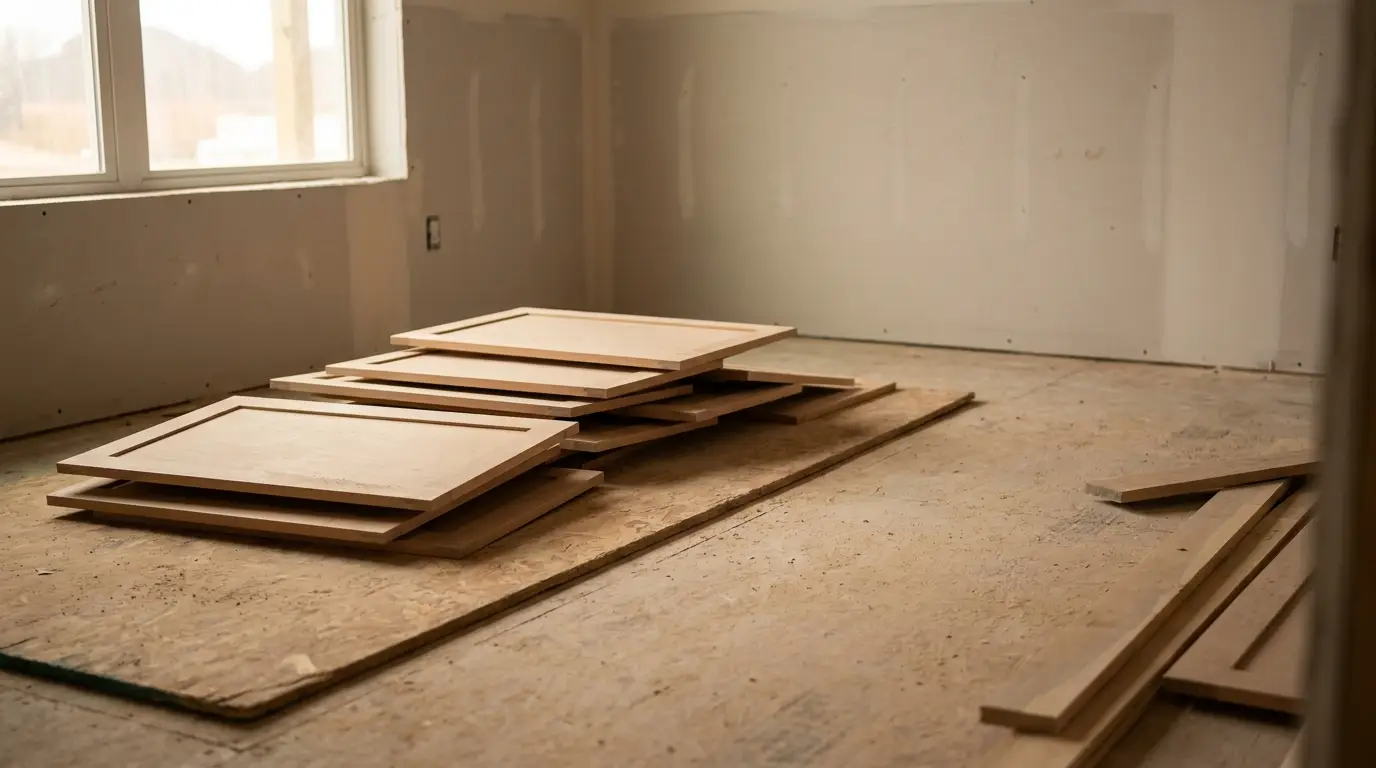
The gap between delivery and installation is the least controlled part of the entire process and the most common origin of a warped door.
Manufacturers are consistent about this. Eagle Woodworking’s own guidance is to keep doors flat in a climate-controlled space and to avoid garages, basements, or anywhere subject to high humidity or temperature swings. Stacking flat matters as much as the location, because doors leaned against a wall for a fortnight take a set.
On a job where the HVAC is not yet running and the drywall mud is still drying, the interior is a humid environment. Delivering finished doors into that is asking them to absorb moisture they will later give back, and the giving back is what the client sees.
Specifying Correctly Is Half the Job
The other half of the problem is upstream, in how the order is placed.
Trade suppliers producing cabinet doors made for professional installations generally publish their manufacturing tolerances rather than leaving them to be discovered. Eagle Woodworking, for instance, states that it manufactures to the nearest 1/16 inch with an allowable tolerance of ±1/32 inch, sets a maximum door dimension of 95 inches, and publishes a separate specifications guide covering permissible bow, warp, and twist.
Those published figures are the useful part. A supplier who tells you their tolerance before you order is a supplier you can plan a reveal around. One who has no published figure is one whose doors you will be fitting to whatever arrives.
Tolerance Is Not the Same as Defect
This distinction causes more disputes than any other in the trade, and it is worth understanding before a claim is made.
Every manufactured wood product has an allowable range for bow, warp, and twist. A door that sits inside that published range is a conforming product, even if it needs adjustment at the hinge to hang correctly. A door outside the range is a defect and should be replaced.
Measuring properly means laying the door on a known flat surface and measuring the deviation, not eyeballing it against a cabinet that may itself be out of square. Half the doors returned as warped are actually being fitted to a carcass that is not plumb.
The Jobs Where This Goes Wrong Most
Three situations account for a disproportionate share of problems.
New construction, where doors arrive before the building has dried out and before mechanical systems are running.
Seasonal-use properties, where the interior swings through an unconditioned winter or summer and then back again. Doors specified for year-round conditioned space will move in a house that is shut down for four months.
And rapid remodels, where the schedule leaves no time for acclimation because the doors arrive on a Thursday and the client is back on Monday.
A Short Pre-Installation Checklist
Confirm the space is conditioned and has been for long enough to stabilize. Store doors flat, indoors, away from exterior walls and heat sources. Allow acclimation time in the space where they will live rather than in a truck or a garage.
Check the carcass is plumb and square before blaming the door. Measure any suspected warp against the supplier’s published tolerance rather than by eye. And where a room is genuinely wet, specify for it at order stage rather than hoping.
None of this is complicated. It is simply the part of the job that happens before the interesting part, which is why it gets skipped, and why the callback arrives six months later.

Holding a Master’s in Architecture from the University of Texas at Austin, Emily Rodriguez has dedicated more than two decades to the art and science of building renovation. Starting her journey in historic preservation, she developed a profound respect for blending old with new in building design. Emily became a vital part of our team in 2019, renowned for her insightful and innovative renovation tips. She has been leading our DIY home improvement series since ever since, where she shares her wealth of knowledge in turning outdated spaces into modern havens. When not engaged in writing or consulting, Emily is a passionate advocate for heritage conservation and enjoys exploring vintage architecture, a hobby that complements her professional expertise.