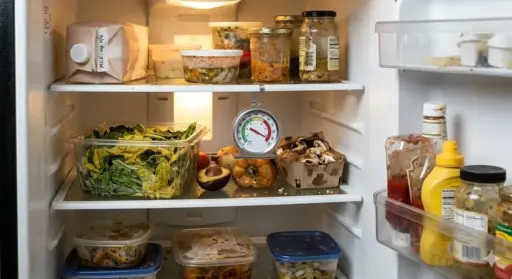

Your refrigerator rarely dies overnight. For weeks before it quits, it drops hints — a little warmer than it should be, a new rattle, a puddle that keeps coming back. Miss them and you’re looking at spoiled groceries and a dead compressor, which often costs more than the fridge is worth. Catch them early, and most are a cheap, simple fix.
The trick is knowing what each sign is telling you. Here are the 10 worth watching, what each usually means, and which you can check yourself before calling a pro.
1. Your Food Is Spoiling Faster Than It Should
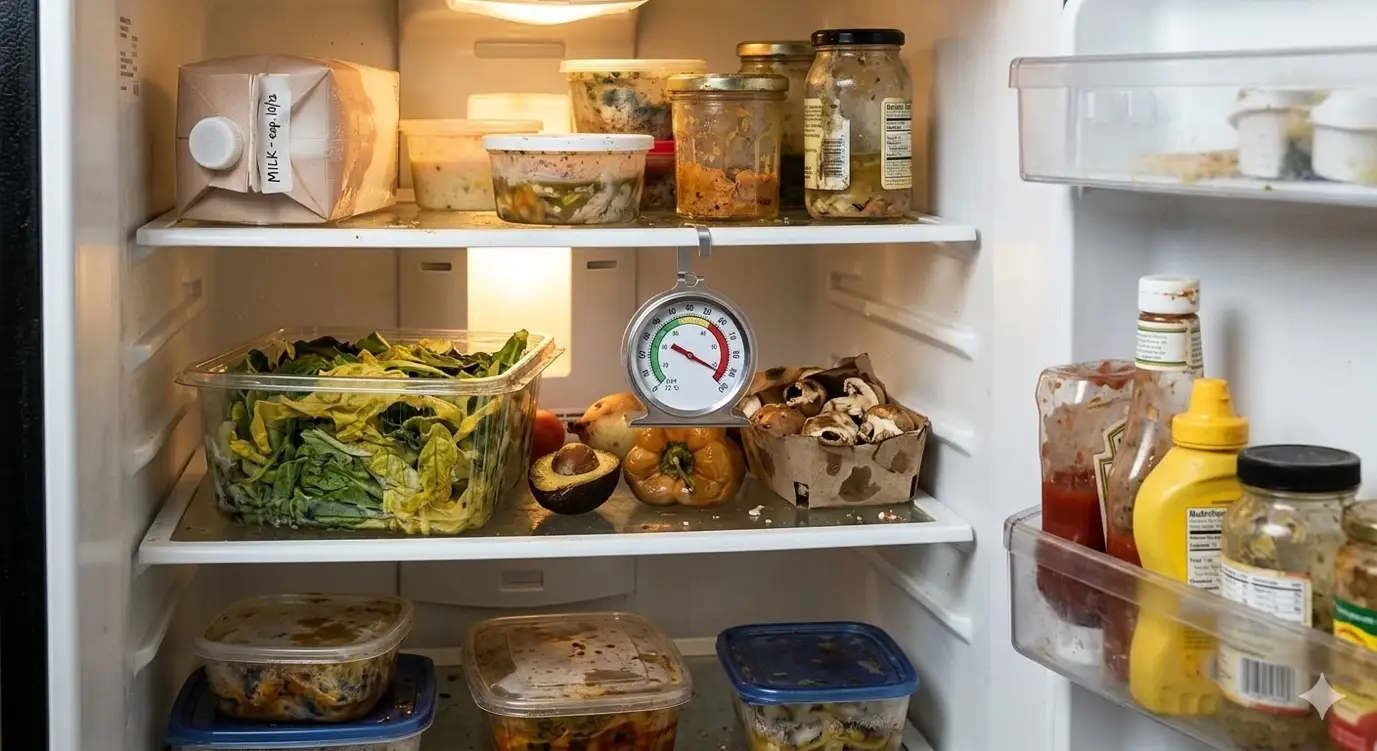
Take this one seriously first, because every other problem here eventually feeds into it: the fridge isn’t holding a steady temperature. Milk turns early, leftovers go off, produce wilts fast. One spoiled item is bad luck; a pattern means the cooling system is struggling.
Don’t trust the number on the door — many fridges show the temperature you set, not the one the box is actually holding. Put a standalone thermometer on a middle shelf for a few hours. The fresh-food section should sit at or below 40°F. If it reads warmer even on the coldest setting, that’s a food-safety problem and a trigger to investigate. The way it’s failing — warm everywhere, or warm only in the fridge (sign #4), or running nonstop (sign #2) — tells you which part is to blame.
2. The Fridge Runs Constantly and Never Shuts Off
A healthy fridge cycles: the compressor runs to temperature, then rests. You know your fridge’s rhythm — that hum that comes and goes. When it stops resting and just stays on, it’s working harder than it should to hold a temperature it used to manage easily.
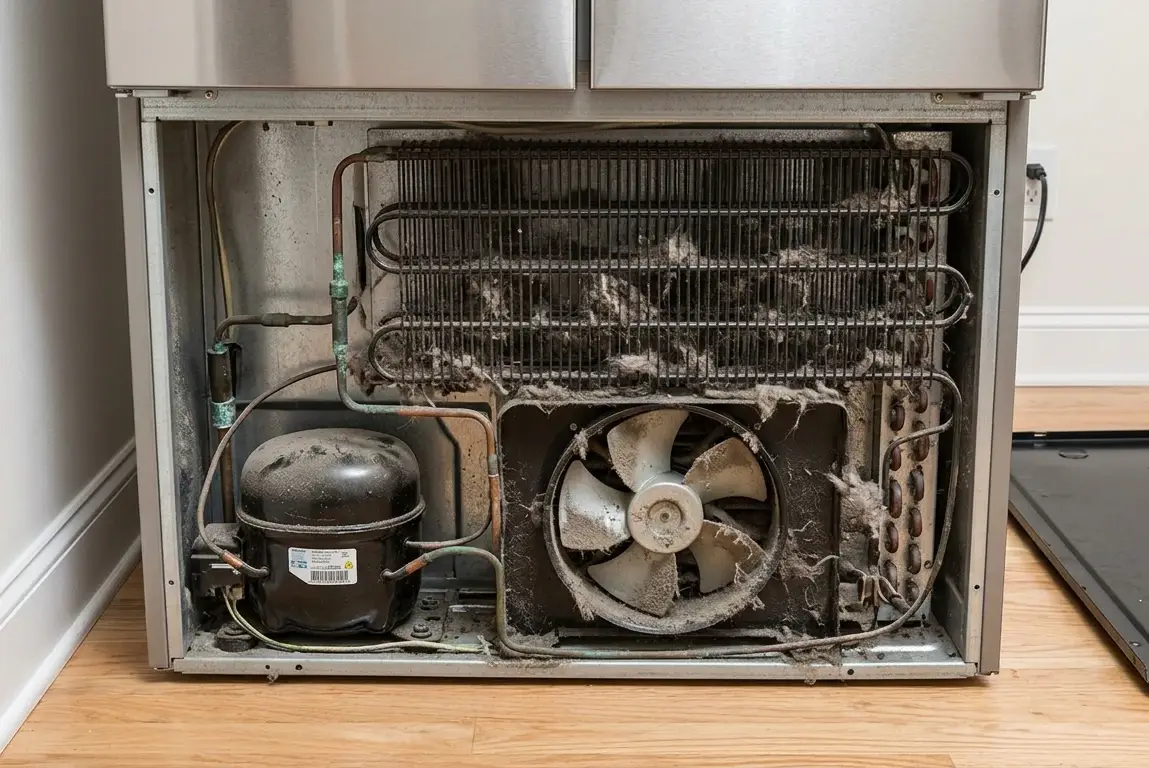
The most common cause is also the cheapest: dirty condenser coils. Underneath or behind the fridge, caked in dust, they can’t shed heat, so the compressor never stops. Unplug the unit, find the coils, and vacuum them — a ten-minute job worth doing twice a year. If it still runs nonstop, the cause climbs: a failing fan, a struggling compressor, a defrost fault, or a slow refrigerant leak, all technician territory. This matters because every extra hour of runtime wears the compressor, the most expensive part in the appliance. Left alone, “runs all the time” becomes “doesn’t run at all.”
3. The Back or Sides Feel Hot to the Touch
Some warmth is normal — a fridge moves heat out of the box, and many run warm refrigerant through the side walls on purpose to stop condensation. A panel that’s genuinely hot to hold is not.
It points to the same place as the last sign: the condenser. Clogged coils or a failed condenser fan leave heat nowhere to go, so it backs up into the cabinet. Start as you did with sign #2 — clean the coils and check that the fan behind the lower back panel spins. If the coils are clean, the fan turns, and it’s still hot, the trail leads into the sealed refrigerant system — a specialist repair, and an expensive one. Hot panels and nonstop running are often two readings of the same problem, and the part at its center is the costly one.
4. The Fridge Is Warm but the Freezer Is Fine
This feels contradictory — ice cream firm, fridge lukewarm — but the split is the clue, and it moves off the compressor onto airflow. In most fridges there’s only one source of cold: the freezer. Cold air is made there and shared with the fridge through a vent, pushed by a fan and metered by a flap called a damper. So when the freezer’s fine but the fridge is warm, the cold is being made — it just isn’t getting where it needs to go.
Three usual suspects: a failed evaporator fan, a stuck damper, or frost building over the vents and blocking the path (which ties into sign #6). Try this: empty the unit, unplug it, and leave the doors open for 24 hours. If it cools normally afterward, frost was the culprit and you’ve bought time; if it warms right back up, it’s the fan or damper — a technician’s job, but a defined, repairable one. Catch it early, because a fridge that can’t hold temperature is a food-safety clock ticking.
5. You’re Hearing or Sudden Silence
Your fridge has a baseline hum, and that makes your ears a diagnostic tool. It’s never silent, but it shouldn’t develop a new voice. Different noises point to different parts:
- Grinding or scraping — worn compressor bearings, the expensive part; take it seriously.
- Buzzing or rattling — usually the condenser fan.
- Knocking, especially when the compressor stops — loose or failing internal parts.
- Repeated clicking — the start relay failing to kick the compressor on.
Locating the sound — lower back (compressor, condenser fan) versus inside the freezer (evaporator fan) — helps a technician and shortens the visit; a buzzing fan or loose panel is often a cheap, first-visit fix. The opposite problem is the worse one: total silence. If the fridge has gone quiet and stays quiet, the compressor may not be starting — and paired with a slowly warming box (sign #1), that’s the breakdown the other warnings were pointing at.
6. Frost or Ice Is Building Up in the Freezer
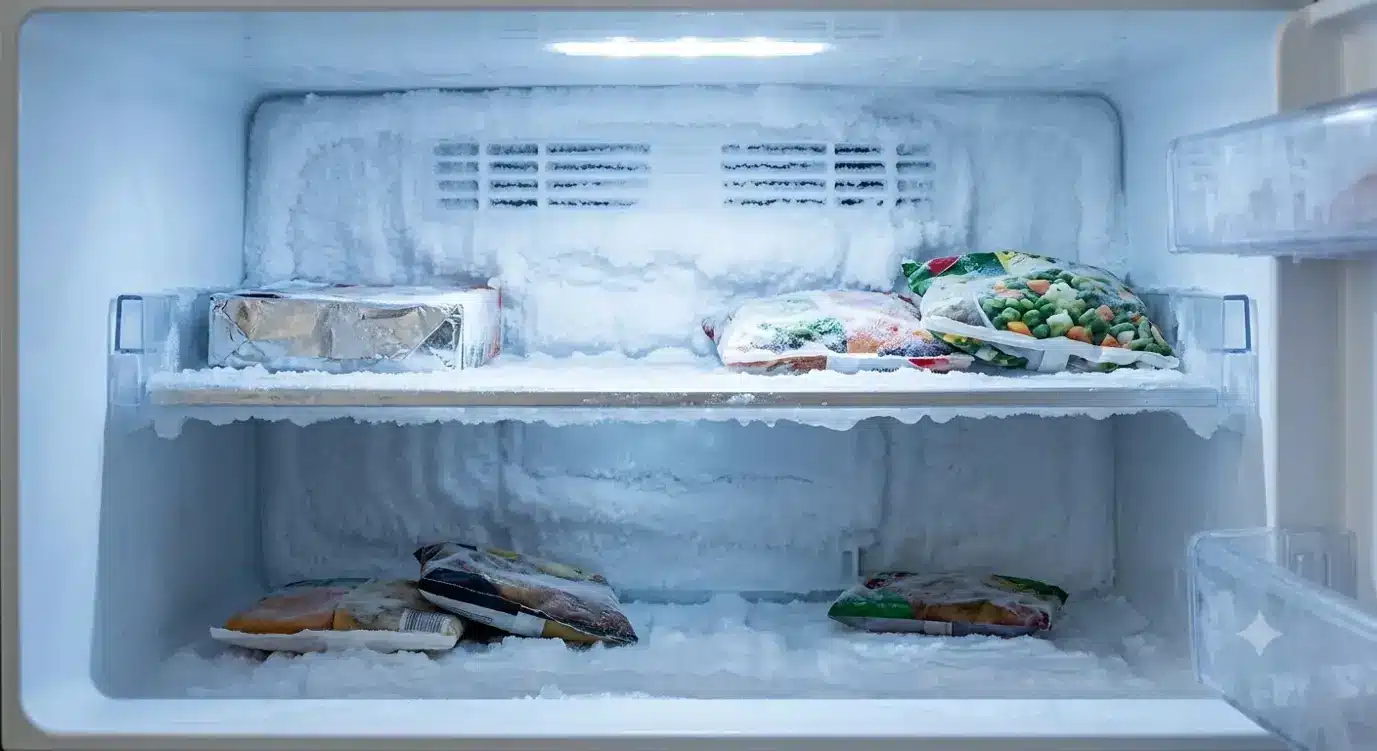
A little frost on a bag of peas is nothing. A wall disappearing under thickening ice — frost you chip at, frost creeping over the vents — is not. Frost-free freezers are designed not to do this, so when ice keeps coming back, the system meant to prevent it has failed.
Two usual causes. First, the door seal: a cracked or loose gasket lets warm, humid air in to freeze, again and again — a cheap, DIY-confirmable fix (the paper test in sign #7 works here). Second, the automatic defrost system — a heater, sensor, and timer that melt frost on a cycle; when one fails, ice just accumulates, and that’s a technician repair. Don’t keep scraping, because the ice builds over the evaporator coils and vents and chokes airflow — exactly how you get sign #4. Worse, heavy ice can damage the evaporator coils, turning a cheap gasket into a serious repair.
7. There’s Condensationdge
Damp interior walls, a film on the cabinet, or beads around the door frame look harmless, but moisture where it shouldn’t be means the box is no longer sealed against room air.
The usual cause is a ten-second check: the door gasket, the rubber seal that locks cold in and humid air out. When it hardens or warps, warm air leaks in and condenses. Close the door on a sheet of paper and pull — if it slides out with almost no resistance, the seal there is shot; walk it around the whole door. A new gasket is cheap and usually a DIY swap, and it fixes more than the sweating, since a leaking seal also makes the fridge work harder and feeds the frost in sign #6. The rarer, serious version: some fridges circulate warm refrigerant through the walls to prevent sweating, and if that stops — a compressor, refrigerant, or control fault — the walls sweat even with a perfect gasket. If the paper test passes and sweating continues, it’s time for a technician.
8. Water Is Pooling Inside or on the Floor
You usually notice this one by stepping in it: a puddle in front of the fridge, water under the crisper drawers, or a small pool inside that keeps returning. Unlike the film in sign #7, this is liquid water that’s supposed to be going somewhere and isn’t.
The most common culprit is the defrost drain. Frost meltwater (sign #6) runs through a small channel to a pan underneath, where it evaporates; when the drain clogs with ice or gunk, it backs up and spills. Often DIY-friendly: find the drain opening (usually the back of the freezer floor) and flush it with warm water to clear the ice plug. The other suspects you’ve met — a failing gasket (sign #7), or on units with an ice maker, a loose or cracked supply line behind the fridge. The tell for simple-versus-serious: if the puddle returns after you’ve cleared the drain, it’s a deeper fault for a technician. Don’t let it ride — standing water warps flooring, seeps under cabinets, and breeds mold, so even when the fridge is fine, your kitchen isn’t.
9. Food Is Freezing in the Fridge Section
This feels like a good problem — your fridge is too cold. Lettuce turns glassy, milk grows a skin of ice. But overcooling is as much a malfunction as undercooling, and it points to the controls that decide how cold the box should be.
The temperature control — a thermostat on older units, a sensor and board on newer ones — reads the temperature and tells the system when to stop. When it drifts or fails, the fridge never quits cooling and freezes the fresh-food section; a stuck-open damper (sign #4) can do it too. Check with a thermometer: near or under 32°F means it’s running too cold, and the control side is the likely cause. First rule out the simple stuff — a knocked dial, or food packed against the rear vents creating a cold spot. If settings are right and food still freezes, it’s thermostat, sensor, or damper territory. Don’t shrug it off: a control that’s lost track of temperature can swing the other way later, leaving food warm next month.
10. Your Energy Bill Is Climbing (or You Smell Something Chemical)
Two of the most telling signs don’t show up inside the box — they show up on your utility bill and in your nose. A fridge runs 24/7, so when it struggles, the cost shows first: fighting dirty coils, a failing fan, or a weak seal, it runs longer and draws far more power. If your bill has crept up with no other explanation, the fridge is a suspect — and the cause is often the same cheap one, coils that need cleaning (signs #2 and #3 are the visible version of this).
The smell is the one to take most seriously here. A faint chemical or slightly sweet odor — not spoiled food, something sharper — can mean a refrigerant leak. Refrigerant is sealed inside the system and shouldn’t be smellable at all; if you can smell it, it may be escaping. That needs a certified technician, promptly — because a slow leak doesn’t just hurt cooling, it destroys the compressor. As refrigerant drains away, the compressor runs hotter and harder until it burns out. That’s how a small, fixable leak becomes the single most expensive failure a fridge can have.
Don’t Wait
Look at all ten signs together and a pattern appears. Caught early, almost every one is cheap and often DIY: clean the coils, swap a gasket, flush a drain, replace a fan or a relay. What actually kills a fridge — the failure that tips it from repair to replace — is the sealed system and the compressor at its heart.
And the cheap signs and the fatal one aren’t separate; they’re a chain. Dirty coils make the compressor run hot. A leaking gasket makes it run longer. Ice from a bad defrost cycle chokes the airflow. A slow refrigerant leak burns it out. The expensive failure is usually built, step by step, from the cheap warnings that got ignored because the fridge still worked.
So the real takeaway is timing. One sign alone is usually a fixable problem. Two or more at once, especially on an older fridge, means the parts are aging out together — the moment for a professional look rather than wait-and-see. When the signs stack up, a technician who handles refrigerator repair can find what’s failing and fix it for a fraction of replacement cost, while it’s still a repair. Your fridge will warn you before it quits; the trick is to listen while the fix is still small — because the difference between a $20 gasket and a new refrigerator is usually just how long the warning went ignored.

Tommy Hardy, an alumnus of the Georgia Institute of Technology with a degree in Mechanical Engineering, has been a go-to figure in residential upkeep and innovation for over 18 years. His career commenced in a leading home appliance manufacturing company, where he mastered the intricacies of household systems. Joining our platform in 2020, Tommy quickly became a reader favorite for his practical and easy-to-follow guides. He took the helm of our DIY section in 2019, consistently delivering content that empowers homeowners. Beyond his professional pursuits, Tommy is a passionate gardener and enjoys woodworking, skills enhancing his hands-on approach to home care.