
Two winters ago I talked a family of five into painting their den the color of a cast iron skillet. The room faced north under an eight foot ceiling, and every instinct they had said dark walls would shrink it into a cave. Within a month it was the most used room in the house. The kids claimed the window corner for homework, and movie night stopped needing a calendar invite. Even the beige living room upstairs started to look like a waiting area.
That project taught me the order of operations for a moody den, because the color turns out to be the easy part. What decides whether the room works is everything you do after the paint dries, and one of those decisions involves a corner most design articles never mention: the place where the household paperwork goes to hide.
Start with a Color that Has Real Pigment in it
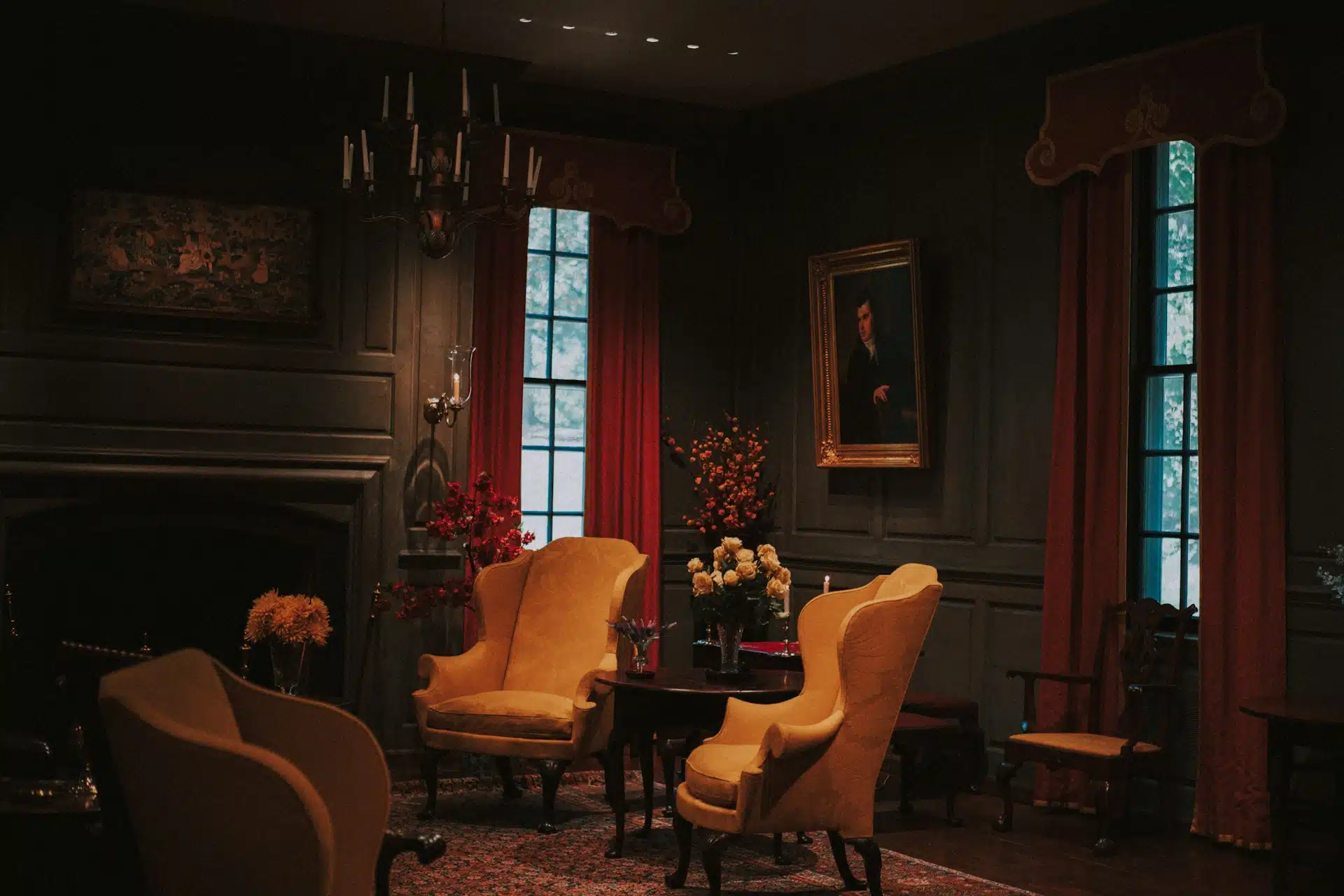
Peppercorn (SW 7674) is my first recommendation for a family den, and I say that as someone who has sampled most of the charcoal family on real walls. It reads as a soft black with the harshness sanded off, and its LRV of 10 tells you what you are signing up for: the walls will return about a tenth of the light that hits them.
In a den, that depth is the point, since a screen looks better against it and the scuff line at kid height vanishes into it. Dark walls also make eight o’clock feel like eight o’clock, which is most of what a den is for.
If charcoal seems severe for your crew, Pewter Green (SW 6208) does the same job in a warmer register. It is a deep, earthy green with an LRV of 12, and it grounds a room while staying a long way from black.
Whichever you pick, commit. Take the color onto the trim and the door as well. Bright white trim slices a dark room into outlined panels, while a fully drenched room lets its own edges dissolve.
Buy sample pots before the gallons and watch two painted squares through a full day; Peppercorn in particular can drift toward blue in cool northern light, and you want to meet that version of it before the whole room wears it. Stay with a matte or flat finish too, since dark paint in a higher sheen announces every roller mark and drywall ripple the minute a lamp comes on.
Lamps Carry a Dark Room
An LRV of 10 changes the math on lighting. In a white room, one ceiling fixture bounces enough light around to carry the space. Dark walls swallow that bounce, so a moody den needs its light delivered in layers, down close to where people sit.
I plan on a floor lamp behind the reading chair and a table lamp beside the sofa, plus something low on the shelves (a picture light works) to pull the back wall forward.
Put the overhead on a dimmer and keep every bulb warm, 2700K or lower. Cool bulbs turn charcoal walls gloomy in a way no paint decision can fix. Warm pools of lamplight against Peppercorn are what people are picturing when they say moody in the first place.
One Big Anchor Beats a Room Full of Small Furniture
Dark walls flatten small furniture into silhouettes. A pair of slim chairs and a loveseat that looked fine against beige will disappear against Peppercorn, and the room starts to feel like a stage set waiting for its props. The fix is a single piece with enough mass to hold the wall, sized close to what the room can take.
For a den that has to seat a whole family, that piece is usually a corner unit. The last den I finished got a cognac leather sectional in top-grain Italian Nappa, and the L shape earned every inch of its footprint: the long run faced the screen while the short leg caught the window light, and its kiln-dried alder wood frame should outlast the kids’ cushion-fort years.
Cognac against charcoal is my favorite pairing in this room, though the same piece comes in black for a tonal scheme and in chocolate when the rest of the palette runs brown.
Whatever anchors your den, keep leather on the shortlist. In a dark room, leather picks up lamplight the way fabric never does, so the biggest object in the room glows a little at night.
Where Does the Paperwork Go?
Every family den collects paper. School forms, tax envelopes, permission slips, the warranty for whatever just broke: it all migrates to the flattest surface in the most used room, and a moody den shows clutter the way a black car shows pollen. Give the paper no home of its own and the sofa arm becomes that home by default.
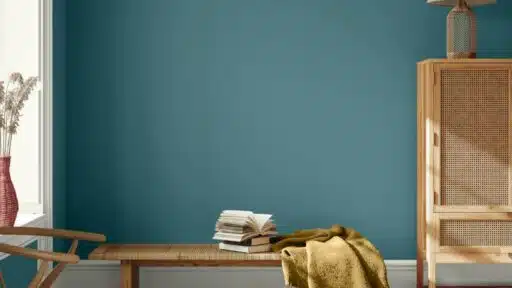
My answer is a working corner behind doors. A tall cabinet or an armoire painted the wall color all but disappears into a Peppercorn room, and inside it you can fit a pull-out shelf for the laptop with a file drawer underneath, a full home office compressed into four square feet. When the doors close, the den goes back to being a den, and nobody arriving for movie night would guess the mortgage lives in the corner.
Set the filing system up in one sitting, because a half-built system is the kind that fails. Label a folder for each category your household generates, and buy folders in bulk so you never ration them; a 50 or 100 count box costs less per folder than picking up a few at a time, and the spares mean next year’s categories get a labeled home the day they appear. After one order and an afternoon of labeling, the whole system lives behind a closed door.
Give it a Month Before You Judge Anything
Dark paint has seasons. Peppercorn under a low August evening sun is a different color from Peppercorn at gray February noon, and during the first week after painting, most people stand in the doorway wondering what they have done.
Hold off on any verdict until the lamps are in place and the furniture has arrived, because a moody den is a composition and no single layer of it looks right on its own.
The family with the north-facing den called me the following spring. They had repainted their bedroom in Pewter Green without asking me, which I chose to take as a compliment, and the cabinet doors in the den still close over the filing drawer every Friday before the movie starts.

Alex Guerrero, a graduate with a Fine Arts degree from the Rhode Island School of Design, has been a visionary in the world of color and design for over 15 years. His professional journey began in the heart of the fashion industry in Milan, where he developed an acute sense for color harmonies and trends. Alex joined our team in 2018, offering fresh and innovative perspectives on color utilization in various spaces. Renowned for his ability to blend contemporary trends with timeless elegance. Outside of work, Alex is an accomplished painter and a volunteer art therapist, his artistic talents further enriching his professional insights.