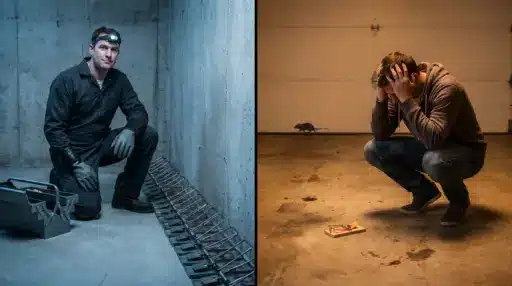
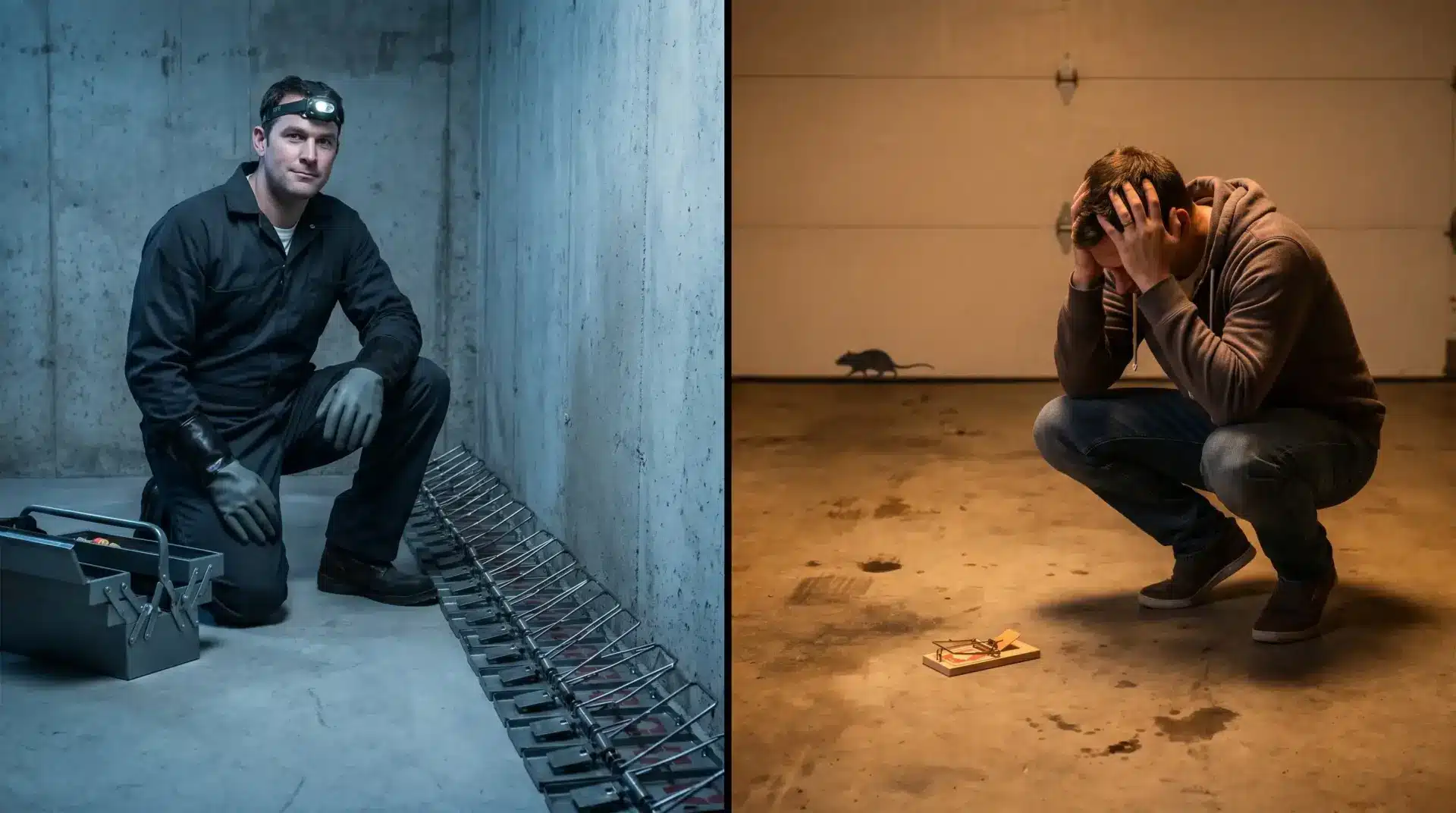

Professional pest controllers walk into the same rat problem a homeowner has been fighting for three months and eliminate it in two weeks. The difference is not the trap brand, it is the entire approach from the first day to the last.
| Approach | Homeowner Default | Industrial Standard | Result Difference |
|---|---|---|---|
| Trap numbers | One or two | Multiple per active run | Night and day catch rate |
| Placement | Guesswork | Mapped activity routes | Targeted vs random |
| Entry points | Rarely sealed | Sealed before trapping starts | Elimination vs management |
| Programme length | Until it feels resolved | Fixed assessment period | Complete vs partial |
| Monitoring | Occasional checks | Daily reset and review | Consistent vs inconsistent |
| Tools | Supermarket basics | Industrial-grade specific | Professional vs inadequate |
The Mindset Gap Between Homeowners and Industrial Pest Controllers
1. Why Homeowners Treat Rat Control as a Single Event
Most homeowners buy a trap when they see a rat. They place it, catch one, and consider the problem solved until the next sighting.
That cycle repeats for months, without the population ever being meaningfully reduced, because the approach treats each rat as an isolated incident rather than as evidence of an ongoing infestation.
An established rat population is not a single event. It is a living system with breeding cycles, territory patterns, and population dynamics that a single trap cannot address.
2. How That Difference in Approach Produces Completely Different Outcomes
Industrial pest controllers approach every job as a program, assessment, mapping, deployment, monitoring, exclusion, and review. Each phase informs the next.
The result is a structured elimination rather than a series of individual catches that never add up to a solution.
The homeowner catching one rat every two weeks with a single trap is not making progress. They are running a program too small to outpace reproduction, and the population is staying stable or growing while the trap keeps catching.
Why One Trap in One Location Never Works
1. The Mathematics of Rat Populations Versus Single Trap Catch Rates
A female rat produces litters of six to twelve pups every three weeks and reaches sexual maturity at five weeks. An infestation of ten rats, a modest estimate for an established problem, can become twenty-five within a month under favorable conditions.
A single trap catching one rat every week is not a solution. It is a minor inconvenience to a population with a reproduction rate that outpaces it comfortably.
Industrial controllers match trap numbers to estimated population size, not to the number of rats visibly sighted. Sightings represent a fraction of the actual population.
2. How Professional Controllers Think About Trap Density
The industrial standard is multiple traps per identified run, typically two to three snap traps spaced closely together along each active route.
On a job with three active runs and an estimated population of fifteen to twenty rats, that means eight to twelve traps deployed simultaneously from day one.
That density produces catch rates that visibly reduce the population within the first week. A single trap in the same situation produces one catch and leaves the rest of the population undisturbed.
How Industrial Controllers Map an Infestation Before Touching a Trap
1. The Assessment Process That Professional Programmes Start With
Before a single trap goes down, industrial controllers spend time mapping the infestation. Droppings are counted and located, with fresh droppings indicating active areas and old droppings indicating historical routes.
Grease smears along walls and skirting boards mark regular travel paths. Gnaw marks indicate feeding sites and entry points. Sound patterns at night indicate where activity is concentrated.
That assessment takes 24 to 48 hours and produces a map of where the population is living, feeding, and moving. Every trap placed after that assessment is placed with a specific reason, not a general hope.
2. Why Entry Point Identification Is the Foundation of Every Effective Programme
Finding where rats are entering the property is not the final step of a rat control program but one of the first. Trapping without knowing entry points means catching rats while new ones replace them through the same gaps. The population never drops below a threshold because the property is still open.
Roof vents are one of the most consistently overlooked entry points in residential properties. Rats access roof spaces through damaged or unprotected vents and establish harborage that is difficult to detect and harder to clear.
A roof vent cap for rodent protection fitted to every roof vent during the assessment phase closes one of the most common and most ignored access routes before the trapping program begins, which is exactly when it needs to happen.
The Volume and Placement Strategy That Produces 30 Catches
1. How Industrial Controllers Deploy Traps in Numbers That Match the Population
The 30-catch result that professional controllers achieve on larger jobs is not luck or superior equipment. It is volume and placement working together.
Thirty traps on thirty mapped positions produce thirty catches. One trap in one guessed position produces one catch if the placement is right and the rat has not already learned to avoid it.
Industrial programs scale trap numbers to the evidence. More droppings, more grease trails, and more gnaw sites mean more traps. The deployment is proportional to the problem rather than to how many traps the homeowner felt comfortable buying.
2. The Placement Rules That Industrial Programmes Follow
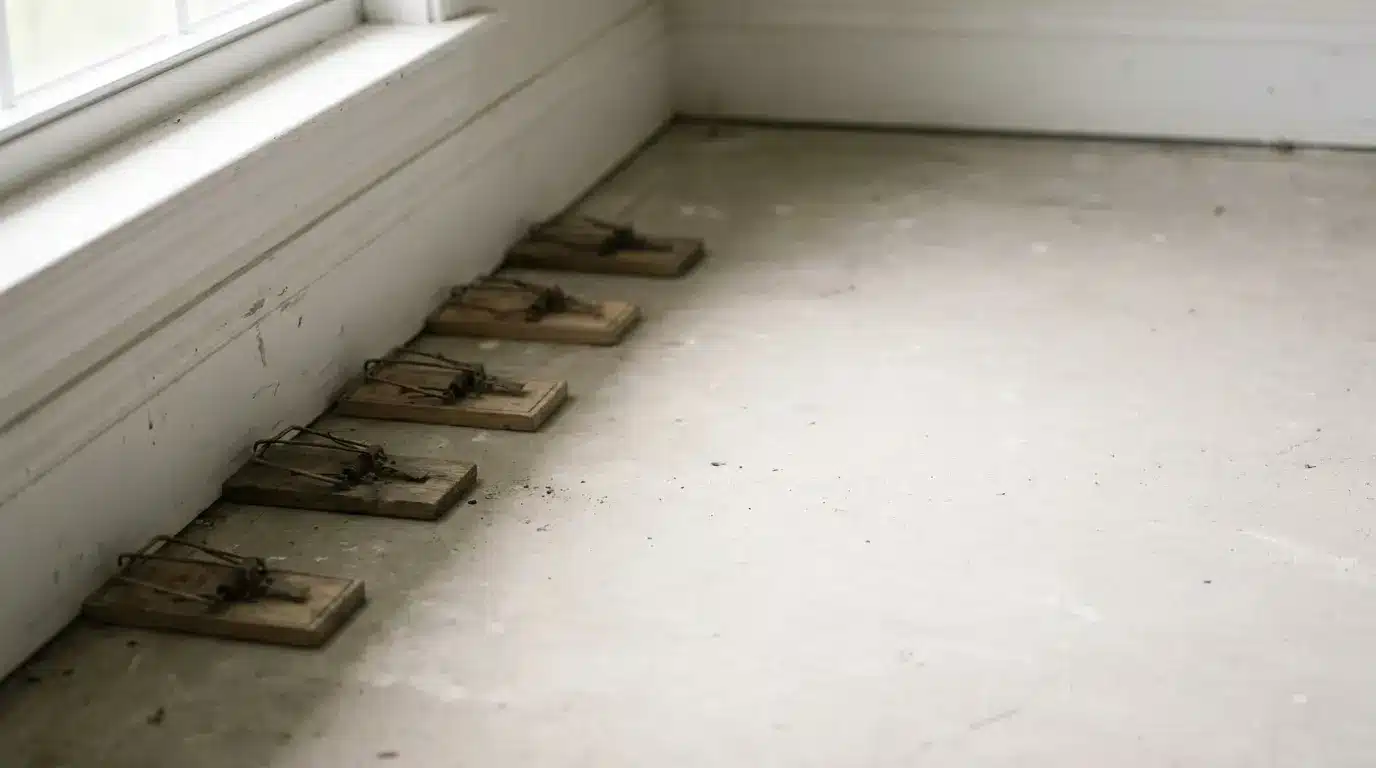
Traps go flush against the wall because I saw rats run along edges, not through open space. The trigger end faces the wall, so the rat contacts it head-on as it travels the run. Bait touches the trigger plate rather than sitting near it.
Multiple traps on each run are spaced 30 to 50 centimeters apart to account for rats that step over the first trap.
Every trap is checked and reset within 24 hours. A sprung trap left in place for three days is a wasted position, and in an active program, wasted positions cost catches.
Exclusion First (Why Professionals Seal Before They Trap)
1. Why Trapping Without Exclusion Is a Permanent Treadmill
A trap program running in a property with open entry points is not an elimination program. It is a population management program, one that requires continuous effort to maintain a problem that never fully resolves itself.
Professional controllers understand this and treat exclusion as a non-negotiable part of the program, not an optional add-on.
Sealing entry points while the trap program is running means the population being caught is not being replaced. The numbers drop with each catch rather than staying stable as new rats move in to fill the territory left by the ones caught.
2. The Entry Points Most Homeowners Miss
Gaps around pipework where it enters the building. Air bricks with damaged or missing mesh. Gaps under external doors larger than 6mm. Roof vents without protective caps.
Holes in soffits where materials have deteriorated. Each of these is a standard item on an industrial controller’s assessment checklist and a commonly missed item on a homeowner’s assessment checklist.
A rat can compress its body through a gap the size of a 50-pence piece. The threshold for what counts as a sealed entry point is lower than most people assume, and anything above that threshold that has not been addressed is keeping the program from reaching completion.
How to Run a Professional-Grade Programme at Home
1. The Step-by-Step Structure Industrial Controllers Follow
From day one to two, observe and map. Note every dropping site, grease smear, gnaw mark, and sound location. Do not place anything yet. On day three, apply UV tracking powder across the most active areas and review with a UV torch after 24 hours to confirm exact routes.
Day four, deploy traps in volume on every mapped route, flush to the wall, and use multiple traps per run.
Seal every identified entry point on the same day. Check and reset every trap within 24 hours from this point forward. Run the program for a minimum of three weeks before assessing completion.
2. The Tools That Close the Gap Between Homeowner and Industrial Results
The difference in results between a homeowner program and an industrial one is partly method and partly tools.
Industrial-grade snap traps, UV tracking powder, proper exclusion materials, and roof vent protection used together produce the systematic elimination that supermarket basics and guesswork never reach.
Shop Rodent Free carries the full range of industrial-grade rodent control products needed to run a proper elimination program, tracking powder, snap traps, exclusion materials, and vent protection, everything that closes the gap between catching one rat at a time and eliminating the problem properly.
The Homeowner Habits That Keep the Problem Going
1. The Common Mistakes That Extend Rat Problems From Weeks Into Months
Placing one trap and waiting. Moving traps every two days because nothing is being caught, rather than adding more traps to more positions. Treating a catch as a resolution rather than evidence that the program is working and needs to continue.
Leaving food sources accessible while trapping gives the population a reason to stay and keeps stress levels low enough that trap shyness does not develop.
Each of these habits is understandable, and each one extends the problem. Industrial programs avoid them by design because the structure of the program does not allow for them.
2. What to Change Immediately If the Current Approach Is Not Working
If the current approach has been running for more than three weeks without visible population reduction, three things need to change immediately.
Trap numbers need to increase, doubling what is currently deployed, as a starting point. Entry points need to be identified and sealed if they have not already been. Food sources need to be removed or made inaccessible.
If all three of those are in place and the problem is still not resolving, the population size is larger than the current program can handle. Scale up the trap deployment, extend the program timeline, and use UV tracking to verify that activity is genuinely reducing rather than just shifting to unmapped areas of the property.
Frequently Asked Questions
1. How many traps do I need for a rat infestation?
More than most people deploy. The industrial starting point is two to three traps per identified active run, scaled to the estimated population size. For a modest infestation with two or three active runs, that means six to nine traps deployed simultaneously. For a larger infestation, more. A single trap or two traps on a property with an established population will not produce a meaningful reduction in the population, regardless of how well they are placed.
2. Where do professionals place rat traps?
Flush against the wall on identified active runs, with the trigger end facing the wall so rats contact it head-on as they travel. Multiple traps are spaced 30 to 50 centimeters apart along each run. Placement follows UV-tracked activity mapping rather than guesswork. Traps go where rats have been confirmed to be moving, not where movement seems likely.
3. How do rats get into the roof, and how do I stop them?
Roof vents are one of the most common and most overlooked entry points for rats accessing roof spaces. Damaged or unprotected vents provide direct access to roof cavities where rats establish harbourage that is difficult to detect and clear. Fitting rodent-proof vent caps to every roof vent during the assessment phase of a control programme closes this route before trapping begins. Other common roof access points include gaps in soffits, damaged fascia boards, and gaps where roof tiles have shifted.
4. Why do I keep catching rats but the problem never goes away? Two reasons in most cases. The trap catch rate is not keeping pace with the reproduction rate — the population is replacing itself faster than it is being caught. And entry points are still open — new rats are moving into the territory vacated by the ones being caught. Solving the problem requires scaling up trap numbers to outpace reproduction and sealing entry points so the population being caught is not being replaced. Running both simultaneously is what produces elimination rather than ongoing management.

Tommy Hardy, an alumnus of the Georgia Institute of Technology with a degree in Mechanical Engineering, has been a go-to figure in residential upkeep and innovation for over 18 years. His career commenced in a leading home appliance manufacturing company, where he mastered the intricacies of household systems. Joining our platform in 2020, Tommy quickly became a reader favorite for his practical and easy-to-follow guides. He took the helm of our DIY section in 2019, consistently delivering content that empowers homeowners. Beyond his professional pursuits, Tommy is a passionate gardener and enjoys woodworking, skills enhancing his hands-on approach to home care.