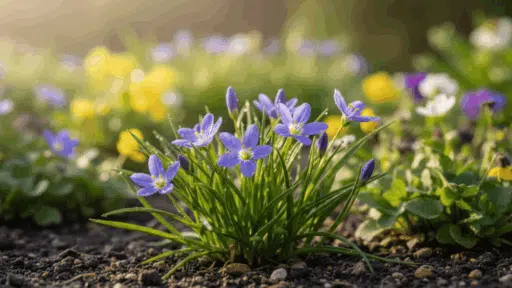
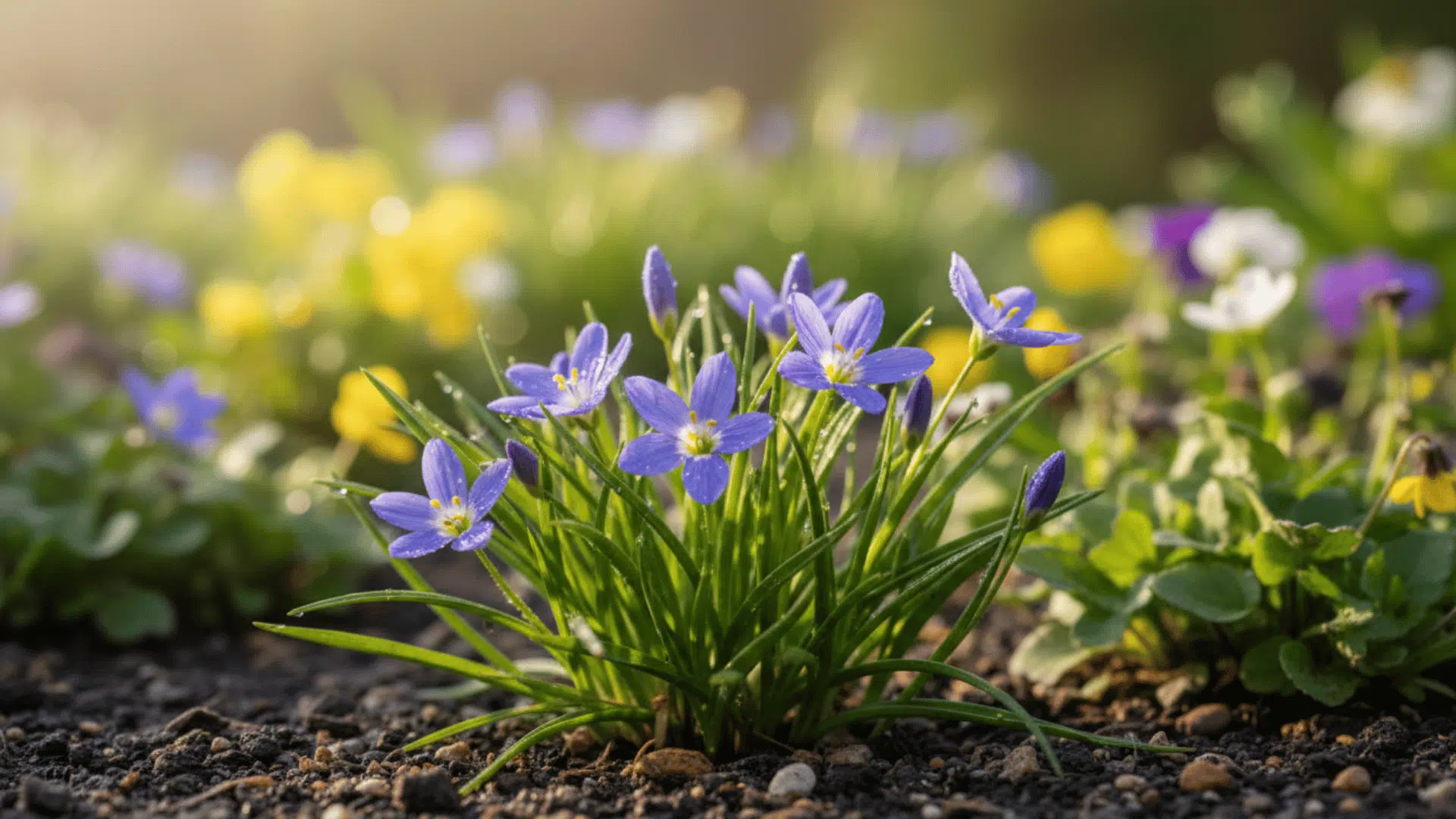

The first time I spotted blue-eyed grass growing along a sunny meadow edge, I honestly thought someone had scattered tiny wildflowers through the lawn grass.
They were so small, so quietly cheerful little six-petaled blooms in a deep violet-blue with a bright yellow center staring right back at me.
I stopped, crouched down, and realized I’d been walking past this plant for years without really noticing it.
That moment stuck with me since then. I’ve grown blue-eyed grass in client yards, my own garden beds, and even a few container setups on sunny patios.
It’s one of those plants that earns its place without making a fuss. It doesn’t demand much, it feeds pollinators, and it adds soft, natural color to any planting scheme.
Even if you’re new to gardening or experienced, this guide covers everything about blue-eyed grass, from what it is to how to grow, care for, and use it in your landscape.
What is Blue Eyed Grass?
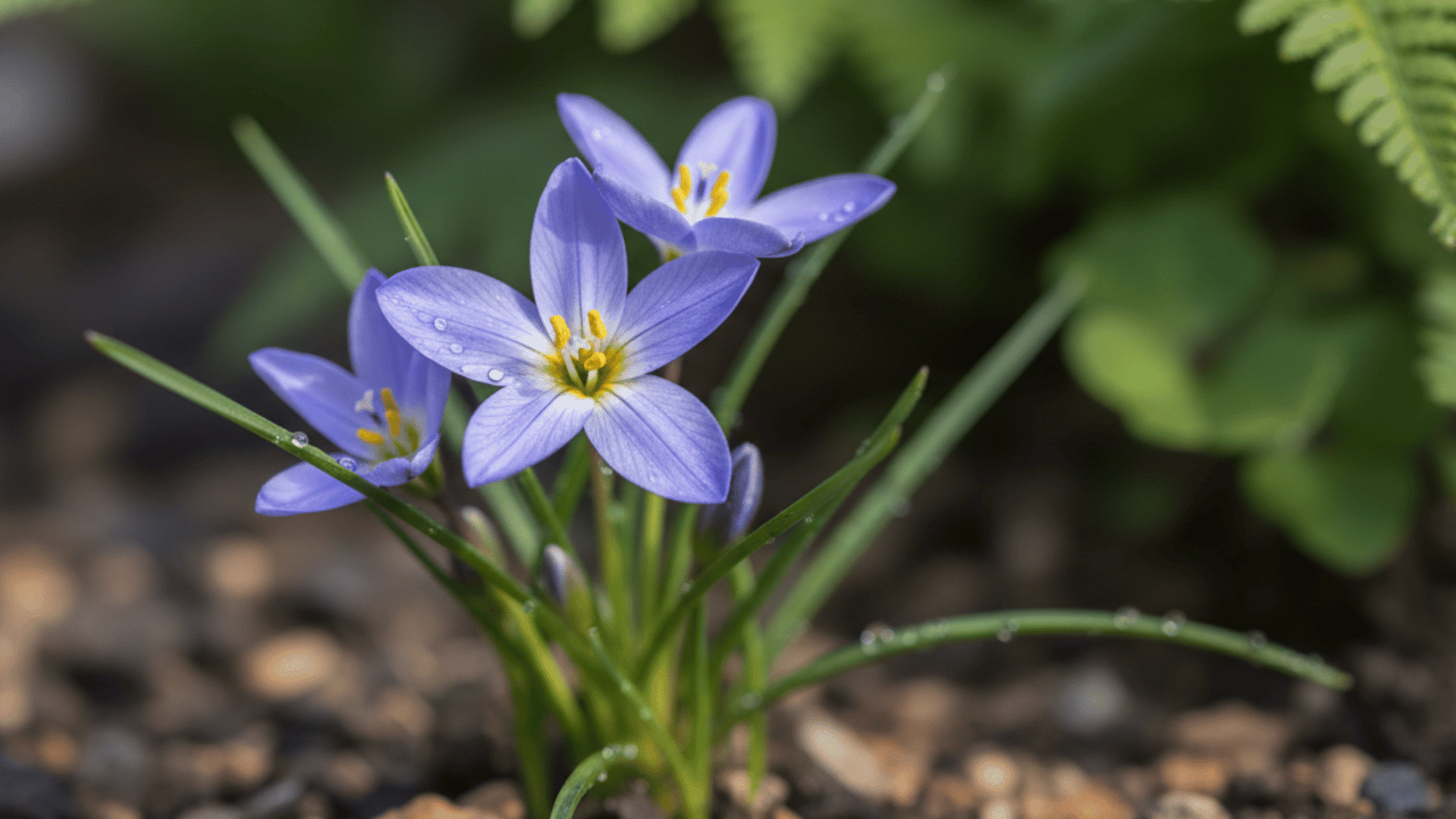
Despite what its name suggests, blue-eyed grass isn’t actually a grass at all. It’s a flowering perennial and a pretty one at that.
The “ grass ” part of the name comes from its thin, flat, grass-like leaves. The “blue-eyed” part refers to those small, bright blooms that seem to peer up at you from among the foliage.
Blue-eyed grass belongs to the genus Sisyrinchium, which is in the Iridaceae family, the same family as irises, crocuses, and freesias.
There are roughly 80 to 200 species in the genus, depending on which taxonomist you ask. Most of them are native to the Americas, particularly North and South America.
The most commonly grown species in home gardens include:
- Sisyrinchium angustifolium (narrow-leaved blue-eyed grass)
- Sisyrinchium bellum (western blue-eyed grass)
- Sisyrinchium californicum (yellow-eyed grass)
- Sisyrinchium montanum (mountain blue-eyed grass)
- Sisyrinchium idahoense (Idaho blue-eyed grass)
Why Blue-Eyed Grass is Not a True Grass?
True grasses belong to the family Poaceae and produce insignificant, wind-pollinated flowers. Blue-eyed grass is fundamentally different.
Its flowers are showy and pollinator-attracting. Its leaves are flat and sword-like, arranged in a fan pattern at the base, much more like a miniature iris than a blade of lawn grass.
Once it blooms, there’s no mistaking it for anything in the grass family. Those vivid little flowers give it away every time.
Blue Eyed Grass Flower Characteristics
With its delicate blooms and tidy clumping habit, blue‑eyed grass is as charming as it is easy to grow:
1. Flower Appearance
The flowers of blue-eyed grass are small but eye-catching. Each bloom is about half an inch to three-quarters of an inch wide, with six petals (technically three petals and three sepals of equal size) arranged in a star shape.
Most species display a vivid yellow center that “eye” in the name surrounded by petals in shades of blue, violet, purple, or occasionally white or yellow.
Up close, the flowers look like they belong on a much larger plant. They have the structure and color intensity of full-sized iris blooms, just scaled down to a fraction of the size.
2. Foliage and Growth Habit
The leaves are narrow, flat, and upright, typically 6 to 18 inches tall depending on the species. They grow in clumping fans that emerge from the base of the plant.
The foliage stays semi-evergreen in mild climates and dies back in colder zones. Overall, blue-eyed grass has a tidy, compact growth habit.
It doesn’t sprawl aggressively or flop over. Most clumps spread slowly over time through offsets and self-seeding, making them easy to manage.
3. Blooming Season
Most blue-eyed grass varieties bloom in spring through early summer, typically from April through June.
Some species, especially in warmer climates, may produce a second flush of blooms in fall if they’re cut back after the first flowering.
In my own garden, the blooms tend to peak right when the spring pollinators are most active. The timing isn’t accidental; these plants and their insect visitors have co-evolved over thousands of years.
4. USDA Zones
Most blue-eyed grass varieties are hardy in USDA zones 3 through 9, which covers a wide swath of the country.
Some species are more cold-sensitive, so it’s worth checking the specific hardiness rating for the variety you’re planting.
Sisyrinchium angustifolium, for example, handles zones 3–8 well, while Sisyrinchium bellum prefers the milder conditions of zones 7–10.
Types of Blue Eyed Grass
From soft white to deep violet, each blue‑eyed grass variety brings its own charm to borders, meadows, and native plant gardens:
| Variety / Species | Flower Color | Height | Growing Conditions | Special Features |
| Sisyrinchium angustifolium | Violet-blue | 6–18 in. | Moist to dry soil | Beginner-friendly |
| Sisyrinchium bellum | Violet-blue | 6–12 in. | Dry, well-drained soil | Drought tolerant |
| Sisyrinchium californicum | Bright yellow | 12–20 in. | Moist soil | Yellow blooms |
| Sisyrinchium Lucerne | Blue-purple | 8 in. | Sun to partial shade | Compact growth |
| Sisyrinchium Devon Skies | Pale blue | 8–14 in. | Moist, well-drained soil | Long bloom period |
| Sisyrinchium E.K. Balls | Deep violet | 12–18 in. | Average garden soil | Larger variety |
| Sisyrinchium Album | White | 8–14 in. | Evenly moist soil | White flowers |
How to Plant Blue Eyed Grass
Blue‑eyed grass can be grown from seed, though it usually needs cold stratification, a period of moist chilling that mimics winter, to germinate well.
Step 1: Mix seeds with damp peat or sand in a sealed plastic bag
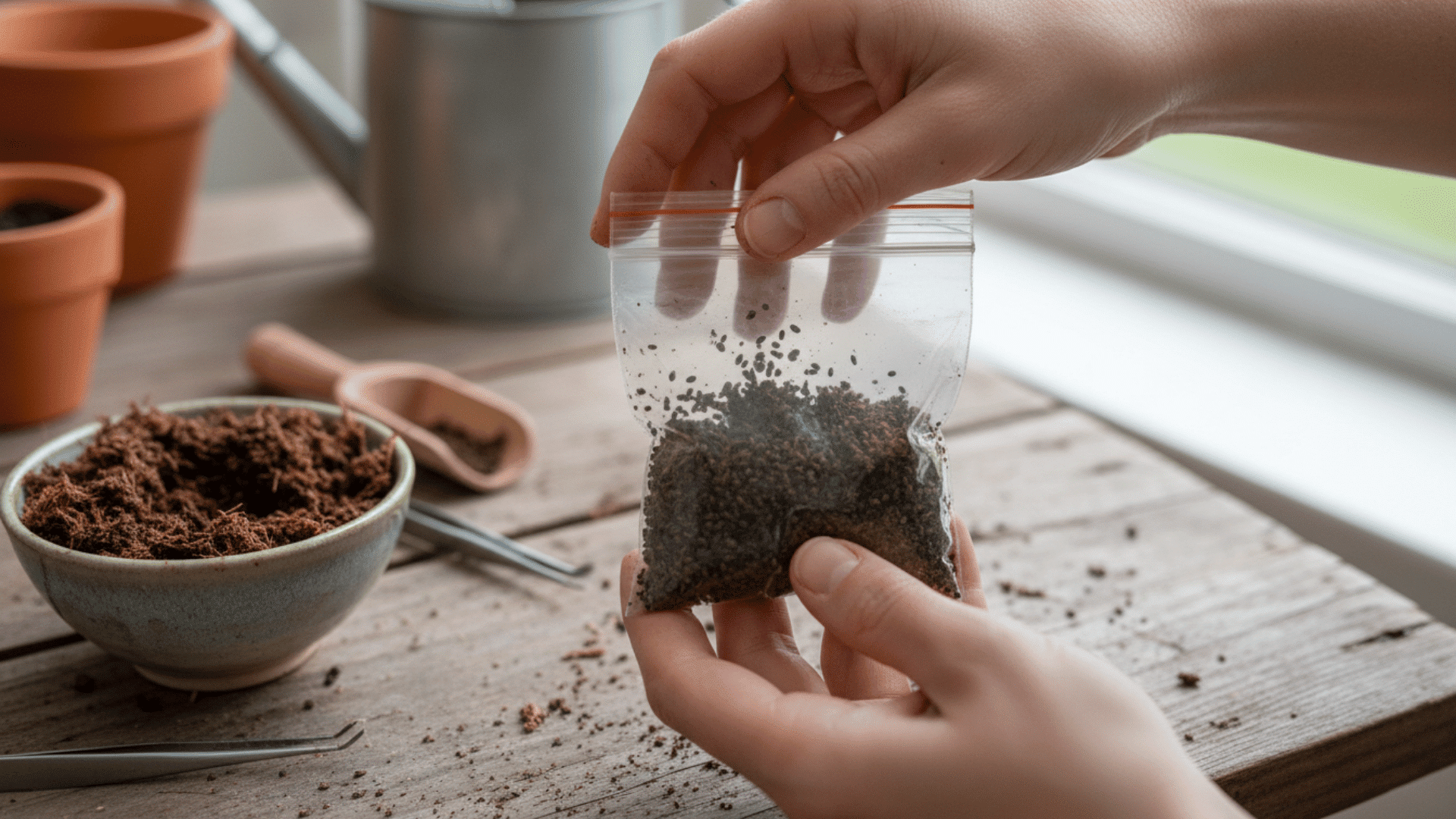
Start by taking a small amount of blue‑eyed grass seeds and mixing them with a little moist (not wet) peat moss or coarse sand in a clear plastic bag.
The damp medium keeps the seeds in constant, gentle moisture so they can absorb water slowly and stay uniformly hydrated instead of drying out partway through.
Gently shake or roll the bag so the seeds don’t clump together and each one has its own tiny pocket of moisture.
Then seal the bag loosely, leaving a small opening or slightly unzipped corner so a tiny bit of air can circulate while the moisture stays trapped inside: this helps prevent mold while still creating the moist, cool environment the seeds need.
Step 2: Refrigerate for 60 to 90 days
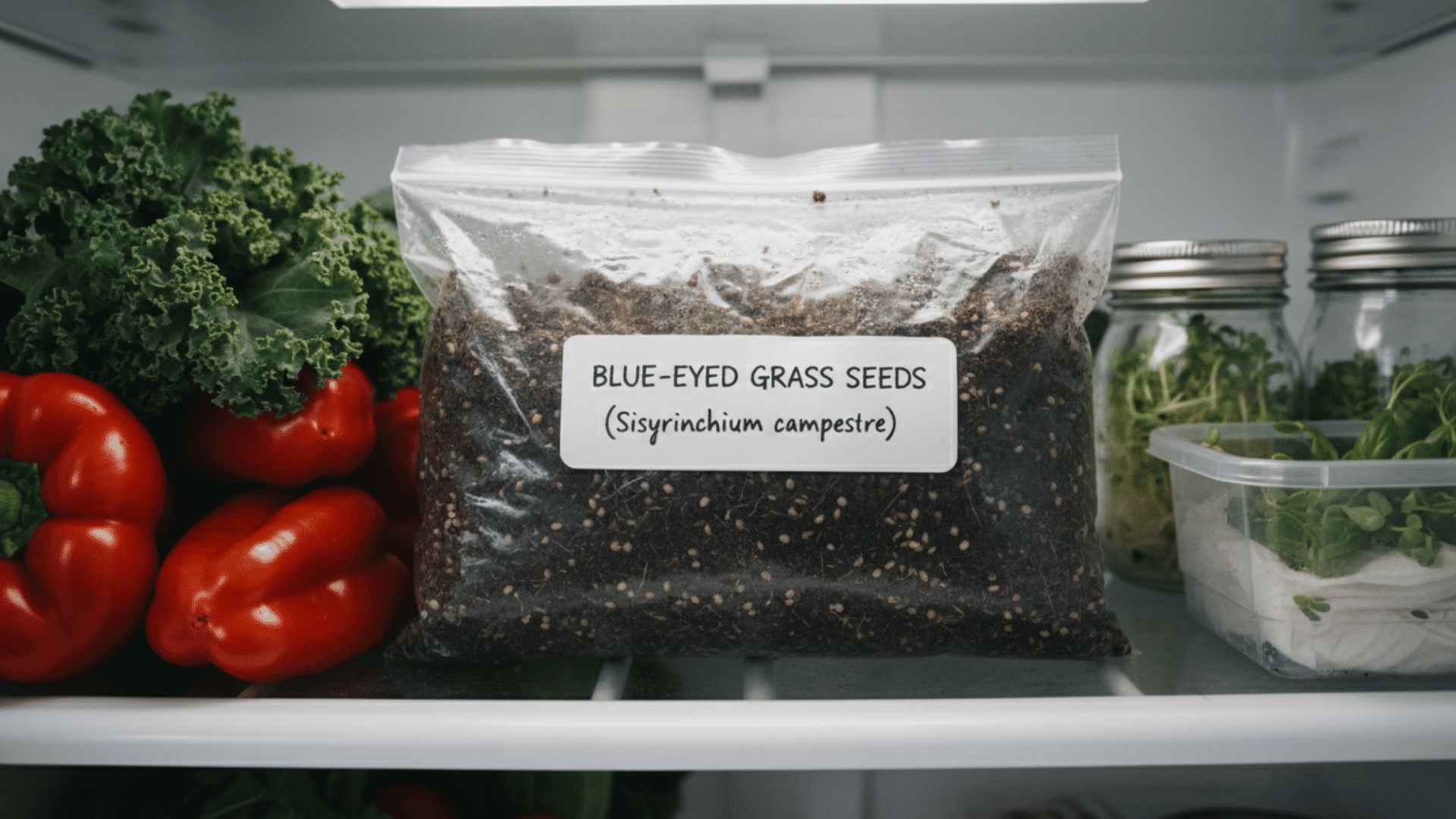
Next, place the sealed bag in the refrigerator, not the freezer, for 60–90 days. Keep the bag out of the coldest, wettest part of the fridge (like the bottom veggie drawer if it’s very damp) and avoid freezing temperatures, which can damage the seeds.
This cold, moist period mimics the natural winter chill that blue‑eyed grass seeds would experience outdoors, and it breaks their dormancy by telling the embryo inside that winter has passed and spring is coming.
Check the bag occasionally: if the mix starts to dry out, you can add a sprinkle of water, and if you notice any heavy condensation or mold, briefly open the bag, wipe away excess moisture, and re‑seal it lightly.
Step 3: Sow seeds in shallow containers with a well‑draining seed mix
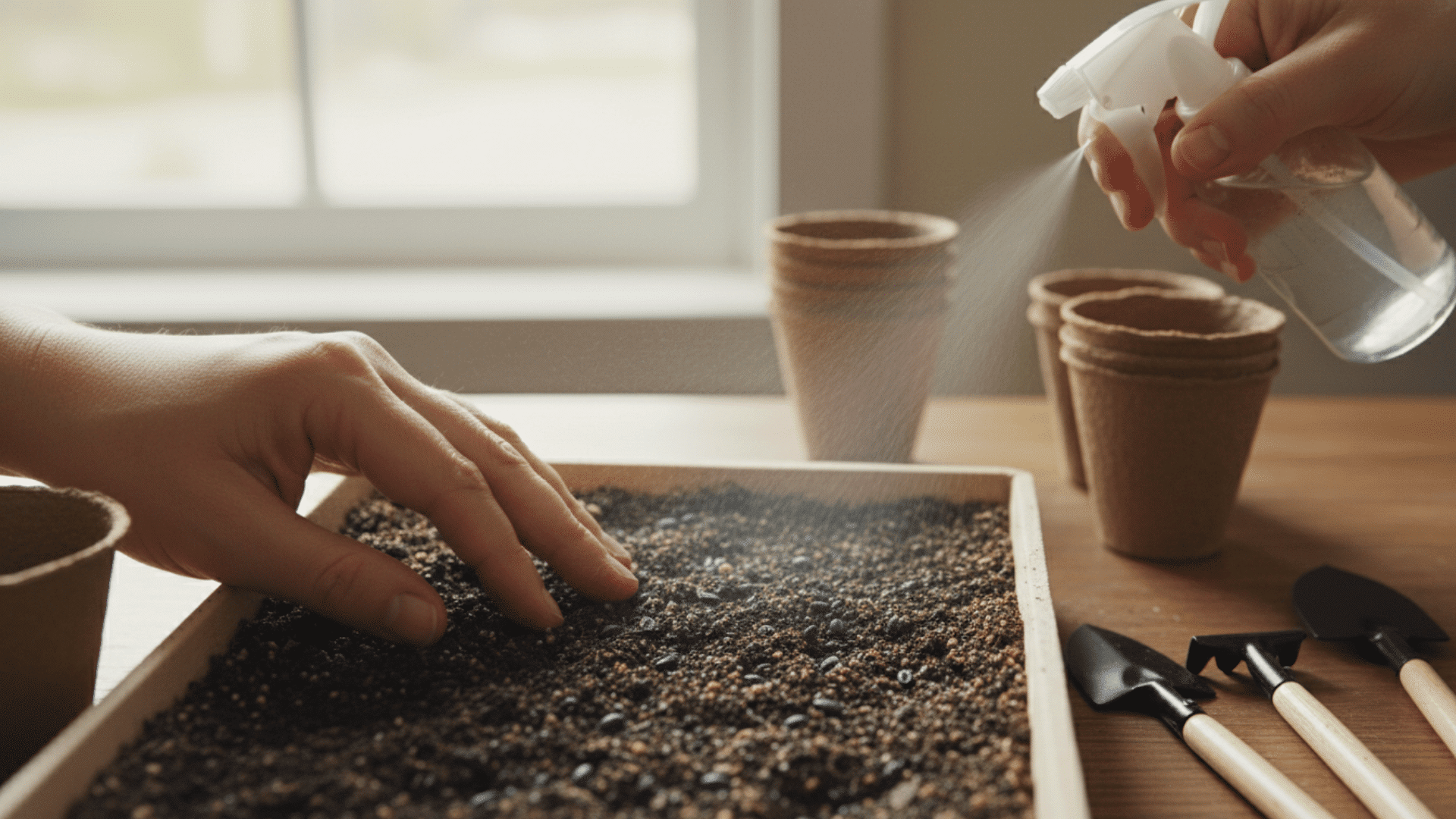
After the cold‑moist period, gently open the bag and pour the seed–peat or seed–sand mix onto the surface of a shallow tray or small pots filled with a light, well‑draining seed‑starting mix.
Don’t bury the seeds deeply: instead, lightly press them into the surface so they have good contact with the soil but still receive a little light, since blue‑eyed grass seeds need some light to germinate properly.
Use a spray bottle to mist the surface until it is evenly moist but not soaking, so the seeds stay hydrated without sitting in water.
If you see any thicker clumps, you can gently spread them apart with a spoon or fingertip to give each seed a bit of breathing room and reduce competition if many germinate in one spot.
Step 4: Place in a warm, bright location
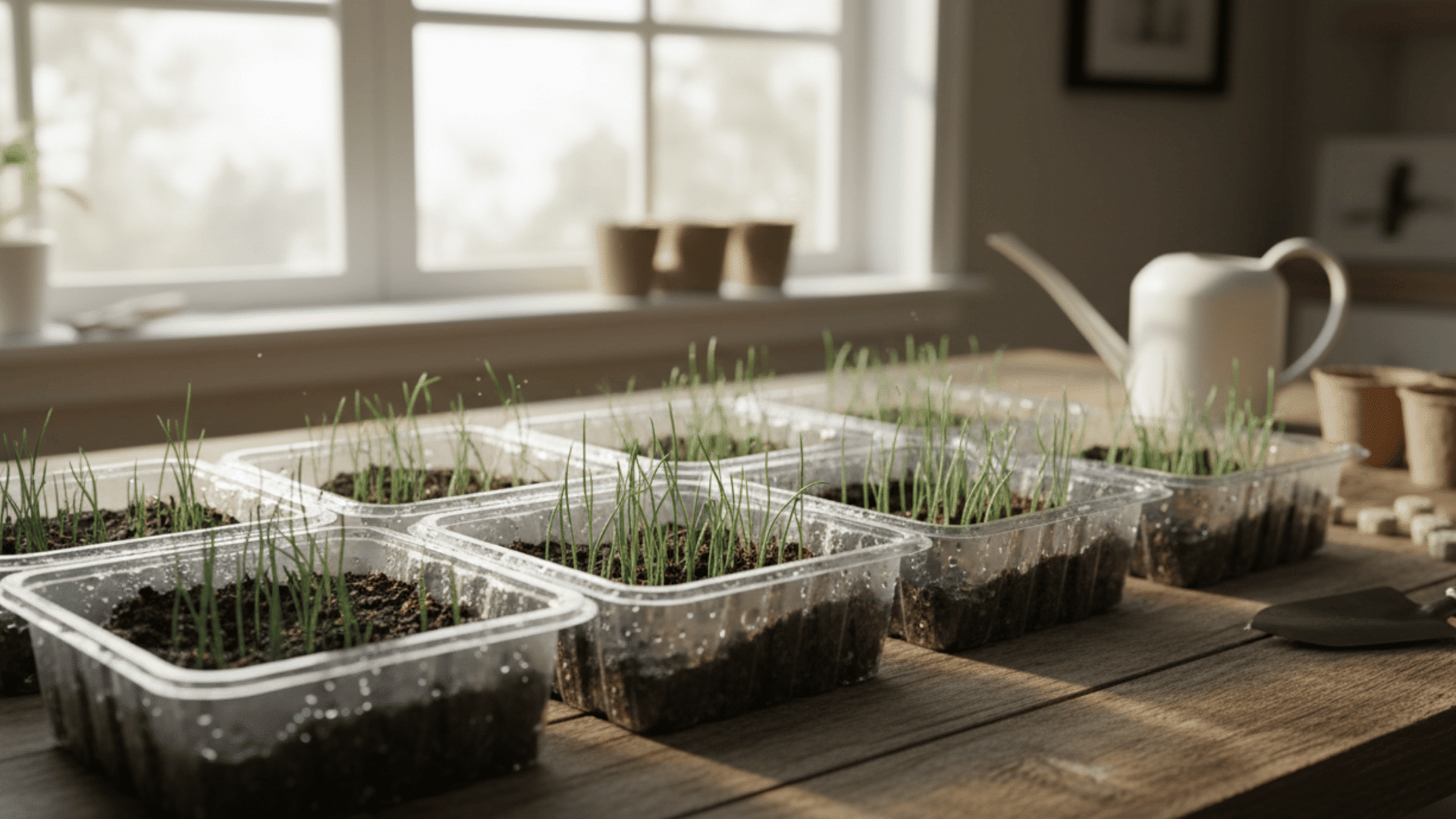
Set the containers in a warm, bright spot, such as a south‑facing windowsill or under fluorescent or LED grow lights placed a few inches above the soil surface.
The soil should stay consistently moist like a damp sponge but not soggy: if the surface dries out, mist it lightly, and if it looks waterlogged, let it dry a little before watering again.
Germination usually begins within 2–4 weeks after the cold treatment, with tiny green shoots pushing through the soil in irregular patches.
Once the seedlings grow a few inches tall and have developed several true leaves (not just the first thin seed leaves), start hardening them off by moving the pots outdoors for a few hours each day, gradually increasing exposure over about a week to help them adjust to sun, wind, and temperature changes.
After the last expected spring frost, transplant them into their permanent garden spot, spacing them apart so they have room to form neat clumps.
How to Grow Blue Eyed Grass Flower
Once you understand its basic needs, blue‑eyed grass is an easy and graceful plant to grow in many garden settings:
- Light requirements: Blue‑eyed grass grows best in full sun but tolerates light shade; too much shade reduces flowering and can cause weak, floppy growth.
- Soil needs: It prefers well‑drained, moderately fertile soil and avoids soggy conditions that can rot the roots.
- Watering tips: Water regularly the first year, then only during dry spells; keep soil slightly moist but not wet, and avoid watering late in the day.
- Temperature and humidity: It handles a wide range of temperatures (roughly zones 3–9), with better performance where air circulation keeps humidity‑related leaf issues in check.
Is Blue Eyed Grass Invasive?
This is a fair question, especially since some Sisyrinchium species do self-seed freely. In general, blue-eyed grass is not considered invasive in North America, where it’s native.
It spreads modestly through self-seeding and slow clump expansion, but it doesn’t take over beds aggressively or crowd out other plants the way true invasive species do.
Outside its native range in parts of Europe, Australia, and New Zealand, some species have naturalized and may behave more assertively.
If you’re gardening in one of those regions, it’s worth checking local invasive species lists before planting.
For most North American gardeners, blue-eyed grass is perfectly well-behaved. If self-seeding is a concern, deadhead the flowers before they go to seed.
Blue Eyed Grass Care Guide
With these basic care practices in place, blue‑eyed grass will return year after year, bringing its charming, grassy clumps and delicate blooms to beds, borders, and meadow‑style plantings:
1. Fertilizer Tips
Blue-eyed grass doesn’t need heavy feeding. In most garden soils, it performs well without fertilizer.
If your soil is particularly poor, a light application of balanced, slow-release fertilizer in early spring can give plants a boost. Don’t over-fertilize; excess nitrogen encourages leafy growth at the expense of flowers.
In container plantings, a diluted liquid fertilizer every four to six weeks during the growing season keeps plants healthy without overworking them.
2. Pruning and Deadheading
Deadheading spent flowers can encourage a second round of blooming and keep plants looking tidy. It’s not strictly necessary, but it’s worth doing if you want to extend the display.
After the main bloom season wraps up, cut the plant back by about one-third to encourage fresh growth.
At the end of the season in cold climates, you can cut the foliage back to a few inches above the ground.
3. Dividing Mature Plants
Blue-eyed grass clumps tend to get dense after three to four years, and older plants sometimes flower less enthusiastically as the center of the clump dies out. Division solves both problems.
Divide in early spring or fall:
- Dig up the entire clump
- Pull or cut it apart into smaller sections, each with roots and foliage
- Replant immediately at the same depth
- Water well and keep consistently moist for the first few weeks
Divided sections usually establish quickly and bloom well the following season.
4. Winter Care
In zones 3–6, blue‑eyed grass dies back to the ground in winter. A light 2–3 inch mulch of straw or shredded leaves helps insulate the crown and buffer freezing and thawing cycles.
In milder climates, the plant often stays semi‑evergreen, with foliage that may look tired or untidy. In late winter, before new growth emerges, you can trim back any dead or scruffy leaves to refresh the clump.
Avoid heavy pruning or early cutting so the plant retains some protection during cool snaps and recovers quickly in spring.
Common Problems with Growing Blue-Eyed Grass
Blue‑eyed grass is generally trouble‑free, but when issues do arise, they’re usually easy to diagnose and fix with simple cultural adjustments:
- Brown Leaves: Usually caused by overwatering, underwatering, or root rot. Adjust soil moisture, improve drainage, and avoid keeping the soil constantly soggy to restore healthy green foliage.
- Overwatering and Root Rot: Wet, poorly drained soil leads to yellowing, wilting, and collapse. Plant in well‑drained soil, water only when needed, and never let pots sit in water.
- Pests and Diseases: Aphids, slugs, and fungal leaf spot may appear occasionally. Control with water sprays, insecticidal soap, iron‑phosphate bait, and better spacing or airflow.
- Poor Flowering: Too much shade, excess nitrogen, old clumps, or recent transplanting can reduce blooms. Move to sun, cut back fertilizer, divide the plant, or give it a season to settle.
Final Thought
Blue‑eyed grass is one of those plants that rewards closer attention.
It’s easy to overlook when it’s not in bloom, just another clump of grass‑like foliage in the border. But when those tiny flowers open in spring, the whole plant changes into something that feels genuinely special.
In my years of working with home gardens, I’ve recommended blue‑eyed grass more times than I can count.
It’s especially good for gardeners who want native plants that are actually easy to grow. Plant it in a sunny, well‑drained spot, give it a little water while it settles in, and then mostly leave it alone: it’ll do the rest.
Come spring, you’ll find yourself crouching down, looking at those little blue‑eyed blooms, and wondering why you didn’t grow them sooner.
It fits into small gardens, large ones, formal borders, and wild‑feeling meadow plantings alike.
What’s your experience with blue‑eyed grass in the garden? Share your thoughts in the comments below, and let’s talk about how this little native can brighten your borders!
Frequently Asked Questions
Where does Blue-Eyed Grass Grow Best?
Blue‑eyed grass grows best in full sun to light shade, in moist but well‑drained soil, often in meadows, borders, or naturalized areas in USDA zones roughly 4–9.
What is the Blue-Eyed Grass Flower Used For?
The blue‑eyed grass flower is mainly used as an ornamental border or groundcover plant and as a pollinator‑friendly native wildflower in gardens and meadows.
What are the Downsides of Bluegrass?
The main downsides are that it can look weedy in lawns, may spread by seed, and can flop or flower poorly if grown in too much shade, overly wet soil, or with excess nitrogen.

Holding a Master’s in Library and Information Science from the University of Illinois, Josh Clarke has dedicated more than 15 years to managing and disseminating information across various platforms. His professional journey includes significant experience as a research librarian, where he developed an expertise in sourcing and providing accurate and comprehensive answers to diverse questions. In 2018, Josh brought his rich experience to our platform, quickly establishing himself as a reliable source for general FAQs. He has been overseeing our information curation since then, combining his research skills with a flair for engaging content delivery. When not involved in information management, Josh enjoys exploring digital photography and participating in local quiz competitions, hobbies that complement his inquisitive nature and love for learning.