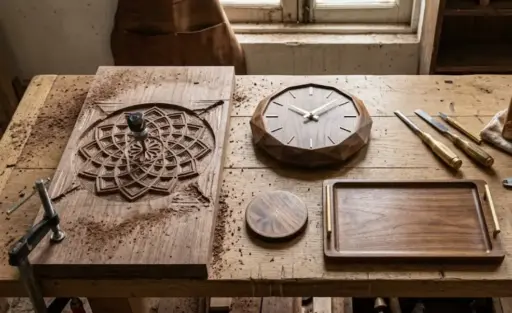
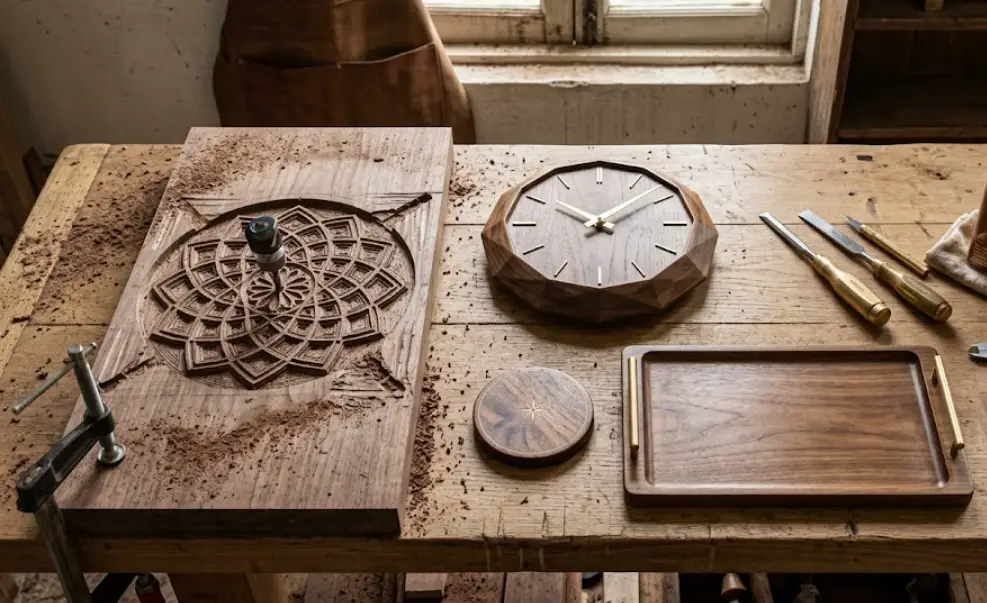

Mid-Century Modern (MCM) design remains one of the most enduring interior styles, celebrated for its clean lines, organic curves, and warm wood tones. But there is a catch: authentic vintage pieces are often expensive, and traditional DIY woodworking typically demands large workshops, heavy tools, and years of experience.
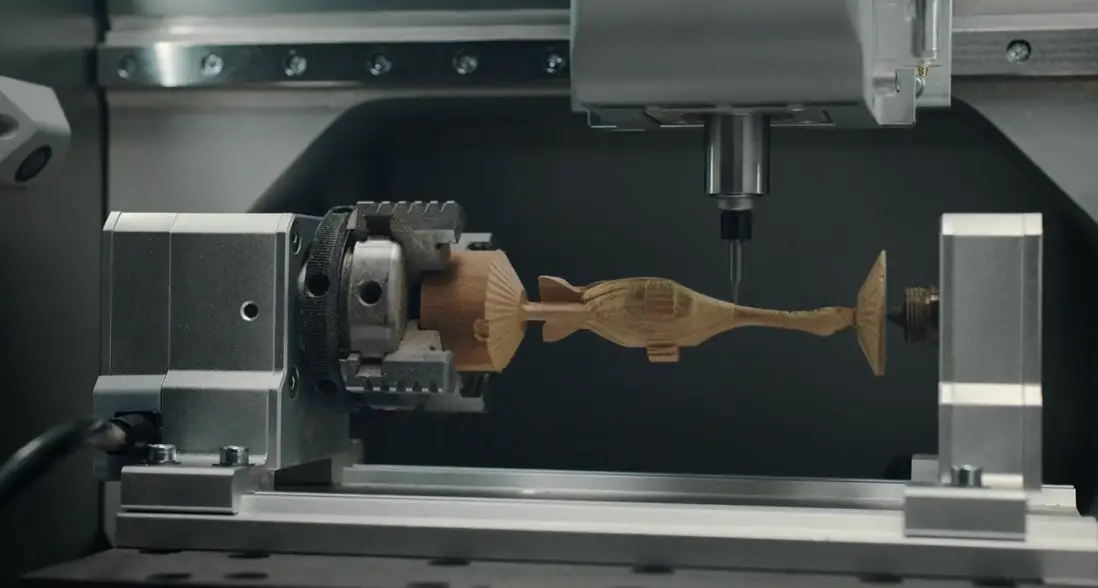
That limitation is rapidly disappearing. With modern digital fabrication tools—especially compact, intelligent systems like the Makera Z1—makers can now recreate intricate MCM details right on a desktop. What once required a full woodshop can now be achieved in a small studio or even an apartment, with precision that rivals industrial production.
Below are ten Mid-Century Modern wooden accents you can realistically make at home, along with insights into how CNC technology simplifies each project.
Part 1: Living Room & Wall Decor
01. The Iconic MCM Starburst Wall Clock
A defining symbol of the MCM era, the starburst clock features radiating wooden spokes anchored by a metallic center.
With a desktop CNC, you can precisely cut 12 identical tapered rays and drill perfectly aligned mounting holes for a brass clock mechanism. Achieving symmetry by hand is difficult—CNC makes it exact every time.
02. Laser-Cut Geometric Valet Tray
This shallow tray often features atomic-era patterns or abstract linework carved into walnut or maple.
Using CNC 3D carving, you can mill a smooth concave surface and engrave intricate geometric motifs directly into the base. The result feels both decorative and functional, with a distinctly retro character.
03. Tapered Wood Plant Stand
A classic plant stand combines a round platform with three outward-angled legs.
The key challenge lies in the angled joinery. A CNC machine allows you to create precise angled brackets or drill perfectly aligned holes, ensuring structural stability without guesswork.
Part 2: Tabletop & Entertaining
04. Brass-Inlay Walnut Coasters
These coasters combine dark walnut with thin brass lines arranged in geometric patterns.
CNC enables multi-material precision: first, mill shallow 1 mm grooves into the wood, then insert brass strips or wire. After sanding and polishing, the contrast between metal and wood creates a refined, high-end finish.
05. Sculptural Wooden Tissue Box Cover
This piece transforms a basic household item into a design statement with fluted or slatted textures.
Creating evenly spaced grooves by hand is time-consuming, but CNC carving can produce consistent wave-like or ribbed surfaces effortlessly, giving the piece a sculptural quality.
06. Eames-Inspired Wooden Bird Silhouette
Inspired by the iconic Eames House Bird, this minimalist sculpture relies on smooth curves and balanced proportions.
A CNC machine can convert a flat design into a softly contoured 3D object, refining edges and profiles to achieve that signature sculptural silhouette.
Part 3: Small Furniture Upgrades
07. Boomerang Slatted Magazine Rack
This rack features distinctive boomerang-shaped side panels connected by wooden slats.
CNC cutting excels at producing complex curves and mirrored parts. You can also pre-cut joinery slots, ensuring clean assembly and structural consistency.
08. Custom Laser-Etched Speaker Grille
Upgrade modern speakers with retro-style wooden grilles featuring perforated or patterned designs.
High-density perforations or intricate cutouts are difficult to achieve manually, but CNC handles them quickly and accurately, blending modern tech with vintage aesthetics.
09. MCM Floating Shelf with Hidden Drawer
A sleek floating shelf with rounded edges and a concealed storage compartment.
CNC machining allows you to carve internal channels and drawer tracks with precision, ensuring smooth operation and tight tolerances that would be challenging with hand tools.
10. Atomic Pattern Cabinet Knobs & Pulls
Small details make a big impact. MCM knobs often feature bowtie shapes or recessed circular forms.
With a compact setup like modern desktop CNC machines, you can batch-produce identical small components with consistent quality—ideal for upgrading entire cabinets or furniture sets.
Step-by-Step Spotlight: Brass-Inlay Coasters
To illustrate how approachable this process is, here is a simplified workflow for making brass-inlay walnut coasters:
Design
Create a simple vector pattern using software like Illustrator or Fusion 360, or download ready-made SVG designs from maker communities.
Setup
Secure a walnut blank onto the CNC work surface. Ensure proper alignment and zeroing for accurate cuts.
Execute
Let the machine mill shallow grooves for the inlay. Advanced systems can automatically switch tools and maintain precise cutting depth throughout the process.
Finish
Insert brass strips into the grooves, sand the surface flush, and apply a wood finish such as Rubio Monocoat or Watco Oil. This enhances the walnut’s rich tone and protects the surface.
This workflow highlights how digital fabrication reduces complexity while improving repeatability.
Conclusion
Mid-Century Modern design does not have to rely on expensive vintage finds or fully equipped woodworking shops. With today’s compact fabrication tools, the barrier to entry has dropped dramatically.
Machines like Makera’s desktop CNC systems bring industrial-level precision into personal creative spaces, enabling makers to reproduce the elegance and craftsmanship of the MCM era from their own desks. Whether you are crafting a single statement piece or producing small batches for a side business, the combination of timeless design and modern tooling opens up entirely new possibilities.

James McLaren, with a rich background in architecture from the University of Manchester, has been contributing his expertise to the world of creative construction and home innovation for over 20 years. His journey began as a project manager for a leading construction firm, where he honed his skills in bringing complex designs to life. James joined our platform as a freelancer in 2019, quickly becoming a favorite for his insightful and practical advice. He has been a pivotal force to our wing ever since, bringing our readers a blend of technical know-how and creative flair. Beyond his professional life, James is an avid woodworker and enjoys restoring vintage furniture, a hobby that complements his professional insights beautifully.